The Demise of the CreditEase Empire: The Chinese P2P Godfather Who Invested in Circle Falls Into the Same Abyss
Written by: Han Li, TechFlow
On October 12, the Chaoyang Branch of the Beijing Municipal Public Security Bureau officially opened a criminal investigation into CreditEase-related companies, and several suspects, including actual controller Tang Ning, were subjected to criminal coercive measures.
This godfather-level Chinese P2P company, which once employed 40,000 people and had its platform listed on the NYSE, completed its entire journey from a pioneer in inclusive finance to a criminal suspect over 20 years.
More intriguingly, CreditEase’s investment ledger is filled with targets in the crypto industry that emphasize transparency and compliance, including Circle, Matrixport, and LayerZero. It watched firsthand how the centralized black boxes of FTX and Celsius collapsed, only to step into the same river in its own core business.
Tang Ning
In autumn 1994, a young man admitted directly to the Department of Mathematics at Peking University from Tianjin Yaohua High School walked into a single-story classroom at Zhongguancun No. 2 Primary School.
That was where New Oriental had just been founded, and Yu Minhong was still worrying about recruitment. This freshman named Tang Ning became the first "student teacher" in the institution's history, attending advanced mathematics classes at Peking University during the day and teaching English at New Oriental at night.
He later recalled witnessing something at New Oriental: as long as a very small organization chooses the right direction and does things right, perseverance can lead it down an extraordinary path.
The sentence took root like a seed.
In 1995, Tang Ning went to the United States to study economics. During his studies abroad, he came across the Grameen Bank model created by Nobel Peace Prize laureate Muhammad Yunus: using unsecured microloans to help the poorest farmers in South Asia lift themselves out of poverty. "The poor have creditworthiness; credit has value." This concept profoundly shook Tang Ning.
After graduation, Tang Ning joined the renowned Wall Street investment bank DLJ (later acquired by Credit Suisse), working on IPOs and M&A transactions for telecommunications, media, and high-tech companies. Unlike the vast majority of Chinese professionals who work in middle or back offices on Wall Street, he stood at the front desk, handling multi-hundred-million-dollar deals.
But he soon found that helping already wealthy companies become even wealthier lacked a sense of fulfillment for him. He wanted more to be involved in the "zero to one" process.
Two years later, Tang Ning returned to China and initially worked on strategic investments at AsiaInfo Technologies. In May 2006, the 33-year-old Tang Ning officially founded CreditEase in Beijing.
Dressed in a white shirt, khaki pants, and carrying a canvas laptop bag with frayed edges.
Rumor has it he bought a dozen pairs of those identical khaki pants to save time choosing outfits every day. When traveling for business, he waited until he arrived at the station to pick up train tickets because picking them up out of town cost an extra 5 yuan fee: "We're still in the early stages of starting a business; we need to save even 5 yuan."
This man accustomed to moving massive sums of money on Wall Street adopted a posture so humble at the start of his entrepreneurial journey that it touched the dust.
The Godfather of P2P
What CreditEase did had no precedent in China at the time: translating Muhammad Yunus's inclusive finance philosophy to China, using a P2P (peer-to-peer lending) model to enable wealthy individuals to lend money to those in need.
But China is not Bangladesh, where the credit reporting system was nearly blank and borrowers' credit information was extremely scarce. Online operations were completely unfeasible, so Tang Ning had to resort to the most rudimentary methods, "getting his hands dirty," visiting clients offline one by one to conduct risk control.
In the early days of the startup, neither borrowers nor investors trusted him. Tang Ning devised a rather bold strategy within the regulatory gray area of the time: he personally fronted the money to lend to borrowers, signed personal debt agreements, then split these receivables by different terms and amounts, packaged them into wealth management products with varying returns, and transferred them to investors.
This was the "offline receivables transfer model" pioneered by CreditEase, the original invention of China's P2P industry.
Looking back through today's regulatory lens, this model harbored a ticking time bomb from its inception: funds passed through Tang Ning's personal account before being routed to borrowers and investors. That central black box was visible only to him.
But in that era of wild growth, no one cared about such details. Everyone only saw one thing: CreditEase's payments arrived on time.
Over the next decade, CreditEase operated like a growth machine. By 2015, the company employed over 40,000 people, with annual transaction volumes exceeding 50 billion yuan. It spread a dense network of financial advisory consultants across 255 cities nationwide. To reach lower-tier markets, CreditEase even opened branches in rural areas across 20 provinces.
On the late night of December 18, 2015, Beijing time, Renli, a subsidiary of CreditEase, rang the bell on the New York Stock Exchange under the ticker symbol YRD, becoming the "first Chinese P2P company to list overseas." The underwriter list featured Morgan Stanley and Credit Suisse.
In this moment, Tang Ning stood at the absolute pinnacle of China's internet finance sector.
The CreditEase brand even appeared in product placement for the hit drama "Ode to Joy." In that era, placing wealth management products into urban idol dramas required not just money, but also a "respectable" face. CreditEase certainly had that.
Two years later, in 2017, CreditEase was also included in the Harvard Business School MBA case library, serving as a successful sample of Chinese inclusive finance.
The Immortal Phoenix Amidst the Collapse Wave
The good times came to an end in July 2018.
During that summer, Beijing experienced frequent heavy rains, and a head of an online lending platform wrote in his WeChat Moments: "Always at the center of the storm."
The P2P industry faced its most devastating wave of collapses. In just the first half of 2018, over 1,100 P2P platforms nationwide encountered problems, with reputable platforms like Touzhijia and Aiqianbang falling one after another. By the end of 2019, the number of P2P platforms nationwide plummeted from a peak of nearly 4,000 to just 427. Several provinces issued direct "one-size-fits-all" bans, shutting down all P2P businesses within their jurisdictions.
The industry was in shambles. News of numerous platform founders fleeing, surrendering, or getting arrested flooded the trending searches daily, alongside reports of investors losing everything.
CreditEase survived.
How did it survive? Tang Ning's strategy was: make drastic sacrifices, sever the P2P limb, and pivot entirely to wealth management for high-net-worth individuals.
In November 2019, CreditEase announced that its P2P platform, CreditEase Huimin, would cease new lending activities, with existing portfolios managed uniformly by Renli. The P2P business, which had once elevated CreditEase to near-godlike status, was formally declared dead.
Meanwhile, CreditEase fully cultivated another facet of its identity: the Ruicheng Family Office.
Ruicheng targets high-net-worth families with assets exceeding 10 million RMB, offering a suite of services including global asset allocation, private equity master funds, and overseas real estate. CreditEase also obtained a capital markets service license from Singapore's Monetary Authority (MAS), with its subsidiary CreditEase Asset Management serving as its compliant overseas operational vehicle.
Through this combination of maneuvers, CreditEase transformed its identity from a "P2P pioneer" to a "high-net-worth wealth manager." After the P2P collapse wave wiped out the vast majority of its peers, CreditEase not only survived but appeared even more respectable.
"15 years with zero defaults" became the most potent line in CreditEase Wealth's sales pitch.
Investors holding millions or tens of millions in assets, seeing the endorsement of an NYSE-listed company, the MAS license from Singapore, and the certification from the Harvard case library, willingly handed over their hard-earned money.
No one bothered to ask: what exactly the underlying assets were.
Precision Hunter in the Crypto World
At the exact same time CreditEase was transitioning from P2P to wealth management, Tang Ning quietly extended another hand, reaching into the crypto world.
In 2016, CreditEase established the "CreditEase New Financial Industry Investment Fund," explicitly locking its investment focus on cutting-edge areas of global fintech: payments, online lending, crowdfunding, insurtech, robo-advisory, as well as blockchain and Bitcoin.
In June of that year, stablecoin giant Circle closed a $60 million Series D funding round jointly led by IDG Capital and Breyer Capital. On the syndicate list, the name CreditEase prominently appeared alongside institutions like Baidu, Wanxiang, Everbright Holdings, and CICC.
This investment proved exceptionally prescient. Circle later launched the US dollar-backed stablecoin USDC, becoming the world's second-largest stablecoin after Tether, and eventually listed on the NYSE in 2026 under the ticker CRCL. CreditEase correctly bet on one of the crypto industry's core infrastructures.
In 2021, Asian top-tier crypto financial services platform Matrixport (founded by Bitmain co-founder Wu Jihan) completed a $100 million Series C funding round, pushing its valuation past $1 billion. In this transaction co-led by DST Global partners, C Ventures, and K3 Ventures, CE Innovation Capital (a CreditEase subsidiary) once again appeared on the investor list.
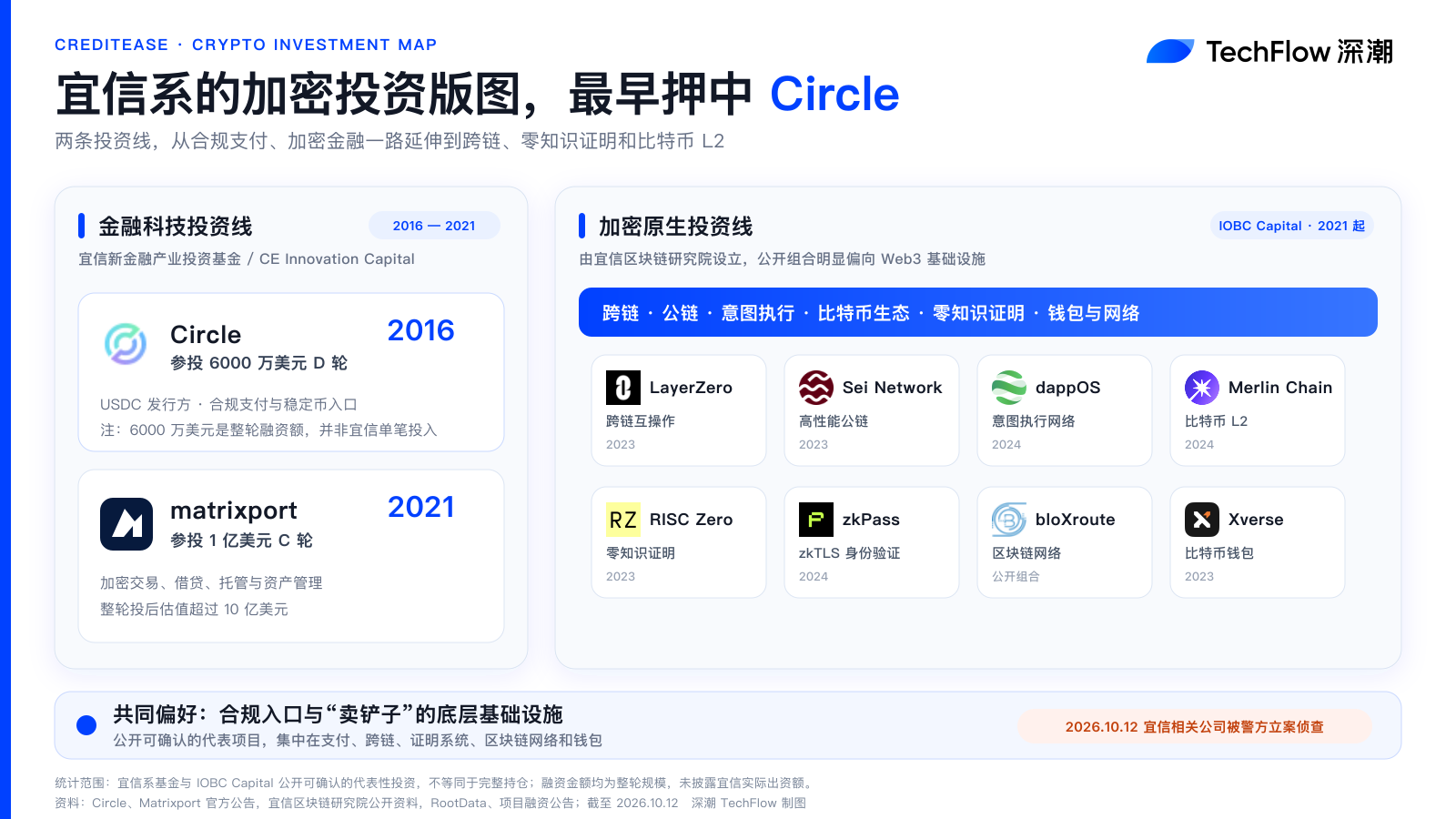
That same year, CreditEase also established a dedicated blockchain investment arm, IOBC Capital, headquartered in Singapore. Its investment scope covered early-stage Web3 projects, with a portfolio including native crypto targets like cross-chain protocol LayerZero, with individual investment sizes ranging between $500,000 and $10 million.
Unfolding CreditEase's crypto investment checklist reveals a starkly different approach from its traditional wealth management business in China: Circle represents compliance and transparency, with USDC marketing full reserves and public audits; Matrixport holds multiple licenses and follows a compliant path; and LayerZero is purely technical infrastructure.
At the crypto investment table, CreditEase avoided betting on meme coins and chasing animal narratives, instead focusing exclusively on well-regulated infrastructure.
This makes what happened later particularly ironic.
Watching Others Die, Then Stepping Into the Same River
In 2022, the crypto industry endured its most brutal de-leveraging event.
In May, the algorithmic stablecoin tied to Terra/LUNA collapsed, wiping out $40 billion in market cap within 48 hours. Immediately following, Celsius, heavily invested in stETH and the Anchor protocol, announced the suspension of all withdrawals, transfers, and trading in June. This CeFi platform, which once managed over $20 billion in user assets, had leveraged deposited Bitcoin and Ethereum, leading to a liquidity crunch amid the market crash.
Three Arrows Capital collapsed, BlockFi failed, followed by the ultimate blockbuster collapse in November—FTX. SBF directly siphoned exchange user deposits to sister company Alameda Research to plug the holes left by high-risk trading and illiquid meme/stablecoin holdings (FTT, SRM).
The crypto industry took a bloody lesson costing hundreds of billions of dollars. At its core, the lesson boiled down to seven characters: "Not your keys, not your coins." If you don't hold the private keys, your coins aren't really yours.
Or stated more universally: never hand over control of your assets to a black box you cannot see through.
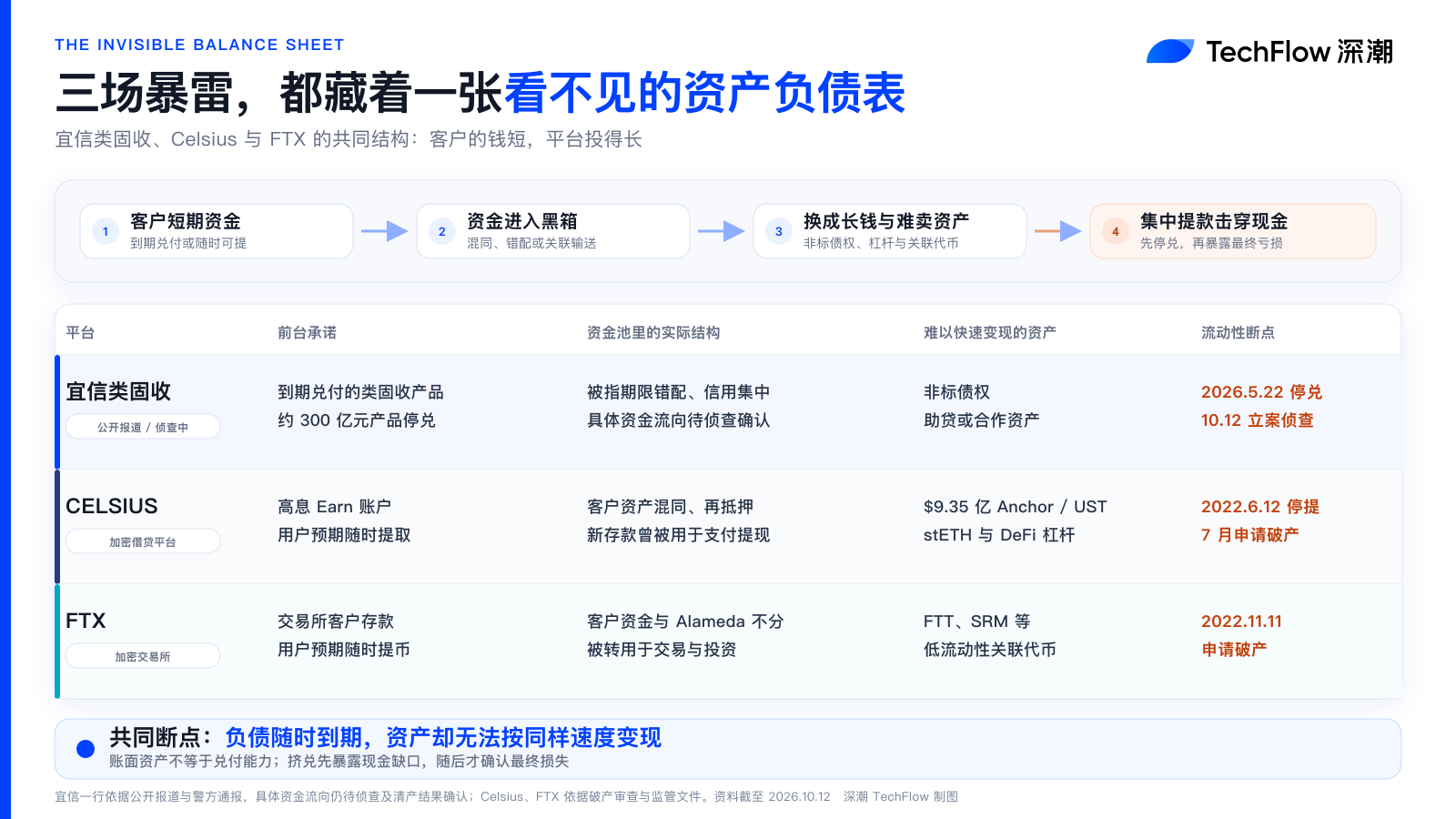
CreditEase's investment team had invested heavily in decentralized infrastructure; they knew black boxes would explode.
Yet within CreditEase's own traditional wealth management business, the exact same black box kept operating.
According to investigations by the Economic Observer, CreditEase Wealth's quasi-fixed-income products are divided into "small fixed" (starting thresholds of 10,000 to 300,000 RMB) and "large fixed" (300,000+ RMB). The underlying assets for "small fixed" are mostly receivables from individual borrower defaults, with contracts only disclosing the abbreviated names of borrowers and withholding all complete information. "Large fixed" claims to invest in "high-quality secured receivables," but the specifics of the underlying assets are similarly kept strictly confidential.
Even more shocking is the condition of affiliated companies. Through corporate ownership tracing, reporters from the Economic Observer discovered that over half of the listing entities, delisting entities, and sponsoring institutions involved in CreditEase's quasi-fixed-income products have been placed on abnormal operation lists or have already been deregistered. One product named "Fengshengtian-24" saw its sponsoring institution deregistered in October 2025, while its listing entity was flagged for abnormal operations in 2024.
Multiple companies frequently acting as listing entities have zero paid-in capital, no fixed business premises, and mostly disconnected phone numbers. The receivables they hold largely originate from CreditEase-affiliated related parties, bundled by auction platforms before being resold to investors.
Tracing the ownership structures of the five implicated sales platforms (Renli Youxuan, Ruicheng, Toumi, Ta Licai, Hao Guihua) reveals a single ultimate beneficial owner: Tang Ning.
Celsius locked user Ethereum into DeFi protocols for mining and leverage; what CreditEase did was simply wrapped in a different shell but shared the exact same core: funneling customers' hard-earned money intended for purchasing "premium consumer loans" into the void of affiliated companies and non-standard receivables.
The difference lies in the fact that users of Celsius and FTX could at least trace partial fund flows on the blockchain. CreditEase investors faced a completely opaque off-chain world.
The Collapse
On May 22, 2026, CreditEase Wealth suddenly announced a "healthy clearance" for all its quasi-fixed-income products, immediately halting all principal and interest repayments effective that day.
The news came abruptly.
An investor who put in over 10 million RMB said he was "completely stunned." A client who had invested for over a decade, upon discovering the product had gone overdue, called customer service only to receive one reply: "A repayment plan is expected to be announced in 4 to 6 weeks."
What infuriated investors further was that some still purchased new products on May 7, and others even rolled over investments on May 22. Staff could not possibly have been unaware of the impending payment halt.
On May 27, dozens of investors flooded CreditEase's headquarters on the 28th floor of China Merchants Tower in Beijing. A surnamed Guo executive claiming to be a vice president of CreditEase stepped forward to state that a dedicated reception center would be established in two days.
On June 15, the reception center finally opened. Upon arriving at the site, Economic Observer reporters found it located next to a security firm, with seven or eight guards stationed at the entrance. Reporters were stopped and asked to show ID cards, and informed that only investors themselves could enter. When reporters tried to speak with investors exiting the building, someone quickly stepped in to intervene, whispering a telling remark to them:
"If public opinion escalates, your funds will be delayed indefinitely; without public attention, you'll get your money back faster."
No one received clear answers regarding core issues like repayment plans or the source of funds.
Tang Ning's final appearance in investors' sightlines was a post on May 28 in the "Tang Ning @ Moments" section of the CreditEase Wealth app—
"Kickstarting the second entrepreneurial journey, grinding hard."
Tens of thousands of investors were waiting for an explanation, hundreds of billions in funds remained a mystery, yet he posted a message about "striving hard."
Subsequently, according to Caixin, several senior executives of CreditEase and Ruicheng were banned from leaving the country. On June 5, Tang Ning's shareholding in CreditEase skyrocketed from 43.4% to 100%. CreditEase transformed from a multi-shareholder company into a sole proprietorship owned by Tang Ning. The timing of this equity change is highly revealing.
Investors waited four weeks, six weeks, eight weeks, yet no official version of the promised repayment plan materialized. An unofficial plan circulated in WeChat groups, with its core clause being "net principal repayment": deducting all cumulative returns previously received by investors over the years before calculating remaining receivables. This means if you invested 1 million and accumulated 300,000 in interest over ten years, your reimbursable principal drops to just 700,000, with no guarantee of when you'd actually receive it.
NPA acquisition firms quickly emerged, buying out investors' receivables at extreme discounts of 23% to 30%. Panic-stricken investors were forced to choose between "waiting might yield nothing at all" and "cutting losses now guarantees at least some recovery."
This scene could almost be overlaid frame-by-frame with the aftermath of FTX's bankruptcy proceedings in 2022, when vulture capital firms like Cherokee Acquisition acquired FTX claims at 10% to 30% discounts.
The sole difference is that FTX creditors ultimately awaited a bull market surge in their underlying Solana token holdings, allowing for full fiat-denominated payouts. Meanwhile, CreditEase's enigmatically low-quality non-standard receivables and affiliated company debts, given the current macroeconomic landscape, offer no narrative of natural asset value rebound.
On October 12, 2026, the Chaoyang Branch of the Beijing Municipal Public Security Bureau officially released a bulletin, opening a criminal investigation into CreditEase-related companies for suspected illegal activities in accordance with the law. Multiple suspects, including actual controller Tang Ning, have been subjected to criminal coercive measures.
From "Godfather of Chinese P2P" to "suspected of illegal and criminal acts," it took Tang Ning exactly 20 years.
An institution that grasped the transparent value of blockchain in its external investments ultimately died from its own internal opacity.
Beyond "Don't trust, verify" becoming instinctual for all capital allocators, Tang Ning and SBF will hardly be the last two to step into the same river.
Join TechFlow official community to stay tuned
Telegram:https://t.me/TechFlowDaily
X (Twitter):https://x.com/TechFlowPost
X (Twitter) EN:https://x.com/BlockFlow_News
 深潮TechFlow