Morgan Stanley Research Report Analysis: The Inference Era Begins, Funds Will Flow from Hardware to the Software Layer
By Rita
Hyperscaler data center capital expenditures will reach $1.5 trillion in 2027, a 60% year-over-year increase, with the growth rate plummeting to 12% in 2028. On September 4, Morgan Stanley released an AI Guide report spanning seven teams and addressing eight key debates. The report notes that AI is transitioning from the training era to the inference era, with investor capital gradually shifting from the hardware and semiconductor layers to the enablement and software layers. AMZN, META, GOOGL, and MSFT as GenAI enablers will benefit from earnings upgrades and valuation expansion.
Capital Expenditure Slows in 2028, Funds Shift Upstream
Hyperscaler data center capital expenditures are projected to grow 60% to $1.5 trillion in 2027, with the growth rate slowing to 12% in 2028 (approximately $170 billion). Reasons for the deceleration include chip supply constraints, diminishing marginal returns from advance construction, and physical limitations (labor, materials, power).
Morgan Stanley estimated the capital expenditure breakdown across four cloud vendors. Amazon's data center capital expenditures are expected to reach approximately $180 billion in 2026, with roughly 38% allocated to advance construction to build capacity ahead of its 2027–2029 commissioning schedule. Microsoft accounts for approximately 37%, Meta for 32%, and Google for only about 5%. Due to having the lowest advance construction ratio, Google will need to significantly increase forward commitments in 2027.
Morgan Stanley points out that decelerating capex growth, combined with the continued expansion of hyperscaler revenues and cash flows, will drive investor capital from the hardware and semiconductor layers toward the enablement and software layers. This aligns with capital flow patterns during the mobile era, where chips and devices rise first, followed by infrastructure and equipment, with software and services lagging last.
145 Gigawatts of Compute Capacity Come Online, ASIC Share Rises Sharply
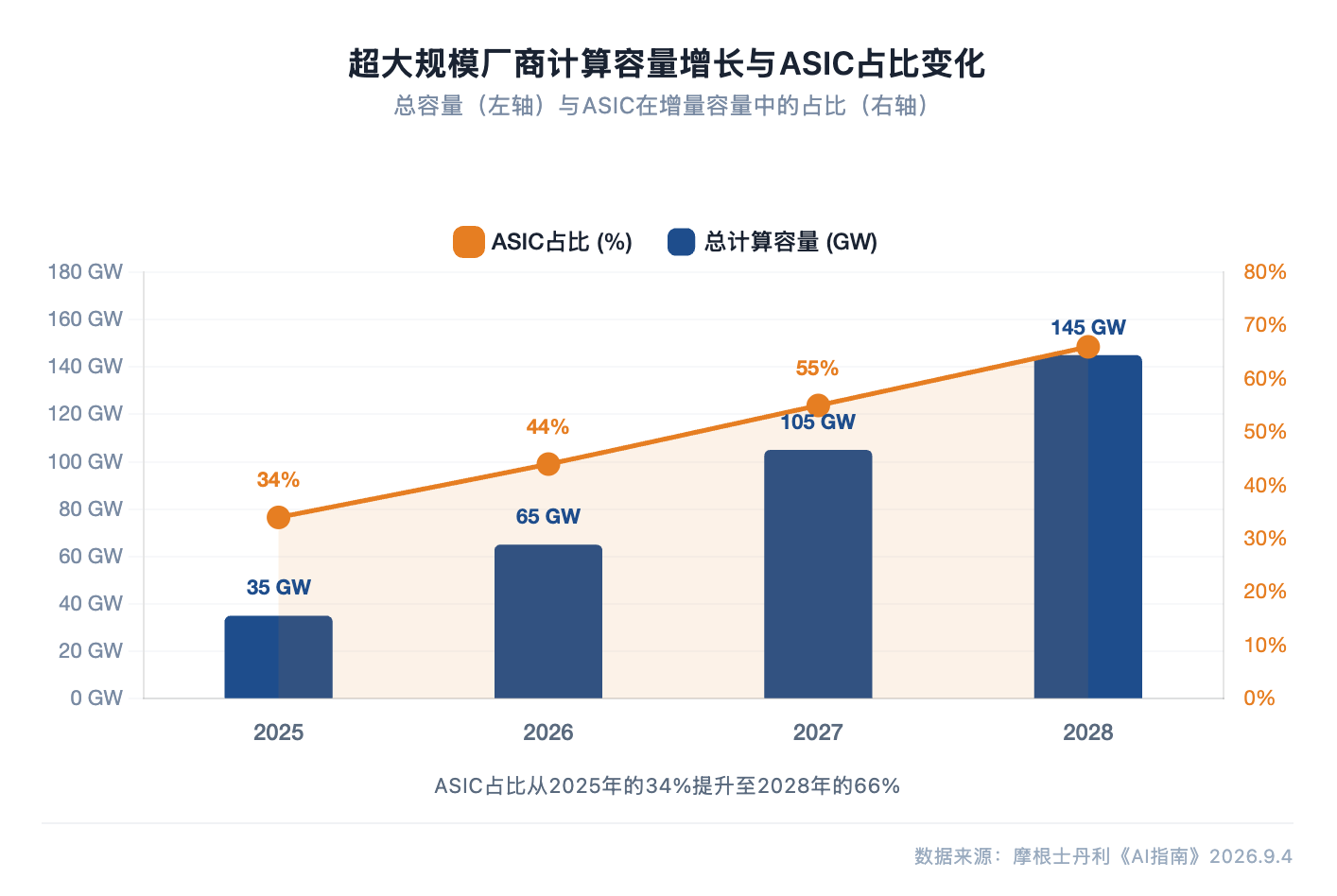
Morgan Stanley projects total compute capacity to grow from 35 gigawatts in 2025 to approximately 145 gigawatts by 2028, adding roughly 38 gigawatts in 2027 and about 44 gigawatts in 2028. Google is the vendor adding the most new capacity, with a combined increase of approximately 20 gigawatts from 2027 to 2028, primarily to support Gemini training, GCP growth, and the deployment of GenAI features for Search and YouTube.
The share of custom chips in incremental capacity will rise from 34% (approximately 2 gigawatts) in 2025 to 66% (about 17 gigawatts) in 2028. This shift is led by Google TPUs and Amazon Trainium units, with Google TPUs adding approximately 15 gigawatts from 2027 to 2028. Over 50% of Google's new capacity is allocated to Google Cloud, and Amazon Trainium has begun pre-selling production capacity for the next one to two years.
Morgan Stanley's cost-per-gigawatt estimates factor in memory inflation for GB200/GB300/VR200 racks as well as rising off-rack costs (power infrastructure, civil construction, etc.). The total cost for the Rubin Ultra generation has reached approximately $50 billion per gigawatt.
GenAI ROI of 25% to 50%, Highest Returns at the Model Layer
Morgan Stanley constructed three frameworks to calculate GenAI ROI, all falling within the 25% to 50% range.
Framework 1 involves hyperscalers leasing GPU capacity. Taking a 1-gigawatt GB300 data center as an example, annual revenue is approximately $19 to $27 billion, operating expenses are around $8 billion (including $4.6 billion in IT depreciation), incremental EBIT margin ranges from 60% to 72%, after-tax net operating profit is about $9 to $15 billion, yielding an ROI of 23% to 39%.
Framework 2 features model developers providing APIs on their own infrastructure. Annual revenue stands at roughly $30 billion, operating costs are about $8 billion, incremental EBIT margin is approximately 75%, after-tax net operating profit is around $18 billion, resulting in an ROI of roughly 46%.
Framework 3 entails model developers offering APIs on third-party infrastructure. Annual revenue is approximately $41 billion, requiring about $28 billion in compute leasing costs, with after-tax net operating profit of roughly $10 billion, leading to an ROI of about 25%.
Morgan Stanley believes the highest returns come from the model layer running APIs on proprietary infrastructure, where META, Google, and SpaceX hold a structural advantage.
Total Addressable Market for Knowledge Work Estimates $20 to $30 Trillion
Morgan Stanley estimates the global total addressable market (TAM) for knowledge work at approximately $22.5 trillion (based on 25% of the global 3.6 billion workforce being knowledge workers, with an average annual salary of ~$25,200), of which roughly $20 to $30 trillion can be digitized and augmented by GenAI tools. On the consumer side, digital opportunity space in sectors like retail, travel, transportation, food delivery, and advertising amounts to approximately $30 trillion.
Based on Morgan Stanley's $22.5 trillion knowledge work market estimate, even achieving just a 4% penetration rate by 2027 (mirroring year two of the public cloud adoption curve) would imply roughly $800 billion in enterprise AI spending. AI diffusion is expected to outpace public cloud, driven by factors including no need for large-scale infrastructure migration, shorter time-to-value, and greater competitive urgency.
Adoption Signals Spreading Across Industries
Approximately 25% of S&P 500 companies quantified GenAI-driven gains in their Q2 2026 earnings reports, up from 14% a year earlier. The technology sector leads in mentions (51%), followed by financials (37%), healthcare, and industrials (each around 20%).
Tech company benefits span both revenue and efficiency. After advertisers used AI agents for targeting, Amazon saw an 8% reduction in cost per impression and a 6% drop in conversion costs. Meta's GEM model and sequence learning improved Facebook ad click-through rates by 8.3% and conversion rates by 15.7%. Nearly 100% of Uber's engineers utilize AI coding tools, doubling code output. Snap's internal AI code review tool covers 90% of pull requests, saving approximately 30,000 hours of code review time.
Financials, industrials, and healthcare are similarly quantifying gains.

Disclaimer
This article is compiled and analyzed by TechFlow Research based on a third-party brokerage research report (Morgan Stanley, September 4, 2026), along with summarized public market information. The ratings, price targets, earnings forecasts, and related judgments cited herein reflect the views of the broker's analysts, representing solely their affiliated institution's stance, not those of TechFlow Research, and do not constitute any investment advice.
Markets involve risks, and decisions should be independent. This article should not be used as a basis for trading any securities.
Join TechFlow official community to stay tuned
Telegram:https://t.me/TechFlowDaily
X (Twitter):https://x.com/TechFlowPost
X (Twitter) EN:https://x.com/BlockFlow_News
 @chaoxiangooo