Chainalysis Launches AI Workspace Chain: Multi-Agent Automated Tracking of On-Chain Funds Cuts Investigation Time in Half
Author: Chainalysis
Translated by: TechFlow
TechFlow Recap: In the new normal of cyber攻防 where hackers exploit AI agents for second-level money laundering and cross-border cross-chain jumps, traditional on-chain forensics relying on manual tool switching and piecemeal data compilation are hitting bottlenecks. Chainalysis has officially launched the AI-native workspace Chain, aiming to bridge the efficiency gap between humans and attackers through large language models and multi-agent automation.
Built on Chainalysis’s 12 years of accumulated on-chain attribution data, the workspace connects existing investigation ecosystems through natural language interactions and the standard Model Context Protocol (MCP), transforming complex data puzzles into instant analytical insights. From cracking multibillion-dollar cross-chain money laundering cases to helping crypto firms cut review times in half, agent workflows are driving a comprehensive upgrade of on-chain defense systems toward autonomy.
Artificial intelligence is accelerating the flow of on-chain funds and emboldening bad actors attempting to steal them. Yet at the same time, AI is empowering Chainalysis to mount a full-scale counterattack. Last Thursday, at a conference held at London’s Barbican Centre, Chainalysis CEO Jonathan Levin officially unveiled Chain, an AI-native workspace designed specifically for fund tracing.
“Tracing the flow of funds step by step is what we do best,” Levin said. He explained that with Chain, Chainalysis’s crypto investigators can now achieve fully automated fund tracing, significantly reducing investigation time through AI-driven workflows: “AI agents handle the heavy, tedious groundwork, while human experts focus on evaluating and validating the final output.”
Chain accepts everyday natural language queries directly (such as “provide a deep background analysis of this address”) and returns sharp, insightful results based on Chainalysis’s 12-year-old intelligence database. It integrates directly into existing Chainalysis investigation workflows, including Reactor and KYT, allowing analysts to get instant contextual answers without constantly switching between tools. Additionally, it seamlessly connects to other mainstream AI tools via the Model Context Protocol (MCP).
“Imagine an investigator tracking a ransomware gang. Historically, this often meant spending days painstakingly extracting and organizing data across different analysis tools, public chains, and data sources,” he noted. “With Chain, investigators just need to ask a question,” and Chainalysis’s agent swarm immediately springs into action. “You just tell Chain your objective, and it automatically builds a workflow to reach it.”
Prior to its official launch, Chain had been deployed as a core internal tool at Chainalysis for nearly a year. For example, in October of this year, our investigators leveraged Chain’s automation capabilities to successfully track a record-breaking hack allegedly orchestrated by North Korean hackers. The perpetrators stole up to $6.4 billion and attempted to conceal their money laundering trail using cross-chain bridges and various DeFi protocols designed to obfuscate traces.

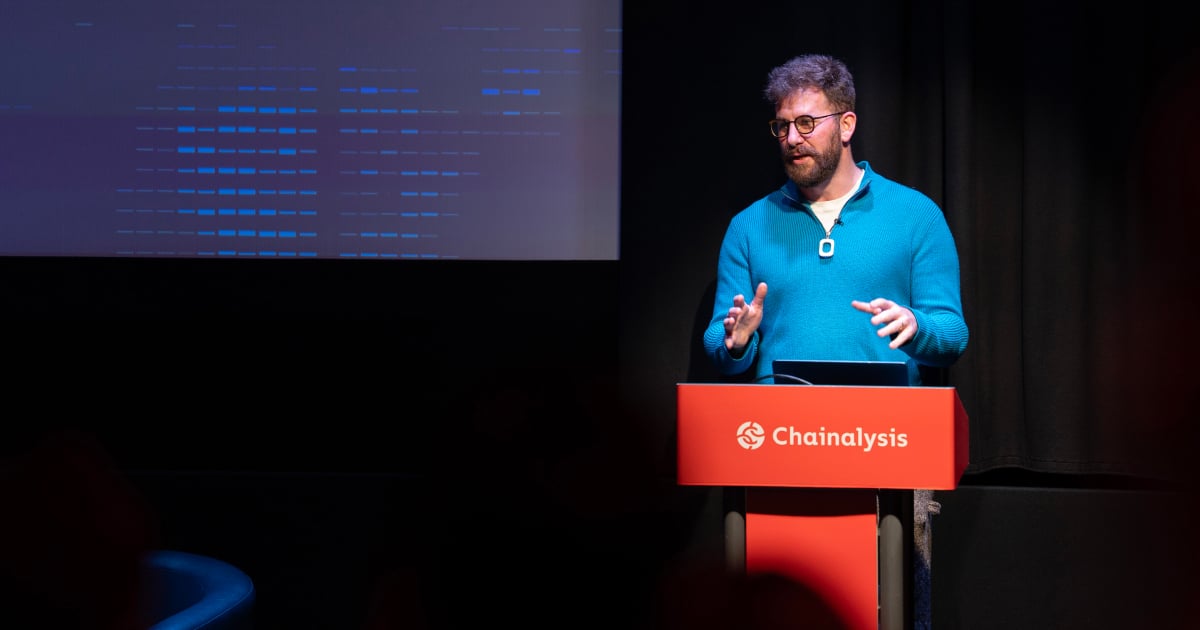
Image: Chainalysis CEO Jonathan Levin introducing the Chain workspace at the Nodes Summit at London’s Barbican Centre
Why We Built Chain
Levin explained at the Nodes Summit that Chainalysis built Chain to “rebalance the scales of power between attackers and defenders.”
He pointed out that certain state-sponsored hackers and cybercriminal groups are already deploying swarms of AI agents to overwhelm targets, committing crimes at “unprecedented speeds that traditional human workflows simply cannot handle.” Defenders must possess cutting-edge technology to keep pace with this rapidly evolving攻防 rhythm.
He stated that Chain is precisely the weapon built for this purpose. For two years, Chainalysis has been “deeply considering how humans should orchestrate and coordinate multiple agents to execute complex tasks on their behalf.” Levin emphasized that the culmination of this exploration is a brand-new platform that “tips the scales back in favor of those battling adversaries.”
Chain will “significantly reduce” the time investigators spend on tedious yet necessary repetitive tasks, while “greatly increasing the practical potential to build deep financial intelligence and establish defensive barriers against these attackers.”
Real-World Applications in Private Institutions
Since Chainalysis launched testing this summer, fiat-crypto on/off-ramp provider MoonPay has been a core heavy user of Chain. During his speech at the Nodes Summit addressing 170 compliance experts and law enforcement personnel, Brian Higdon, Risk Director at MoonPay, shared how his team deeply integrated the tool into their daily workflows.
Higdon admitted that the initial goal of testing Chain was to make MoonPay’s “investigators’ work lighter and more efficient, freeing up core mental bandwidth for genuine risk identification and assessment.”
For any crypto business, such risks are highly complex. According to Chainalysis research, although the vast majority of crypto fund flows are completely compliant and legal, the rare illicit transactions must face rigorous and continuous oversight and review.
“The compliance and regulatory standards we face far exceed those of traditional banks,” Higdon stated. “We need to monitor complex downstream on-chain activities in the ecosystem, many of which have no direct relation to us. We must achieve real-time monitoring while possessing massive concurrent processing capabilities.”
Higdon noted that Chain completely changed this. Tasks that previously took MoonPay investigators 90 minutes can now be fully completed by a group of collaborative agents in just 45 minutes. Explaining that Chain integrates directly into MoonPay’s internal business systems to automate tasks, he added: “My team isn’t just sitting at computers typing questions into some large language model; instead, we let the system run autonomously at the backend.”
“These AI-native tools allow you to keenly capture illicit fund-flows that were almost impossible to detect before.”
The Future Outlook for Chain
Chain is currently in a limited preview phase and is expected to officially open to a broader client base in January 2027. Institutional teams eager to experience the workspace firsthand can now apply for early preview access or book product demos. Industry professionals who missed the live Nodes Summit in London can also watch the full conference replay online.
Frequently Asked Questions (FAQs)
What is Chain?
Chain is Chainalysis’s newly launched AI-native workspace, designed specifically for conducting on-chain investigations and compliance reviews. It runs automated workflows to optimize critical tasks, deeply mine investigative leads, and comprehensively reduce the workload of compliance teams by offloading heavy duties to agents. Backed by Chainalysis’s industry-leading data assets, Chain underwent two full years of intensive R&D and refinement.
How are private institutions currently using Chain?
Private institutions have been first to leverage Chain to significantly boost processing speed and operational efficiency in compliance operations. For example, the investigative team at fiat-crypto on/off-ramp provider MoonPay is utilizing Chain workflows to closely monitor complex crypto fund movements and mitigate potential risks. Brian Higdon, Risk Director at MoonPay, stated that Chain has directly cut the time required for his team to complete investigations by half.
When will Chain be publicly available?
The limited preview version of Chain is now open to select customers, with plans to formally roll out more widely to global clients in January 2027.
Join TechFlow official community to stay tuned
Telegram:https://t.me/TechFlowDaily
X (Twitter):https://x.com/TechFlowPost
X (Twitter) EN:https://x.com/BlockFlow_News
 Chainalysis