Why has the FDE role become the most sought-after engineering frontier in the AI era?
Author: Gergely Orosz, The Pragmatic Engineer
Translated by: TechFlow
TechFlow Summary: As enterprise AI deployment faces engineering gaps and quagmires, Forward Deployed Engineers (FDEs) are evolving from Palantir’s secret weapon into a standard role for top Silicon Valley AI and high-growth tech companies. They stand with one foot breaking through complex on-site business environments for clients, and the other foot driving the architectural evolution of core enterprise products.
This article provides an in-depth analysis of the real-world engineering practices and operational mechanisms of three benchmark companies—Palantir, OpenAI, and Ramp—and deconstructs the essential boundaries between FDEs and traditional Solutions Engineers (SEs) as well as Agent Engineers (AEs). This role is not only a technical lever for unlocking million-dollar enterprise deals but is also regarded as the premier incubator for founders and CTOs of next-generation startups.
This article was previously published exclusively as a paid column entry until November 2026, when I decided to make it completely free to the public. This is because over the past 12 months, job postings for “Forward Deployed Engineers (FDE)” have surged fourfold in the market. I hope this piece provides a holistic view of this role and clearly explains its fundamental differences from traditional software engineering positions.
If you’d like to receive these in-depth analyses tailored for software engineers and tech professionals weekly in your inbox, please consider subscribing to this column. With over 1 million readers who are software engineers and tech experts, it is currently the #1 software engineering newsletter on Substack.
Since the original publication of this article in 2025, several highly insightful and significant developments have emerged in this field during 2026:
• The core focus of FDEs has shifted entirely toward “AI-native forward deployed engineers.” Virtually all actively hiring FDEs—at least barring very few exceptions—are selling AI-driven software or hardware products. They urgently need FDEs to help deeply integrate these AI products into existing enterprise client systems, which often involves massive underlying pipeline engineering, rebuilding new workflows, and training client engineering teams on AI-native engineering principles.
• In industry deployment practices, the vast majority of FDEs do not seem to actually feed code back to the underlying core platforms. Although early FDEs at early benchmark companies discussed below (such as OpenAI and Ramp) indeed deeply participated in and fed back into platform architecture, for the vast majority of hiring companies post-2026, FDEs rarely have the energy or opportunity to engage in core platform R&D in their daily work.
• At many companies, the FDE role increasingly resembles a hybrid of an “AI-powered Solutions Architect + Product Engineer.” When I researched and wrote this article in 2025, the operational boundaries between FDEs and traditional Solutions Engineers (SEs) were quite distinct; however, by 2026, the differences between the two in many newly established roles have significantly narrowed.
• FDEs offer developers an excellent pathway to gain firsthand, hands-on experience with “AI-native” practices. While this role may not be the most glamorous choice for senior (and above) engineers, for those working in traditional tech environments with “limited AI practice opportunities,” it allows them to directly interact with cutting-edge tech stacks and brand-new deployment engineering pipelines at a very high density.
• Entering 2026 and beyond, market demand for this role is exceptionally strong. It remains one of the few high-difficulty positions where startups commonly report severe recruitment bottlenecks. If you are currently job hunting or observing the market, this is undoubtedly highly strategic industry intelligence.
Looking across this year’s AI startup ecosystem, one of the most prominent key trends is the rapid rise of the dedicated software engineering role known as the “Forward Deployed Engineer (FDE).”
The role has even been hailed by prominent Silicon Valley venture capital firm Andreessen Horowitz (a16z) as “the hottest job in tech today.” FDEs blend multiple attributes across software engineering, commercial sales, and platform architecture. Since the beginning of this year, strongly catalyzed by the industry-wide acceleration in integrating AI deployment solutions, demand for hiring in this role has seen explosive growth, and this recruitment frenzy is certainly not limited to AI-focused startups.
Today, we will conduct a panoramic breakdown of Forward Deployed Engineers, focusing on the following core dimensions:
• What is a Forward Deployed Engineer (FDE)? A software engineer shuttling repeatedly between on-site client operations and core product R&D—a highly challenging and hardcore task, without a doubt.
• Role Origins. Prior to 2016, big data pioneer Palantir employed more FDEs (internally codenamed “Delta”) than traditional software development engineers (Dev). No company has shaped this role better than this enigmatic tech giant.
• OpenAI’s Engineering Deployment Practices. ChatGPT creator OpenAI officially established this role this year and distinctly separated it from Solutions Architects (SA), which lean toward professional consulting services.
• Ramp’s Agile Mechanisms. Established nine months ago, fintech unicorn Ramp now employs approximately 15 FDEs, organized into lean Pod agile combat units that strictly adhere to four core operational principles.
• Why are FDEs so hot right now? Deeply integrating Large Language Models (LLMs) and AI products into actual business scenarios is this role’s destined battlefield; meanwhile, Palantir’s massive commercial success has also provided a benchmark paradigm for the entire industry.
• Differences between FDEs, Solutions Engineers (SEs), and Agent Engineers (AEs). Despite overlapping areas, FDEs are typically endowed with the explicit mission of feeding code and architectural insights back into the underlying core products.
• The Career Panorama of FDEs. Analyzing talent profiles, recruitment screening criteria, compensation structures, and future career progression paths.
Special thanks to Colin Jarvis (Head of Forward Deployed Engineering at OpenAI), Leo Mehr (Head of Forward Deployed Engineering at Ramp), and Anjor Kanekar (former Palantir FDE for 7 years) for providing exclusive, first-hand insights for this article. Anjor is currently offering market-facing consultancy services on FDE system setup and team hiring.
What Exactly Is a Forward Deployed Engineer?
Recruitment postings for FDEs across major tech companies consistently outline several core characteristics of the role:
Solid Software Engineering Fundamentals
Virtually all hiring managers seek developers with a rock-solid software engineering foundation and hands-on delivery experience to ensure robust underlying engineering logic. Ramp prefers senior candidates with over five years of engineering experience when hiring Senior FDEs, but will also make exceptions for a handful of top-tier fresh graduates. Palantir hires engineers with just one year of post-graduation experience. Meanwhile, healthcare tech startup Commure and industrial AI startup Matta place particular emphasis on candidates’ hands-on experience in end-to-end building and delivering actual projects.
Collaborate with Sales Teams to Close Major Deals
Many startups that onboard FDEs deploy them directly as commercial weapons for conquest. In short, when potential enterprise clients hesitate about whether they can successfully integrate and effectively use a certain product, the sales team proactively offers to send an FDE on-site to tackle the challenge and assist the client in clearing technical barriers to complete integration. Ramp clearly states in its job posting: “Work closely with our sales and business development teams to secure exciting key orders, deeply activate clients, and continuously expand the commercial value Ramp brings over long periods.”
Fully Embed Within Client Business Trenches
As OpenAI’s job posting states: “As an FDE, you will embed deeply within client teams, understand their business domains, and collaboratively develop solutions with clients in problem spaces that are often vague, undefined, or dynamically evolving, directly addressing core pain points.”
This role inevitably includes frequent travel arrangements to work side-by-side at client sites. Palantir requires FDEs to spend roughly 25% of their working hours on-site at client locations; healthcare AI company Commure expects this ratio to reach up to 50%.
For companies with highly specialized client bases, this even means entering extraordinary extreme operating environments. For example, industrial AI startup Matta requires FDEs to “directly go deep into factory workshop floors to define solutions.” Former Palantir FDE Anjor Kanekar recalls spending extended periods stationed on the final assembly lines of aerospace manufacturing giant Airbus. Many of his FDE colleagues even operated in physically isolated airgapped networks under extreme conditions—a far cry from traditional office-based developer life.
Feed Back into Core Products and Integrate into Underlying R&D Forces
Ramp sets highly explicit expectations for this: FDEs must drive the core product engineering roadmap, make critical decisions on prioritization and scoping, determine when to build bespoke custom solutions for clients versus when to accelerate underlying common projects. Ramp utilizes a deep embedding mechanism, integrating FDEs into the core underlying R&D team to accumulate deep expert experience in cutting-edge niche technology areas.
Ultimate Orientation Toward Customer Success
The absolute core of this role lies in enabling clients to achieve commercial and technological success based on the company’s own product foundation. As robotics startup Gecko Robotics succinctly puts it: “FDEs are dedicated to finding the most impactful problems. We spend considerable time embedded with clients to uncover the root causes of issues, propose innovative solutions, and never call it quits until expectations are met.”
Some companies view the role more heavily as technical consultants. For instance, AI agent orchestration platform Lindy hopes FDEs will assist clients in building and maintaining no-code workflows, “while serving as technical advisors to clients.” Clearly, the boundary between pure consulting and being a versatile engineer balancing client needs and underlying products can easily blur.
Distinct Corporate Flavors
Because FDEs represent a relatively emerging hybrid profession, each company formulates unique role expectations based on its own business priorities. Some lean heavily toward assisting sales in closing deals, others focus on client technical support, and still others prioritize code feedback to the underlying core architecture.
This is undeniably a role carrying extremely high comprehensive expectations. Take enterprise software giant Salesforce’s requirements for a Senior FDE as an example; the list covers: driving tangible business outcomes through hands-on engineering deployment, building transformative AI solutions, designing and crafting customized agent AI solutions, fully managing the complete lifecycle of data configuration and integration, proactively eliminating technical blockers, driving Agentforce product innovation, becoming a trusted strategic technology partner for clients, conducting difficult technical debugging and root cause analysis, leading agile prototype validation and rapid iteration, and implementing best engineering practices.
This strikingly long checklist mirrors the implicit advanced expectations placed on senior (Senior+) software engineers in traditional tech tracks. My personal favorite, however, is Palantir’s classic definition of the role: “The responsibilities borne by an FDE closely resemble those of a co-founder/CTO at a startup: You will operate in a lean small team, taking end-to-end ownership of executing high-risk, high-value critical projects.”
In today’s market, roles highly overlapping with FDE carry various titles, such as “Agent Engineer,” “Solutions Architect,” “Sales Engineer,” and “Technical Delivery Engineer.” Their job content is remarkably similar, but the most fundamental dividing line lies here: a true FDE not only embeds deeply into frontline trenches to serve clients but must also continuously submit code to the company’s foundational core products sold externally.
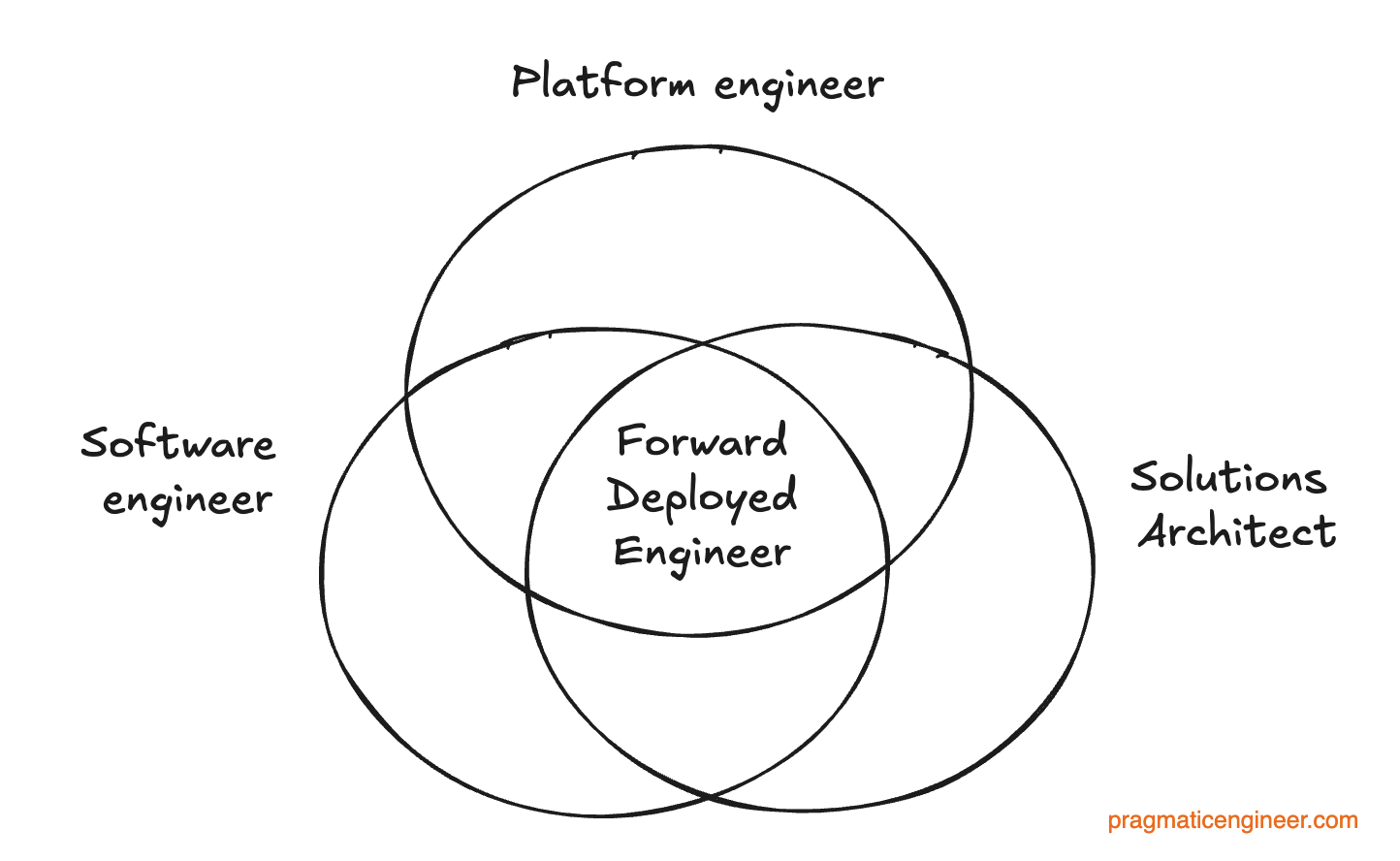
The diagram below outlines my synthesized typical mental model for FDEs. It should be noted that in companies where FDEs do not need to feed back into underlying products, the weight of the “Platform Engineer” portion on the right is often comparatively diminished:
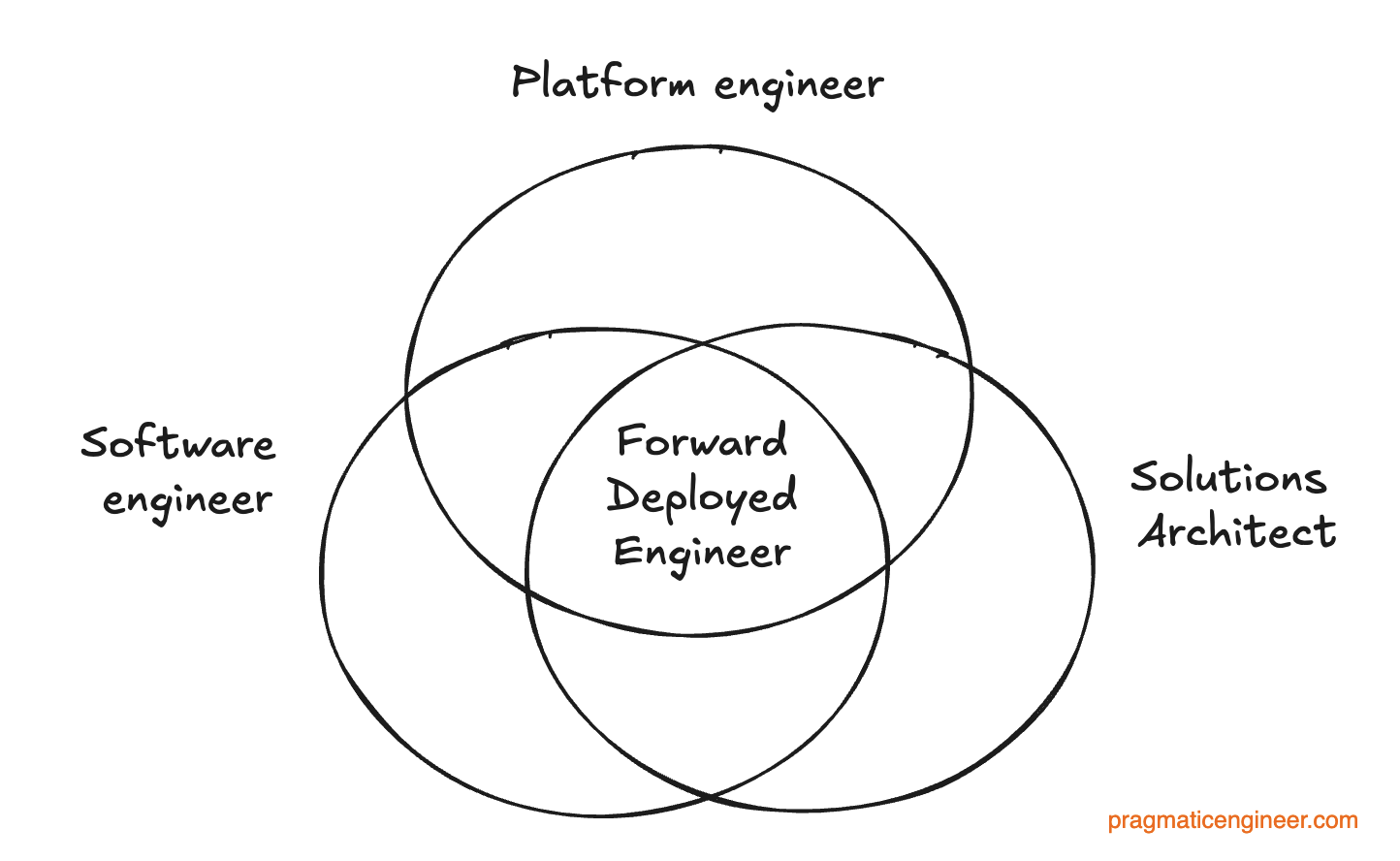
Figure: Mental Model of a Forward Deployed Engineer (FDE): 50% Client Frontline Deployment + 50% Core Product Engineering
Origins: Starting from Palantir’s “Delta” Secret Weapon
The position of “Forward Deployed Software Engineer” was initially born out of big data pioneer Palantir in the early 2010s, internally named “Delta.” Founded in 2003, Palantir has long provided rigorous big data processing services for government agencies such as law enforcement and defense/military sectors, as well as large commercial entities. The data they handle is often extremely sensitive and highly classified.
Until around 2016, the number of internal FDEs at Palantir actually exceeded that of traditional software development engineers (Dev). It wasn’t until 2016 that Palantir officially launched Palantir Foundry, an integrated data platform designed for commercial and civil government sectors. From that point on, an increasing number of FDEs began bringing back invaluable field-tested experience accumulated from frontline operations to feed into the R&D and evolution of the Foundry core platform.
Even today, no company globally possesses more FDEs than Palantir, nor has any startup come close to matching its influence in shaping this role. Palantir once provided a profoundly insightful official explanation for this role:
“Delta (Forward Deployed Software Engineers) are responsible for deploying our software platforms onto the frontlines with clients. Operating under the business expansion architecture, their sacred mission is to deliver substantial technical deployment outcomes for clients. As frontline squad members directly supporting specific customers, Delta focuses on technology-driven value creation, deploying and customizing the Palantir platform to overcome severe business bottlenecks. They measure success and failure by the actual impact on clients’ business objectives. For example, we partnered with a manufacturing giant to reduce defect rates on assembly lines. To crack this metric, Delta comprehensively utilized Palantir products, multiple programming languages, open-source toolkits, industry-standard build systems, and their own engineering creativity to design custom solutions. You can understand it this way: the focus of traditional Dev engineers is ‘one capability, serving massive numbers of clients,’ whereas the focus of Forward Deployed Engineers (Delta) is ‘one client, providing a diverse array of comprehensive capabilities.’”
FDEs are sometimes mistakenly viewed by outsiders as traditional management consulting advisors, but there is a fundamental difference: consultants typically deliver one-time paper recommendations and then depart, while FDEs work side-by-side with clients, engaging in long-term, deep-dive operations. More importantly, FDEs feed back into the underlying architecture. When a client urgently needs a capability that the underlying platform lacks, the FDE will directly take on R&D responsibilities, manually adding feature capabilities and underlying improvements to Palantir’s core products.
A Slice of Daily Work for a Palantir FDE
As early as 2019, two Palantir FDEs stationed at different global offices authentically recreated their typical daily routines:
Dyon, stationed in Abu Dhabi, described it as: “Most of the time, I spend two to three days a week working onsite with clients. Part of that time goes into meetings with client tech or business executives, while the rest focuses on monitoring, debugging, deploying, or configuring our software platform for that client. Upon returning to the company office, I dedicate time to writing code patches, reviewing technical PRs, and planning/simulating next-phase proposals. The remaining time is spent synchronizing via email or video calls with headquarters’ tech support, core product teams, and junior engineers dispersed across multiple remote sites.”
G.M., stationed in São Paulo, stated: “My daily rhythm shifts dynamically almost every month, which is precisely what makes this job so fascinating. During some weeks, I spend most of my time doing high-intensity coding and reviewing team code, acting like a pure software engineer; while during other weeks, the vast majority of my energy goes into jointly defining future project boundaries with clients or diving into user communities to ensure our delivered systems truly hit the mark on business needs.”
Overall, the typical weekly allocation of effort for a Palantir FDE consists of the following composite blocks:
• Client frontline project execution: The absolute core pillar, consuming the majority of effort;
• Core product improvement contributions: Submitting new features and generalized optimizations to the product trunk to avoid falling into endless customization quagmires in the future;
• Business development collaboration: Assisting with technical demos, evaluating RFPs, and participating in key technical communications with major accounts;
• Cross-departmental agile communication: Closely aligning with internal support functions within the company;
• Team tier management: Senior FDEs typically guide between 2 to 6 mid-level engineers.
Facing such intricate intersections of responsibilities, excellent FDEs must possess an extremely decisive ability to say “no.” One Palantir senior FDE summarized: “I strictly limit my meeting time, constantly asking myself before every session: Is a meeting absolutely necessary for this topic? Must I personally attend? The vast majority of people in the company uphold the same principle, which ensures that every meeting I attend delivers an exceptionally high time ROI.”
Why Does Palantir Rely So Heavily on the FDE Role?
Palantir’s business is deeply entrenched in core government departments and immensely large, heavy traditional corporate giants. It can be safely asserted that without the strike force of FDEs pushing ahead, these rigidly bureaucratic traditional organizations would fundamentally lack the capacity to bridge Palantir’s massive, complex systems with their own legacy tech stacks.
In stark contrast to agile startups filled with geek spirit, embracing rapid trial-and-error, and unafraid of using clever hacks to solve problems, enterprises are often hindered not merely by technical bottlenecks, but by tangled bureaucratic procedures and internal friction fueled by “that’s not my job” excuses.
Palantir deploys a fully empowered team of hardcore engineers whose sole objective is to seamlessly integrate software and create substantive value for clients. This asymmetric advantage achieves a “kill two birds with one stone” effect: First, because onsite FDEs know nothing of and need not care about internal client bureaucracy, they remain entirely immune to systemic friction; second, this cohort of geek-spirit developers always maintains a “how can I make this happen” breakthrough mindset rather than making excuses for “why this cannot be done.” Compared to traditional enterprises pushing system integration themselves, Palantir’s approach demonstrates overwhelmingly superior execution efficiency.
OpenAI’s Forward Deployed Engineer Architecture
Colin Jarvis serves as the Head of OpenAI’s Forward Deployed Engineering (FDE) team. He joined OpenAI in 2022 as a Solutions Architect (SA) and was promoted to head the Solutions Architecture team last year. Early this year, facing increasingly complex enterprise deployment challenges, Colin submitted a detailed business case proposing the formal establishment of an internal FDE team at OpenAI to deliver more precise technical penetration. Initially comprising just 2 engineers, the team has rapidly expanded to over a dozen, establishing a footprint across global core hubs:
• USA: New York, San Francisco
• Europe: Dublin, London, Munich, Paris
• Asia: Tokyo, Singapore
OpenAI still currently retains the Solutions Architect (SA) sequence. Whether SA or FDE, both assist clients in tackling the arduous challenge of deploying complex underlying Large Language Models (LLMs) into actual production systems.
However, FDEs are clearly much deeper in the trenches, and face far greater business ambiguity than traditional SAs. The SA function leans toward advisory consulting: they rarely write code directly on client production infrastructure, instead typically building Proof of Concepts (PoCs) or Minimum Viable Products (MVPs) using desensitized or offline sample data provided by the client.
In contrast, FDEs must plunge headfirst into the frontline: they code directly within client infrastructure environments, leveraging the client’s own dev toolchains to tackle deliveries. More importantly, the FDE team deeply aligns with OpenAI’s frontier research goals, specifically selecting benchmark clients capable of feeding back into and driving underlying model research evolution. Compared to traditional public cloud solution architects, FDEs must navigate effortlessly through waters of extreme chaos and uncertain requirements.
FDEs are also substantively driving the evolution of the core product roadmap. In a typical large account project for call center voice automation, an FDE built a specialized engineering evaluation baseline (evals) for the voice model. Initially, the model’s performance in the client’s specific voice scenarios fell far short of production readiness. The FDE team quickly took frontline real-world data deep into OpenAI’s core research division, teaming up to targetedly optimize the model’s inference performance in voice scenarios, ultimately enabling that client to become the first globally to push this cutting-edge voice solution into large-scale production.
This achievement simultaneously drove massive underlying upgrades to the OpenAI Realtime API. It was a perfect win-win: the client gained frontier AI capabilities at a pace far exceeding expectations by leveraging the FDE’s trench assault, while OpenAI completed a technical verification through frontline combat, allowing all global clients to share in the leap of the underlying product.
OpenAI’s Dual-Track Working Architecture
Colin thoroughly elaborated on how the OpenAI FDE team navigates the parallel technological dual tracks of “client-facing” and “core-product-facing” in their daily work:
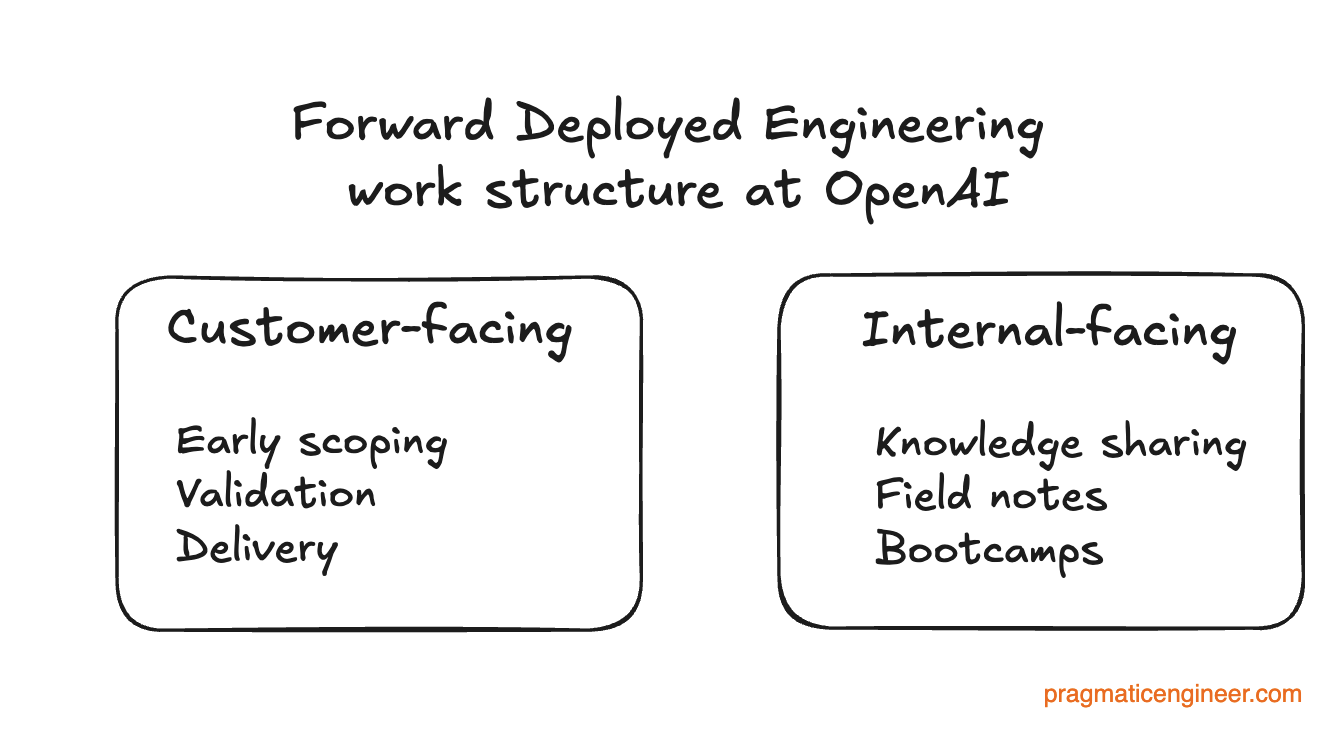
Figure: OpenAI FDE Team’s Parallel Dual-Track Working Architecture: Client-Facing vs. Core-Product-Facing
End-to-End Client Business Deployment Process
In client-facing project deployments, the standard advancement process is clearly divided into three phases:
Phase 1: Early Scoping. FDEs stake out at client sites for several days, sitting alongside frontline business personnel to map out end-to-end workflows, precisely locking onto the key linkages with the highest commercial value, rapidly running prototype validations based on synthetic data, and simulating concepts on whiteboards to lock in priorities.
Phase 2: Strict Metric Validation. FDEs go to the client frontline to answer a fundamental question: “Does the scope we previously defined truly represent the actions where we can generate the highest commercial value for the client?” Once consensus is reached, both sides jointly establish strict validation metrics. This typically covers: building quality assessment systems (evals) based on real user input and labeled data, scaling up annotation workflows, conducting feature engineering and gradient-climbing tuning against evaluation metrics, and ultimately delivering a detailed compliance report upon passing evaluations.
Conducting rigorous validation prior to formal delivery is not commonplace in traditional software engineering, but Colin explains it is an ironclad rule bought with bitter experience: “FDEs constantly shuttle through massive uncertainty. Client requirements sketched verbally in the early stages often drastically diverge from onsite real data and underlying system realities. We must maintain a preference for agile trial-and-error, hit walls and clear mines immediately, burst bubbles, and rapidly correct the project scope toward the most pragmatic direction when faced with insurmountable hard objective constraints.”
Phase 3: Engineering System Delivery. FDEs stay onsite several days a week, deeply dissecting technical details, pulling real production data, completing core module coding internally at OpenAI, and continuously demonstrating iterations to the client, always focusing on building production-grade solutions that run end-to-end through a “minimum viable loop.”
A highly representative industry deployment case is the project the team advanced in partnership with century-old agricultural infrastructure giant John Deere in Iowa. The team focused on cracking the large-scale engineering bottleneck of “personalized farmer intervention guidance.” Previously, John Deere relied on manual phone calls to farmers guiding efficient machinery usage; today, the client hopes to leverage intelligent solutions, combined with their latest precision weeding and chemical-reduction technology, to provide personalized operational insights for every farmer, thereby drastically reducing pesticide spraying costs.
To ensure the technology truly landed, Colin and frontline FDEs personally traveled to farms in Iowa, running hands-on tests shoulder-to-shoulder with farmowners:
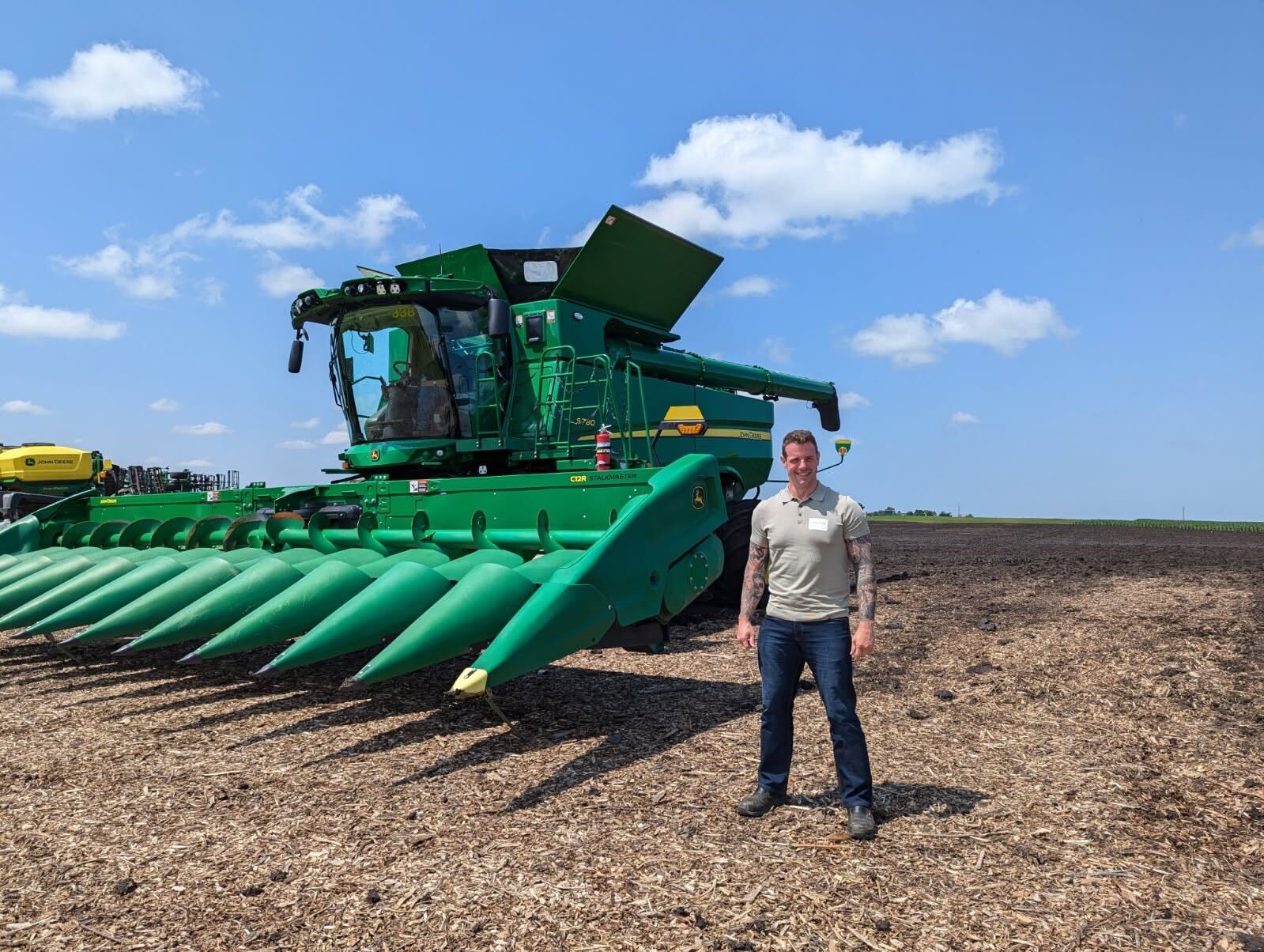
Figure: OpenAI FDE Lead Colin Jarvis Onsite at an Iowa Farm Assisting John Deere with Deployment
At that time, the project delivery window was extremely tight: John Deere required the brand-new feature to be fully ready for the next planting season, representing the most critical timeframe for field weed spraying. Pushed under immense pressure, the team completed full-chain deep integration within the tight schedule, achieving massive commercial success.
Internal R&D Feedback and Ecosystem Contributions
Although FDEs’ primary battleground is conquering external client projects, they simultaneously continuously feed frontline insights back into OpenAI, resonating at high frequency with the core team:
• Establish fixed knowledge-sharing mechanisms with the core Research team (typically biweekly);
• Conduct biweeklies comprehensive frontline deployment reports to OpenAI’s Head of Product and product manager teams;
• Operate an internal public Slack channel “FDE Field notes” where all FDEs openly broadcast frontier discoveries and pain-point reflections straight from the trenches;
• Host quarterly offsite bootcamps for all staff, tightly bonding team members spread across eight core cities spanning three continents.
In open source and underlying ecosystem building, the FDE team is also the primary contributor to OpenAI’s official Agents SDK. Initially, OpenAI’s Solutions Architecture team led the construction of the open-source lightweight multi-agent orchestration framework Swarm to help external clients access the official API with lower barriers. Today, the Swarm framework has formally upgraded and evolved into OpenAI’s official Agents SDK, and both the Solutions Architecture team and FDE team remain the absolute core sources of code contributions to this foundational toolkit.
Ramp’s Engineering Practice: Making FDEs the Center of Revenue and Innovation
Leo Mehr steers the Forward Deployed Engineering team at the renowned fintech unicorn Ramp. He recounts the formidable early days when this squad was first established:
““Ramp established the FDE function entirely due to the practical necessity of supporting the scaled expansion of enterprise-grade large accounts. Ramp was founded in 2019. By 2023, founding engineer Calvin Lee realized he had to frequently jump into the trenches himself to customize bespoke engineering development for several of Ramp’s ultra-large enterprise clients. When I joined Ramp in March 2024, the entire FDE team consisted of only a mere two engineers. During those early days, we were stuck in a survival struggle, running around putting out fires all day long. Applying former Stripe Director of Engineering and renowned engineering management author Will Larson’s four-stage framework for high-performing engineering teams, we were squarely in the ‘Falling behind’ stage:””

Figure: Will Larson’s High-Performance Engineering Team Development Stages Framework
““I assisted the team in re-anchoring its strategic direction: we aggressively hired talent to bolster our ranks, escaped the quagmire of ‘Treading water,’ and rallied everyone tightly around the sacred mission of securing large enterprise accounts. A year later today, we have powerfully transitioned to the ‘Innovating’ stage, capable of proactively and preemptively developing underlying feature capabilities, strongly assisting Ramp in rapidly achieving deep Product-Market Fit (PMF) in enterprise-grade mega-deals and emerging verticals like healthcare and govtech.””
Today, Ramp’s FDEs span the complete lifecycle of enterprise clients:
• Pre-sales phase: Participating on-demand in core sales conquest meetings, providing robust technical backing alongside the business development team;
• Post-sales phase: Responsible for leading system integration and deep custom delivery end-to-end after the client officially signs and purchases.
A large defense-tech unicorn stands as a highly decorated case study for this team. Because this client handles numerous classified and government contracts, it faces exceedingly complex and stringent government reimbursement accounting audit standards. To tackle this industry challenge, Ramp’s FDE team specially developed a comprehensive “per diem” government reimbursement underlying abstraction architecture for them.
Even more thrilling is that the per diem module custom-developed by Ramp specifically for this client has now been seamlessly distilled and reused across Ramp’s full platform for numerous other enterprise clients. This is precisely the “flywheel effect” the FDE team tirelessly pursues: deep custom solutions forged on-site for individual clients ultimately succeed in escalating into core assets that expand the universal capabilities of the entire platform.
Team Structure and Mentorship-Driven Pod Model
Currently, Ramp’s FDE team has grown to approximately 15 personnel and plans to steadily expand to around 20. Given the team’s outstanding performance in assisting the company to conquer large enterprise-grade major accounts, its strategic value is widely recognized as enormous. Personnel efficiency outputs are tightly bound to the company’s core commercial revenue, causing this department to be directly treated internally as a central “profit center.”
The team’s organizational formation is divided into lean “Pods” combat units: closely paired and mentored by experienced senior Leads and entry-level engineers. Pod leads typically possess 4 to 15 years of profound engineering accumulation. This master-apprentice transmission formation enables Ramp to boldly absorb outstanding fresh graduates stepping into the workforce, deeply binding exceptional campus recruits with Senior and Staff-level veteran FDEs for joint operations.
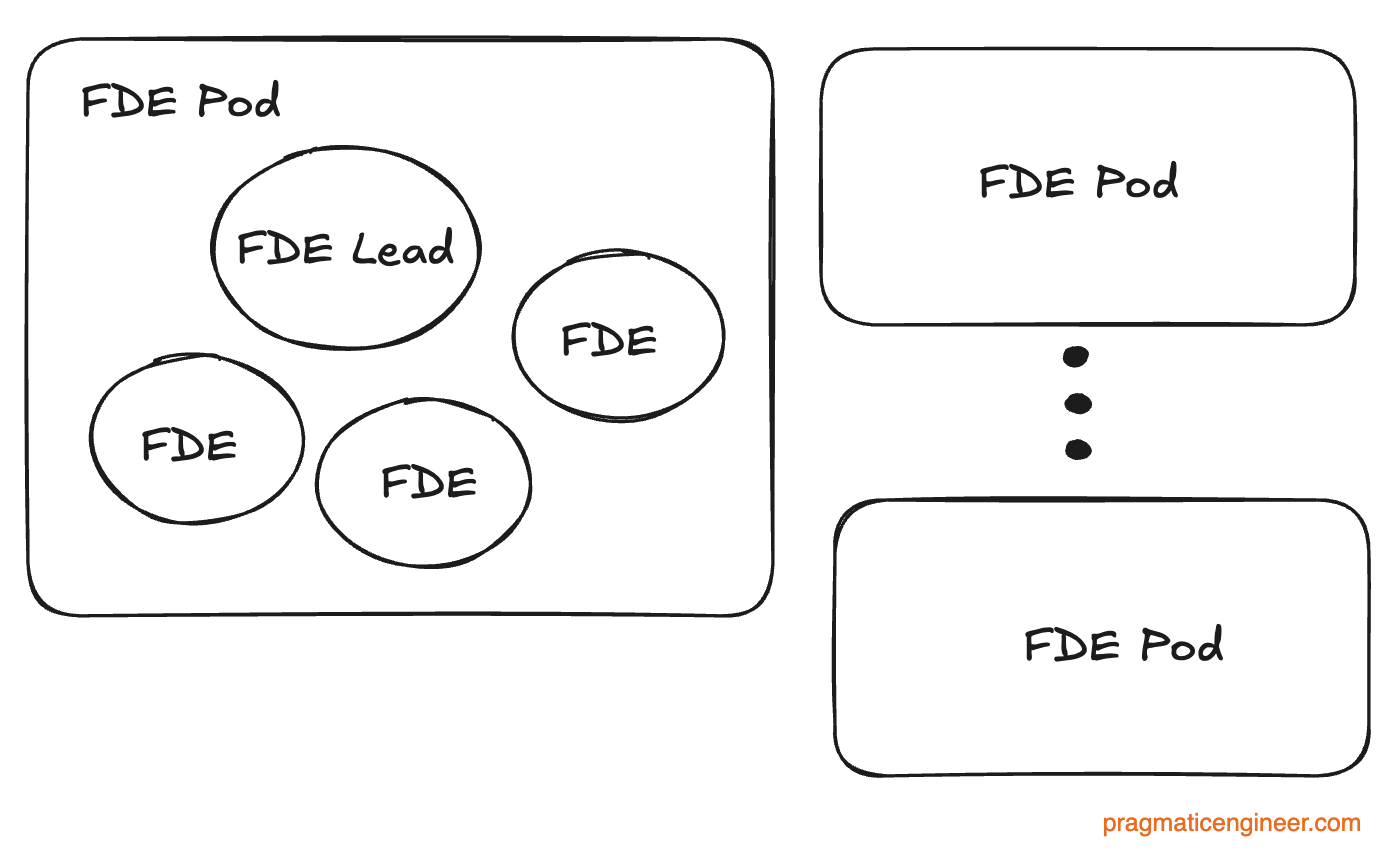
Figure: Ramp’s FDE Organizational Pod Architecture Model
Notably worth mentioning is that Ramp’s FDE team exhibits a rare “ultra-high density of former founders”: among the ~15 FDEs, 6 were previously independent founders of startups, including 3 who founded companies incubated by Silicon Valley’s top accelerator Y Combinator. This extraordinarily high talent density is extremely rare in the industry, reminding me of the unique engineering culture at Bluesky, where over half the engineers possessed founder backgrounds.
Four Core Operational Principles
Leo meticulously summarized the four core operational laws forged by the team in the frontline trenches:
Principle 1: Always Be Scoping. On real commercial battlefields, clients frequently insist on developing highly complex features with absolute certainty. But when we dig deep into frontline business details, we often discover that simply tweaking or optimizing certain existing client workflows or tools can perfectly resolve pain points without writing a single extra line of code. Countless cases prove that deeply probing two core questions with clients often saves days of meaningless heavy engineering drain. “Always Be Scoping” has become our paramount first guiding doctrine.
Principle 2: Generalize Our Work. Firmly reject tailoring and stitching one-off code for individual clients, especially shortsighted moves that massively increase core product complexity. The mighty power of an excellent product stems from building a highly generalized platform capable of repeated reuse. Our ultimate goal is to construct high-dimensional abstractions that propel the company to victory on the market time and again, rather than creating a terrifying “octopus”: a core platform entangled with countless bloated tentacles, each stuffed with spaghetti-patched code built exclusively for specific clients.
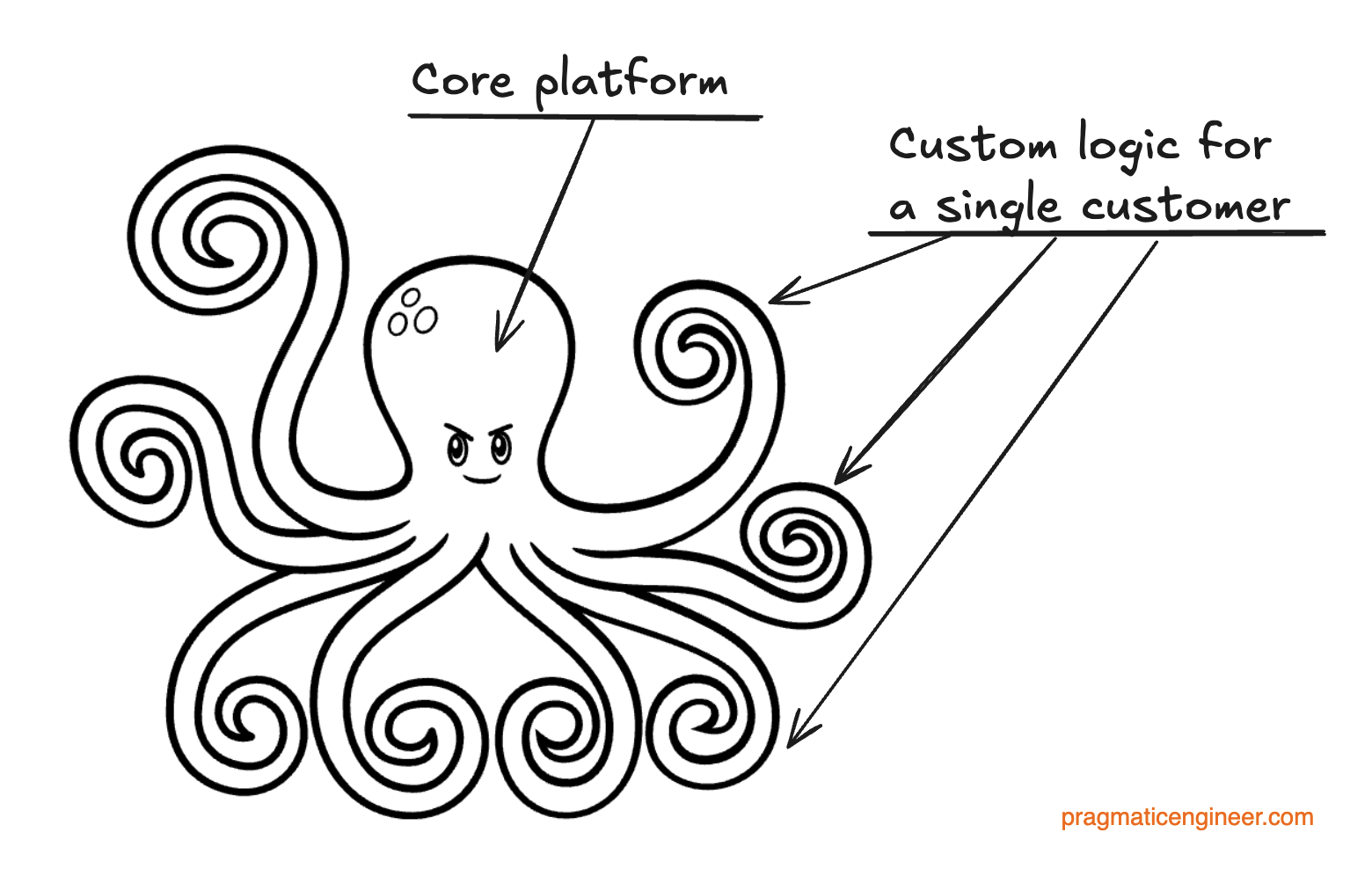
Figure: Avoiding Projects from Descending into Chaotic “Octopuses” by Pursuing General Availability (GA)
Principle 3: Fully Embrace Agility (Do More). We firmly believe we must maintain the highest-frequency iteration cadence and delivery momentum, especially amid complex warfare conditions tightly coupled with the client frontline, where requirements are often highly volatile and fraught with uncertainty, making frontline feedback incredibly precious. In engineering advancement, over-pursuing perfection is the enemy of efficiency; continuously rolling out incremental micro-deliverances effectively eliminates internal friction and vastly consolidates combat morale.
Principle 4: We Win When Our Customers Win. The standard for measuring team success or failure is absolutely not how many code features we helped the company ship, but rather how much substantial success we achieved for our clients. Sometimes, we help break through impasses through solid engineering assault; other times, the most brilliant victories actually come from using minimal—or even zero—code cleverness to turn danger into safety.
Why Are FDEs So Hot Right Now?
Truly integrating Large Language Models (LLMs) and frontier AI technologies into enterprise-level real-world business is the core driving force propelling the FDE role to explode across the internet this year.
Although superficially connecting to an LLM seems to require merely calling a few lines of API code, the vast majority of large traditional enterprises remain utterly baffled about how to effectively harness these new models. To make AI truly operate and generate productivity, it demands massive, rigorous engineering system support: building quantitative evaluation systems, cleaning and reconstructing data flows, establishing guardrail mechanisms, optimizing latency and costs, bridging classified authentication… For non-tech-native traditional enterprises, these engineering challenges are akin to insurmountable quagmires.
Faced with this brutal engineering gap, traditional enterprises urgently need software vendors to dispatch full-stack engineering experts on-site to anchor operations and lead assaults. At this juncture, FDE teams capable of stationing on the frontline to troubleshoot stubborn ailments become the decisive trump card for alleviating corporate doubts and facilitating major contract signings.
Meanwhile, Palantir’s astonishing commercial results and sustained profitability displayed in capital markets over the past two decades have also thoroughly awakened the Silicon Valley tech circle. The industry suddenly realized that Palantir’s profound moat and commercial barrier constructed relying on the FDE knife-strike in defense and large government/enterprise sectors is exactly the core cipher behind its status as a perpetually victorious giant. This powerful demonstration effect is driving a wave of AI startups and B2B tech nobles to compete in imitating this organizational model.
The Essential Differences Between FDEs, Solutions Engineers, and Agent Engineers
In the traditional context of enterprise software, the “Solutions Engineer (SE)” role has existed for a long time, but compared to it, FDEs demonstrate significant divergence across several core dimensions:
First, traditional solutions architects largely fall into pre-sales support or technical consulting attributes. As Colin Jarvis recalled combining his own experiences working at a public cloud giant: Traditional SAs rarely write code directly on clients’ real production infrastructure; they usually tune models using offline desensitized data or build Demo demonstrations in sandboxes. In contrast, FDEs must go deep into the frontline, directly writing actionable business code on clients’ production environments and existing tech foundations.
Second, FDEs are absolutely not “Professional Services” in the traditional sense. In many companies, solutions engineering is often a clearly priced paid consulting project billed to clients by man-day or hour. However, tech giants like OpenAI firmly refuse to let FDEs degenerate into commonplace mass-market outsourcing services. Colin revealed that merely three months after OpenAI established the FDE function, onsite requests from clients exploded. The team faced a difficult choice: ride the trend and recruit hundreds to do outsourcing, or maintain strategic restraint?
Ultimately, OpenAI decided to restrain scale, aligning FDEs tightly with core underlying research and product evolution directions. This means the team must apply ruthless strategic filtering to clients: only when major clients present business challenges sufficient to approach or even shatter existing model capability limits will the FDE team deploy fully and launch joint assaults.
On the other hand, accompanied by the AI Agent explosion wave since 2024, the market has spawned another highly similar brand-new role: “Agent Engineer.” For example, AI unicorn Sierra, founded by former Salesforce Co-CEO Bret Taylor, focuses on building white-label customer service AI agents for enterprises and pioneered introducing the Agent Engineer function within the industry, assisting clients in deeply integrating its Agent OS platform into their tech stacks:
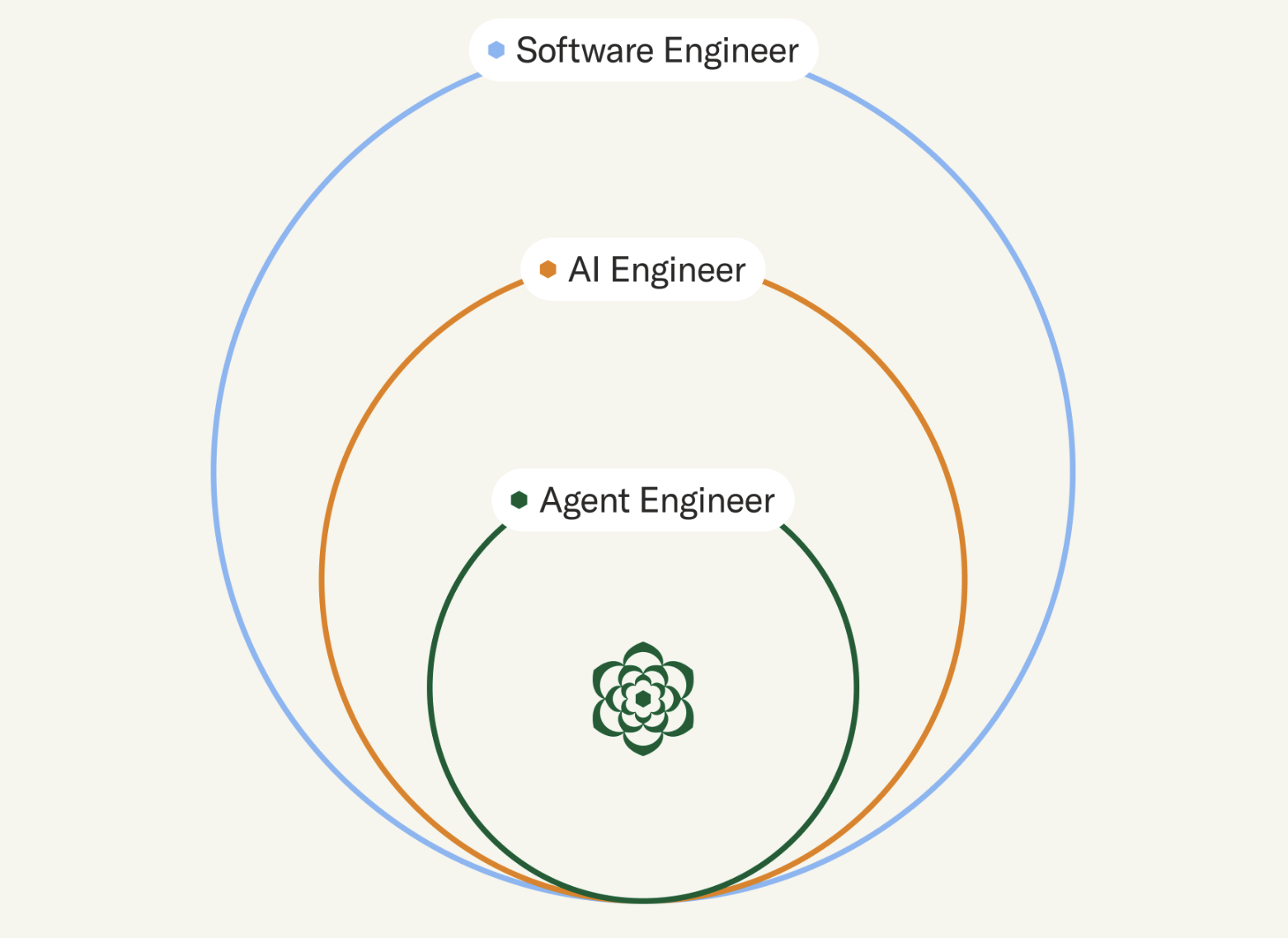
Figure: Intersection Positioning of Agent Engineers in Software Engineering and AI Engineering (Source: Sierra AI)
These engineers tailor-fit agents to match specific scenarios for clients, requiring deep mastery of LLM principles, vector databases, prompt engineering, Agent orchestration architecture, and other foundational AI engineering skills. Simultaneously, they must also personally hook agents up to client systems to ensure stable production performance, and feed distilled toolkits back into public bricks for the core platform. It can be said that within the AI track, “FDEs specializing in AI” and “Agent Engineers” have already highly converged in their essential connotations.
FDE Career Development and Growth Paths
How to Recruit and Identify Top-Tier FDE Talent
Ramp Forward Deployed Engineering Lead Leo Mehr meticulously reviewed the three core traits they value most when recruiting and screening FDEs:
• Extreme subjective initiative and work ethic: This is the most crucial preliminary signal for predicting whether a candidate can stand out in the FDE trenches. Quoting Meta’s current Chief AI Officer Alexander Wang (founder of Scale AI): “Hire people who genuinely care deeply about winning or losing and throw themselves completely into the work.”
• Rock-solid software engineering fundamentals: Candidates must not only proficiently write code but deeply understand how to architect and build robust, highly available software systems.
• Keen customer empathy and clear communication skills: Skilled at interacting with enterprise clients, capable of asking piercing scoping questions and locking requirement boundaries, endlessly curious about client businesses, and harboring sincere empathy for user pain points.
In practical interviews, Ramp also compiled a set of highly referential positive trait signals:
• Experience as university Teaching Assistants (TA) or student club leaders: These candidates typically possess outstanding communication patience and willingness to mentor others;
• Strong “Service orientation” mindset: Genuinely enjoying the sense of accomplishment derived from helping others solve thorny problems and create value through technology;
• Founder background: Former founders are ideal candidates for this role, as they naturally possess a comprehensive technical and commercial perspective akin to a small startup team’s CTO;
• Early-stage startup practical background: Engineers who have endured struggles in dynamic, uncertain environments adapt much better to the chaos and complexity of FDE fields.
Compensation Levels and Industry Perks
On the overall compensation curve, FDE pay levels essentially match or slightly exceed those of pure Software Development Engineers (SWEs) at the same grade. Zuhayeer Musa, co-founder of the renowned compensation insight platform Levels.fyi, revealed to me: “According to our consultants in the defense-tech sector, FDE compensation bands completely mirror core R&D engineers’ salary brackets, although roles in classified defense and similar specific domains often require additional security clearance approvals.”
Referencing the latest actual compensation data samples recorded on the Levels.fyi platform:
• Scale.ai (acquired by Meta): Washington D.C. mid-level L4 FDE, annual total comp ~$286k ($185k base + ~$91k stock grants annually);
• Windsurf (acquired by Google): Full-stack Forward Deployed Engineer, annual total comp ~$255k;
• Ramp: L3/entry-level FDE base salary typically ranges between $150k and $200k, higher tiers command higher baselines attached to extremely generous early-stage equity grants;
• Palantir: Traditional base salary range typically falls between $135k and $220k, complemented by highly flexible long-term stock incentives as core wealth levers.
Worth emphasizing is that although FDEs work closely with sales on the commercial frontline, they absolutely do not receive floating commissions based on sales quotas. This ensures that the engineers’ interests are tightly bound to software quality and the robustness of the underlying long-term architecture, preventing over-promising to clients or hastily patching together low-quality code solely for short-term sales splits.
Career Advancement: The Golden Incubator for Future Entrepreneurs
Regarding career promotion ceilings, former Palantir senior FDE Anjor Kanekar provided a vivid summary based on his 7-year military-like tenure:
Under Palantir’s cherished flat culture, FDEs exhibit exceptional career elasticity and exceptionally broad evolution tracks: Some grow all the way into top-tier product leaders controlling the company’s lifeline (for instance, the current helmsman fully commanding Palantir’s core flagship products Foundry and Gotham started as an FDE); Some ascend to become vertical domain masters overseeing hundred-billion-dollar traditional industry accounts like healthcare, pharma, and finance; Some become strategic stewards handling top-tier core accounts; Others forge the purest path to becoming top-tier Technical Experts (ICs).
More notably, the FDE role has been universally acknowledged across Silicon Valley as the “West Point Military Academy” for nurturing future startup founders. Within Palantir’s alumni network, FDEs who independently founded their own tech companies are numerous; Ramp similarly actively recruited several former founders into this squad. As Ramp’s Forward Deployed Engineering Lead Leo Mehr bluntly stated: “We pour all our strength into recruiting the smartest batch of top talent in the world. Personally, I am completely at ease expecting that they will likely deepen their roots at Ramp for 2 to 4 years, after which many of them will branch out to found their own great enterprises.”
Core Insights and Future Outlook
Looking across the current industrial landscape, despite the market uniformly labeling them under “FDE,” three distinctly different forms with unique missions have clearly differentiated beneath the surface:
Type 1: Assassin-Type FDE Penetrating Traditional Camps (Exemplified by Palantir). Primarily targets government agencies and slow-paced traditional legacy enterprises. For traditional clients unable to recruit top-tier product engineers, software vendor-dispatched FDEs fill critical engineering skill gaps, puncturing bureaucratic barriers with fierce geek spirit to accomplish system deployment.
Type 2: Agent Engineers Based at Frontier AI Vendors (Exemplified by OpenAI, Sierra AI). LLM technology is brand new and obscure, with deployment rife with high ambiguity. This cohort of engineers not only master LLMs, vector databases, and complex Agent orchestration, but also arrive onsite to bridge real business scenarios, distilling frontline-honed evaluation systems and orchestration architectures into the official core toolkit.
Type 3: B2B Tech Expansion Pioneers Accelerating Enterprise Mega-Deals (Exemplified by Ramp). Closely collaborating with commercial expansion, deeply embedding complex commercial platforms into the business territories of major clients, and precisely extracting high-dimensional abstractions during assaults to continuously strengthen the universal product foundation.
The Forward Deployed Engineer (FDE) role is undoubtedly a hardcore position demanding extremely high comprehensive qualities from developers. It perfectly fuses two weighty roles: rooting oneself in the trenches to solve clients’ actual business pain points on one hand, and continuously feeding engineering assets back into the company’s underlying core products on the other.
The enormous gift contained within this challenge lies in: it tempers all-around hybrid skills capable of birthing future tech-business empires, and for ambitious developers, opens up a golden career leap passage combining technical depth and business vision in a rapidly evolving AI era.