IOSG: Why "Coin Stock Memes" Can Never Replicate GameStop's Short Squeeze?
By Mario Chow@IOSG
In January 2021, retail investors managed to squeeze out GameStop’s short sellers because the float was fixed, meaning there were no extra shares for shorts to borrow and return. It was only resolved when Robinhood shut off the buy button.
Five years later, a wave of meme coins has emerged on Robinhood’s own chain, with their pricing assets not being USD but tokenized stocks of real public companies. $BONER is priced against Hims & Hers, $MEME against AMC, and $AI against Nvidia. The narrative remains the same: short squeeze. Buy up the coins, drive the tokenized stock price higher, and force the institution maintaining the peg to buy actual shares in the secondary market.
We reconstructed the minting and burning records for all tokenized stocks on this chain. To sum it up in one sentence:
On-chain prices can indeed be pushed up, and quickly. But the issuer subsequently patches it back down, usually within an hour.
Here are four specific findings.
Money does reach New York. Over that AMC weekend, Robinhood’s issuing agent bought and custodyed approximately $7.6 million worth of actual AMC stock in the secondary market, accounting for 7.6% of pre-market volume during its busiest stretch. Therefore, anyone claiming this mechanism completely bypasses the real market is wrong.
But the float is now alive, breaking the manipulation logic right here. The same agent expanded the circulating supply of tokenized AMC 19-fold within three days, from 152,106 shares to 2,895,758 shares. For Hims, that round went from 468 shares to 130,876 shares. The issuer keeps printing beneath your feet; you cannot lock up any supply. In 2021, Robinhood blocked retail buys; in 2026, it openly sells and pockets the spread. This latter defense is far more effective.
What you get is a needle, not a short squeeze. And even this needle isn’t small: AMC peaked at +22% in pre-market trading, Farmmi surged +321% intraday, yet both reverted almost entirely within a week. A squeeze persists because covering forces further covering. Both instances faded because the very mechanism that channels funds is inherently self-shutting.
There is also a magnitude issue rarely calculated. Even targeting the cheapest underlying, pulling off a genuine short squeeze would require a $3.4 billion meme coin—thirteen times the largest project on this chain—to extract roughly a 9% gain.
It must also be clarified what is actually being bought when purchasing these coins. It is not company exposure. These coins truly price whether a company notices you. The single largest price swing in this entire saga came from a post by a CEO on Thursday evening, and Adam Aron’s stance at the time was decidedly unfriendly: he called the tokens disgusting and hired securities counsel. Yet the tokens still hit seven times the stock price overnight. The real payoff here is corporate attention, and it pays regardless of whether that attention is benevolent or hostile. The short squeeze narrative sells a different return, which mathematically never materializes.
On the tokenized stock line, the truly valuable asset is neither the meme coins nor the launchpad, but the creation/redemption channel. That is a whitelist.
The Weekend AMC Came Back
On Thursday, September 3, at 5:18 PM ET, 78 minutes after market close, AMC CEO Adam Aron posted that Robinhood’s tokenized AMC was “disgraceful, absurd, and disgusting,” stating he had retained external securities counsel.
Crypto Twitter saw something else entirely. Within six hours, two meme coins named after the tweet, $CINEMA and $MEME, began trading in pools priced against tokenized AMC. The NYSE had already closed. Yet that token, which theoretically should equal exactly one share of AMC, surged to $18.04.

The actual stock price closed at $2.54 that day. Seven times higher, overnight. The underlying is still a company whose entire investment thesis revolves around “surviving the last mania.”
At the open the next day, the premium vanished, but the process looked nothing like most people assumed. The stock spiked to $3.11 in the first fifteen minutes of pre-market trading, up 22%, then slid steadily back, closing at $2.65. Section 6 breaks this segment down. This single hour is the easiest part of the whole episode to misread.
Precisely because of this, the AMC case is so illustrative. Everything the short-squeeze theory says should happen did happen: genuine meme ticker symbols, a real CEO, a real crowd, a true decoupling, and actual buy orders hitting the tape. The stock ultimately returned to where it was a week prior.
Stock Tokens on Robinhood
Three things need introduction first, as none of them existed eighteen months ago.
Robinhood Chain is a public blockchain operated directly by Robinhood. The top hundred active pools turnover roughly $1.65 billion daily, with the vast majority consisting of standard crypto assets.
Stock tokens are issued by Robinhood Assets (Jersey) Limited and track individual US equities. Legally, they are not stocks but debt instruments that provide economic exposure equivalent to one share, backed by actual shares held in custody at a broker-dealer. In practice, one token equals one share of exposure, and licensed intermediaries (Authorized Participants, APs) can create and redeem them at fair value. It operates on the exact same mechanics as an ETF.
Launchpads refer to sites like long.xyz, where anyone can deploy a meme coin and a trading pool with one click. What changed in August is the pricing asset: previously, meme coins were priced in USD, now they use tokenized stocks. You aren’t buying $BONER with dollars; you’re buying it with tokenized Hims & Hers.
This single substitution contains the entire story because it means buying meme coins is effectively buying stocks. Your $ETH or $USDG gets swapped into stock tokens en route, causing pools to continuously accumulate shares while fees are siphoned off as stock rather than cash. Mechanically, a group of meme coin buyers transforms into a bid side for a public company’s stock.
There are now seven such stock-priced venues among the chain’s top hundred most active pools, generating combined daily volume of approximately $73 million. This is no longer a niche experiment.
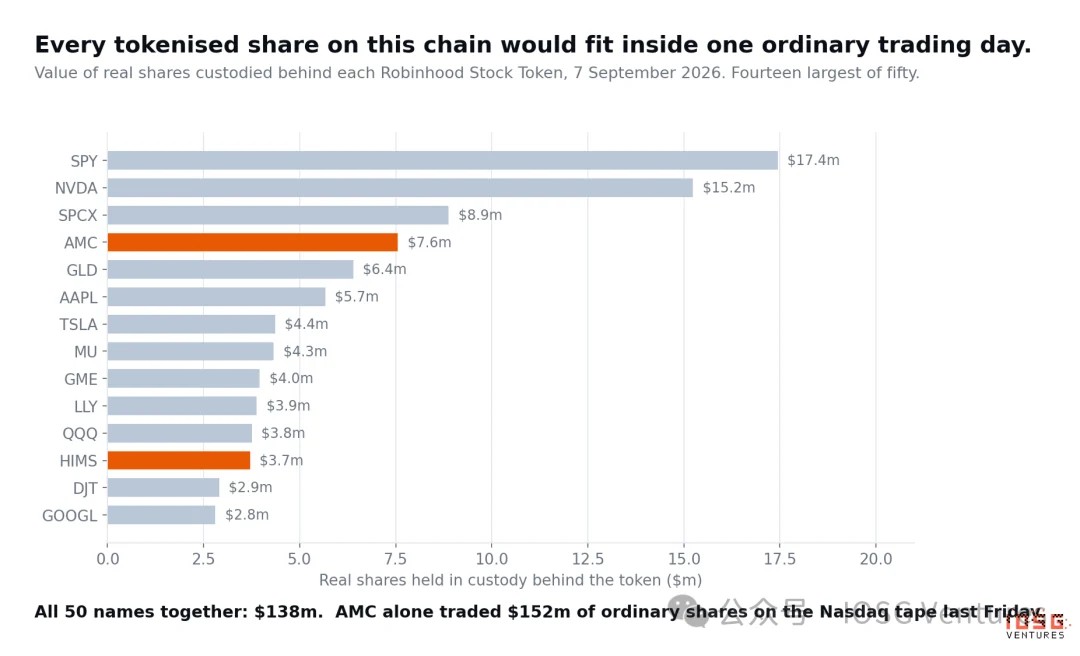
Remember one figure, as it explains most subsequent questions: behind all fifty tokenized stock targets on this chain lies roughly $138 million in actual equity. Meanwhile, AMC alone saw approximately $150 million in trade volume on Nasdaq last Friday. The entire on-chain stock market cannot match a single mid-cap stock during a busy afternoon.
The GameStop Analogy, and Where It Breaks Down
The entire short-squeeze narrative was originally forged in the fire of GameStop, so let’s get 2021 exactly right first.
GameStop succeeded thanks to a hard constraint: shorts sold roughly 138% of the float, meaning more shares were borrowed and sold than actually existed. Retail investors bought and held tight, leaving shorts nowhere to cover. The stock price skyrocketed from $17 to $483 intraday on January 28. It only ended when brokers restricted buying, with Robinhood being the most prominent example, triggered by a $3 billion clearinghouse margin call. The float was fixed; the only leverage anyone possessed was closing the door.
Swap the same scene onto Robinhood Chain.
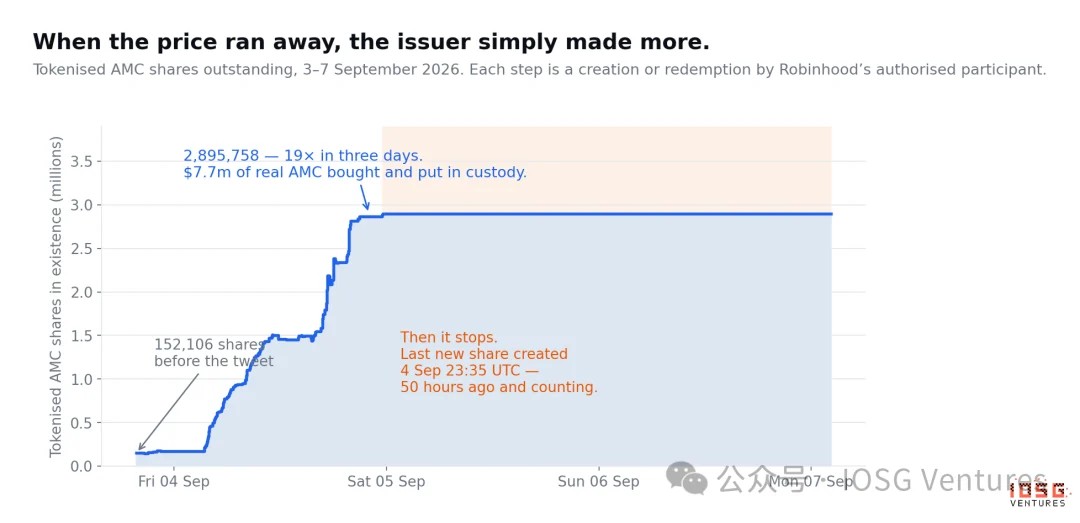
When tokenized AMC rallied to seven times the stock price, Robinhood’s issuing agent didn’t shut the door. It went out and bought actual AMC shares, placed them in custody, and minted corresponding new tokens. Over three days, it created 3.05 million shares, burned 310,000 through redemptions, and expanded the tokenized float from 152,106 to 2,895,758 shares. Seventy-two hours, nineteen-fold.
Hims tells the same story, just at a slower pace. When $BONER launched on August 20, tokenized Hims on Robinhood Chain stood at just 468 shares; today it sits at 130,876 shares, a 280-fold expansion corresponding to roughly $3.6 million in actual Hims & Hers shares bought and custodied. On September 3, we ran a test: over four days, $BONER’s share of tokenized supply dropped from 81% to 47%, while its actual token holdings increased. It didn’t lose the float; the float was diluted around it.
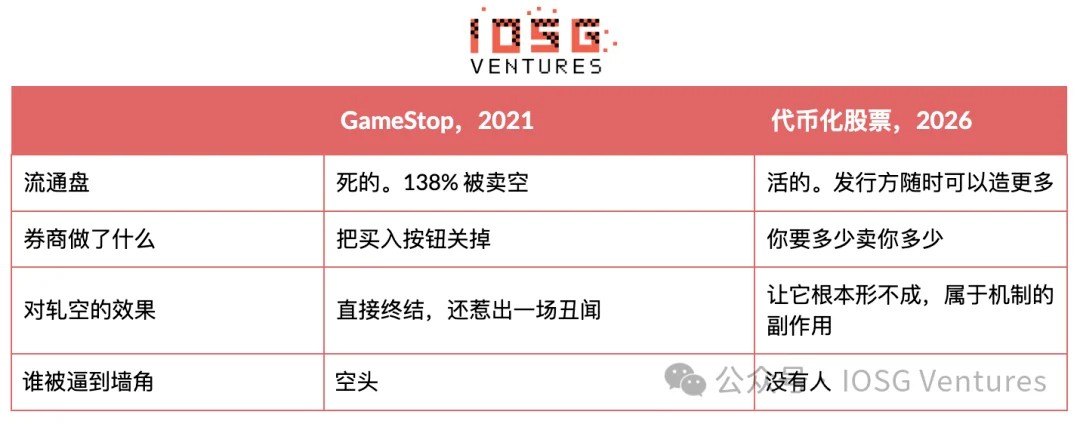
One clarification is necessary. The creation/redemption channel was not built to prevent short squeezes. It exists to ensure tokens track their underlying stocks, which is precisely why one holds tokenized stocks instead of meme coins, and operates on the exact same machinery as all ETFs. Failing to manipulate the price is merely a byproduct of the mechanism doing its job. Moreover, this outcome is vastly superior to the 2021 door-closing tactic because nobody was locked out of selling.
What Are Buyers of Meme Coins Actually Betting On?
Let’s trace the chain from the retail side. The first half holds up; skipping it would be dishonest.
You buy $MEME with USD. Routers swap USD for stablecoins, then for tokenized AMC, and finally for the meme coin. Physically, your capital becomes a bid for tokenized stocks along the way. As more buyers enter, the token price exceeds the actual stock price, creating a premium. APs seize the profit opportunity: they buy real AMC on the NYSE, deliver it to custody, receive newly minted tokens, and sell those tokens into the pool at the premium price.
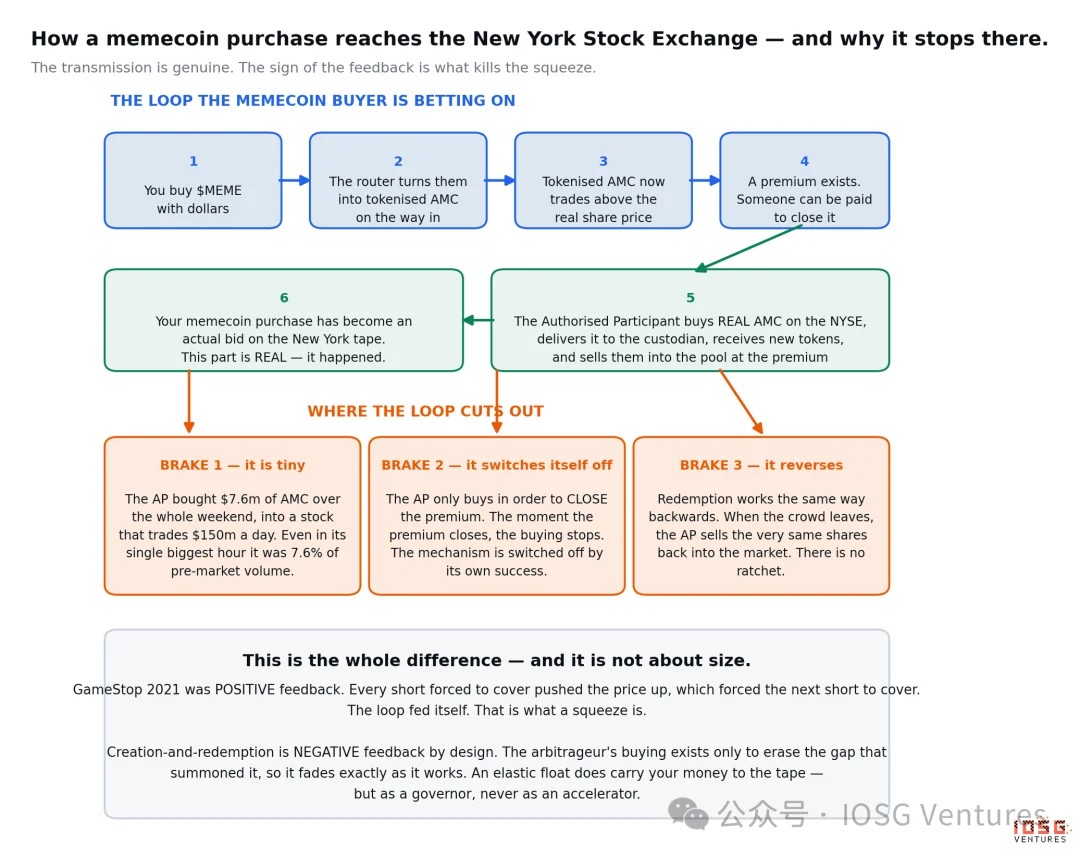
The core retail premise is correct. Crowd money does hit the New York tape as real buy orders. This isn’t theoretical; it’s $7.6 million in AMC trades over a single weekend, with peak activity accounting for 7.6% of pre-market volume.
Next comes the “flywheel” narrative: forced buying pushes the stock price higher, rising prices validate the thesis, more people rush in to buy coins, and APs must buy even more. This represents the ideal script, but it fractures at three critical points.
First, the volume is too small. $7.6 million faces off against a stock with $150 million in daily volume. Under steady-state conditions, AP footprints account for roughly one-tenth of one percent of total volume.
Second, and most critically: the mechanism shuts itself down. APs buy solely to eliminate the premium; once the premium vanishes, the rationale for buying disappears. It is killed by its own success.
Third, it is reversible. Redemption is simply creation in reverse; as the crowd disperses, APs sell the exact same batch of shares back into the market.
Line these three up, and the answer emerges regarding what fundamentally changed between 2021 and now. Size has nothing to do with it.
GameStop operated on positive feedback: every forced cover slightly lifted the price, compelling the next short seller to cover. The loop fed itself. That is the definition of a squeeze.
The creation/redemption mechanism is designed as negative feedback: arbitrageurs buy strictly to erase the premium that summoned it, so it takes effect only as it dissipates. An active float will indeed deliver your capital to the tape, but it acts as a governor, never an accelerator.
A fixed float turns buy pressure into a spiral; an active float converts the same pressure into a decaying impact cost. Both can move stock prices, but only one locks the momentum.
Put bluntly, remember this above all else: a crowd can absolutely pull up on-chain prices, and quickly. What they cannot do is pin them there, because the moment the stock market opens, APs fill the gap. The ceiling depends not on crowd size, but on how many hours remain until the channel reopens.
The one thing issuers cannot print is time. See Section 7 for details.
Who Is Sitting at the Table?
Don’t view this as a machine. Start by asking who sits at the table and what each seat profits from, making evaluation infinitely easier.
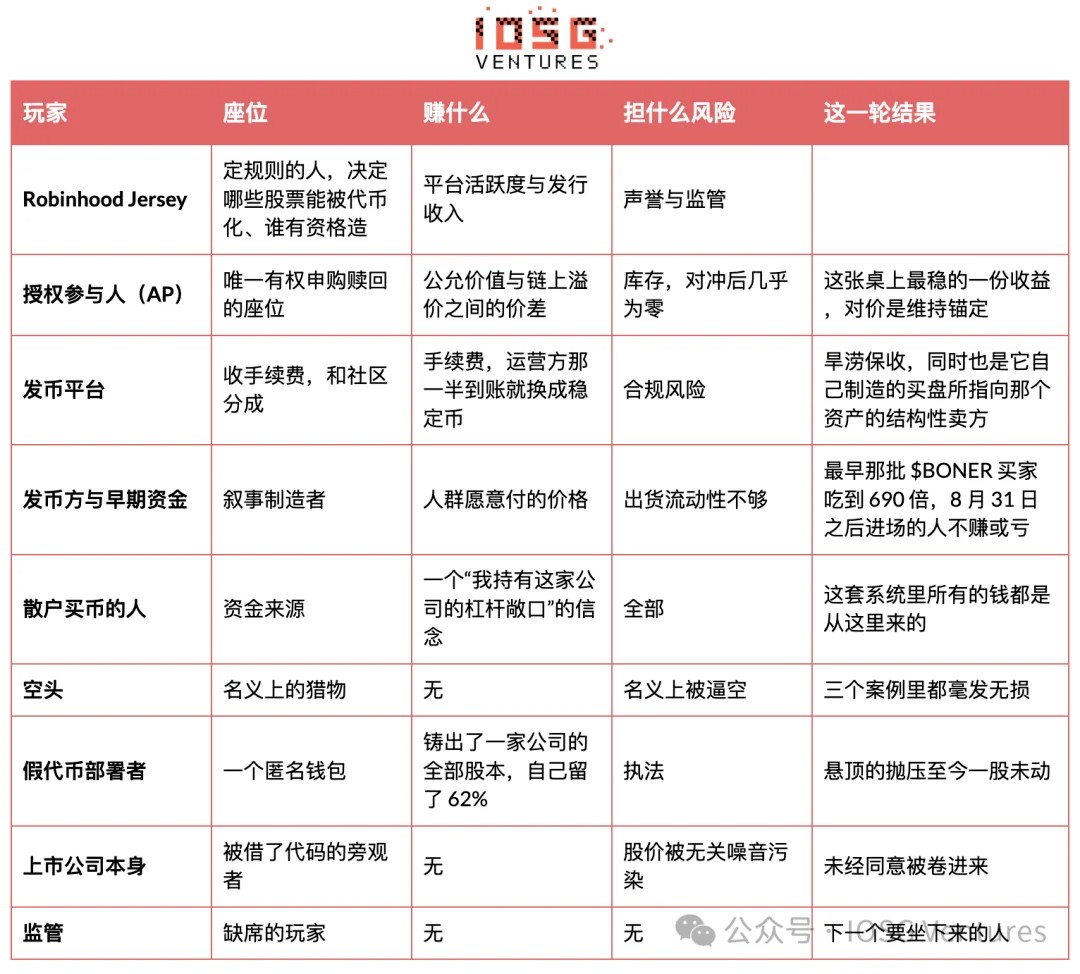
One point deserves explicit statement: Authorized Participants are the most consistently profitable actors at this table. They mint tokens at fair value, sell them into premiums manufactured by the crowd, and repurchase once the crowd disperses. Over that AMC weekend, they bought and custodied approximately $7.6 million in actual shares at prices of their choosing, facing a market willing to pay up to seven times fair value. Nothing improper here. This is a compensated role, and precisely this compensation motivates someone to operate at 4 AM. The peg holds because this trade generates profit. The only metric that matters to us is where sustainable yield originates. It originates here, not on launchpads or in the coins themselves.
The GameStop Analogy, and Where It Breaks Down
The question isn’t “Is this a short squeeze?” but rather: “Can the pricing asset be created and redeemed?”
Everything else hinges on this, as it determines whether the premium is merely a transient decoupling destined to be arbitraged away, or fundamentally the price of a distinct asset.
Genuine Robinhood stock tokens are backed by Jersey prospectuses, physical shares held in custody, dedicated series and ISIN codes for each target, and a whitelist of intermediaries authorized to create. On block explorers, their names end with “• Robinhood Token” and the exchange rate field contains a valid value.
Fake versions require only 63 lines of Solidity and roughly $400 in gas. Fixed supply, no issuer, no oracle, and the referenced backing simply states “an operational obligation of the issuer,” meaning nothing on-chain verifies it—and nothing ever could.
Both appear identical on block explorers, quoted by the same platforms, and displayed in the same wallets. The sole distinction rests in a single nullable field.
Did It Actually Move Real Stock Prices?
This section demands precision, because focusing solely on closing prices lets skeptics off too easily. By closing price alone, AMC rose 4.3% that day, appearing uneventful. But calculating from the final pre-event price to the absolute peak, including pre- and post-market, tells a completely different story.
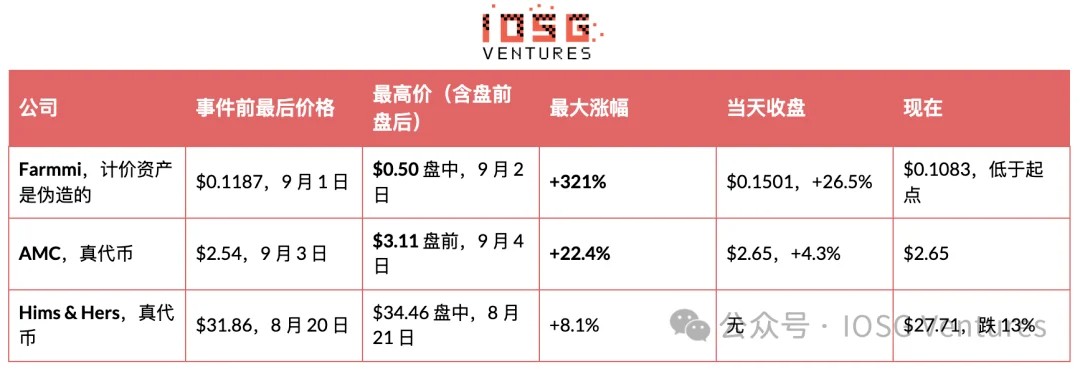
Therefore, the honest takeaway isn’t “meme coins failed to move stocks,” but rather: “they pushed aggressively, but never held ground.”
The pre-market session on September 4 best reveals how the mechanism operates, worthy of minute-by-minute review. Compare on-chain prices against Nasdaq pre-market quotes, not previous closes: At 4:00 AM ET when pre-market opened, the token traded at $4.09 against a last real price of $2.54, a 61% gap. Fifteen minutes later, buoyed by 8.35 million shares in pre-market volume, the stock hit $3.11, while the token was already sliding. Roughly half of this convergence stemmed from the stock price chasing the token, not the token correcting downward. This perfectly matches the transmission predicted by the positive-loop thesis.
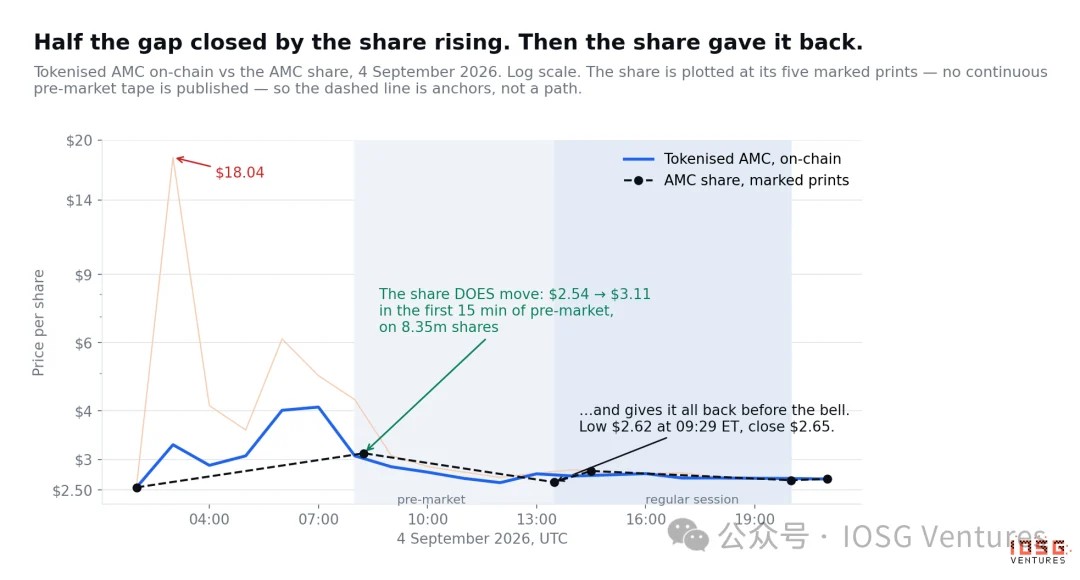
Then it stopped. By 9:29 AM ET, the stock had retreated to $2.62, with the token at $2.61. The buying spree sparked shortly after 4 AM found no second round, because the premium it chased had evaporated. The stock ultimately closed at $2.65.
Contextualize these three events historically: AMC traded 57.2 million shares that Friday, 1.9 times its average, ranking only fifteenth in the past six months. On July 20, AMC saw 186.8 million shares change hands, entirely unrelated to meme coins. Hims’ volume never deviated from normal ranges. Farmmi, however, traded 872.6 million shares on September 2 against a daily baseline of just 45,000 shares—a roughly 19,000-fold surge.
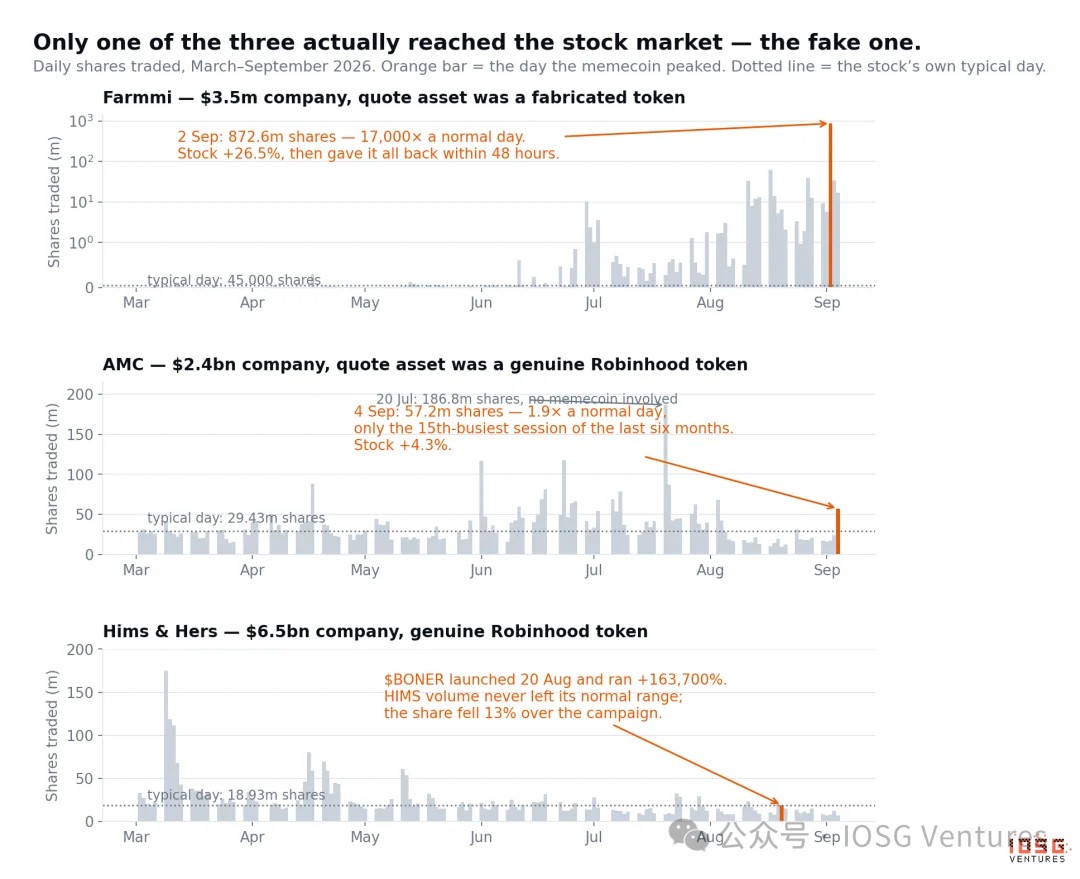
This pattern defies intuition. The on-chain venue impacted the tape most severely precisely when the company was so small that the on-chain community constituted nearly its entire market, a scenario exclusive to fake pricing assets since Robinhood refuses to tokenize sub-$1 billion market cap firms. The two companies backing genuine tokens are far too large; $3.6 million or $7.6 million in buying pressure simply cannot prop up their prices.
As for the fates of these meme coins themselves, they bear no relation to the above: $CINEMA lit the AMC fuse and is now down 93%. $MEME arrived late, inherited the crowd, and currently holds a $102 million valuation. $JINQIAN rode the only genuinely moved stock and plummeted 98%. They are attention assets; the company name stamped on the label is purely decorative.
Weekends Are the True Vulnerability, and On-Chain Squeezes Can Indeed Happen There
The actual structural weakness here lies not on the stock side, but in the mismatch where creation channels operate on New York business hours while tokens trade twenty-four-seven.
This dynamic is visible in real time right now. At the time of writing, the most recent supply increase for any Robinhood stock token (AMC, Hims, GameStop, Nvidia, SPY) occurred on Friday, September 4 at 23:35 UTC, exactly 50 hours ago. Monday is Labor Day, so channels won’t reopen until Tuesday pre-market, creating an 80-hour window: tokens trade normally while zero new issuance is possible.
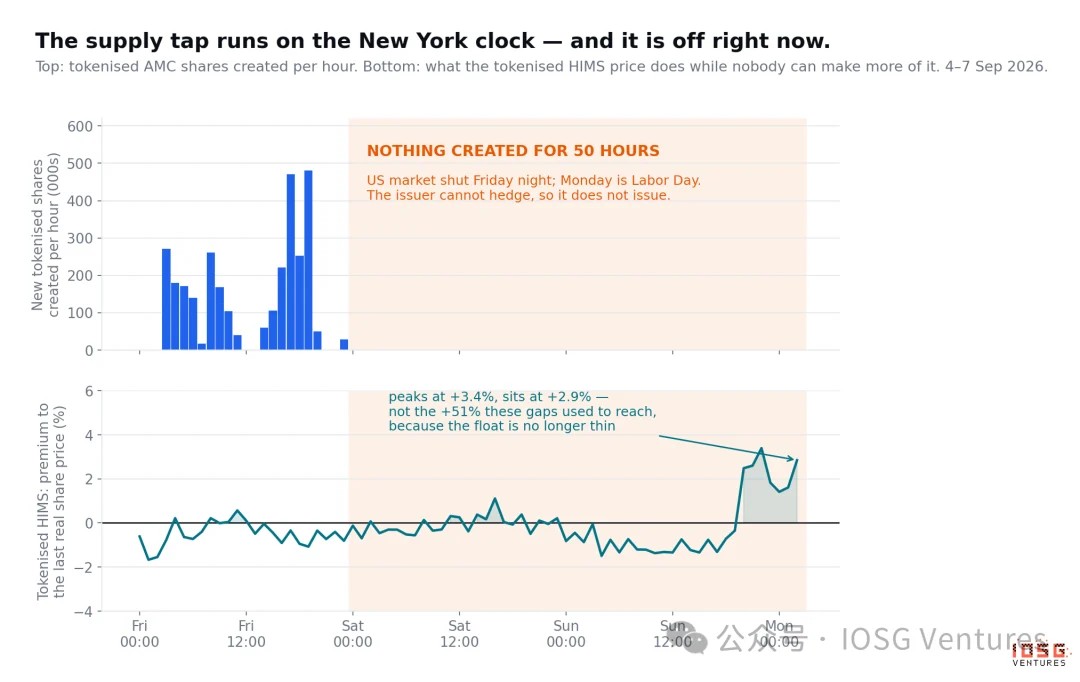
Read this alongside Section 3, and earlier conclusions require narrowing. All prior arguments stated squeezes were impossible due to an active float. But within this window, the float is not active; it is frozen. For a full three days, the supply of tokenized AMC locks tight like GameStop’s equity table in 2021, immune to whatever capital arbitrageurs might throw at it.
Thus, the honest conclusion is narrower than “nothing can be squeezed here.” Listed stocks cannot be squeezed via this channel, as detailed in Section 3. But the tokens themselves can be squeezed, exclusively within market closure windows. This is no hypothesis: the $18.04 versus $2.54 spike originated exactly like this, as did our August test recording tokenized Hims closing +51% in a single hour. Token-level squeezes are a real, recurring, calendar-driven phenomenon on this chain.
Which raises the obvious question: why isn’t it happening now?
Correctly, it isn’t, and the reason is critical. Over the entire weekend, tokenized Hims fluctuated between -2% and +4%, currently pausing at +2.9%. Tokenized AMC traded mostly at a discount, touching lows of -7%. Combined volume reached roughly $40 million, yet the peg never broke.
It circles back to that initial 19-fold expansion. After the panic, the issuer did not contract the supply, meaning the currently frozen float is deep: 2,895,758 shares, not 152,106. Thin floats have always been the prerequisite; market closures merely amplify them. By deploying three days of excess supply, APs preemptively disarmed the next three-day fuse. For an unintentional maneuver, it’s remarkably elegant.
For holders of these tokens, the practical reading is: the risk factor is the calendar, not the company. When a long weekend, a public holiday, and a dormant target with minimal recent issuance align, the relationship between on-chain prices and real stock prices weakens most severely.
Stress Test: How Big Would It Need to Be to Work?
This isn’t a playbook; it’s a ruler measuring how far this mechanism remains from “functional.” First, define two terms, as the entire argument rests on them.
Short interest represents the number of shares borrowed and sold, with sellers betting on price declines. Those shares must eventually be repurchased. This is the fuel.
Days to cover is short interest divided by average daily volume: the number of regular trading days required if shorts were the sole buyers in the market. This is the fuse. High numbers trap shorts, indicating normal volume cannot absorb them without pushing prices up; low numbers allow orderly exits through the main door.
GameStop shorts sold more shares than physically existed, making it impossible for any normal volume to flatten everyone out, hence the vertical price action. Days to cover for these tokenized targets sit between 3 and 9. Everyone walks away clean.
The ceiling is therefore mathematically capped: even if shorts across all these targets covered simultaneously, gains would barely reach 7% to 14%. None double.
Two additional metrics clarify the picture. Channel conversion rate: at peak, $BONER valued roughly $85 million, forcing approximately $3.6 million in actual Hims purchases and custody, translating to roughly 4 cents of forced buy pressure per dollar of meme coin market cap. The cost implication: driving prices to full-squeeze levels requires the channel to purchase nearly the entire short position.
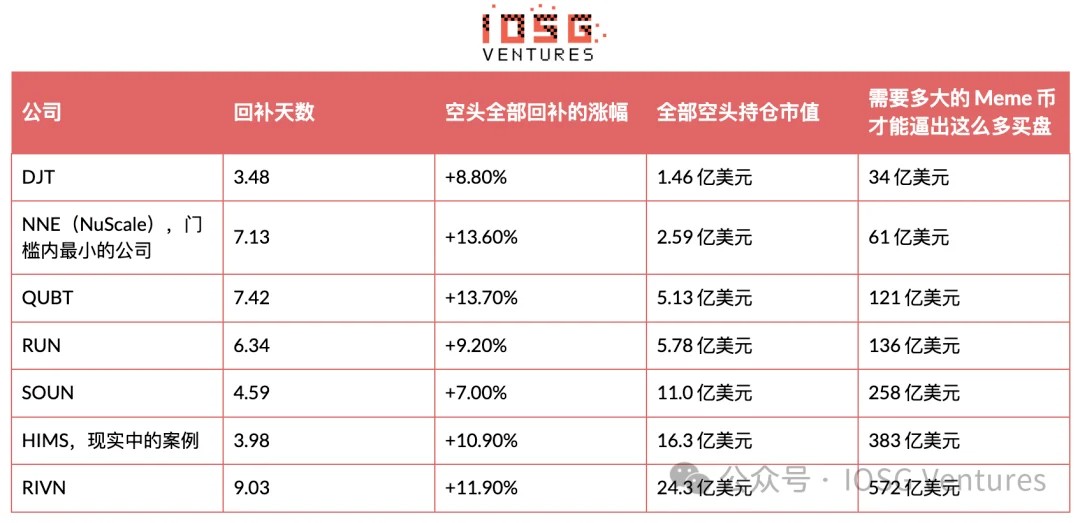
To set scale: the largest meme coin in this chain’s history is $AI at $270 million. The lowest barrier row in the table requires thirteen times that figure to extract roughly a 9% gain.
Nor are there cheap micro-caps available to exploit. The smallest company Robinhood has tokenized is NuScale at $951 million, dwarfing Farmmi by three orders of magnitude. This threshold is no coincidence: fake tokens exist because of it, and genuine tokens remain secure because of it.
Under What Conditions Would We Change Our Assessment?
If Robinhood lowers its market cap threshold or launches series for genuinely small companies. Our entire margin of safety here relies on the fact that none of the vulnerable targets have been tokenized.
Emergence of a second AP, or acceleration of the current one. Today’s premium ceiling is dictated by channel closure duration. A 7x24 creation channel would erase the final pockets of real decoupling, while slower or narrower channels amplify them.
Shift to 24-hour US equity trading, which would instantly annihilate off-hours spreads.
A dormant target colliding with a long weekend. The vulnerability noted in Section 7 is currently dormant due to increased supply, not because it was patched. A newly listed token or one with minimal recent issuance coinciding with a holiday market closure brings that 2021 attribute roaring back.
Proliferation of fake pricing assets from exception to norm. Within a single week, two clone contracts synced equity tables to five significant digits, while another spoofed ticker breached the chain’s most active venues. This category’s spread requires no permission.
What We Take Away From This
The choke point of tokenized stocks is the creation/redemption channel, not the trading venue. Downstream components—launchpads, meme coins, liquidity pools—are all substitutable and will inevitably compete into zero profit. The irreproducible seat belongs to whoever concurrently holds the issuance license, custody relationships, and AP whitelist. If we seek exposure to tokenized stocks, it resides here.
Premium discipline derives from a functioning primary market—a foundational ETF lesson revisited on-chain within a week. The median premium on tokenized Hims sits below 1%, because anyone can instantaneously mint more. The counterfeit FAMI token lacks this anchor; thus, its premium failed to converge, plunging straight through parity into a 10% discount and continuing downward. Identical curve shapes, opposite mechanisms, entirely divergent risks.
Counterfeit pricing assets represent the next regulatory flashpoint and the genuine investor protection crisis here. A token mimicking a company’s complete equity structure, backed by nothing, omitting issuers, and marketed alongside legitimate securities to retail is not an edge case; it has surfaced twice and is spreading. It costs $400 to build and is indistinguishable from real securities on any consumer-facing interface. This warrants raising with Molly to determine if further commentary is needed.
This fundamentally redefines what these coins actually are. They are not leveraged exposures to public companies. During trading hours, the underlying asset explains merely 1% of the coin’s volatility, containing virtually no corporate linkage. They resemble wagers on corporate attention: Will the CEO notice? Will the company respond? Will this ticker get swept into a narrative large enough to force headquarters to weigh in? This bet has paid out. Aron’s aforementioned post initiated the single largest price swing in this report, while the Hims & Hers CEO also followed the $BONER account. Neither endorsed anyone; attention alone commanded payment.
Short squeezes form the other leg of the narrative. It is the sold-off component, and the one that fails under scrutiny. Buyers of these coins should at minimum understand which leg they are genuinely long.
Finally, retain the framework that endures. A short squeeze is not about “gaining more”; it is about “momentum feeding itself.” Tokenization activates the float, transforming what would otherwise form a spiral into a decaying impact cost—tangible, measurable, and extinguished before noon. The precise characteristic that makes tokenized stocks robust infrastructure is exactly what renders them squeeze-proof. It yields favorable outcomes for Robinhood, serves as expensive tuition for all who purchased the narrative, and simultaneously reminds us: monitor the issuance layer, not the trading architecture grafted upon it.
Join TechFlow official community to stay tuned
Telegram:https://t.me/TechFlowDaily
X (Twitter):https://x.com/TechFlowPost
X (Twitter) EN:https://x.com/BlockFlow_News
 IOSG Ventures