The 26-Year Evolution of Social Trading
Written by: JamesX
The first study to quantify this action came from a public chat room called Activetrader. Researchers preserved chat logs from 2000 to 2003, identifying nearly nine thousand trades involving 676 traders. Participants used nicknames to report what they had just bought or sold, and the system recorded the message timestamps down to the minute. Researchers later found that once a buy or sell signal appeared in the chat room, subsequent orders were more likely to move in the same direction. The probability of moving in the same direction increased by 40.7%.
Following was still quite cumbersome back then. When one person posted an order, another would have to switch to their own trading software and re-enter it. Between these two steps lay several minutes and a whole set of judgments. Readers found it hard to verify whether the poster actually executed the trade or how large their position really was. Followers saw just a single post but bore the full risk to their own accounts.
Today, opening the FOMO app compresses this entire workflow into a smartphone screen. Users can view public trades and historical performance, follow a specific trader, and tap into the asset page to place an order after receiving a notification. What once spanned chat rooms and trading terminals now requires only a few taps.
The changes over these past twenty-plus years revolve around how trust and execution are distributed. Early users relied mainly on nicknames, screenshots, and collective memory. Later, platforms connected to real accounts and began automatically placing orders for followers. CEXs incorporated traders into leaderboards and profit-sharing systems. With FOMO, public trades, on-chain wallets, and feeds are linked together, though final confirmation for each trade typically remains in the user’s hands.
The closer technology gets to actual trading, the more concrete the controversies surrounding Social Trading become. How returns are calculated and what kind of risk reward systems rank leaders determine who users see first. Once signals enter an account, latency, slippage, and fees cause the same directional signal to yield different results. How platforms monetize and how regulators assign responsibility all ultimately converge on one question: after a user hits 'follow', whose decisions do the subsequent ones truly belong to?
From Activetrader to FOMO, products have consistently shortened the distance between two actions: seeing someone else's trade and changing your own capital. The shorter the distance, the more obvious the convenience, and the less time followers have left for their own judgment.
Trading records become content first

Figure 1 The advanced trading floor of the New York Stock Exchange in 2001. Trading had entered the screen era, and public discussion and personal live trading records began transitioning from offline to online.
The early internet did not invent copy trading out of thin air. Tips shared in brokerages, stock recommendations in newspapers, paid newsletters, and TV market commentary had already been doing similar things. The internet changed the speed, and also changed who had the opportunity to become a signal provider.
In chat rooms and forums, an ordinary trader could continuously publish their own moves. They didn’t need the title of a fund manager, nor did they need to persuade a media outlet first. If a few judgments happened to be accurate, their nickname would get remembered. Others would start asking what they should buy next, willing to pay for faster information, or simply copying their trades.
This kind of 'live trading' has a strong sense of immediacy. Once positions are opened, prices quickly give answers. Yet there is still a gap between immediacy and authenticity. Posters can cherry-pick trades they want to show, making winning tickets look great in isolation, while losing positions sink to the bottom of the chat history. Position sizes are even harder to gauge. Earning 30% with a hundred-dollar trial position carries vastly different risk than leveraging most of an account.
A verifiable live trading record must at least include entry times, fill prices, position sizes, and exit records. It also needs to account for deposits, withdrawals, and unrealized losses. Without these, equity curves can easily be made to look impressive. Forums at the time couldn’t verify things for readers, so reputation relied mainly on continuous posting, collective memory, and how long a nickname persisted.
Covestor, launched in 2007, took a step forward. It connected users’ online portfolios to real brokerage accounts, pulling trading records directly from data sources. Reports showed that within months of launch, the managed capital across connected accounts had reached $100 million. This number itself does not represent investment performance. The value of this product shift lies in the recording method: traders lost one more opportunity to cherry-pick screenshots, and observers could see a more continuous history.
In 2008, Stocktwits started as an application built on Twitter, organizing market discussions using cashtags (a dollar sign followed by a ticker symbol). When users talked about Apple and typed $AAPL, the system aggregated related posts. It made scattered discussions searchable, allowing traders to track sentiment shifts around assets. Orders remained within brokerages, separating content from execution.
Early Social Trading was driven by two types of products. One enabled traders to speak, while the other proved they had actually acted. The former brought social connections and virality, the latter provided continuous records. It wasn’t until platforms began routing trade signals directly into accounts that the next phase began.
Systems begin placing orders for followers
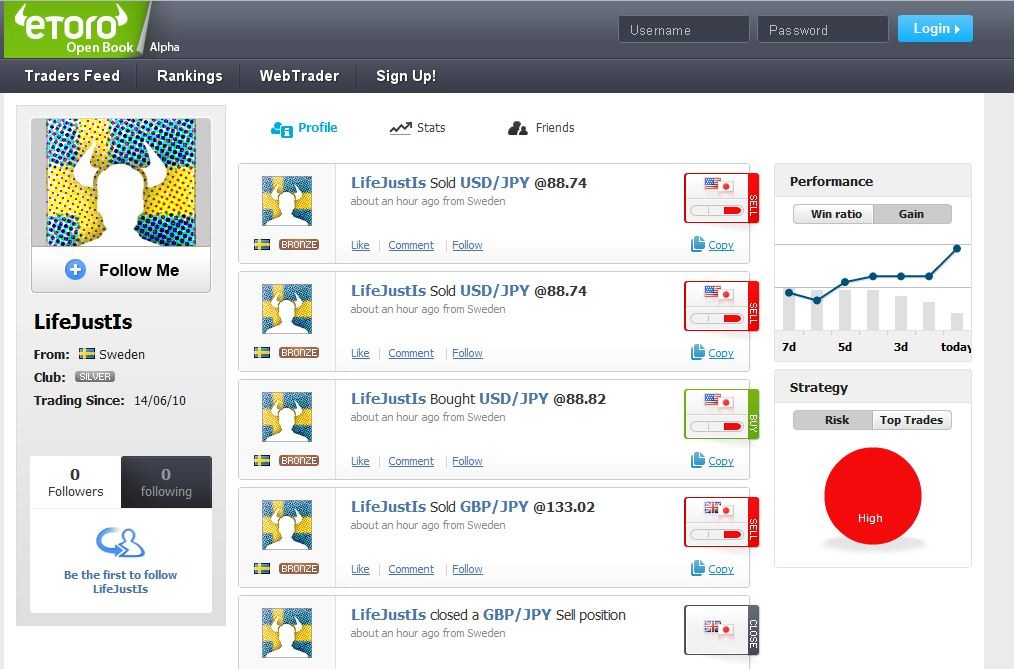
Figure 2 An early interface of eToro OpenBook in 2010. Activity feeds, risk metrics, returns, and copy operations were already consolidated onto a single page. Historical screenshot sourced from Finance Magnates.
Copy trading first developed rapidly in the retail forex market due to highly practical conditions. Forex markets operate for extended hours, instruments are relatively standardized, and direction, size, and stop-losses easily translate into machine instructions. With numerous retail traders already using desktop terminals, signal services only needed to resolve account connectivity and order forwarding.
Founded in 2007, ZuluTrade’s early model centered on forex signal providers. Traders supplied signals, subscribers chose whom to follow, and the system copied trades to brokers linked to subscribers’ accounts. Academic literature often places ZuluTrade at the starting line of social trading platform history. This 'first' must still be used cautiously. Depending on whether you define it solely by automated copying or require concurrent features like feeds, public identities, and user interaction, the pioneer label shifts accordingly.
eToro launched OpenBook and CopyTrader in 2010. OpenBook integrated traders’ profiles, activity feeds, and follow relationships into investment products, while CopyTrader let users replicate selected traders’ actions. Its impact on later products was profound. Signal providers were no longer just rows of return numbers on a list; they gained avatars, viewpoints, and followers, accumulating a public identity within the platform.
A study spanning June 2010 to October 2012 analyzed over 28.5 million trades from 81,300 real-money traders on a major online social trading platform. Within the sample, independent trading accounted for 31.8%, individual Copy Trades only 0.6%, and Mirror Trades 67.6%. Mechanical mirroring already exceeded two-thirds of all trades. While many still picture Social Trading as exchanging viewpoints, that dataset points elsewhere: communication rapidly evolves into execution.
In 2012, MetaQuotes embedded Trading Signals directly into MetaTrader 5, followed by support for MetaTrader 4. Users select signals within the terminal, subscribe for a fee, and subsequent trades are automatically mirrored by the terminal. Providers charge monthly subscriptions. Platforms offer growth charts, account balances, instrument distribution, and buy/sell ratios, later adding Equity charts that factor in unrealized P&L, marking the boundary before and after account monitoring integration.
These features seem mundane today, but they solved genuine problems back then. A sudden deposit boosts the balance without increasing trading capacity. Looking solely at balance curves, deposits are mistaken for profits. Even when open positions sit at heavy floating losses, realized gains can still look attractive. MetaTrader’s introduction of more comprehensive statistics aimed precisely to patch the earliest flaws exposed by leaderboards.
Automated copying introduced new engineering challenges. If a provider trades EURUSD, a subscriber’s broker might list the same instrument as EURUSD.m. Minimum lot sizes, leverage, and quoting conventions may differ. Once signals transmit, the system must handle instrument mapping and position conversion. MetaQuotes later built a virtual hosting network close to broker servers to reduce latency. Although users click subscribe just once, a full infrastructure stack operates behind the scenes to keep both accounts as synchronized as possible.
This structure quickly solidified. Platforms host Signal Providers offering trades and Followers replicating them. Traders collect subscription fees or profit shares, followers receive automated execution, and platforms control rankings and connectivity. Though names like Lead Trader, Master Trader, and Copy Trader on modern CEXs have shifted, the underlying role dynamics remain largely unchanged.
Leaderboards produce selectable experts
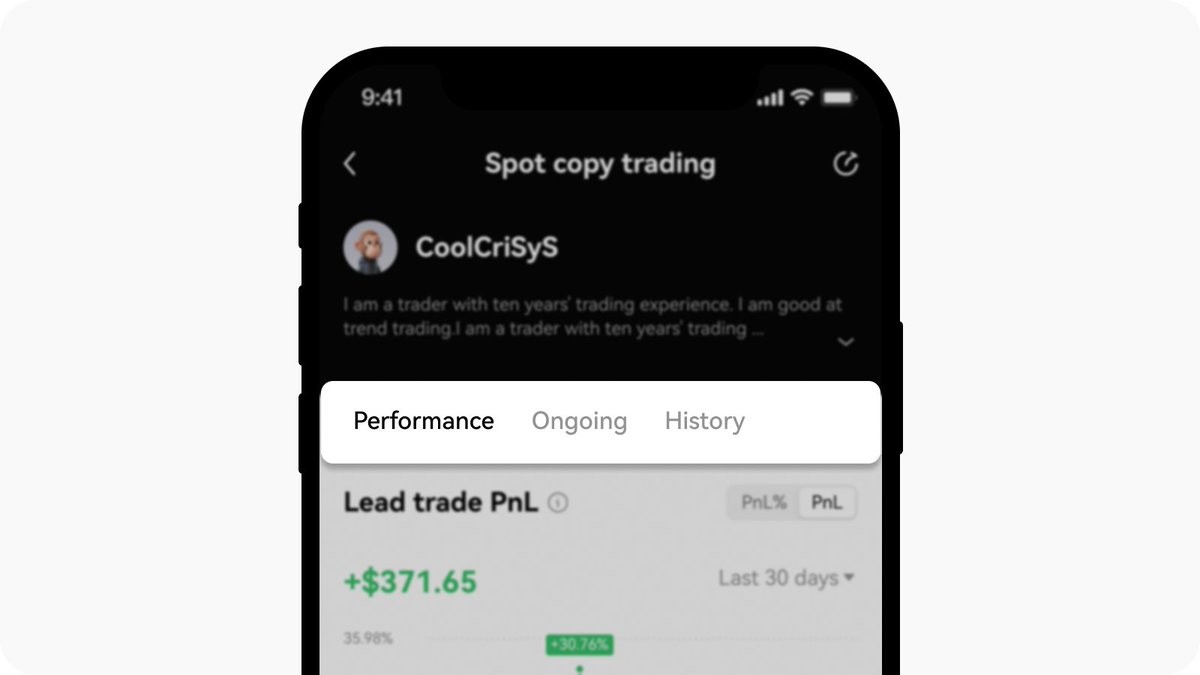
Figure 3 The trader performance page for OKX spot copy trading. Returns, history, and current trades are compiled into comparable metrics. Figures shown are interface examples and do not represent average returns. Source: OKX Official Help Center.
When platforms host thousands of traders, users’ first problem fundamentally shifts. They no longer struggle to find someone to follow; instead, they face difficulty deciding whom to choose.
Leaderboards provide the easiest answer. Those with the highest recent returns sit at the top, with total profit, ROI, win rate, maximum drawdown, and follower counts displayed alongside avatars. Complex strategies are compressed into a few comparable numbers. Glancing at the ranking, new users easily feel a sense of certainty: the number one spot must at least trade better than number one thousand, right?
This assumption is often too hasty.
Imagine two traders both earning 30% in a month. The first uses low leverage, with a peak drawdown of only 6%. The second nears liquidation multiple times, suffers a 70% max drawdown, and finally bounces back on a heavy bet. On monthly ROI alone, they are identical. Factor in drawdown and position sizing, however, and followers face two entirely different outcomes.
Win rates can also deceive. A strategy wins nine times consecutively, gaining 2% each time, but loses 30% on the tenth; the win rate still sits at 90%. Total PnL is capital-dependent. A trader with $100,000 making 5% earns more in absolute terms than a small account doubling its balance. Twenty-four-hour leaderboards favor short-term explosions, while annual lists tend to retain those who survive long enough. Users only see survivors; accounts that blow up and drop off the board are rarely counted again.
Numerous studies have examined such issues. Empirical analysis of two social trading platforms revealed that simply buying the highest cumulative return trader yields poor results. Performance improves slightly when risk metrics like the Sharpe Ratio are factored in. Once trading costs are accounted for and tested against common asset pricing models, the following strategies in the research show no stable abnormal returns. Neither follower count nor allocated capital forms a reliable crowd wisdom signal.
One study used trading records and social connections from a Chinese social trading platform to observe signal followers. Findings indicate that higher trading frequency and high-volatility stock preferences spread along social networks. Subsequent trades heavily influenced by social learning underperform compared to those closer to independent decision-making.
Laboratory experiments yield similar results. Participants witnessing the fastest wealth growth on a leaderboard mimic their bids, even though those leaders hold no additional info, and wealth growth alone doesn’t prove trading skill. Another copy trading experiment found that merely displaying others’ successes increases participants’ risk-taking; adding direct replication functionality amplifies this effect further.
These materials do not prove that copy trading inevitably leads to losses. They demonstrate that leaderboards excel at highlighting recent standout winners but cannot independently prove the sustainability of their edge. The less information a platform displays, the more likely users are to substitute ranking for judgment.
Leaderboards also reshape traders in turn. Someone originally trading with their own money faces consequences limited to themselves. Once they gain followers, short-term ROI buys higher rankings, which attract more copiers and profit shares. A steady 8% return strategy might trail behind someone doubling up heavily. Platforms don’t force anyone to take risks; the incentive structures already map the direction onto the page.
Crypto brings signal providers into exchanges
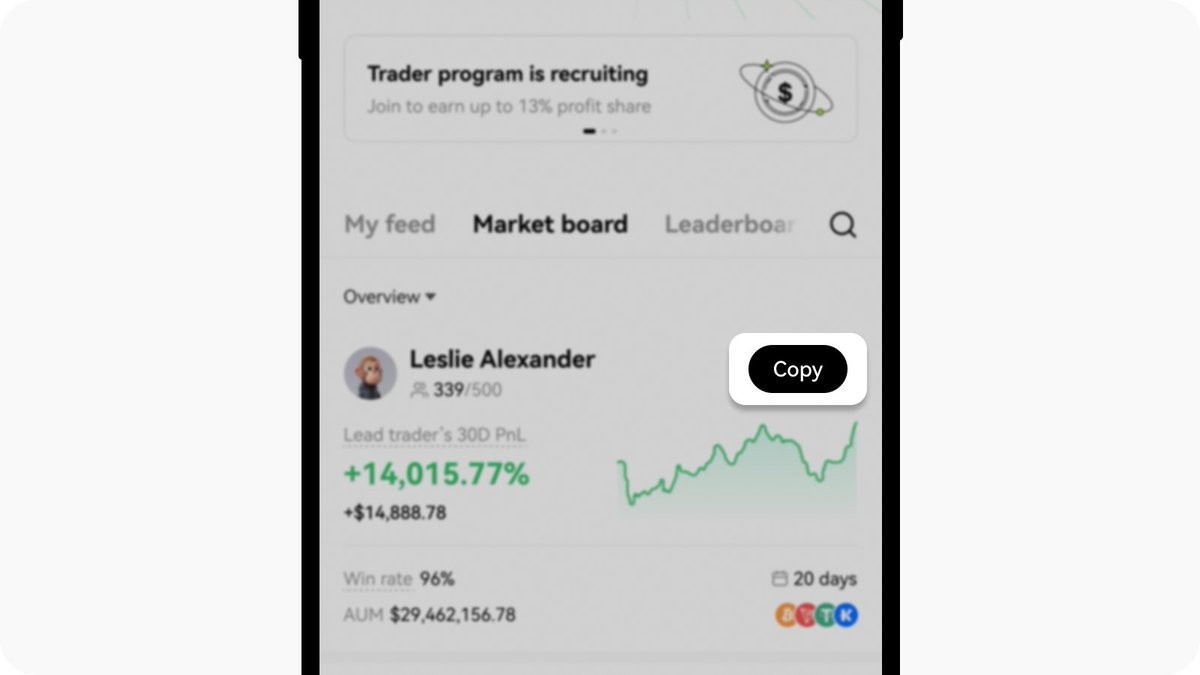
Figure 4 CEXs consolidate trader PnL, win rates, AUM, profit sharing, and copy buttons into a single product architecture. Accounts and returns shown are interface examples. Source: OKX Official Copy Trading Guide.
Crypto is highly conducive to the copy trading business. Markets run 24/7, new tokens constantly emerge, and rallies/fades often complete within hours. Perpetual contracts pack long, short, and high leverage into a single account. Traders habitually communicate on Telegram, Discord, and X, so once a viewpoint drops, readers can immediately open an exchange.
Early crypto copy trading thrived outside exchanges. Group admins broadcast entry prices, stop-losses, and targets, with users executing manually. Free groups attract audiences, paid groups sell faster signals, and exchange affiliate links payout based on user volume. In this model, admins hope signals appear effective while simultaneously wanting members to trade more. These interests sometimes align, but frequently clash.
CEXs moved this relationship in-house, solving several friction points. Trade records originate from the same exchange, allowing platforms to auto-calculate returns. Entries and exits happen internally, so signals no longer need to bridge chats and trading software. Followers can set allocation amounts, ratios, and stop-losses. Traders gain homepage exposure and profit sharing.
Bitget officially claims it launched One-Click Copy Trade in 2020, describing it as the first such offering from a mainstream crypto exchange. This 'first' stems from Bitget’s own statement, suitable for charting its product timeline rather than serving as industry consensus. By 2021, Bitget was openly recruiting global copy traders. The role became formalized: traders applied for status, adhered to platform rules, and managed their leaderboard performance.
OKX followed a clear two-step rollout. In May 2022, it debuted a Social Trading page letting users inspect portfolio compositions, trade histories, PnL, and risk levels of top performers. Users were primarily observing then. In January 2023, OKX launched Copy Trading globally, enabling real-time replication of Lead Trader positions. Spot copy trading followed in November 2023.
Binance announced via official event notices in August 2023 that copy trading was live, allowing providers to share profits and commissions. Spot copy trading officially launched in May 2024, letting users allocate fixed amounts or percentages. Bybit structured independent sub-accounts, tiers, and profit splits around Master Traders and Followers. Other exchanges later expanded offerings to cover spot, derivatives, and bots, transforming copy trading from an optional page into a permanent entry point.
This wave of product expansion reshaped the signal provider’s identity. Once messaging in external groups, they now function as an exchange-supplied resource. Exchanges constantly seek individuals with proven track records willing to showcase performance. Providers supply both trades and content/user acquisition. Funds and volume generated by followers further boost their tier level.
Platforms, providers, and followers thus form a revenue-sharing structure. Followers pay standard trading fees, plus funding rates on perpetuals. After profitability, providers claim a cut of the profits. Under 2026-era publicly archived rules, Bitget caps profit sharing for various tiers between 10% and 20%; Bybit’s standard Copy Trading tier ratios historically ranged 10%–15%. OKX adjusts proportions dynamically by product and tier. Exact figures update periodically, but the structural relationship remains stable: traders earn a share upon profitable executions, while platforms collect fees per trade.
This distribution model attracts skilled traders willing to go public while rewarding high frequency and visibility. A low-turnover strategy executing ten trades yearly generates minimal fees for the platform. Conversely, another executing dozens of daily entries/exits drives massive volume regardless of modest net returns. How rankings calculate and traffic distributes directly dictates which trading styles dominate visibility.
The same signal cannot replicate identical return curves
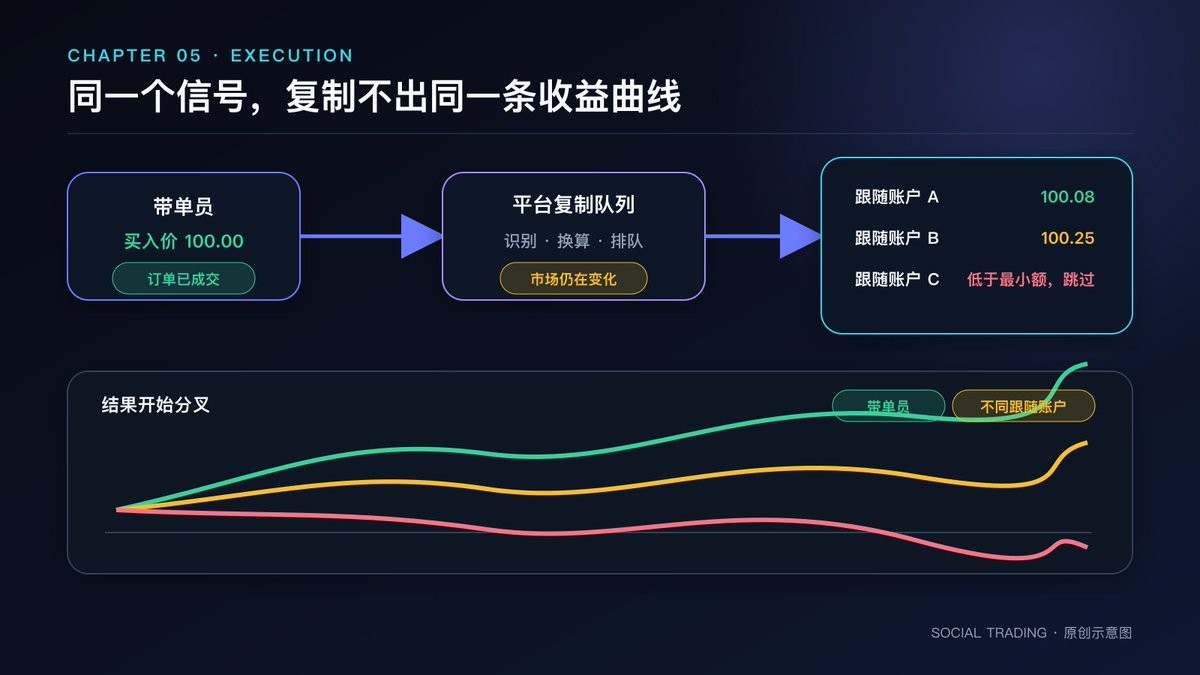
Figure 5 After a provider’s order fills, it still passes through platform recognition, position conversion, and follower queueing. Even with identical directions, execution and results can diverge.
Copy trading feels intuitively simple. Provider buys, follower buys. Provider sells, follower sells. Since both perform identical actions, returns should approximate each other.
Actual execution stretches far beyond that sentence.
Providers submit orders first. After fills, platforms flag them as copyable, generating orders for a batch of follower accounts. Market prices continue shifting throughout this pipeline. With sufficient liquidity, seconds of delay barely matter. But if a trader buys illiquid altcoins backed by massive copier funds, the follower orders themselves push prices upward.
Once entry prices differ, subsequent return curves immediately diverge. OKX help docs previously noted that if a follower’s fill deviates beyond a threshold, copying halts. This safeguard shields users from egregious slippage but means follower accounts miss certain trades. The provider’s complete record and the follower’s filled set are no longer identical.
Position conversion introduces further deviation. A provider with $10,000 risking 10% opens a standard position. A follower allocating only $100 calculates a proportional order potentially below minimum lot size. Systems round up, truncate, or skip entirely. Differing leverage and margin modes across accounts also yield distinct liquidation thresholds.
Timing of entry matters equally. If a trader holds an already profitable position, new copiers joining mid-strategy can either sync at current market prices or mirror only future trades. Syncing late means chasing proven gains; mirroring selectively fails to fully replicate the original strategy.
Exits amplify crowding. Providers sell first, dragging prices lower as follower orders cascade in. In thin markets, latecomers secure the worst fills. While the provider’s dashboard shows profit, followers deduct slippage, fees, and profit shares, leaving minimal returns or outright losses.
Perpetuals add funding rates. If providers and copiers open positions across settlement intervals, funding obligations differ. Larger provider accounts absorb deep drawdowns; smaller accounts hit margin limits sooner at identical percentage allocations. Automated copying transmits direction, but not capital base, costs, or risk tolerance.
Users can obviously intervene manually: exit early, adjust stops, or pause copying. Each intervention distances outcomes further from the provider. Platform controls are beneficial, yet the word 'copy' easily blinds people to these structural differences.
Profit sharing also carries temporal accounting methods. Exchanges typically withhold portions upfront on winning orders, offset them against subsequent losses within settlement cycles, then disburse net shares to providers. Bitget integrated High-Water Mark mechanics in 2026 to prevent duplicate payouts on the same equity swing. Rules grow increasingly granular because early per-trade deduction models frequently allowed providers to skim shares despite overall follower losses.
Walking through the entire process clarifies the core issue: providers merely set a decision starting point. Followers’ outcomes traverse signal latency, market depth, and account constraints. After stripping fees, the historical curve on screen serves only to understand the trader, never as a direct guarantee of future follower returns.
Regulators begin questioning who decides for users

Figure 6 ESMA released a Copy Trading regulatory briefing in 2023, discussing business classification, disclosure, suitability, remuneration, and conflicts of interest. Source: ESMA official documents.
Early Social Trading was often packaged as a neutral tech tool: platforms feed signals, users pick whom to follow, and PnL stays within their own accounts. As automated execution proliferates, this defense crumbles. After hitting 'auto-follow', every subsequent trade triggers from another human’s actions. This pipeline closely mirrors delegated portfolio management.
The UK FCA issued copy trading guidance in 2015, classifying automated copying without explicit manual input by the account holder under portfolio or investment management discussions. Service nature shifts dramatically when users execute each trade personally. This distinction captures social trading’s most critical boundary: are users consulting information, or delegating consecutive decision-making to others?
The EU’s ESMA addressed legal classifications for automated signal execution as early as 2012. In 2023, it published a 25-page Copy Trading regulatory briefing requiring case-by-case assessments. Who supplies signals, who executes orders, commercial ties between providers and platforms, and whether users must still act on each trade—all these details alter service classification.
ESMA’s scope is broad. Platforms displaying potential returns must prominently feature associated risks. Fees require pre-trade disclosure and potentially post-trade aggregation. Platforms must verify target user categories and assess comprehension. When providers earn compensation, platforms manage conflicts of interest and continuously audit trading activities.
In 2024, IOSCO bundled Copy Trading, Mirror Trading, and Social Trading under 'online imitation trading practices'. The report notes frequent links to short-term, high-risk strategies, particularly in forex and crypto. Retail users may auto-copy without grasping leverage or costs. Providers appear as successful figures online, yet credentials and track records often lack independent verification. When financial influencers promote these tools, boundaries blur between informational content, advisory recommendations, and commercial advertising.
These regulatory texts address fragmented jurisdictions and cannot dictate national legal rulings directly. Collectively, they raise a product-level question: having the trade button inside a user’s account doesn’t guarantee decision liability remains theirs. The deeper the automation, the harder platforms defend their characterization as neutral display screens.
Crypto CEXs face compounded complexities. Followers typically replicate high-leverage perpetuals amidst 24/7 price swings, while platform services carry geo-restrictions. The same product may operate freely in some nations yet vanish entirely elsewhere. Seeing global leaderboards doesn’t guarantee local access to identical products, dispute channels, or legal protections.
Regulatory scrutiny signals Copy Trading’s maturation. When early chatrooms failed, users could only blame themselves for misreading messages. Once platforms curate traders, arrange rankings, automate execution, and participate in profit splits, their influence embeds itself into every operational layer.
On-chain wallets become new live-trading IDs
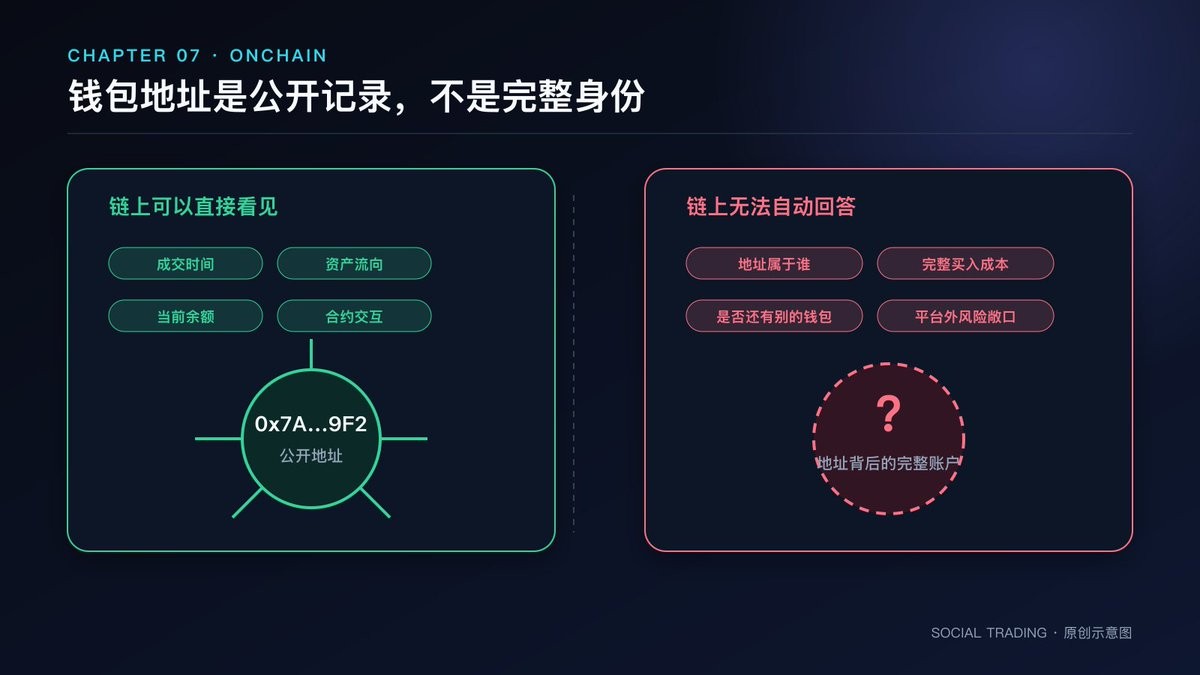
Figure 7 Blockchains reveal fill times, balances, asset flows, and contract interactions, yet a single address cannot reconstruct a trader’s full identity or complete risk exposure.
Blockchain provides an alternative data layer for Social Trading. What an address buys, transfer timestamps, and current holdings are typically queryable from public ledgers. Traders need not manually upload screenshots; third parties can trace activities directly via addresses.
This is easily oversimplified as 'on-chain total transparency.' Assessing the actual degree requires closer inspection.
Block explorers confirm transaction existence, listing senders, receivers, smart contract calls, and token transfers. They cannot identify the humans behind screens or aggregate cross-chain and exchange holdings. Single entities fragment across numerous addresses; corporations route hundreds of users through shared custody structures.
Wallet analytics platforms inject context into raw addresses. Nansen’s interface supplies labels, historical balances, trade logs, related wallets, and PnL. It maintains a Smart Money classification filtering addresses by realized profits, win rates, and multi-cycle performance. These labels demystify on-chain activity for retail users but introduce new judgment layers. Profit calculation methodologies, entity clustering algorithms, and chain coverage directly determine wallet tagging.
On-chain PnL proves harder to compute than mere balance fluctuations. Receiving one million dollars in tokens could mean purchasing or simply project team transfers. Moving assets between self-owned wallets registers as zero PnL. Cross-chain bridges drain old balances while boosting new ones, falsely signaling sales when viewed chain-by-chain. Airdrops cost near-zero; OTC desks lack transparent bid prices. Without comprehensive cost bases, leaderboards showcase only fragments of reality.
Trading robots circa 2023 tightly coupled observation with execution. Binance Research’s contemporaneous analysis of Telegram Trading Bots categorized direct swapping, sniping, copy trading, and wallet tracking as standard features. Users receive Telegram alerts on specific wallet buys, clicking through to execute via their own wallets. Chat rooms reemerge, now bridged to on-chain data and execution contracts.
While resolving speed, usability barriers remain high. Users create/import wallets, fund gas, configure slippage, understand allowances, and dodge key leaks or malicious bots. Cross-chain assets lack native interoperability. USDC sitting in a Solana wallet won’t autonomously teleport to Base to purchase tokens.
Next-generation product mandates are clear: preserve on-chain asset breadth while mimicking conventional fintech UX. FOMO emerges precisely at this intersection.
FOMO packs social feeds and on-chain trading into one app
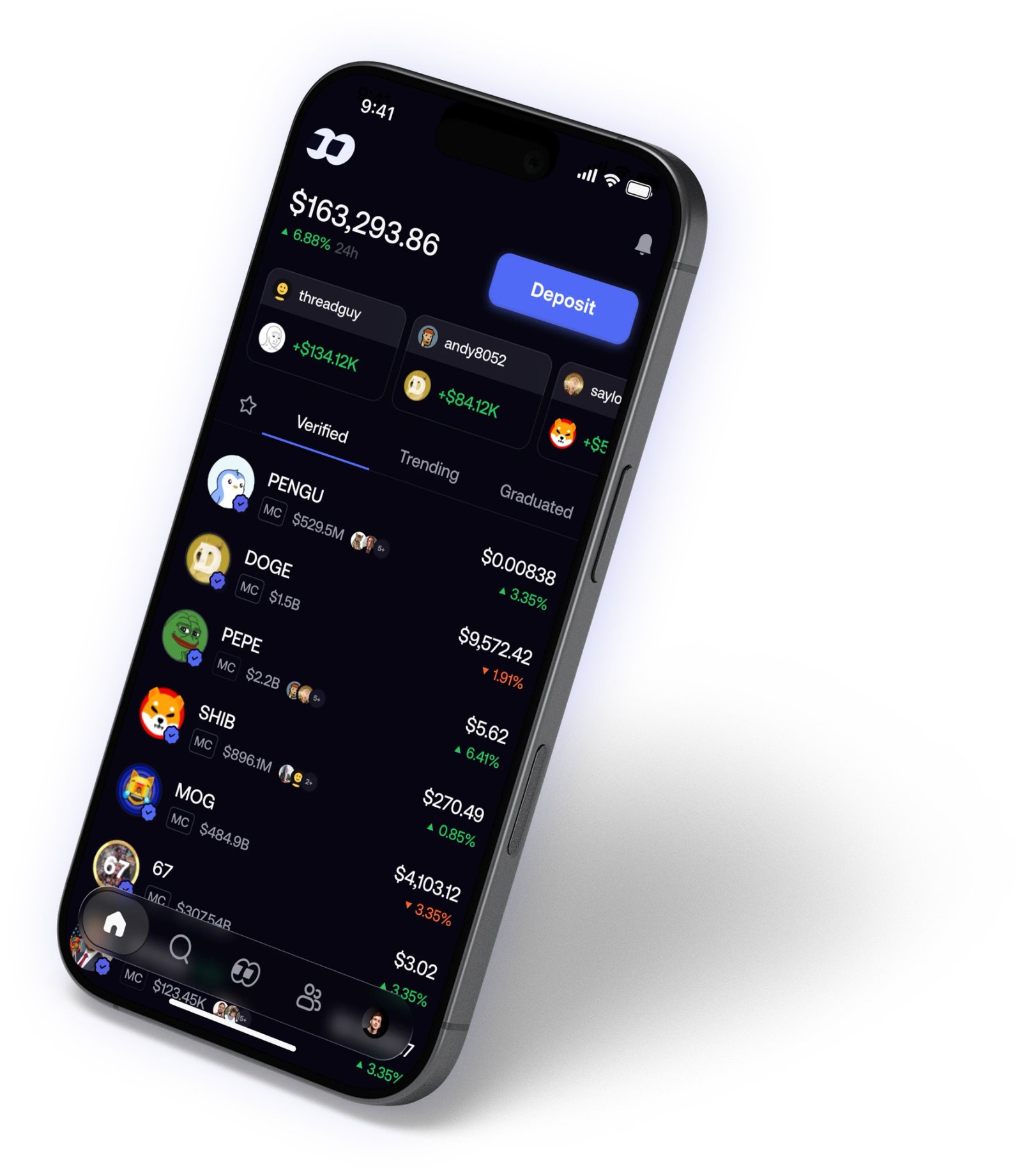
Figure 8 FOMO consolidates asset discovery, public performance, feeds, and order entry into a single mobile interface. Source: FOMO official website.
FOMO Labs announced a $2 million Pre-Seed round in February 2025. The cap table lists over 140 investors, including prominent crypto founders, operators, and traders. Three months later, FOMO launched its public beta, positioning itself as a socially prioritized crypto trading app for mainstream users. Press releases tie team backgrounds to Uniswap, OpenSea, dYdX, Square, and Google. Confirmed here is merely the company’s public personnel bios; inferring precise historical contributions from summaries remains speculative.
Initial FOMO focus centered on Solana and mobile interfaces. Users register via email or Apple ID, triggering embedded wallet creation. Funding occurs via external transfers, fiat cards, or Apple Pay. The platform unifies token discovery, peer activity tracking, and trade execution portals.
September 2025 added Base support and Friends Feed, isolating followed traders. Leaderboards and PnL began aggregating cross-chain data. October saw BNB Chain integration, introducing dynamic PnL overlays on charts and average holding durations on holder pages. Trading comments expanded to broader participants. November’s Monad mainnet launch triggered another major UI overhaul.
Product iterations and fundraising coincided. In November 2025, FOMO announced a $17 million Series A led by Benchmark, pushing cumulative capital to $19 million. At disclosure, six months post-beta, the platform processed nearly $700 million in volume, exceeding 120,000 registered users with 35,000 active traders. Weekly growth reportedly approached 10%. These figures reflect corporate disclosures detailing reported traction, not audited financial statements.
Early 2026 saw FOMO integrate standard fintech features. January added Coinbase-backed Apple Pay deposits, tax reporting utilities, and biometric authentication. Users attach personalized rationales to trades, termed 'Trade Thesis.' Following a February feed redesign, perspectives surface alongside author PnL and balances. Opinions no longer float isolated; readers instantly verify whether speakers maintain actual positions.
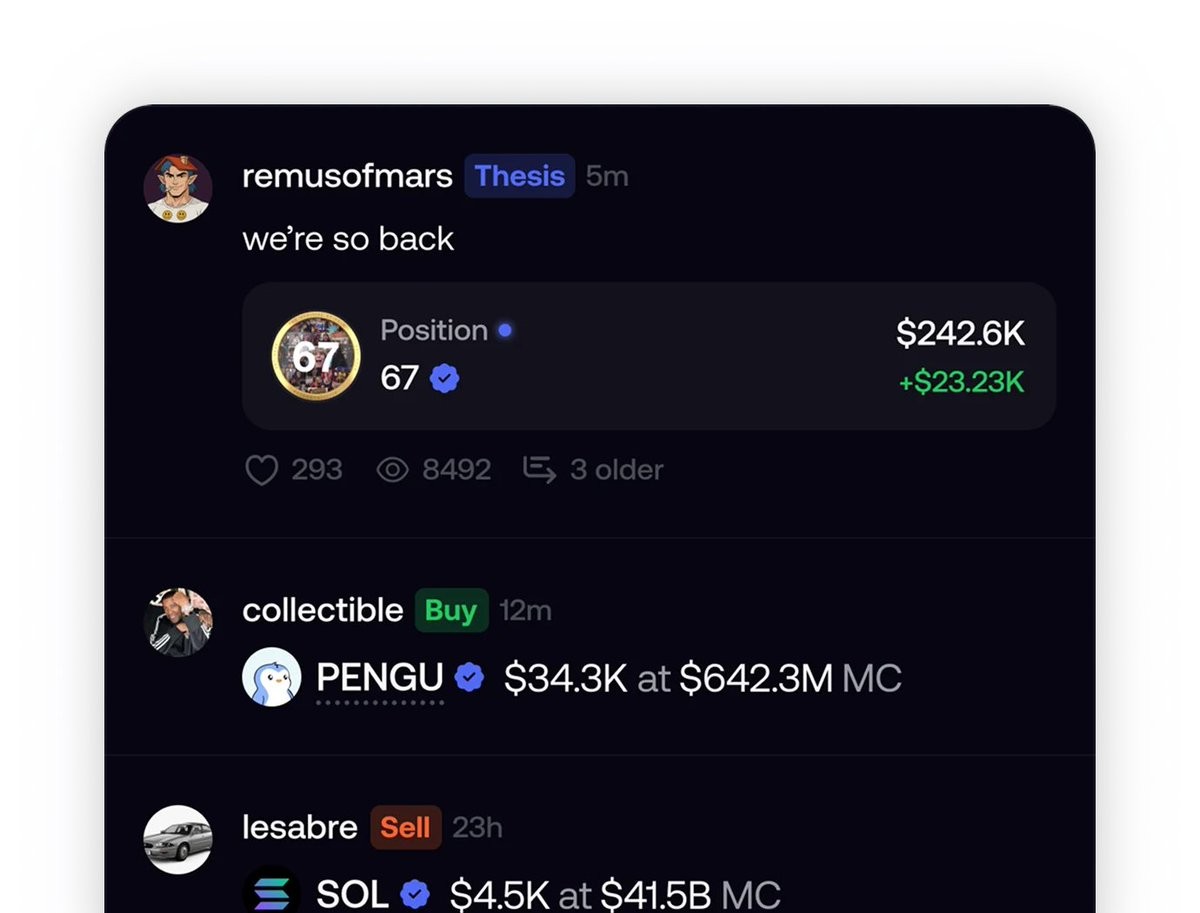
Supplementary Figure FOMO Feed simultaneously displays Thesis, position performance, and authentic trade activity. Source: FOMO official website. Accounts and trade figures serve as product demonstrations.
April embedded TradingView charts into the web client, enabling technical indicators, drawing tools, and overlaid trade activity maps. Late April marked FOMO Web’s official release. Mobile account states, balances, positions, and social graphs sync seamlessly across browsers. Boundaries between traditional terminals, social networks, and wallets erode further.
June introduced perpetual contracts backed by Hyperliquid and TradeXYZ. Initial deployments supported isolated margin, configurable take-profit/stop-loss orders, and expanded scopes covering crypto, equity, index, and commodity perps. US persons remain excluded. These instruments offer derivative price exposure, explicitly distinguishing equity perps from actual share ownership.
That same month, FOMO secured a $75 million Series B led by Index Ventures, with participation from Union Square Ventures and Benchmark. Disclosed metrics surpassed 625,000 users, $4 billion cumulative volume, and 110 million+ social interactions. An additional 68,000 users purchased crypto for $25 million via first-time Apple Pay integrations. Cumulative funding now exceeds $94 million, substantially surpassing typical wallet applications.
July onboarded Robinhood Chain, an EVM-compatible Layer 2 (Chain ID 4663) settling gas in ETH. Operated independently from Robinhood’s brokerage app, trading assets on this chain via FOMO does not link legacy Robinhood securities accounts to the protocol.
Terms of Service specify Robinhood Tokens narrowly. Issued by Robinhood Europe UAB, these constitute chain-based OTC derivatives pegged to US equities and ETPs. Access routes through Relay and third-party infrastructures. Subject to geographic restrictions, they grant no shareholder rights to underlying listed companies. Naming proximity to stocks masks fundamental legal distinctions from direct equity holding.
As of September 2, 2026, Google Play lists support for Solana, Robinhood Chain, BNB Chain, Base, Ethereum, and Monad, showing 500,000+ downloads. Official site and store metrics use different counting standards. Downloads, registrations, and active traders inherently measure distinct behaviors. The article retains source-specific terminology rather than synthesizing inflated aggregates.
A clear boundary separates FOMO Social Trading from CEX copy trading
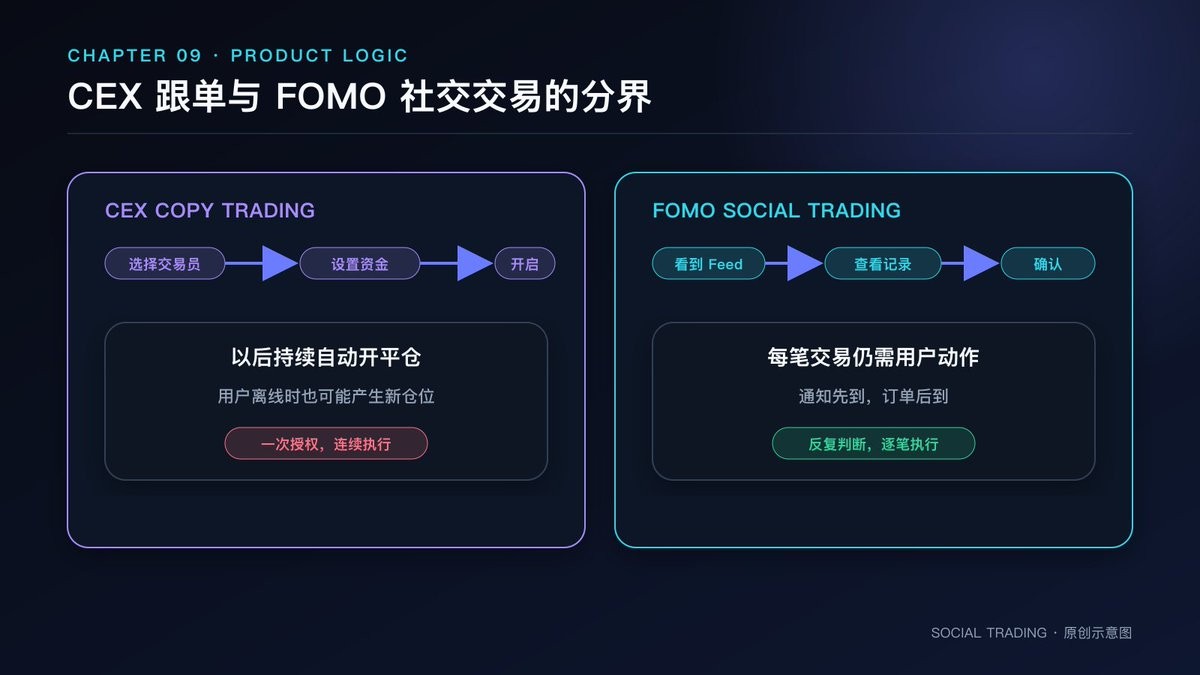
Figure 9 CEX copy trading typically auto-executes continuously after single authorization, whereas FOMO’s core social trading workflow still demands explicit user action per trade.
FOMO formally distinguished Social Trading in February 2026. It defines Copy Trading as auto-replicating another trader’s actions, surrendering consecutive decisions to systems. Its Social Trading description outlines a separate pipeline: users monitor live feeds, scan leaderboards, follow creators, receive notifications, and personally decide whether to execute.
Occasional 'copytrade' usage appears in FOMO guidelines. Detailed steps reveal users must visit trader profiles, review histories, toggle notifications, conduct independent analysis, and voluntarily proceed. Here, 'copytrade' aligns closer to colloquial 'following buys' rather than evidence suggesting spot accounts auto-mirror counterpart orders continuously.
This distinction fundamentally alters product liability and user experience.
Within CEX Copy Trading, users select providers, configure capital/parameters, and delegate continuous execution. Positions open/close while users sleep. The upside prevents missed opportunities from ignored alerts; the downside permits unverified risk accumulation overnight.
FOMO’s default flow delivers alerts first, requiring users to open asset pages, verify trader histories, confirm parameters, and finalize orders manually. Final rejection authority remains intact. Latency resurfaces, condensed from multi-minute chat-room window swaps into successive smartphone taps.
FOMO expands accessible assets beyond CEX limitations. Internal exchange traders execute only listed pairs on centralized order books. FOMO bridges multi-chain assets with decentralized execution protocols, theoretically widening discovery horizons and accelerating new token visibility. Liquidity depth and security quality vary drastically. Newly launched illiquid tokens cannot share execution assumptions with CEX-listed BTC perpetuals.
Account architectures diverge significantly. CEXs custodian user assets and reconcile internal ledgers. FOMO’s terms disclose Privy-generated embedded wallets granting users visibility and private key export capabilities. Privy documentation confirms eligible wallets support key extraction, enabling address migration across independent clients.
Exportability grants tangible sovereignty but eliminates interdependence. Email logins, seed recovery, routing logic, on-chain protocols, and fiat rails rely on disparate backend services. Users retain exit options, yet daily execution depends entirely on FOMO and its supporting infrastructure operating nominally.
FOMO optimizes unified USD balance abstraction. Users bypass per-chain gas purchases and manual bridge transfers. Relay orchestration enables this seamless UX: users retrieve quotes, Solvers execute fills on destination chains, and systems track progress via Request IDs. Applications overlay App Fees during quotation, accruing automatically.
UI consolidation masks underlying friction costs. Latest T&Cs bifurcate charges into platform fees and third-party expenses. Platform levies scale dynamically by volume, instrument, token, and routing, locking to pre-confirmation displays. Third-party components encompass pool liquidity fees, selective network gas, and expected-versus-filled price slippage. Perpetuals incur standalone 0.05% FOMO fees atop underlying protocol costs and funding rates.
Synthesizing these attributes positions FOMO as an on-chain Social Trading application. It borrows CEX-like registration flows and unified balance abstractions alongside social feed mechanics. Settlement and asset universes derive natively from blockchain infrastructure. Auto Copy Trading represents merely one latent capability; the operational axis prioritizes audience discovery preceding deliberate user execution.
When social and trading converge too tightly, feeds begin altering orders
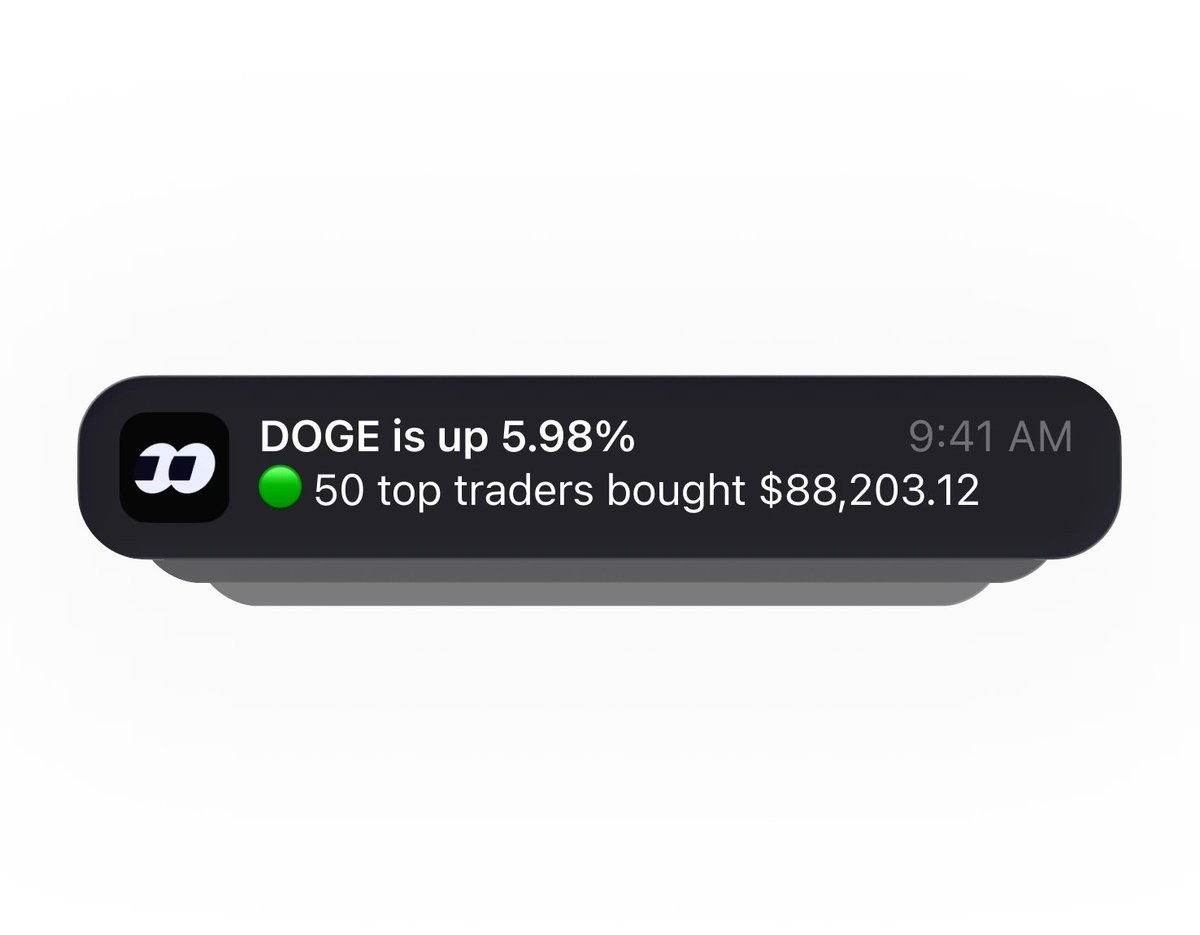
Figure 10 Notifications quantifying head trader inflows compress verified data, leaderboards, and trading impulses into singular alerts. Source: FOMO official website. Monetary figures denote product simulation.
FOMO resolves chronic crypto UX fragmentation. Historically, users spotted tokens on X, verified addresses via explorers, checked pricing dashboards, then switched wallets and DEX interfaces. Misaligned contracts or mismatched chains plagued every transition. Consolidating these surfaces into a single app drastically lowers friction for novice on-chain buyers.
Convenience carries inherent neutrality. It reduces execution errors while simultaneously compressing impulse-to-order latency.
Leaderboards highlight recent provider profits; feeds surface corresponding new accumulations. Opening the asset reveals broader expert adoption; notifications flag surging volume. Individually plausible, collectively they generate intense social proof.
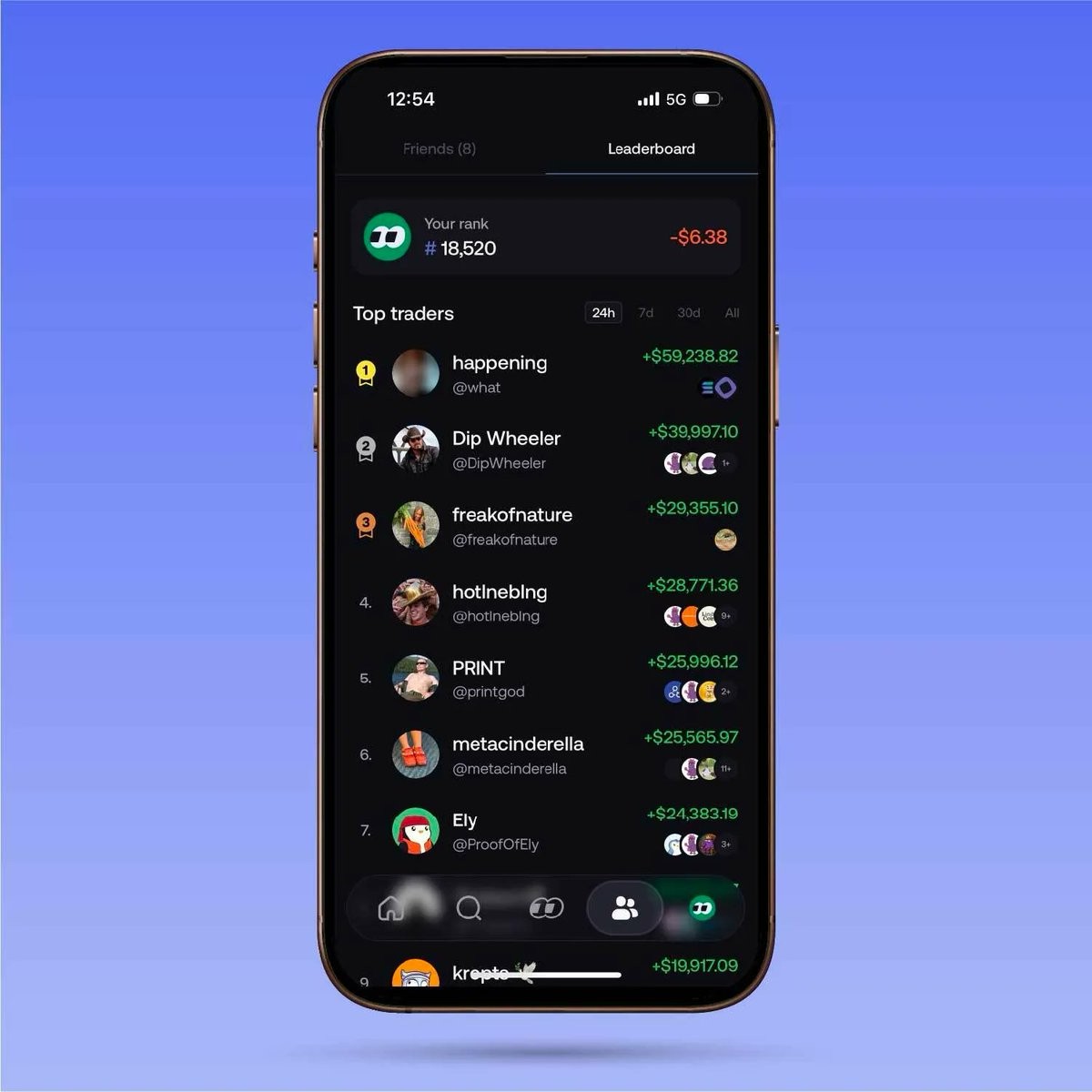
Supplementary Figure FOMO APP’s 24-hour leaderboard converts trading gains into visible identities and social standings. Source: FOMO official user guide. Rankings and values serve as product simulations.
Low-cap tokens suffer acutely from concentrated copying. Early accumulators capture depressed prices and expansive upside trajectories. Post-publication capital floods arrive, distorting pricing and slippage. Provider exits funnel copier liquidity through identical egress points. Verified early profits validate timing advantages but cannot guarantee subsequent buyers access equivalent fill prices.
FOMO’s social mechanics commodify trading performance into digital identity. Profiles broadcast PnL, balances, holding durations, follower counts, and thesis posts. Realized gains buy leaderboard visibility and audience growth. Expanded reach amplifies ideological propagation. Public ledgers check reckless exaggeration while incentivizing pursuit of visually dominant return figures.
Provider incentives diverge subtly from CEX counterparts. Centralized exchange curators extract direct profit splits, necessitating sustained AUM/follower maintenance. FOMO participants currently resemble content creators and public speculators, cultivating influence through relational networks. Structural pressures converge: steady, mediocre trades struggle for attention, while explosive short-term setups propagate organically.
App Store reviews ground promotional narratives. High Google Play ratings coexist with documented user complaints regarding mobile latency, fee structures, authentication flows, and exit UX. Others validate social discovery mechanics. Lacking standardized sampling, testimonials prevent statistical fault-rate calculations or fraud allegations. They nevertheless underscore that marketed 'one-click' descriptors catalog consumer motion, while on-chain fill velocity and outcomes endure rigorous network liquidity stress tests.
FOMO signifies a pendulum swing in Social Trading
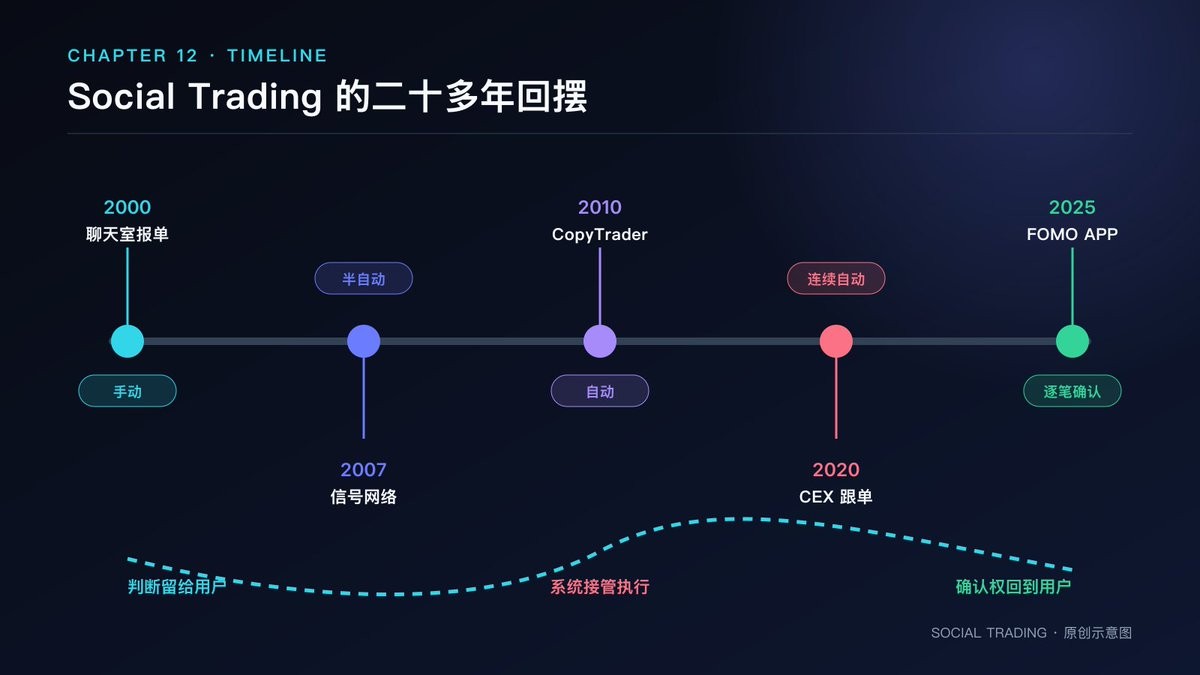
Figure 12 Social Trading never linearized toward total automation. Execution authority oscillates continuously between manual, semi-automated, perpetually automated, and tick-confirmed models.
Reflecting on two decades, Social Trading trajectory defied linear progression toward full autonomy.
Primitive chatrooms deferred decisions to users, sacrificing truth verification and execution speed. ZuluTrade, eToro, and MetaTrader routed ledger data to accounts while ceding order routing to algorithms. CEX infrastructure amplified automated replication, institutionalizing traders as selectable, commission-bearing platform resources.
FOMO preserves live ledgers, rankings, and social graphs while reinstating mandatory trade confirmation across numerous scenarios. It retreats decision delegation partially, compressing execution friction via embedded wallets and cross-chain routing. Users abandon blanket position mirroring, opting instead for rapid alert-driven accumulation.
This counter-movement delivers tangible utility. Observing expert accumulation prompts thesis reading, duration auditing, and liquidity scanning. Users retain veto power over mismatched exposures. Continuous auto-binding locks algorithmic adherence; Social Trading preserves discretionary recalibration per trade.
Risk profiles migrate structurally. Primary dangers shift from continuous account takeover concerns to susceptibility to feed curation and real-time sentiment contagion. Platforms dictate recommendation hierarchies, temporal windows, and push thresholds. Users retain final invocation clicks, yet prior attentional framing remains product-managed.
Brand nomenclature intersects this tension deliberately. Fear Of Missing Out inherently describes accelerated discovery mechanisms paired with distinctive memorability. Analytical assessment terminates here; evaluating strategic orientation requires auditing notification cadences, ranking algorithms, warning prominence, and cognitive cooling periods embedded in confirmation workflows.
Sophisticated Social Trading architectures must persistently surface unflattering metrics. Display drawdown severity accompanying provider gains, quantification of follower fill discrepancies, and net retention post-fees/profit splits. On-chain variants mandate coverage transparency, delineating unattributable wallets and PnL gaps lacking basis tracking.
Ranking methodologies warrant restructuring. Absolute returns attract initial gaze; risk-adjusted performance proxies authentic quality. Short-term slots remain viable but require longitudinal complements. Provider equity ratios, drawdown recovery horizons, and follower net realization outrank flashy win percentages as diagnostic tools.
Platform architectures must clarify provider monetization vectors. Compensation mixtures—profit shares, subscriptions, or referral rebates—dictate behavioral alignment. Algorithmic incorporation of volume metrics demands explicit disclosure. Transparency extends beyond wallet visualization; operator sorting logic and revenue streams require parallel illumination.
Cross-asset social graphs and AI agents emerge next

Figure 13 As AI agents acquire wallet provisioning capabilities, Social Trading confronts renewed authorization boundaries, signal filtration mechanics, and liability attribution frameworks. Source: Crypto.com Research.
FOMO converges spot, perpetual, and Robinhood Chain assets under unified identities. Funding documentation projects expansions into equities and prediction markets. Continued vertical integration renders public profiles composite displays merging crypto holdings, equity derivatives, and conditional event contracts. Social Trading transitions from 'who to copy for coins' toward cross-asset financial social graphing.
Artificial intelligence infiltrates this ecosystem incrementally. Conservative implementations aggregate historical stylistic tendencies, detect leveraged divergence spikes, and flag drawdown deviations. Advanced iterations filter signals against user constraints, construct orders, and trigger executions asynchronously during user absence.
Infrastructure providers like Privy prototyped Agentic Wallets. Users program expenditure parameters and allowance bounds, permitting bounded autonomous trading. Technological maturation resurrects foundational accountability questions. Human signal provision migrates toward multi-agent orchestration where algorithms trail synthetic participant cohorts.
Autonomous agents cannot mathematically resolve leaderboard bias. Optimizing for short-term ROI accelerates momentum chasing rather than alpha generation. Training datasets exclude blown-up dormant accounts, importing survivorship distortions into optimization functions. Accelerated algorithmic throughput synchronously exacerbates crowding effects and execution slippage.
Sustainable pathways channel AI into analytical governance. Algorithms decompose returns into macro exposure versus selection skill, quantify follower fill variance, and detect stylistic drift. Users prescribe position caps, drawdown ceilings, and exclusion lists; agents optimize strictly within parametric boundaries. Automation advances; decision architecture requires rigorous specification.
Regulatory frameworks adapt correspondingly. Autonomous agent curation and persistent order routing intersect classical advisory, portfolio management, and execution classifications. Deflecting liability via 'tool neutrality' defenses falters. Historical debates centered on signal provider vetting; contemporary discourse pivots to algorithmic selection methodologies and independent audit requirements.
Technology compresses distance, yet judgment remains non-replicable
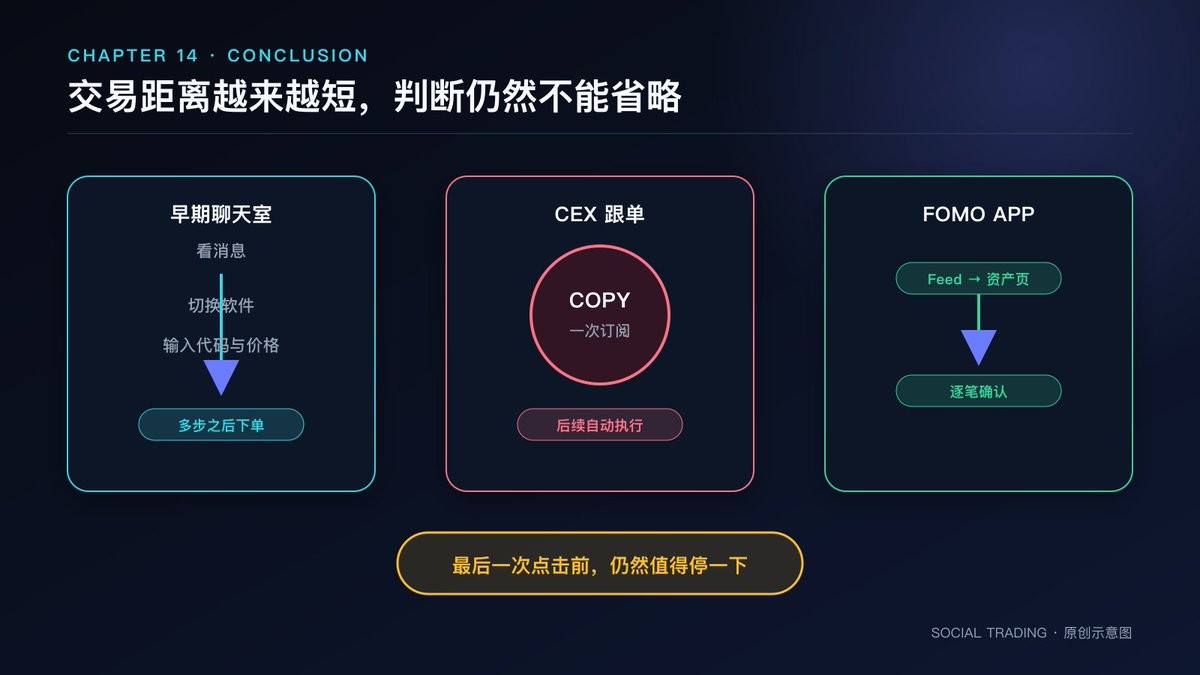
Figure 14 From multi-step manual execution to continuous subscription routing, evolving to per-trade mobile verification, technological compression persists. Final judgment discretion remains anchored to the user.
Inside 2000 Activetrader chatrooms, traders broadcast accumulation intent; peers deciphered signals, launched desktop clients, and manually constructed orders. Temporal delays separated communication from execution, accompanied by skepticism. Participants evaluated source credibility before committing capital allocations.
CEX Copy Trading collapses this interval into singular subscription events. Every provider subsequent movement routes algorithmically to follower accounts. Infrastructure validates extended ledger histories while abstracting continuous user deliberation away entirely.
FOMO recalibrates this arrangement entirely. Public transactions, creator profiles, and ranking matrices populate unified feeds, backed by embedded wallets and cross-chain execution engines. Mandatory user confirmation persists; interactive buttons hover adjacent to social signal triggers.
Social Trading genuinely democratizes visibility. Ledger continuity improves; position sizing and drawdown tracking become auditable; on-chain addresses accept cryptographic verification. Experienced allocation methodologies and error recognition protocols previously circulated within closed circles now operate under public scrutiny.
Imitation mechanics accelerate exponentially. Profit metrics attract audiences; audiences generate volume; volume elevates assets onto trending dashboards. Traders, infrastructure operators, and participants mutually benefit within feedback loops, concurrently absorbing systemic volatility.
Conclusion
Retrospectively tracing two decades reveals uninterrupted acceleration. Primitive chatrooms enabled anonymous real-time visibility; centralized platforms established continuous verification pipelines. CEX infrastructure delivered signals directly to follower accounts; FOMO reintegrated on-chain discovery and execution into singular streams. Every iteration compresses follow latency further.
Velocity resolves mechanical friction without absorbing trading consequences. Provider profitability reflects proprietary capital, cost structures, and risk tolerance alone. Leaderboards certify recent success but cannot guarantee equivalent entry pricing or subsequent drawdown endurance for copiers.
Decades ago, processing chatroom reports required software switching and manual re-entry. Those cumbersome minutes inadvertently carved space for due diligence. Contemporary environments eradicate waiting. Having products eliminate procedural steps, users must intentionally reclaim contemplative pauses. Scrutinize underlying metrics and fee structures before assessing catastrophic loss absorption capacity.
Ultimately, Social Trading value depends on facilitating calibrated decision-making. Platforms optimizing purely for imitation velocity deliver refined impulsivity. As interface polish reaches asymptotic smoothness, voluntary deceleration remains an indispensable trader discipline.
Join TechFlow official community to stay tuned
Telegram:https://t.me/TechFlowDaily
X (Twitter):https://x.com/TechFlowPost
X (Twitter) EN:https://x.com/BlockFlow_News
 @0xJamesXXX