Meme from a Macro-Cycle Perspective: Differences and Similarities with Previous Rounds
By Alex Xu
In the crypto cycles I have personally experienced (2016-2026), memes have always had their place in each cycle.
However, during the past few booming bull markets, the visibility of memes has varied greatly. My personal observation is:
- 2016-2018 Bull Market: Relatively low visibility. It's hard for me to recall which meme assets existed besides Doge during that cycle (perhaps it's simply too long ago)
- 2020-2022 Bull Market: Visibility increased somewhat, but still not center stage (the original Doge and the new-generation Shib performed brilliantly; from April to May before the May 19, 2021 crash, animal-themed memes dominated the market)
- 2023-2025 Bull Market: The absolute center stage. Heat and duration significantly increased, accompanied by diverse variations (from early Bitcoin inscription-based memes, to political memes, cult memes, social media memes, presidential-grade memes, and finally AI agent memes)
A question worth contemplating and answering is: What determines the visibility and mental share of memes in each crypto bull market cycle?
This question will influence how we choose our investment focus throughout the entire crypto bull market, specifically: whether we should continue to overallocate energy and capital to memes in this cycle.
From the examples of meme types in each cycle above, you can see that my definition of memes is quite broad. For instance, I categorize inscription assets and agent-themed projects launched by AI launchpads under the meme umbrella.
Because in my definition, crypto assets can broadly be divided into business-type/production-type assets and meme-type assets:
When people primarily focus on and trade its business aspects, such as a protocol's product-market fit (PMF), assets under management (AUM), revenue generation capability, and token buyback/burn mechanisms, the asset leans toward a business/production type. Such assets may be driven by various narratives in the short term, but ultimately must answer one question: How strong is my profitability/token return capability? This aligns with most listed companies;
when trading primarily focuses on the asset's consensus aspect—that is, its reach and level of understanding, as well as the strength of recognition from current and potential investors—the asset leans toward a meme type. From this perspective, consensus is the "fundamental" of meme assets.
Within this seemingly binary classification, there are also gray areas. For example, the massive influx of AI agent projects originating from Virtual and ai16z in 2025 (do you remember Luna, the Web3 virtual influencer who sang and danced live? Or AixBT, the Web3 investment research AI chatbot?).
Most of these projects were born with a business positioning, but were initially driven more by narrative consensus. By the time they faded out, they were still far from achieving true PMF or meaningful revenue scales. Therefore, in my definition, they lean closer to memes rather than business projects.
Another category includes meme launchpads, such as Pump and Pons. Although they belong to meme infrastructure, they are fundamentally business projects. It's just that meme participation heat serves as their core business metric, dictating their valuation levels.
Returning to the key question earlier: what determines the positioning and weight of memes in each market phase? Under what circumstances do memes become the main theme of the rally?
I believe the core factor is primarily: the supply and quality of business/production-type assets within that cycle.
When a cycle features explosive narratives for business-type assets plus smooth business development, speculative capital in the crypto space will flow primarily there. Conversely, when business-type projects decline, quality product innovation is scarce, and fundamental data is generally weak, crypto funds will choose to flow into meme asset categories unrelated to traditional fundamentals.
Because FOMO sentiment and the desire for get-rich-quick outcomes always resurrect with each cycle, the influx of capital and emotion brought by bull markets must ultimately go somewhere.
This is also why meme visibility has been so different across past cycles:
- 2016-2018 Bull Market: The breakthrough year for smart contracts/public chains. This was the cycle with the most explosive narratives and imagination. The narrative around public chains and future business potential was vast enough to drive even traditional VCs crazy, consuming almost all speculative capital;
- 2020-2022 Bull Market: The inaugural year for blockchain applications. Narratives remained high-quality. DeFi, NFTs, and GameFi took turns entering the stage. The Web3 concept went global, accompanied by observable spikes in business metrics (TVL, trading volume, fees, active addresses, and insane APRs). The amount of capital attracted by the industry rose further, but under the active or passive influence of celebrities like Elon Musk and Vitalik Buterin (whose address got dollar-bagged), memes began absorbing overflow capital;
- 2023-2025 Bull Market: The dullest cycle for blockchain business narratives and actual business performance. Most product innovations from the previous cycle were debunked, and there were virtually no truly new products in a strict sense. As one fades, another rises. Although the industry's capital absorption growth rate was far below the first two cycles, the existing capital pool remained massive, and most of it flooded into memes.
So, what are the background conditions currently shaping meme positioning in this seemingly unfolding bull market cycle?
Currently, many conditions resemble those of the previous cycle, namely:
- High-quality business narratives (business models that make sense) remain scarce. The few that exist (RWA, prediction markets) are mostly controlled by non-token issuing enterprises or publicly traded companies. There are limited quality secondary token carriers (primarily Ondo, but token value capture is currently lacking);
- FOMO and the desire for rapid wealth remain unextinguished. Casinos attract gamblers in any era.
Therefore, unless a batch of high-quality business-type projects reemerges at some point, memes will most likely remain the main theme of this bull market (if not the only one).
Does that mean investors should overallocate to memes this cycle? Not necessarily.
This cycle introduces two new factors that will increase the difficulty of speculating and surviving in memes:
Extremely ample meme supply: Having gone through the last cycle, the assembly line for meme issuance and harvesting processes has become highly industrialized. Supply is now fully established, approaching infinity.
Short-sighted and fragile demand-side psychology: After enduring multiple waves of repetitive harvesting across various narratives in the last cycle, the core investor base with genuine faith in memes is no longer what it used to be (remember Murad's call for a meme supercycle last round?). Meme consensus is essentially capital clustering. Shifts in mentality lead to unstable clusters, causing the median cap ceiling and lifecycle of memes to decline.
More importantly, the short-sighted psychology and wariness of clustering on the demand side will feed back to cause supply-side actors (developers) to exit faster. This is a self-reinforcing process, and it represents the most concerning scenario for meme launchpad projects.
In reality, even if memes were overallocated right at the beginning of the last meme supercycle (January 2024), as of today, meme sector returns only rank in the middle of the broader crypto sector, remain negative, and significantly underperform BTC:
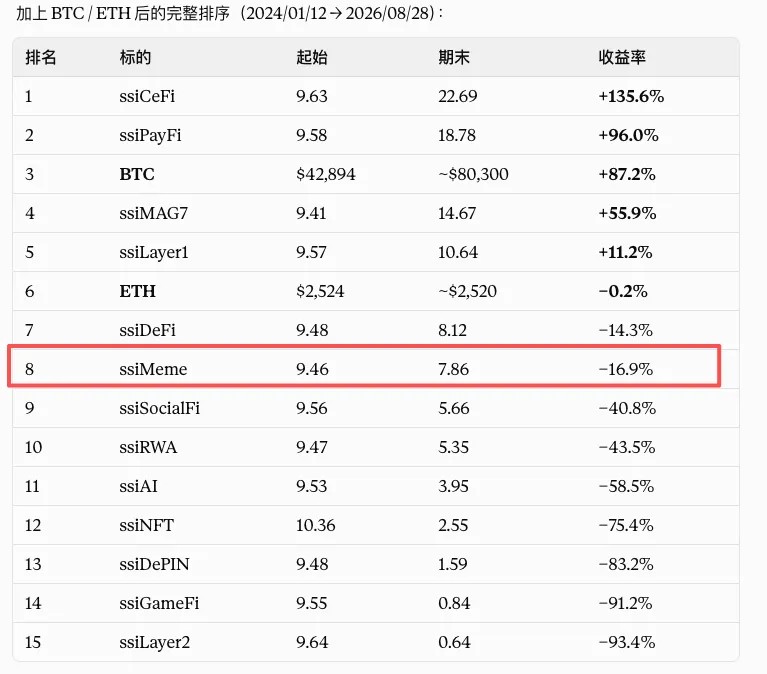
Note: Based on the Sosovalue Crypto Sector Index. The index calculation logic covers the top ten targets in each sector (monthly updates) with market cap weighting (refreshed at a 5-minute level).
It's worth noting here: Because the above index tracks top-market-cap memes, it differs significantly from the actual trading experience of early-chain meme chasers. On-chain early-stage memes have mortality rates and volatility (including upward swings) far higher than top-tier memes. While there are no reliable statistics, I imagine the actual yield curve over a cycle would be much worse.
After discussing where meme speculation has become more difficult this cycle, let's talk about the marginally positive factors compared to the last round:
Primarily, the net onboarding of users and capital onto-chain by the new player, Robinhood.
Of course, regarding how many Robinhood users on-chain are actually traditional brokerage app investors, I believe the absolute proportion remains low. However, if memes on Robinhood continue to heat up, users continuously getting battered by semiconductor stocks might consider coming here to test their luck.
Furthermore, Robinhood still has some cards left to play, such as launching its own chain's powerhouse memes and meme launchpads on its main platform, which could provide aerial refueling for on-chain momentum.
Naturally, playing these cards too early would leave insufficient room for future imagination. Therefore, keeping them hidden in the short term exerts greater deterrence against bears.
Let's take another look at the emerging narratives in the current meme market.
As mentioned earlier, memes represent a generalized asset class. In just over two years during the last cycle alone, they underwent multiple iterations: inscriptions, politics, cult/retro internet culture, social media, mainstream figures (Trump), and finally AI agents.
Among current meme categories, NiuLai makes sense as a Chinese meme. The relatively newer ones are currency-stock themed memes on Robinhood, or "stock memes." Key features of these memes include:
- Paired with public company stocks: Where there is NVIDIA (NVDA), there is AI (Artificial Inu). They can be freely created;
- Paired on-chain with RWA coin-stocks to form Uniswap-based AMM liquidity pools;
- Based on these mechanisms, stock meme creators have various customizable ways to handle transaction fee allocation and usage, such as using them to buy back and burn stock memes, or distributing them to stock meme holders.
Building on these mechanisms, the market recently spawned the narrative: "Stock memes short squeeze Wall Street."
To explain the specific mechanism: Fanatical meme traders buy stock memes on-chain. Since on-chain liquidity for stock memes mainly comes from pairing with coin-stocks, when users purchase stock memes using stablecoins or ETH, they must first route trades to buy the paired coin-stocks, creating unilateral buy pressure. If on-chain minting of the coin-stock is hindered (e.g., due to weekends) combined with a small on-chain circulating supply, the system cannot quickly mint and dump tokens to arbitrage the on-chain price back to the normal stock market price. Consequently, the on-chain price of the coin-stock may spike several times higher in the short term.
The recent situation with Boner (stock meme) and HIMs (coin-stock) on Robinhood is precisely this case.
Given that Hims itself already carries a significant portion of short positions in the stock market, the narrative of "on-chain finance counterattacking Wall Street," or even a "short squeeze of Wall Street," takes shape.
So, how would you rate the narrative quality of this kind of meme?
Average.
Good meme narratives require solid logic and emotional resonance, strong viral spread, and better resilience against falsification.
First, the short-term surge in the HIMS coin-stock stems from friction in Robinhood's on-chain minting mechanism. Logically, this makes the narrative fragile and easily disproven (Ondo's coin-stock minting/burn depth is better; consequently, the HIMS it supplied experienced minimal fluctuations that day).
Secondly, "short squeezing Wall Street" is an uninspired retread, reeking of artificial orchestration. It lacks the raw momentum, organic community fermentation, and grassroots viral spread that characterized the debut of the original movement target—GameStop in 2021.
Additionally, the template for stock meme narratives is being rapidly replicated, with projects like SAYLORMOON emerging quickly.
At the end of the article, I want to discuss what kind of investors are suited for memes.
Whether investing or speculating, the former centers on evaluating an asset's long-term intrinsic value, while the latter focuses on predicting short-term capital voting. Though their methods and emphases differ,
they share one commonality: those skilled and focused in this arena consistently profit from those who lack both focus and expertise.
Based on my observations of exceptional meme players around me, they typically possess one or more of the following traits:
1. Abundant energy, active thinking, and a genuine passion for trading itself;
2. Imaginative and highly sensitive to narratives;
3. Consistent, sustained on-the-ground/on-chain monitoring and execution, remaining highly attuned to market temperature and trend shifts;
4. Operating within relatively closed, high-cognition practical circles where targets and insights are shared, featuring frequent and intensive communication;
5. Having developed a relatively systematic speculative framework, with the ability to rapidly patch vulnerabilities and even iterate the whole system entirely.
* Another important bonus factor:
If you are a KOL with a substantial downstream subscriber base, you possess the ability to amplify narratives, accelerate consensus formation, and attract capital clustering for smaller, early-stage memes, helping nascent projects cross the critical threshold from obscurity to viability. If you also maintain a network connecting other KOLs, you can collaborate to magnify this capability exponentially.
Placed within the realm of value investing, however, some of these advantages would become ineffective or even detrimental. Their behavioral patterns typically include:
1. Low trading frequency and fewer entries;
2. Unwillingness to pay premiums for asset imagination and storylines;
3. Keeping distance from "Mr. Market," avoiding fixation on volatility and market quotes, and proactively isolating from mass sentiment.
This is why value investing and market speculation are difficult to reconcile within a single individual, given the glaring incompatibility between the core innate abilities required for each.
It's hard to envision someone enthusiastically paying for a grand vision and narrative behind Asset A, yet becoming cautious and conservative for Asset B, trusting only thoroughly evidenced logic.
Regardless, mastering both speculation and investment requires profound self-awareness. Avoiding investment paths incompatible with your inherent talents and nature, while fully leveraging strengths and mitigating weaknesses, is also an investment principle of "sidestepping unsolvable puzzles."
These are merely personal views, offered for reference only.
Wishing everyone successful hunting throughout this bull market cycle.
Join TechFlow official community to stay tuned
Telegram:https://t.me/TechFlowDaily
X (Twitter):https://x.com/TechFlowPost
X (Twitter) EN:https://x.com/BlockFlow_News
 Mint Ventures