MSTR Shareholder Confronts Michael Saylor: Investment of $73,000 Has Fallen to $20,000, What Should I Do?
Source | Strategy
Translated by | Wushuo Blockchain
On August 17, 2026, Strategy Founder and Executive Chairman Michael Saylor and CEO Phong Le participated in a live investor Q&A hosted by Coin Stories Podcast host Natalie Brunell. (This interview took place before the market recovery, so some information may be outdated.)
During the interview, the two addressed investor concerns regarding MSTR's stock pullback, common share issuance via ATM, STRC buybacks, Bitcoin sales, and cash reserves. Michael Saylor stated that Strategy's most important task at present is to fix and expand its digital credit business, rather than paying dividends to MSTR shareholders or prioritizing common stock buybacks. He noted that Strategy is currently in a Bitcoin bear market and must prepare to endure difficult periods lasting several months to one or two years, but the company will continue accumulating Bitcoin and remains bullish in the long term.
Additionally, the two discussed Strategy's digital asset classification framework, the potential exclusion of Bitcoin treasury companies from indices by MSCI, institutional adoption of STRC, the impact of AI on Bitcoin custody security, and why the company does not pay Bitcoin dividends.
Guest comments do not represent the views of Wushuo Blockchain and do not constitute any investment advice. Please strictly comply with local laws and regulations. Audio transcription and translation are completed by GPT and may contain errors.
Bitcoin is Digital Capital, STRC is Digital Credit
Natalie: Alright, we have many questions to address, so let's jump right in. The first question comes from several investors, and they'd like Michael to answer.
You recently posted an image on X outlining a spectrum of digital asset currencies, including digital capital, digital credit, digital currency, and digital money. What exactly are the related products you classified under digital currency? Additionally, do you disagree with the notion that "Bitcoin is money"?
Michael Saylor: If we use the theoretical definition of "money," you could say money is a store of value based on holder possession, independent of sovereign issuance, much like gold. However, this reflects the classical Austrian School view of money.
The mainstream definition today considers money to be fiat currencies like the US dollar, or equivalent assets that maintain a peg to fiat. By that perspective, I believe 99% of the world understands money as fiat currency, while money market instruments are fiat-pegged tools that generate yield.
I estimate about 1% of the world falls into the Austrian school of economics, believing gold is money; among them, some believe silver is money, others believe Bitcoin is money. But I see this as an academic debate worth avoiding, as only about 0.1% of global capital or economic value is actually deployed in the Bitcoin network.
In other words, 99.9% of the world's capital, money, and valuable assets remain outside the Bitcoin ecosystem. A significant portion consists of equity capital and real estate capital, along with metallic capital like gold, plus trillions in credit assets.
Therefore, if we want the Bitcoin network to grow 10x or 100x, we must attract capital from traditional finance. This means drawing in equity capital, credit capital, or money market funds.
For those who haven't bought Bitcoin yet—whom we aim to serve—they view money as a medium of exchange, unit of account, and store of value. In Japan, they consider the yen or yen money market instruments as money; in the US, the dollar or dollar money market instruments; in the EU, the euro or euro money market instruments.
Thus, "money" in traditional finance or Keynesian contexts refers to fiat currency or yield-bearing fiat equivalents. My chart illustrates a classification framework for digital assets.
We consider Bitcoin to be capital; in other words, digital capital is Bitcoin. Its competitors include gold, real estate, equity capital, credit assets, money market instruments held as capital, and art.
Again, 99% to 99.9% of global economic value and capital is not Bitcoin. To attract this capital, we must demonstrate why Bitcoin outperforms gold, art, real estate, equity indices like the S&P 500, or bullion.
STRC is digital credit. We extracted a credit instrument from capital. It has a certain degree of volatility—lower than Bitcoin but higher than fiat currency.
The next step is to create something that looks like a "digital currency" on top of STRC. This digital currency can be understood as an idealized, Bitcoin-backed stablecoin. It maintains stability against fiat currencies—whether the stable dollar, stable yen, or stable euro—while also generating yield.
Digital Currency Should Maintain Stability While Generating Yield
Michael Saylor: The difference between digital money and digital currency is that digital money typically refers to stablecoins like Tether, Circle, or other digital stablecoins. Regardless of the monetary system they are tied to, digital money itself does not generate yield.
Within the crypto and digital asset ecosystems, digital money has won the race for mediums of exchange. I know some Bitcoin purists or early participants didn't want this, or kept hoping it wouldn't happen. But by 2026, we can see that virtually all prices worldwide are quoted in fiat. If I say 99.9%, I might even be understating it; there are probably more nines after the decimal point.
Meaning, mediums of exchange are still typically fiat currencies like the dollar. Including stablecoins, they still don't pay yield. Therefore, stablecoins are excellent for making change and settlement, but poor stores of value—or weak ones, at best.
The concept of "digital currency" aims to combine the best features of digital credit and digital money to create a tool that remains relatively stable against fiat while simultaneously generating yield.
If you can make a stablecoin-like tool generate yield, it becomes a vastly superior store of value. The asset I listed in my chart is one of the first—and possibly the very first—attempts on the market to create a digital currency asset.
It uses financial engineering to stabilize the asset price near $1 while allowing it to generate yield, with that yield sourced from digital credit.
I expect people will eventually build dozens, if not hundreds, of different types of monetary assets. That asset in my chart isn't the only option. As far as I know, over a dozen institutions in the digital asset ecosystem are currently developing digital currency assets.
Nor do I believe digital currency will exist only in token form. The US might see digital currency funds established as ETFs, while other regions might develop ETPs and publicly traded funds across various exchanges. Private funds would also exist. Money market funds today already come in private, non-publicly traded forms, as well as public ETF structures; stablecoins are essentially currency-linked monetary instruments.
We believe that if Bitcoin is to grow 10x or 100x, we must create channels for inflows from credit and money markets.
Right now, without STRC and the nascent digital currency tokens, fiat capital flowing into the stablecoin market is entirely backed by fiat assets like the dollar; capital entering the equity market can support BTC, but credit and money market capital simply aren't flowing into this ecosystem.
If we create high-quality credit, we can build further monetary instruments on top of it. Companies creating digital credit like Strategy and Strive also hold their own equity, which attracts capital inflows that then flow toward Bitcoin. Companies creating digital currency tools similarly hold equity; since their products are built on digital credit, they will also attract more capital into the ecosystem.
Therefore, we believe that if we can create credit instruments, monetary instruments, money instruments, and equity tools, and tie them to BTC or connect them to the Bitcoin ecosystem, the entire economic system will grow.
The product in my chart is merely what I see as the first case study among many future digital currency tools, not the only one. I certainly am not endorsing it or advising investment; it is a type of securities-based investment. However, I consider it a groundbreaking event, similar to the debut of money market funds and the subsequent emergence of ETFs backed by them.
Strategy Will Not Pay Dividends to MSTR Common Shareholders
Natalie: Moving on to equity, let's discuss MSTR common stock. Rob asks:
"I have three children, and out of confidence in MSTR's long-term potential, I invested $73,000 for each. Today, each $73,000 investment is only worth $20,000, so that so-called long-term potential has become a matter of whether I'll ever break even.
"MSTR common shareholders seem to be your lowest priority. You're propping up STRC and issuing shares via MSTR's ATM to repay convertible bonds, while so-called earnings per BTC doesn't help my kids much. I have a ten-year investment horizon, but I worry you'll massively dilute through ATMs, causing the stock price to never return to $325 per share.
"Have you considered paying dividends to MSTR common shareholders, at least doing something concrete for them in the short term?"
Phong Le: I'll answer first, and Michael can add on. Rob, thank you first for being a shareholder, and for investing in MSTR for your children.
MSTR common shareholders are undeniably our most critical priority. Creating value for MSTR and lifting the stock price is our primary mandate. How do we achieve this? By ensuring MSTR outperforms Bitcoin.
Since we began adding Bitcoin to the balance sheet in August 2020, Bitcoin is up 32% and MSTR is up 41%, so in the long run, we have outperformed Bitcoin.
I understand you entered late and haven't seen this alpha. Over time, when Bitcoin rises, we typically rise more because we hold more Bitcoin per share. Historically, we achieved this through leverage, and recently more through magnification mechanisms.
But this also means that when Bitcoin drops, we typically drop more, which is exactly what you've experienced. Bitcoin has pulled back 50% from its all-time high, while MSTR has pulled back roughly 75%.
Because Bitcoin is our underlying asset, increasing Bitcoin per share boosts MSTR's value when Bitcoin rises; correspondingly, MSTR declines more sharply.
So how do we increase Bitcoin per share? Historically, mainly through leverage, including convertible bonds. Recently, through the digital credit Michael just mentioned, as well as the magnification mechanism enabled by STRC.
Ultimately, if you want common stock to rise, you must increase Bitcoin per share; and increasing Bitcoin per share means STRC must operate successfully. That's why we seem to be focused almost entirely on STRC right now, discussing how to bring STRC back to par. Long-term, this is what drives up Bitcoin per share and MSTR common stock.
We will not pay common stock dividends because it is not the optimal use of capital. For us, the best capital allocation strategy is to keep STRC functioning, buy Bitcoin, and add it to the balance sheet. That is the company's ultimate goal.
Therefore, if you believe in the underlying asset, Bitcoin, and trust it will rally again due to the characteristics Michael previously discussed, MSTR will eventually appreciate over time. That is the company's objective.
Natalie: Michael, any additions?
Michael Saylor: If you want dividends, you should buy our preferred stock. For example, STRD offers an effective yield close to 15%. If you want to hold a relatively stable instrument that pays dividends, consider STRC or STRK; they are designed specifically to pay dividends while offering upside potential.
If your investment horizon is under four months, you likely should hold money market instruments. If your horizon is between four and four years, and you want to recover principal while securing solid returns, you lean more toward a credit investor, in which case consider a credit instrument.
If investing in equity, you need at least a four-year time horizon, ideally seven to ten years. Bitcoin hit its historical high about a year ago. When we are in a bear market, you get leveraged Bitcoin exposure. If Bitcoin drops 50%, we could drop 75%; in a bull market, we expect to outperform Bitcoin.
So, buying MSTR gives you magnified Bitcoin exposure. Buying Bitcoin itself is like riding a rollercoaster.
If you choose to ride the rollercoaster, you should evaluate it using a four-year composite metric. When analyzing Bitcoin, we look at the 200-week simple moving average, viewing it through a four-year lens to see where it trades relative to that four-year mean.
I believe MSTR will exhibit greater volatility than Bitcoin because the purpose of equity products is inherently to provide leverage. If we pay dividends on common stock, we would effectively weaken the equity thesis and also undermine the credit product thesis.
Equity is volatile precisely because we issue credit products; we relentlessly build the balance sheet because the company's future rests on its credit business.
If we can sell $10 billion in STRC annually, and BTC performance exceeds our hurdle rate—currently around 10% to 10.5%—then from a common shareholder's perspective, the issuance of this $10 billion in credit products would increasingly resemble net income. This allows the credit product sales to command valuation multiples. Without credit product sales, there is nothing for the market to assign multiples to.
Therefore, the paramount task is stabilizing the credit business and building one that is as sustainable and high-quality as possible. Equity returns will follow subsequently.
Strategy May Need to Endure One to Two Years of Difficult Times
Michael Saylor: We are currently in an investment phase, focused on establishing the credit business first. Short-term actions that benefit equity may not benefit its long-term value; conversely, short-term moves that aid the credit business will ultimately benefit equity.
At the end of the day, the company's product is credit. The better the credit product, the more valuable the company becomes. We believe that as long as the credit business, especially STRC, succeeds, the company will become extremely valuable.
This is a long-term investment, somewhat akin to Netflix or Amazon. When Amazon built Amazon Prime, it offered cheap or even free shipping for a long time, and people thought it was bad for equity; but later, nationwide consumers subscribed to and used the service, and Amazon captured the market.
We hold the same view. We aim to win the digital credit market and ultimately create the world's highest-quality credit product. If we succeed, common shareholders will be the biggest beneficiaries. I am also a major shareholder myself, holding over 19 million common shares, so I understand your pain.
However, we must prepare for difficult years ahead. It could be one year, or two; we don't expect it to last four, but we may have to weather several months, a year, or two before things begin to move in favor of common stock.
Strategy Is Not Currently Prioritizing MSTR Buybacks
Natalie: Several investors pointed out that you recently sold Bitcoin and bought back STRC. Do you have plans to buy back MSTR?
Michael Saylor: We are willing to buy back MSTR if it trades below mNAV—the multiple of market cap relative to the net value of its Bitcoin assets—or if a buyback aligns with the company's best interests. We evaluate these scenarios weekly and daily.
Currently, STRC trades below par, making STRC buybacks a clear choice; MSTR is not currently trading below mNAV. If needed in the future, and if MSTR shows a significant discount relative to mNAV, you might see us take similar action.
But this is not the company's highest priority right now. The most important thing we can do is repair the credit business. If the credit business recovers, the equity premium should expand, which will benefit common stock.
Taking capital that could otherwise repair the credit business to repurchase common stock would negatively impact both equity and the credit business. Once the credit business weakens, even repurchasing stock in the open market will erode the stock's fundamentals.
The core question is whether this credit business is worth $100 billion or $1 trillion. If the digital credit business fails, the answer is zero; if it succeeds, the debate is simply whether it's worth $50 billion, $100 billion, $250 billion, or $1 trillion.
Thus, our most critical job is making the credit business successful. Our capital is currently allocated around this objective.
Issuing MSTR Does Not Necessarily Dilute Bitcoin Per Share
Natalie: So, fixing credit fixes equity. Phong, the following question is from Johannes Schmidt.
You once cited JPMorgan as a benchmark for Strategy's digital credit business. But the ethos of Bitcoin has always been to replace the centralized, trust-dependent banking system represented by JPMorgan. Isn't structuring Strategy's business, including STRC, after JPMorgan at odds with Bitcoin's founding decentralized principles? How do you reconcile pursuing a JPMorgan-style corporate architecture while remaining loyal to Bitcoin's founding ethos?
Phong Le: I'll answer. However, let me clarify the previous question first, as there is a common misconception that issuing equity inevitably dilutes shareholders.
If we sell the digital credit product STRC, and then issue equity to pay dividends, this actually significantly accretes shareholder value.
Issuing equity at a price above 1x mNAV—we are currently around 1.07x mNAV—and using the proceeds to buy Bitcoin also accretes shareholder value because it increases Bitcoin per share.
Issuing equity and then repurchasing STRC below the issuance price similarly accretes shareholder value. For instance, if STRC issues at $100, we issue equity when MSTR trades above 1x mNAV, and then repurchase STRC at $95, this also accretes value for common shareholders and increases Bitcoin per share.
That is the crux. I want to ensure everyone grasps this. Many see Saylor using ATMs for issuance and assume it necessarily dilutes shareholders; but from a Bitcoin-per-share perspective, that isn't always true.
Michael Saylor: There's another scenario: if we sell equity above mNAV in exchange for dollars, this also accretes shareholder value.
All transactions we execute accrete value, strengthen the company's balance sheet, make the company more robust, and improve long-term prospects.
Strategy Aims to Become the JPMorgan of the Digital Asset Space
Phong Le: We do not want to become JPMorgan; we want to become the "JPMorgan of the digital asset space." Those are vastly different concepts.
JPMorgan has much to learn from. It is the world's most valuable bank, and we hope to become the world's most valuable digital asset company. JPMorgan commands immense trust and massive equity value; we seek to earn that same level of trust and equity value within the digital asset world.
JPMorgan is also one of the largest players in the repo market and a bank the US federal government seeks to assist during crises. We aim to achieve comparable levels of trust and scale in the digital asset realm.
However, we are not copying JPMorgan's business model. The analogy simply means we aspire to be the largest and most critical participant in the digital asset world.
Step one is becoming the company holding the most Bitcoin globally. Currently, our holdings represent roughly 4% of total Bitcoin supply. Afterward, we will build products on top of Bitcoin. MSTR is digital equity, STRC is digital credit; subsequently, other players in the digital asset space will build new products atop ours, such as the digital currencies Michael previously mentioned.
We believe that as the largest Bitcoin holder, we can secure an industry position akin to JPMorgan's, but this does not mean we are replicating its operations.
This is like Michael saying "STRC is our iPhone moment." We obviously do not intend to run the company by mimicking iPhone or Apple; the comparison exists solely because the iPhone is the most successful product in world history, and we believe STRC can become the most successful digital credit product globally.
STRC Proceeds Are Not Limited to Purchasing Bitcoin
Natalie: Next question is from X user @GrainOfSalt. Can Strategy sell STRC and use the proceeds to build a cash reserve and buy back MSTR, rather than just purchasing Bitcoin? This approach was mentioned in the Q1 earnings presentation; is it still a viable option?
Michael Saylor: Absolutely. We can deploy this capital in many ways; we can swap STRC for MSTR, dollars, or BTC, or exchange it for other outstanding debt or credit instruments. There are likely other uses as well. We maintain a highly open stance on how to utilize this capital.
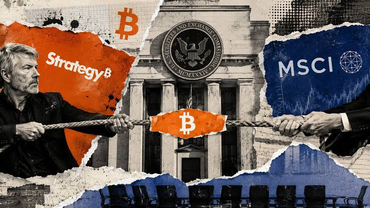
MSCI Exclusion Affects Approximately 3% to 4% of MSTR Float
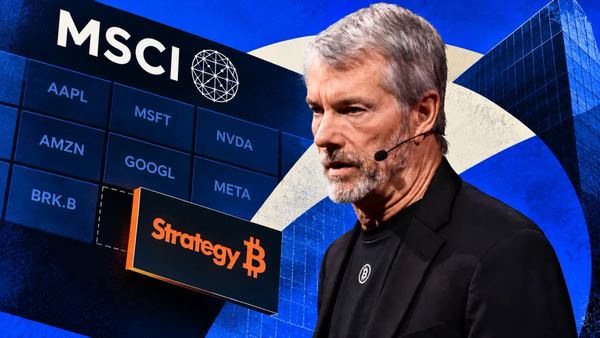
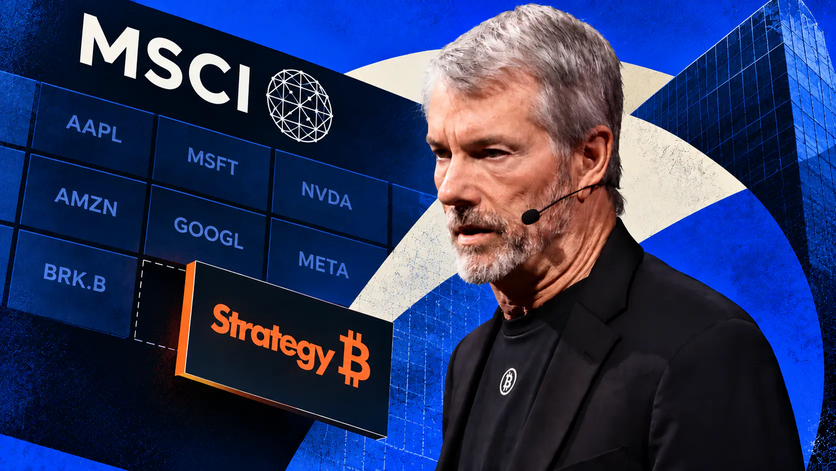
Natalie: Next question from Garrett. How do you view MSCI's recent proposal to adjust rules by excluding Bitcoin treasury companies from its index? What impact do you expect this will have on these companies' stock prices?
Phong Le: I'll address the latter part first. MSCI index funds currently hold approximately 3% to 4% of our float. If we are excluded from the relevant index, it may create some selling pressure for a period. However, this doesn't materially concern us. 3% to 4% is insufficient to cause a significant long-term shift in stock price, so I would define the impact as "immaterial."
If we factor in the Bitcoin we hold, the related impact is even smaller, perhaps only 0.1%.
More importantly, I believe MSCI's approach contradicts the US government, global markets, and other indices. They are attempting to handle this for a second time, using a different method by redefining what constitutes operating assets. I find this somewhat questionable.
The SEC and FASB have already defined what qualifies as an operating asset for Strategy; Bitcoin is clearly our operating asset, but MSCI disagrees. It seems to be taking a stance contrary to US GAAP and the SEC's position.
We will submit a response to further understand why it adopts this adversarial posture toward Bitcoin as an asset class. I believe MSCI will consider our response along with others, handle it constructively, and I hope it abandons the latest proposal.
Even if they ultimately proceed, I do not believe it will be highly material to us.
Strategy Will Maintain High Dollar Reserves Long-Term
Natalie: Sergio asks whether Strategy might primarily build a cash reserve reaching $20 billion to $30 billion through STRC, to enable large-scale deployment during future bear markets. Would a higher cash buffer also help MSTR get included in the S&P 500 index?
Michael Saylor: We will always hold substantial cash going forward. Over time, we expect dollar reserves, Bitcoin reserves, and unrestricted operating cash to continue growing.
These funds can be flexibly deployed to repurchase credit instruments, stocks, debt, or buy Bitcoin, whenever we deem it prudent. Strategy's capital allocation options are expanding. At this stage, we anticipate the company will only continue to grow and possess more transaction choices than in the past.
Phong Le: Regarding the S&P, we need to distinguish between S&P credit ratings and the S&P index.
In terms of credit ratings, Strategy's current corporate rating is B-. Increasing cash reserves may help this and improve the rating over time. Ultimately, however, what truly affects the rating is whether rating agencies classify the Bitcoin on the balance sheet as capital.
Currently, they do not view Bitcoin as genuine capital, assigning it a value even lower than zero. If this treatment changes, our rating would rise. This factor outweighs increasing dollar reserves.
As for inclusion in the S&P 500 index, I believe it has no direct correlation with the dollar size on the balance sheet.
Strategy Is Not a Short-Term Bitcoin Trader
Natalie: Jerry asks whether Strategy will long-term focus on raising capital to increase Bitcoin per share, or engage more in opportunistic spot Bitcoin purchases to support liquidity and price discovery?
Michael Saylor: Our core business is creating digital credit products that strip away most of Bitcoin's volatility while extracting yield; STRC is one such product.
The current digital credit market size is approximately $15 billion. We believe this market can grow to $100 billion, then $200 billion, $400 billion, ultimately reaching $1 trillion.
Transactions executed by Strategy are fundamentally a bet that Bitcoin's long-term performance will exceed the company's hurdle rate. Currently, this hurdle is around 10.5%, with data updating every 15 seconds on the company website. The company's duration is approximately 33 years; therefore, we are betting on the next 10 to 30 years, not trading Bitcoin daily.
Investors should not buy MSTR because they believe we are skilled at trading Bitcoin. If you think you've found someone exceptionally good at trading Bitcoin, you should invest in their private fund.
The reason to buy MSTR is that Strategy holds approximately $60 billion in capital and could potentially generate $5 billion, $10 billion, or even $20 billion in digital credit annually. If Bitcoin outperforms the cost of capital, the company could create roughly $20 billion in value annually and grow at a 30% annual rate.
In practice, Strategy will hold more cash. If Bitcoin trades at a very high premium relative to the 200-week moving average, after selling credit products, we may prefer to hold cash; if the premium is low or even negative relative to that average, we might allocate more capital to Bitcoin.
Thus, Bitcoin's cyclical position may influence the cash-to-Bitcoin allocation ratio, but Strategy is fundamentally not a short-term trading company.
Many overlook that in bull markets, MSTR's equity premium typically expands, demand for common stock increases, demand for credit products rises, and associated credit risks decline. Consequently, both equity and credit businesses expand rapidly, drawing more capital into Strategy.
During rising or high-priced bull markets, more capital flows into the company, so we typically purchase more Bitcoin. In bear markets, equity premiums contract, credit products weaken, and demand for both equity and credit fall, meaning our Bitcoin purchases in weak markets are usually lower than in strong markets.
However, if we buy Bitcoin with commonly issued stock trading at a high premium, the exact purchase price of Bitcoin isn't the primary concern. As long as we exchange higher-premium stock for Bitcoin, the transaction continues to accrete shareholder value.
For example, if Bitcoin rises to $1 million and MSTR stock climbs to $25,000 per share due to an expanded premium, we use equity to buy Bitcoin. Even if Bitcoin later falls from $1 million to $200,000, it is inaccurate to claim we bought at five times the current price, because we exchanged high-premium equity for Bitcoin at the market peak.
For Bitcoin purchased using credit instruments, the true question isn't short-term drawdowns, but whether Bitcoin's performance over the next decade will exceed the cost of credit. We are long-term thinkers, not short-term traders.
The scale of Strategy's dollar or Bitcoin allocation, and the extent of capital market activities, are ultimately driven by capital markets. The Bitcoin market dictates Bitcoin capital, the credit market dictates STRC demand, the equity market dictates MSTR demand, and derivatives markets exert some influence. These markets evolve independently daily, sometimes interlinked, and we participate in them every single day.
Strategy Will Not Acquire Other Cash Flow Businesses
Natalie: We are about halfway through the Q&A. Here is a question from live viewer Tim Fiaka. How do you view acquiring companies that generate cash flow alongside being backed by a Bitcoin treasury? Could Strategy adopt some form of cash-flow-generating business model in the future? What benefits could cash flow bring to MSTR?
Michael Saylor: We will not do that. For other companies, this might be a perfectly reasonable business model, and there are indeed other firms and investors specializing in acquiring cash flow businesses.
But Strategy's business model is creating digital credit. If we deviate from this path, we risk distracting ourselves, diluting the company's focus, and introducing various operational complexities.
This would also dilute equity value, as investors would find it harder to accurately value and trade MSTR. Currently, MSTR investors mainly just need to build a Bitcoin valuation model. If we acquire numerous disparate businesses, investors would have to individually assess each of our held assets and ventures.
This would also harm the derivatives market. The market for MSTR call and put options reaches tens of billions of dollars; if Strategy begins fragmenting into various cash flow businesses, related investors would be impacted.
Meanwhile, this would weaken the credit business. Currently, we can recalculate the company's credit risk every 15 seconds; adding other businesses would require building a heterogeneous credit model to determine what credit risk the new ventures impose on the existing company.
Therefore, we consider this a dilutive distraction for Strategy. We will continue focusing on our existing business model, as we believe it is the one best suited for the company to execute.
Following STRC Drawdown, Strategy Will Strengthen USD Liquidity Reserves
Natalie: Let's discuss questions specifically related to digital credit. What lessons has management drawn from STRC's recent drawdown and recovery? How will these lessons be applied to further drive STRC adoption?
Michael Saylor: Phong, you go first?
Phong Le: The biggest takeaway is that we must hold sufficient USD liquidity on the balance sheet to guarantee dividend payments. That is why we currently hold $4.8 billion in cash.
When raising funds through STRC in the future, we may allocate a portion of proceeds into dollar reserves or other forms of USD liquid assets to support dividends and bolster institutional investor confidence in STRC.
Michael Saylor: I believe we also realized that the company must always be prepared to buy or sell any asset.
To ensure Bitcoin receives fair valuation, Strategy must be capable of both buying and selling Bitcoin. If we were unwilling to sell Bitcoin to fund credit product dividends, it would negatively impact the credit business. Therefore, we must be able to trade BTC.
If we want to stabilize STRC, we must similarly be able to both sell and repurchase STRC. Previously, we excelled at issuing STRC at $100 and buying Bitcoin; now we have proven to the market that Strategy can also sell Bitcoin and repurchase STRC.
This is like a car cannot only turn in one direction. We cannot have only a right hand; we must possess both left and right hands simultaneously.
As Phong mentioned, we must also demonstrate that the company can dynamically manage reserves, including dollar reserves, unrestricted cash, restricted cash, and Bitcoin. All of this is critically important.
We also recognize the necessity of continuously monitoring and improving capital structure. If we aim to expand the credit business, we must always pay close attention to capital structure quality.
Institutional Ownership of STRC Rises from 20% to 30%
Natalie: Phong, when we shared a panel at the Bitcoin Conference in Las Vegas previously, you noted that roughly 80% of STRC holders were retail investors at the time. Stewart asks that he recently saw you announce multiple institutional funds making large allocations to STRC. Why did retail investors adopt this product first? Why are institutions starting to enter now? What is the current ownership split between the two?
Phong Le: Whenever a new product category emerges, retail investors are typically the early adopters, and digital credit is no exception.
For digital credit products, institutional investors prefer to see one to three years of dividend payment records and price performance before entering, so they tend to join later.
Currently, the retail-to-institution split for STRC has shifted from 80% and 20% to roughly 70% and 30%. This does not mean retail investors have decreased; in fact, retail holdings have doubled, but institutional growth has been far more pronounced.
We have observed institutional adoption beginning to accelerate. I believe Strategy's digital credit capital framework has strengthened institutional investor confidence.
Retail investors are certainly vital, but institutions typically hold for longer periods and utilize less leverage; therefore, rising institutional adoption will help STRC maintain stability over time.
Strategy Has No Current Plans to Shift to Daily Dividend Payments
Natalie: A few investors wonder if STRC might switch to paying daily dividends like SATA. Will other preferred shares switch to monthly or daily dividend payments?
Michael Saylor: Currently, we have no plans to alter the dividend payment frequency for other preferred shares. STRD, STRE, STRF, and STRK are primarily targeted at institutional investors, whose holders have consistently accepted quarterly dividend payments, so this arrangement is not expected to change in the foreseeable future.
We are actively observing SATA's daily dividend model, but we currently have no plans to adopt daily payments. Strategy's primary focus remains enhancing the credit quality of STRC and strengthening the company's balance sheet.
Phong, any additions?
Phong Le: None, that covers it. Daily dividend payments are an interesting concept, and we will continue monitoring SATA, but the current twice-monthly dividend schedule works quite effectively for our investor base.
Strategy Is Not Currently Prioritizing STRK Buybacks
Natalie: Several STRK investors raised questions, with one live viewer asking whether you will consider repurchasing STRK.
Michael Saylor: Right now, our focus is restoring STRC to a healthy state. You should expect us to dedicate intense focus to this task. We want STRC to remain stable and grow predictably.
Only after STRC regains stability will we evaluate whether appropriate actions should be taken regarding other products and investors.
For STRK or other Strategy security investors, the best thing the company can do right now is also to restore STRC's health, since measures beneficial to STRC typically benefit STRK as well.
Strategy Will Not Allow STRC to Trade Significantly Above Par for Extended Periods
Natalie: John Lee Dumas asks under what circumstances Strategy would allow STRC to trade significantly above $101 for extended periods without taking action to bring the price back to par. What is the strategic rationale for permitting such a premium to persist?
Michael Saylor: We will not do that. STRC's target trading range is around $99 to $100; we have no interest in allowing it to trade significantly above $100.
One of this product's core value propositions is that when the price hits $100, investors can sell at $100 without worrying about missing out on higher prices; simultaneously, investors can buy nearly any desired quantity around the $100 mark.
Allowing wide price fluctuations above and below would stagnate the market. Investors originally preparing to sell at $100 might wonder if the price will rise to $101 or $102, causing a decision that should take 15 seconds to drag on indefinitely.
If STRC trades between $95 and $105, people might spend three months deliberating a decision that should take three seconds. Conversely, if STRC sits at $100.50, investors fearing it will revert to $100 may place limit orders and wait days.
Imagine telling a bank customer that withdrawals might randomly return only 99% of their funds, but occasionally 101%; this uncertainty would trouble everyone.
Strategy's core value lies in stripping product volatility while extracting yield. Just as Standard Oil derived its name from standardized kerosene, its value stemmed from the product not suddenly exploding. If one gallon in every hundred gallons of kerosene could explode, even with a disclaimer on the can, it wouldn't be a product off by 1%; it would be a product off by a factor of 100.
Therefore, we are striving to create the highest-quality credit product possible.
For investors, Strategy's value proposition is that the company will provide necessary liquidity as close to par as possible. If someone wishes to buy $1 billion in STRC, we will not charge them $110 per share; instead, we will endeavor to offer the product near $100.
On the flip side, sellers also want confirmation that selling at $100 was not a mistake. If STRC drops to $95 or $90, the company will deploy available resources to vigorously push it back to the target trading range and near par.
If the company is ambiguous about this, it breaches its commitment and undermines STRC's value proposition. STRC aims to be the lowest-volatility, highest-liquidity, and most predictable credit instrument in the digital credit market.
Strategy Will Not Sacrifice STRC Stability to Curb Shorts
Michael Saylor: Some argue Strategy should allow STRC to climb to $101, $102, or $103 so shorts are deterred.
But we prioritize the interests of approximately $10 billion in credit investors over the $300 million in short investors. We operate this product for buyers and holders of credit instruments, not to cater to short-side anxieties.
Even if someone shorts STRC at $100, we view this as advantageous to Strategy and welcome the behavior. If someone is willing to pay roughly a 12% dividend cost to short STRC while contributing their balance sheet and liquidity to help build the digital credit ecosystem, this could genuinely be a positive.
If someone shorts $10 billion in product when STRC hits $100, we receive $10 billion in credit capital, while the counterparty annually pays roughly $1.2 billion in dividend costs, helping STRC grow into a $20 billion AUM product.
Thus, we see no rational reason to avoid strict STRC management and maximizing volatility removal. Lower volatility yields higher liquidity, making STRC more likely to become the premier credit instrument. Better products generate higher demand, and elevated demand ultimately benefits common stock and the broader company.
If investors desire a product that might trade between $95 and $105, we already have STRF. It carries actually lower risk, higher collateral coverage, and longer duration, specifically designed for long-term credit investors seeking potential price appreciation above $100.
However, demand and liquidity for STRF are demonstrably lower than STRC. Allowing STRC to fluctuate freely like STRF could reduce product demand by an order of magnitude, constrict liquidity, and erode market confidence. Therefore, I believe STRC prices should not be allowed to float randomly.
Michael Saylor: Strategy Is Currently in a Bitcoin Bear Market
Natalie: Michael, you previously stated that if Strategy holds 5% of total Bitcoin supply, Bitcoin could reach $1 million per coin; if holdings reach 7%, the price could hit $10 million.
Given that current Bitcoin prices are below November 2021 levels, while Strategy then held only roughly 120,000 Bitcoin, have your long-term price expectations and related assumptions changed?
Michael Saylor: We have not made precise predictions regarding when these prices will materialize. We simply know directionally that the more Bitcoin Strategy buys, the more bullish it is for Bitcoin.
We are currently in a bear market, making the environment tougher and progress more difficult. Yet we will continue buying Bitcoin and remain long-term bullish on this asset.
If you attempt to predict short-term prices, you are a trader, and I have little useful advice for you. My recommendation is: do not invest in Bitcoin unless you plan to hold it for over four years; ideally, hold it for ten.
We believe the more Bitcoin purchased, the higher the price will be. We remain long-term bullish on this asset.
Strategy Begins Utilizing Frontier AI Models to Audit Security Risks
Natalie: Next question from William. Phong, perhaps you can answer.
Frontier AI models can now identify security vulnerabilities across various software systems. How does Strategy evaluate the threat this technology poses to Bitcoin custody? What measures is the company implementing?
Phong Le: Strategy utilizes the three largest institutional-grade custodians globally. We regularly communicate with these entities, auditing their software, hardware, personnel, and automated workflow security protocols.
These custodians also provide services for most Bitcoin ETFs worldwide, meaning they undergo scrutiny from numerous distinct institutions.
We have consistently supported these custodians and the entire open-source Bitcoin community in utilizing frontier AI models. Some institutions are already employing these models to test their software, and Strategy has begun doing the same.
Rest assured, aside from Bitcoin capital allocation, Bitcoin security and custody rank among the company's most critical priorities, and we take them extremely seriously.
Strategy is also a member of the Bitcoin Security Alliance. The alliance brings together the world's largest Bitcoin custodians, issuers, exchanges, holders, and banks. We are collaborating with these entities, pooling forces to jointly investigate relevant security concerns.
Strategy Will Not Pay Dividends in Bitcoin
Natalie: This question comes from Jim, addressed to Michael. Regardless of the timeline, do you believe in Bitcoin's ethos of separating money from the state? Might Strategy ever use Bitcoin instead of dollars to pay dividends?
Michael Saylor: Bitcoin's value lies in its nature as a gold-like, non-sovereign store of value. Thus, it genuinely separates capital and currency from the state apparatus. The larger Bitcoin grows, the higher the proportion of global capital stored in non-sovereign digital assets becomes, which is precisely why we are so passionate about it.
However, we have no plans to pay dividends in Bitcoin. Currently, roughly 99.9% of global money remains fiat, with Bitcoin accounting for only about 0.1%. A more sensible arbitrage is issuing credit products, paying dividends in fiat, and then purchasing Bitcoin.
If Bitcoin appreciates roughly 30% annually, and we project it will outperform the S&P Index long-term, while credit costs sit far below that level, we prefer paying a 10% credit cost while capturing Bitcoin's 30% appreciation.
Paying dividends in Bitcoin equates to distributing an asset that may appreciate 30% annually while earning only about 10% yield. The flaw here is that liability costs will be dictated by the strongest currency.
This is like promising a 30% yield but deploying those proceeds into bonds yielding merely 4% in a specific country. Reversing the trade direction leads to eventual insolvency, so I strongly advise against it.
The correct approach is borrowing dollars or yen to invest in Bitcoin, thereby capturing the spread in the proper direction. Furthermore, the global pool of borrowable USD and JPY exceeds the borrowable Bitcoin pool by roughly 1,000 times.
Thus, issuing fiat credit instruments to purchase digital assets like BTC makes economic and financial sense; the reverse defies such logic.
STRC's AI Ads Boost Retail Investor Adoption
Natalie: Anthony asks that earlier this year, Strategy ran several AI-generated STRC ads on X, including a video of a retired engineer vacationing on a beach, content parodying "This Is Spinal Tap," and simulated scenes of traders discussing STRC. What results have these ads produced? Is the company satisfied?
Phong Le: The metrics we track include view counts, click-through rates, unique visitors to the Strategy website, and session duration. By these metrics, the ad performance has been quite positive.
I believe they also drove STRC adoption among retail investors. Exploring capabilities via AI has been fascinating, and these ads established a cohesive narrative, so I am broadly satisfied with the outcomes.
That said, if Strategy deems institutions as STRC's more critical target audience, such ads may not directly trigger institutional purchases, but at minimum, they raise awareness regarding STRC.
Michael Saylor: Also Produces Bitcoin AI Videos in His Spare Time
Natalie: To wrap up with something lighthearted. Jay wants to know how you unwind normally. Do you play video games, engage in sports, or have other hobbies?
Michael Saylor: We produce and release AI videos promoting Bitcoin. The most recent fun project involved editing clips of me speaking in Korean, Japanese, Italian, and French.
Natalie: Exactly. I recall you mentioning on a show or podcast that a picture speaks a thousand words. These visuals sometimes reach more people than quarterly earnings calls or entire books. You don't necessarily even need to speak; the video or photo itself conveys the message.
Phong Le: I still make time to relax; Michael basically only works. I have three children and enjoy traveling with my wife and family. I play basketball, cook, video game, and occasionally watch shows that require minimal mental exertion.
However, I guard my time rigorously to avoid dedicating excessive hours to endeavors that do not generate substantial value.
Join TechFlow official community to stay tuned
Telegram:https://t.me/TechFlowDaily
X (Twitter):https://x.com/TechFlowPost
X (Twitter) EN:https://x.com/BlockFlow_News
 @Strategy