Upbit Accelerates New Listings: Total Trading Volume Halved, New Coins Account for Nearly 30% Share
By r2Jamong
Compiled by AididiaoJP, Foresight News
Entering the second half of 2026, Upbit’s token listing pace has suddenly accelerated markedly. Using Surf AI to compile a complete monthly breakdown of Upbit’s new listings so far this year, we found that the velocity of new coin deployments increased significantly starting in June. At the same time, the broader KRW market is cooling rapidly: monthly trading volume for Upbit KRW pairs fell from 72.7 trillion KRW in January to 27.1 trillion KRW in July, a decline of 63%. Bitcoin’s price also dropped from around 118 million KRW at the beginning of the year to the low 90 million KRW range. The quieter the market becomes, the more frequently Upbit adds new tokens—a stark reversal from the traditional logic that exchanges push hard to list assets primarily during bullish periods.

Token listings have almost become Upbit’s last line of defense for proactively driving trading volume in a bear market.
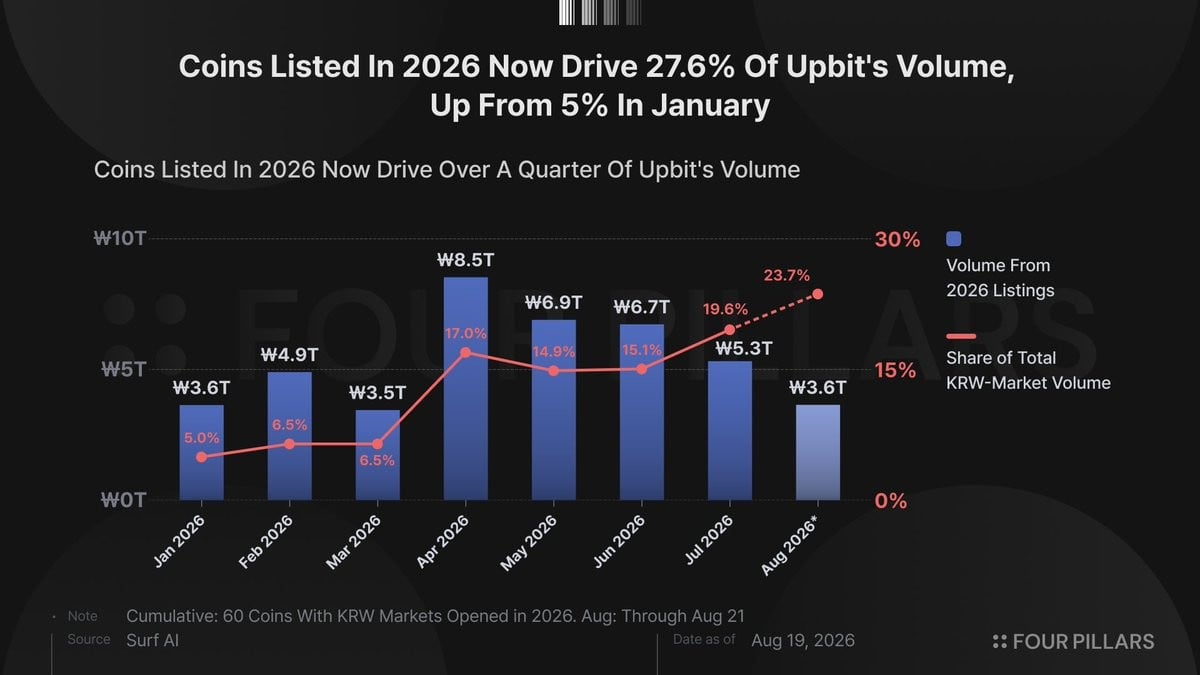
As of August, 61 tokens have launched KRW trading pairs on Upbit this year. These new coins collectively contribute between 3 trillion and 8 trillion KRW in monthly trading volume. While total market-wide trading has shrunk to one-third of January levels, trading volume generated by this year’s new listings has consistently risen from an early-year low. Consequently, the share of total volume attributable to newly listed coins jumped from just 5% in January to 27.6% in August. Since Upbit applies a uniform fee structure across its KRW market, nearly a quarter of its current fee revenue comes directly from these tokens listed earlier this year.
Looking at individual token performance, newly listed coins account for an average of 1.2% of total market volume within their first 30 days. Standout projects can even capture 4%–5% of the share: CHIP reached 4.8%, RE hit 4.0%, and SLX stood at 3.8%. CAP, which debuted in August, already captured 4.5% in its first 16 days and continues to contribute. In stark contrast, stablecoins like USDS, RLUSD, and USDG consistently hold below 0.1% of trading volume. Even when newly listed, they barely generate any incremental volume.
In other words, during a market downturn, new listings have become almost Upbit’s only internal lever for influencing trading volume. But this lever hasn’t grown the overall pie or genuinely revitalized market sentiment. It merely expands the slice for new tokens at the expense of a shrinking total market.
For years, South Korean digital asset exchanges like Upbit and Bithumb have been viewed as the primary gateway for global access to KRW exposure, carrying immense strategic value. A listing often commands a significant “Upbit premium,” making it a scarce resource fiercely contested by project teams. However, this dynamic is shifting this year—being listed on Upbit is increasingly treated less as a catalyst for generating fresh demand and attracting incremental capital, and more as a defensive tool to plug contracting volumes and stabilize fee income.
The fact that the listing premium remains effective today shows that genuine buyers still exist in this market. Yet, the more frequently this lever is pulled, the fewer viable tools remain. Premiums are inherently built on scarcity, but that scarcity is being gradually eroded now, drained to barely preserve trading scales throughout a bear run. When the next cycle truly heats up, whether KRW liquidity will retain its full strategic value—or whether it will be diluted by incessant listings—remains an open question.
For the broader landscape of Asian centralized exchanges, Upbit’s strategy may simply be a microcosm: when macro liquidity and market sentiment both weaken, exchanges are forced to rely on short-term tactics like token listings to maintain their baseline operations. But once scarcity is overdrawn, the very foundation of long-term competitiveness may begin to unravel.
Join TechFlow official community to stay tuned
Telegram:https://t.me/TechFlowDaily
X (Twitter):https://x.com/TechFlowPost
X (Twitter) EN:https://x.com/BlockFlow_News
 @r2Jamong