Agency Business and API Merchant Endpoints: How Trust Costs Determine the Market Tipping Point
Written by: Jun__Yoo
Compiled by: AididiaoJP, Foresight News
Imagine the following scenario: You plan to purchase an item worth $1,000, and you are faced with two checkout options:
- Fully Automated AI Checkout: From product recommendation to payment completion, the entire process is operated independently by an AI agent.
- AI-Assisted Checkout: AI is only responsible for information search and product recommendation, while the final payment decision and execution are still confirmed by you.
How would you choose? The author is optimistic about the prospects of Agentic Commerce, but at this stage, I would not hesitate to choose the latter. I believe most consumers would make the same judgment. What is the core reason behind this?
This article aims to first clarify the concepts of Agentic Commerce and API Merchant Endpoints, then analyze the "Trust Cost" that causes consumers to worry about fully automated checkout, and finally explore the potential breakout points of this market and its future evolution path.
I. Concept Definition: Agentic Commerce and API Merchant Endpoints
Agentic Commerce refers to a business form where AI agents, after obtaining authorization from individuals or enterprises, autonomously execute product and service search and comparison, and partially or fully complete the ordering and payment process. Major global consulting firms predict that by 2030, the scale of purchase transactions directly or indirectly involved by agents will reach trillions of US dollars.
Based on the level of authorization obtained by AI agents, their development can be divided into three stages:
- T1 Assistance Stage: AI is responsible for search and recommendation, while the final payment step is confirmed by humans.
- T2 Delegated Execution Stage: Humans preset budgets and purchase conditions (such as spending limits), and the agent autonomously places orders and pays within these constraints.
- T3 Fully Autonomous Stage: Software autonomously selects and purchases resources callable by external machines (such as API interfaces, data, cloud services, etc.), without requiring manual approval for every transaction.
In the T3 stage, an emerging business form is arising: API Merchant Endpoint (Headless Merchant Endpoint). Such merchants have no traditional website interface and only receive payments and deliver services through API endpoints. It is seen as a new form that SMEs may present following physical retail and traditional e-commerce.
A real early market has already formed: AI agents purchasing software resources and services from other software. A new generation of developers (often referred to as "Vibe Coders") has also begun building native Agentic Commerce businesses. Against this background, stablecoin wallets, blockchain networks, discovery platforms, and transaction coordinators (Facilitators) are entering the field, attempting to capture value at different levels.
II. Trust Cost: The Core Variable of Agentic Commerce
Before discussing the breakout path of Agentic Commerce, it is necessary to examine the evolution logic generally expected by the market.
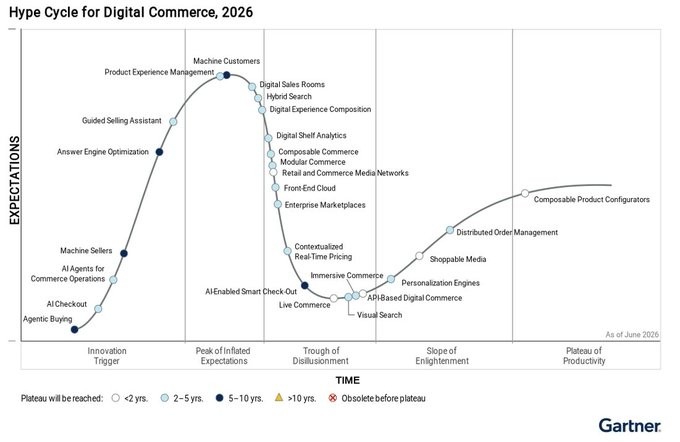
The mainstream view holds that Agentic Commerce will follow a path of gradual development from low authorization (T1) to high authorization (T3), accompanied by the gradual accumulation of trust. Many protocols and technologies follow this trajectory.
However, this article argues that the actual order of market formation may be exactly the opposite. Agentic Commerce may achieve a breakthrough first in the T3 stage with the highest level of authorization, especially concentrated in the niche market of API Merchant Endpoints.
Recall the case at the beginning. Facing a $1,000 item, the fully automated AI checkout option makes one hesitate. But if the scenario is replaced with: purchasing data worth $10 from an API endpoint, would your choice change? If you still lean towards assisted checkout, what if the amount is reduced to $0.1 or even $0.01?
Why do changes in transaction amounts lead to decision differences? The fundamental reason is that every choice involves risk. When the expected risk of a decision is higher than the expected benefit, we tend to reject that option.
We define this risk and psychological burden as Trust Cost. Trust Cost is the sum of risks and psychological burdens that users must bear when adopting a certain technology or service. It varies with the level of authorization and is also influenced by factors such as transaction amount, result verifiability, and recoverability.
III. Delegation Zone and Its Expansion Mechanism
With the concept of Trust Cost, we can define the "Delegation Zone"—that is, the range within which users are willing to accept a certain technology or service at a specific authorization level.
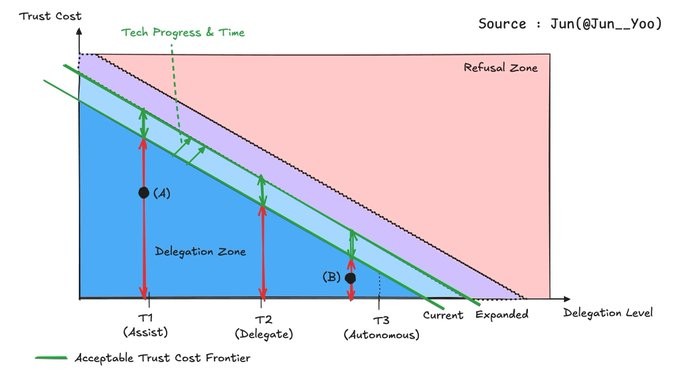
In the T1 stage, since users retain final approval rights, they can bear higher Trust Costs, thus covering services with larger transaction amounts and higher risks. As the authorization level progresses towards T3, users are only willing to grant permissions to those services that have compressed Trust Costs to extremely low levels. Therefore, the current Delegation Zone is widest at the T1 stage and gradually narrows towards the T3 stage.
However, the Delegation Zone is not static. With technological progress and user experience accumulation, the Delegation Zone can gradually expand. Looking back at the development of e-commerce from the late 1990s to the early 21st century: early e-commerce focused on low-value, standardized goods such as books and CDs, precisely due to consumer concerns about online payment security. With the improvement of payment systems and security mechanisms, and the formation of consumer habits, online purchase of high-value appliances and even cars became the norm.
For a service to be adopted by users, it must first enter their Delegation Zone. There are mainly two paths for this:
- At low authorization levels (T1), wider Trust Cost tolerance makes services easy to enter;
- At high authorization levels (T3), service providers must compress Trust Costs low enough to cross the Delegation Zone boundary.
It needs to be emphasized that entering the Delegation Zone only represents "acceptable" from a risk perspective, while actual adoption also requires the net benefit of the service to be positive.
IV. Adoption Decision: Net Benefit Determinism
Whether a user adopts a certain agent service, their decision model can be simplified as: Does the benefit brought by the agent exceed its Trust Cost (including supervision costs and potential risks)?
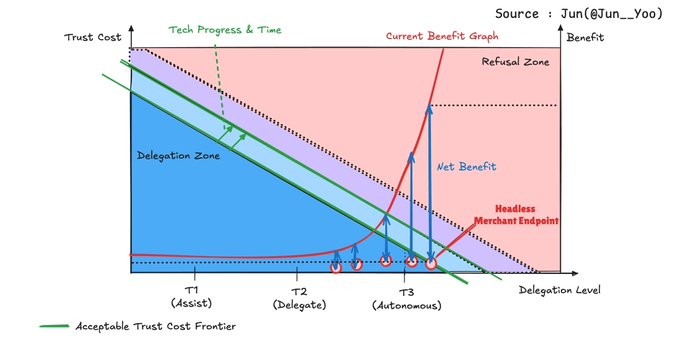
It is worth noting that increasing authorization does not necessarily bring a proportional increase in benefits. If users still need to verify every action of the agent, their supervision costs will largely offset the benefits brought by automation. More critically, human attention cannot achieve "partial recovery." The difference between a process where the agent handles 90% and humans handle 10%, and a process where 100% is handled by the agent, is far from 10%. That remaining 10% human intervention is enough to completely change the allocation structure of attention.
This explains why benefits may show a non-linear leap when approaching the T3 authorization level. Just like the difference between autonomous driving L2 and L3 levels, it is not about vehicle performance, but whether the driver still needs to continuously monitor. Only when the supervision obligation is completely lifted does the supervision cost approach zero. At this point, one person can manage multiple agents simultaneously, and benefits will show exponential growth.
From a net benefit perspective, its value is the difference between "benefit" and "Trust Cost." The larger the gap, the higher the user adoption willingness. The real market opportunity lies in those fields that can reach the T3 authorization level while benefits still significantly exceed Trust Costs. In such markets, Product-Market Fit is easiest to form.
API Merchant Endpoints exactly meet all the above conditions.
V. Why Focus on API Merchant Endpoints?
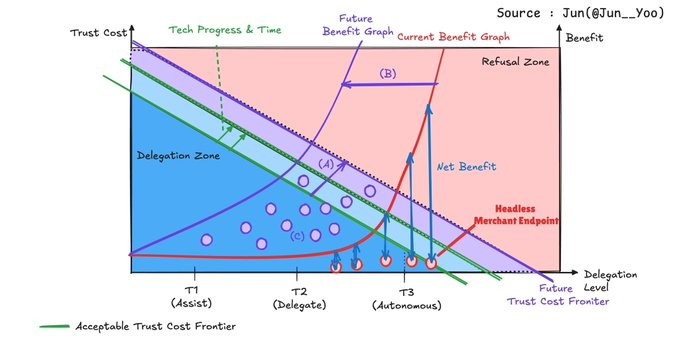
The importance of this market is reflected in the following levels:
- Limited Downside Risk: In high-frequency, low-unit-value Machine-to-Machine (M2M) transactions, the loss caused by a single transaction failure is limited.
- Immediate Automation Benefits: Agents autonomously coordinate the procurement process according to preset strategies and budgets, significantly saving manual search, price comparison, and approval costs.
- Results Easy to Verify: The final output (such as data, calculation results) usually has clear verification standards, and user risk is controllable.
In this scenario, users can easily perceive that "benefits exceed Trust Costs." Suppose the end user needs an output worth about $10, the agent needs to combine multiple data and computing resources to complete it. One output may involve multiple links such as data retrieval, model inference, computing power purchase, calling professional agents, and result verification. If humans manually find suppliers, compare prices, and approve payments one by one, the search and approval costs may far exceed the value of the task itself.
Under this structure, a single user request will be decomposed into multiple external calls (serial or parallel), each step involving payment to different suppliers. As task complexity increases, the number of potential payment events will increase sharply. In a multi-layer agent structure, payment events may grow non-linearly.
With the accumulation of payment data and transactions in this market, trust mechanisms will also gradually mature. Safeguards such as proof of delegation, spending limit enforcement, result verification, and dispute arbitration, after repeated testing in low Trust Cost scenarios, will promote the increase of the upper limit of acceptable transaction amounts at the same authorization level. This may trigger the following evolution:
- Delegation Zone Expansion: The boundary of acceptable Trust Costs moves up and expands to the right, and the range of tasks users are willing to delegate expands.
- Benefit Curve Shifts Upward: Services and ecosystems mature, and the total benefits users can obtain increase.
- Adoption Zone Expansion: Services that previously did not meet the adoption threshold will gradually enter the user selection range.
This will form a self-reinforcing positive cycle, promoting the joint growth of markets at various stages of T1, T2, and T3.
Therefore, API Merchant Endpoints are very likely to become the first sandbox environment to fully test the entire process of Agentic Commerce with low Trust Cost digital resources. Although the transaction amount is small, the payment frequency is extremely high, providing dense testing and iteration opportunities for trust architecture and payment infrastructure.
VI. Key Layers Worth Attention
If the API Merchant Endpoint market develops according to the above path, the following five layers are worth focusing on:
- Stablecoin Issuers: Earn reserve asset yields from the new net circulating balance.
- Blockchain Networks: Charge network fees for payment events settled on-chain.
- Coordinators (Facilitator): Charge verification and settlement fees for each payment event managed.
- Wallets: Control budget execution and asset flow before and after payment, and provide related financial services.
- Discovery Platforms: Take a cut from routed payment volume through supplier search and order allocation.
The API Merchant Endpoint market has the potential for non-linear growth. It seems most cutting-edge, but may become the field in Agentic Commerce that is understood by the market earliest and realized fastest. This trend is worth continuous attention and in-depth tracking.
Join TechFlow official community to stay tuned
Telegram:https://t.me/TechFlowDaily
X (Twitter):https://x.com/TechFlowPost
X (Twitter) EN:https://x.com/BlockFlow_News
 @Jun__Yoo