2x Long SK Hynix ETF (07709) Renamed, Do Investors Still Have Hope of Breaking Even?
Author:Gelong
For a fund to change its name sounds ordinary enough.
But changing "2x Long Hynix" to "At Most 2x Long Hynix"—adding the two words "At Most"—could mean the hope of breaking even for tens of thousands of unitholders is extinguished right there.
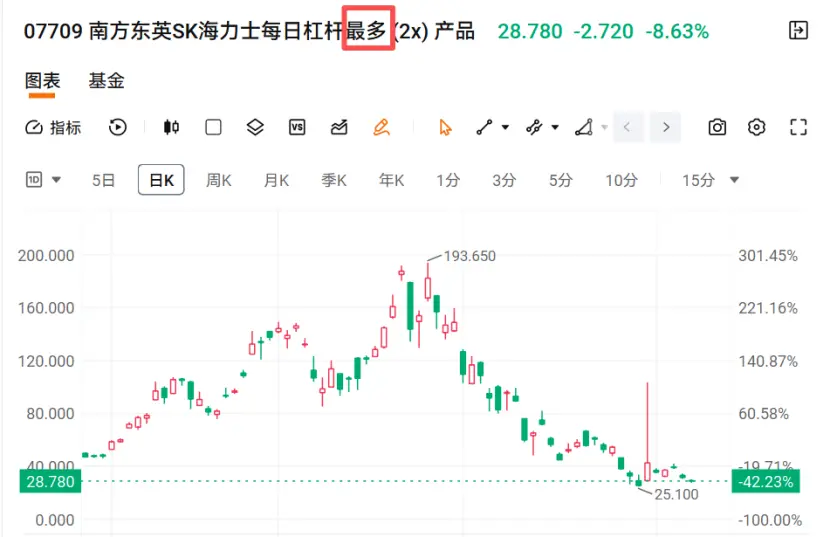
07709 is a CSOP 2x Leveraged ETF tracking South Korean semiconductor giant SK Hynix.
When it listed in October 2025, the issue price was only 7.8 HKD. Coinciding with the AI wave sweeping the globe, SK Hynix, as a core supplier of HBM chips, saw its stock price soar. This product went crazy along with it; by June 2026, the price surged to 193.65 HKD, a gain of over 10 times, with size breaking through 130 billion HKD, becoming a hot favorite in the market.
However, leverage has always been a double-edged sword.
In late June, SK Hynix's underlying stock fell from its highs, and the 2x long 07709 plummeted accordingly. The maximum decline was nearly 87%, falling from 193.65 HKD to around 25 HKD, with billions in market value evaporating. As of press time, the latest price of 07709 is 28.6 HKD.
Just as unitholders waited anxiously, hoping a rebound in the underlying stock would help them break even, the fund company CSOP made its move.
An announcement on July 27 declared that starting August 3, the product would switch to a "flexible leverage structure"—the leverage multiple would no longer be fixed at 2x, but could be dynamically adjusted between 1.1x and 2x.
In plain language, this means: when the market is good, they'll try to give you 2x; when the market is bad, they'll quietly drop it to 1.1x.
Objectively speaking, during a market crash, reducing the leverage multiple can reduce the ETF's decline, serving to protect investors. But the problem is, if the market bottoms out and rebounds, reducing leverage will make it slower for losing investors to break even, consuming more time costs, capital costs, etc. This is especially pertinent given that the Korean stock index, SK Hynix, and Samsung Electronics stock prices have already retraced so much, and Morgan Stanley has issued a report stating that the leverage clearing in Korean stocks is nearing the end and valuations are becoming attractive again.
Of course, this change has a specific background: the Securities and Futures Commission (SFC) of Hong Kong released new regulations regarding leveraged products on July 24, allowing products to adjust target leverage multiples under extreme market conditions. Procedurally, the fund company may not have violated any rules.
But does compliance necessarily mean reasonableness?
When rising, "2x" is the selling point to attract capital; when falling, "2x" becomes "At Most 2x", shrinkable at any time.
For the same product, the same batch of unitholders, the treatment between rises and falls is like night and day.
Although this operation is not illegal, it effectively rewrites the rules of the game, touching upon the most core and sensitive point of the fund industry, even this financial market, and the business society—contractual spirit.
For fund companies in Hong Kong, changes such as investment objectives, performance benchmarks, and diversification restrictions that damage investors' original expectations belong to major changes to the fund constitution and cannot be changed unilaterally by the manager.
The formal process for modifying rules is as follows:
1) The fund company and trustee submit filing to the Hong Kong SFC in advance to obtain regulatory pre-examination opinions;
2) Send a circular to all unitholders and convene a unitholder meeting;
3) A special resolution needs to be passed: more than 75% of the voting shares present must approve for it to take effect;
4) The notice period must be at least 30 days in advance, giving unitholders buffer time to redeem and exit;
5) Only after final approval by the SFC does the constitution revision officially take effect.
Did this company go through these procedures for such a major modification to the product, and did it obtain the consent of the fund unitholder meeting? If there are procedural issues, should the fund unitholders join together to claim compensation for the losses suffered?
What is more thought-provoking is that the fund charges a 1.60% management fee annually, accumulating approximately 356 million HKD in revenue from listing to present.
When the NAV surges, management fees rise with it; when the NAV plummets, management fees are collected without error.
Now that the rules have changed, the fund company has successfully avoided liquidation risk and continues to make money steadily, while unitholders who entered at high positions may not even have this last hope of waiting for the underlying stock to rebound and turning the tables via leverage.
To put it plainly, this name change is essentially sacrificing the unitholders' potential to break even in exchange for the fund company's own survival and continuity.
This structural misalignment where the manager earns steadily while unitholders lose alone is the most terrifying part.
Theoretically, if the fund company predicts the stock price will bottom out and rebound, it can adjust the leverage back to 2x, but this requires very high trading capability and precise prediction to achieve. If the fund company truly had such capability, why did it fail to successfully predict the significant retracement over the past month?
The chill here is not about the K-line chart, but a cruel story about rules, contracts, interests, and trust.