Altcoin Market Making Black Box: How Project Teams Use "Loans + Call Options" to Create Hidden Selling Pressure?
TechFlow Selected TechFlow Selected
Altcoin Market Making Black Box: How Project Teams Use "Loans + Call Options" to Create Hidden Selling Pressure?
Perpetual contracts, on-chain shorting, and on-chain lending information—these three waves of democratization are gradually prying open this black box.
 Navigating Web3 tides with focused insights
Author: WuBlockchain
Compiled by: TechFlow
TechFlow Intro: What does "5% allocated to market makers" in tokenomics actually mean? Is it borrowed or sold? What is the strike price? Must the tokens be returned at expiry? These three questions determine the price trend of an altcoin for an entire year, but retail investors almost never see the answers. The accidental exposure of the Movement Labs token protocol lets us see clearly how this black box operates for the first time.
If you are as curious as I am about what "5% allocated to market makers" in tokenomics actually means, this article is worth reading. Is this 5% borrowed or sold? What is the strike price? Must tokens be returned at expiry, or can options be exercised? The answers to these three questions can determine the price trend of an altcoin for an entire year, but retail investors almost never see them.
Introduction
In the spring of 2025, a few months after Movement Labs launched the MOVE token, something both familiar and unusual happened in the crypto space.
It was familiar because this story followed the standard altcoin script: TGE marked the price peak, market makers were accused of continuous dumping, the project publicly denied the accusations, and the price gave the clearest verdict.
The unusual part was that the market making protocol itself was exposed. Chat logs, term sheets, market maker holdings, strike prices, and borrowed token quantities were gradually revealed through Twitter, investigation reports, and community discussions. For the first time, the industry was able to see, through a specific project, how the standard MM lending structure—the "token lending + call option" protocol—turns what should be a liquidity service into a channel for market makers to dump at zero cost after listing.
Looking back, MOVE is not an exception but the norm. The only difference is that someone leaked the protocol. Even beyond scheduled unlocks, the continuous selling pressure common in altcoins is largely rooted in the same type of arrangement. But most of the time, these protocols are buried in PDF files, encrypted Signal groups, and informal understandings known only to the project and its market makers.
If the evolution of the crypto market over the past decade is boiled down to a core theme, it is that capabilities once controlled by a small group—including leverage, shorting, and information—are gradually being transferred to retail investors through on-chain protocols. Perpetual contracts broke the asymmetry of leverage access. Protocols like Shortit are breaking the asymmetry of shorting rights. Putting MM lending details on-chain will dismantle the last barrier: information asymmetry in the primary market.
Once these three forces converge, the altcoin market will for the first time possess a price discovery structure comparable to traditional capital markets.
This article explores these three waves of democratization: how they emerged, why they are converging, and what the altcoin market will look like once realized.
Triple Asymmetry in Altcoin Price Discovery
Altcoins are not stocks. This sounds obvious, but almost every structural problem in the altcoin market stems from a widely assumed but rarely stated fact: it has the appearance of a financial market, but almost none of its underlying framework.
A US stock IPO must pass SEC review, underwriter pricing, roadshows, lock-up periods, post-listing market making rules, and insider selling disclosure requirements. Every stage is bound by public and enforceable rules. Retail investors may not sit at the same table as Goldman Sachs, but they at least know the shape of the table: float size, when insiders are allowed to sell, who the market makers are, and whether there are restrictions on naked short selling.
Altcoins are different. From launch to secondary market trading, almost all the most important variables do not require mandatory disclosure. Actual effective circulating supply, market maker identity and holdings, option strike prices and unlock schedules—all variables that directly shape price expectations—are usually hidden from retail investors.
This structural opacity has long created three layers of asymmetry in the altcoin market.
The first layer is leverage asymmetry. In the early crypto market, especially before 2017, spot trading was almost the only option. Even if retail investors' judgment was correct, they could only express themselves through unleveraged spot positions. In contrast, projects, VCs, and market makers could amplify the same directional bets many times over through OTC lending, derivatives trading desks, and proprietary capital deployment. Therefore, even if two participants in the public market obtained the same information, their ability to act was fundamentally unequal.
The second layer is direction asymmetry. Before perpetual contracts, the crypto market was essentially a long-only market. Short positions for BTC and ETH could be barely constructed through spot lending, but altcoins were almost impossible to short. This created a peculiar equilibrium: the marginal incentive of almost every market participant pointed in the same direction, namely to push the price up first. Only because price increases could generate returns were narratives, KOLs, media coverage, and marketing budgets incentivized to pull in the same direction. A large part of the reason the altcoin market has long relied on narratives stems from it being structurally a one-way market.
The third layer is information asymmetry. Even if retail investors obtained leverage and shorting tools, they still did not know at what price or when to act. They did not know the actual effective circulating supply, how many tokens were lent to market makers, option strike prices, or the economically rational choices for market makers at different price levels. The project knows, VCs know, market makers know. Only retail investors are kept in the dark.
These three asymmetries together created the most enduring power structure in the altcoin market over the past decade: projects, early VCs, and market makers simultaneously controlled information and tools. They could reposition before each round of tokens was passed to retail investors, ultimately transferring price risk to participants lacking equal access. This is a problem in altcoin market design, not a moral defect specific to a certain project.
Next is one of the most important structural shifts in the crypto space over the past decade: how these three asymmetries began to disintegrate.
Perpetual Contracts: Democratization of Leverage
In 2016, BitMEX launched a product that seemed strange at the time in the Seychelles: perpetual contracts, a derivative with no expiry date using funding rates to track spot prices.
There is no exact equivalent of this invention in traditional finance. Traditional futures always have expiry dates, and these dates determine their hedging and arbitrage structures. BitMEX removed the expiry date and introduced funding rates as the cost of holding positions. From an engineering perspective, this standardized infinite-term leveraged positions and made them liquidatable and custodial.
Before this, crypto retail investors wanting leverage could only use "margin spot trading" on CEXs. In practice, this meant borrowing money from the exchange to buy tokens, a process that was cumbersome, had opaque costs, and primitive liquidation mechanisms. Institutions operated in completely different ways, using proprietary trading books, OTC lending, and cross-exchange arbitrage. Leverage was already a standard part of their toolkit.
Leverage has existed for a long time. What perpetual contracts truly changed was their accessibility. BitMEX offered up to 100x leverage, allowing anyone with USDT to open positions. After Binance entered in 2019, it brought this mechanism to global retail investors. The trading interface was simplified to two buttons, long and short, margin ratios were automatically calculated, and liquidation queues were visible to everyone.
The 2021 bull market provided the final validation for this shift: perpetual contract daily trading volume exceeded spot trading volume. The main venue for price discovery in the crypto space shifted from the spot market to perpetual contracts.
This shift is often described as "retail investors being harvested by perpetual leverage." This assessment is only half true. Perpetual contracts did lead to a large number of retail investors being liquidated when using high leverage, but they also gave retail investors a tool for the first time, allowing them to make leveraged bets with institutions on equal footing. Before perpetual contracts, even if retail investors correctly predicted market direction, the maximum size of positions was limited by the amount of capital available for spot trading. After perpetual contracts, a trader's position capacity was limited only by personal risk tolerance and margin management.
More frequent liquidations are the cost of leverage democratization. This is an inherent feature of the tool, not necessarily a defect. A market that allows retail investors and institutions to bet at the same table must make everyone bear the same risk structure.
But perpetual contracts only solved leverage asymmetry. Even with 100x leverage, a retail investor expecting an altcoin to fall might still find no suitable tools. Most altcoins do not have perpetual contracts. Even if they do, liquidity is often so thin that funding rates eat up returns. Perpetual contracts solved leverage and direction asymmetry for major cryptocurrencies, but left two layers of unresolved problems: direction asymmetry for altcoins and information asymmetry for all tokens.
These are the problems that must be solved in the next decade.
Shorting Rights: Democratization of Directional Exposure
If you believed in 2023 that a certain altcoin would fall—perhaps an L1 that peaked at listing, a GameFi token with valuation detached from fundamentals, or an AI agent token with exhausted narratives—you would encounter an awkward reality: there was almost no way to short it.
Perpetual contracts on CEXs cover only a few major cryptocurrencies. Most altcoins outside the top 50 by market cap either have no derivatives or only a contract with extremely poor liquidity. Order books may be so thin that a trade of a few tens of thousands of dollars could move the price by 5%. Funding rates might be consistently positive for shorts, meaning traders have to pay a "shorting tax" every 8 hours, while liquidation thresholds are extremely unfavorable for position holders. Therefore, even if market judgment is correct, liquidity constraints erode the trader's ability to act, making shorting mathematically unattractive.
Shorting through spot lending barely exists for altcoins. No CEX is willing to maintain a lending market for long-tail tokens because liquidity is insufficient and risk is too high for lenders.
This created a long-term structural problem in the altcoin market: it is a long-only market.
A long-only market produces a set of specific equilibrium effects. The marginal incentive of all market participants points in the same direction. Projects want prices to rise. VCs want prices to rise. MM wants prices to rise, at least before exercising options. KOLs want prices to rise. Media wants prices to rise. Secondary market retail investors want prices to rise. When everyone in the market can only profit when prices rise, narratives, traffic, marketing, and community operations all focus on one question: how to push the price up a little more? This is an incentive structure problem, no need to frame it as a moral issue.
The deeper consequence is that when no one can bet on declines, negative information can never be priced into the market. Efficient markets require pessimists and optimists to bet against each other at the same price for that price to approach fair value. For most of the past decade, only optimists could bet in the altcoin market. The only option for pessimists was not to buy, and not buying leaves no signal in the price.
This is the problem that on-chain shorting protocols like @youcanshortit attempt to solve: allowing any retail investor to short any token at any time at a transparent pricing cost. The core mechanism can be simplified as follows. The protocol maintains a lending pool, allowing any token holder to lend tokens to short sellers. Short sellers pay a transparent interest rate determined by supply and demand in the pool, rather than a CEX black box. Stablecoins obtained from selling borrowed tokens remain in the protocol as collateral. If the token price rises, the position is liquidated. If it falls, the short seller profits.
In traditional finance, this mechanism is called securities lending, a professional market open only to institutions. In the crypto space, it must operate on-chain and be open to retail investors because no CEX is willing to provide this service for long-tail tokens. For them, it makes no economic sense at all.
The value of democratizing shorting rights is easily misunderstood. Most people think this just allows retail investors to bet on price declines and profit from crashes. This is only the tip of the iceberg. Shorting has always been mathematically difficult, and risks are asymmetric, so even with tools, most retail investors may still not be profitable. What it truly changes is something deeper. Once tokens can be shorted, overly optimistic narratives will be tested by short sellers, and overly pessimistic narratives will be tested by short covering. The altcoin market begins to take the form of a two-way debate.
But even with two-way position tools, retail investors still face a fundamental problem: they do not know at what price or when to short. The most important variables determining mid-to-short-term supply in altcoins, namely market maker holdings and option strike prices, remain invisible to them.
This is the third asymmetry, and the true last mile.
Putting Market Maker Lending Information On-Chain: Democratization of Information
A. Standard Structure of Market Maker Lending
To understand why market maker lending is the core of altcoin information asymmetry, one first needs to understand its standard structure. Even for retail investors who have been in the cryptocurrency space for many years, they may have heard the term "market maker" but never seen what a real market maker agreement looks like.
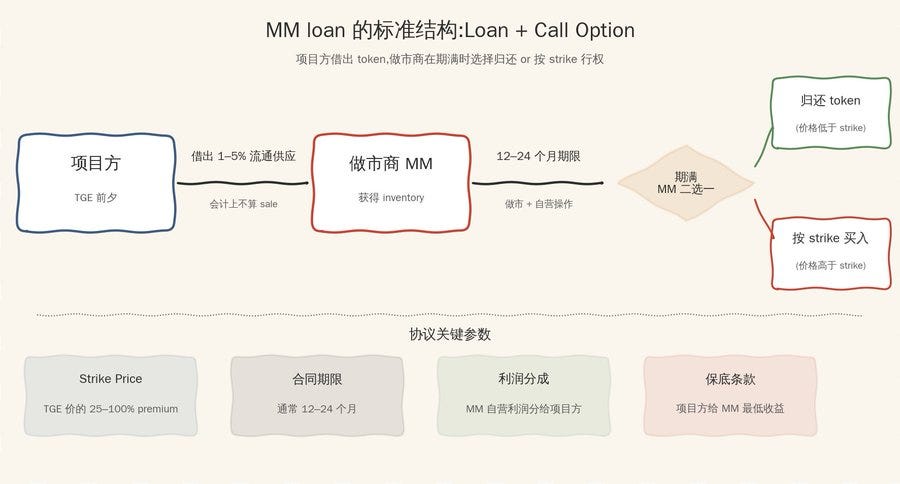
Agreements between altcoin projects and market makers almost always follow the same template: lending + call options.
Shortly before TGE, the project provides a certain number of tokens to the market maker in the form of "lending", usually equivalent to 1% to 5% of the circulating supply. From an accounting perspective, the word "lending" is important. The project did not "sell" tokens, so no sales revenue needs to be disclosed. In tokenomics documents, these tokens are still classified as "market maker allocation" or "liquidity reserve". The protocol usually lasts 12 to 24 months. At expiry, the market maker has two options: return the same number of tokens, or purchase them at a predetermined strike price. In financial terms, this choice to buy or not buy is a European call option. The strike price is usually set at 25% to 100% higher than the TGE price.
The agreement may also include profit-sharing arrangements, downside protection clauses, and market making obligations, but lending + call options is the underlying framework.
This structure is extremely attractive to both parties. The project gains immediate secondary market liquidity without directly selling tokens. From an accounting perspective there is no sale, and the tokenomics narrative remains clean. The market maker's situation is even more favorable. It obtains a large inventory without upfront costs, gains an upside option, and bears almost no downside risk. If the price falls below the TGE price, the market maker simply returns the tokens without needing to recognize impairment losses. Incentives are asymmetric. The project bears the opportunity cost, because if the token price rises and the market maker exercises, the project loses the opportunity to sell these tokens at a higher price. The market maker gets all upside gains and bears almost no downside risk. This is why market making has become one of the most profitable businesses in the cryptocurrency space over the past few years, although almost no retail investors understand the actual structure of this business.
B. How This Structure Systematically Drives Dumping
Once the agreement structure is understood, one can understand why many altcoins face continuous selling pressure even beyond token unlocks. The key is to study the market maker's rational choices in different price ranges.
When the price is far below the strike price, the probability of the market maker exercising is close to zero. When the market price has already fallen to $0.50, it will not purchase tokens at a strike price of $2. In this case, the borrowed tokens have no long-term ownership value to the market maker because they must eventually be returned. The rational choice is to sell before returning, buy back at a lower price, and lock in the spread. Each round of "sell high buy low" allows the market maker to generate profit using tokens lent by the project. Any part not bound by profit sharing becomes pure profit for the market maker.
As the price approaches the strike price, incentives become more complex. If the price rises above the strike price, the market maker needs to purchase the borrowed tokens at the strike price at expiry. Price increases benefit the market maker, but exercising still has costs. The rational approach is to sell in advance as a hedge, partially offsetting potential exercise obligations. From a market perspective, this creates an invisible supply wall near the strike price, thereby suppressing attempts to break through that level.
These two mechanisms together produce one of the most common but hardest to explain phenomena in the altcoin market: continuous and seemingly irregular selling pressure beyond token unlocks. Retail investors see prices fall but cannot find any unlock events to explain it. This is because the selling pressure does not come from the project or its VCs, but from market makers holding tokens "lent" by the project. In tokenomics documents, these tokens are classified as "liquidity reserves". But from a trading perspective, they are actually already in circulation and generating continuous selling pressure.
This is the structural basis of so-called "price control". When a token's price seems to be precisely controlled within a certain range, every rise repeatedly hits a ceiling, and every fall always finds buyers, behind it is likely an option-driven market maker behavior model at work. Retail investors just cannot see its parameters.
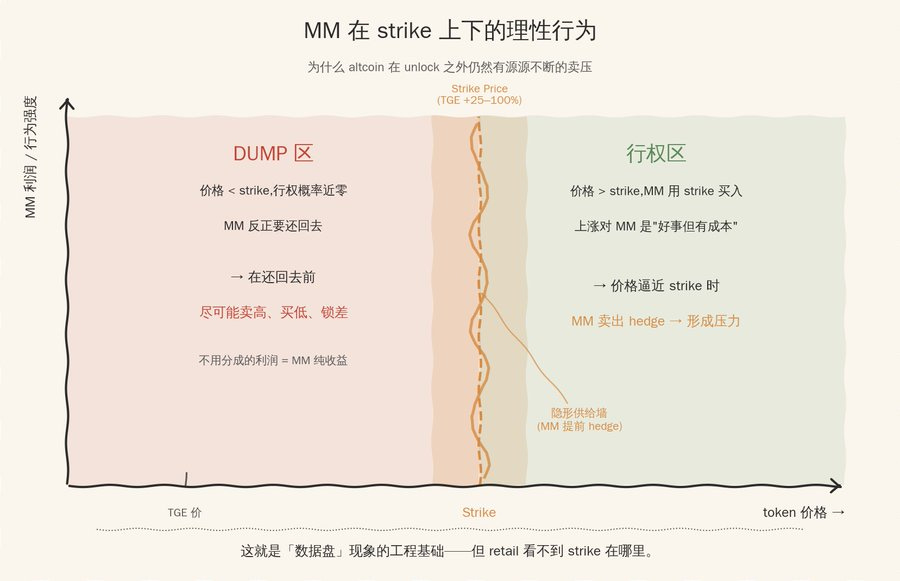
Figure: Schematic of dumping mechanism—market makers "sell high buy low" when far below strike price, preset selling when approaching strike price, forming continuous invisible selling pressure beyond unlocks. Source: WuBlockchain
C. What On-Chain Information Should Be Disclosed?
If market maker lending is considered the most important black box variable in the altcoin market, the next question is what information should be disclosed.
Not every detail needs to be public. The market maker's quoting algorithms and risk management parameters are part of their alpha, and putting them on-chain would destroy their business model. What should be disclosed is the minimum information set that directly affects retail investors' price expectations, without exposing the market maker's proprietary algorithms: quantity of borrowed tokens and related wallet addresses, contract term, strike price, unlock and repayment schedule, profit sharing mechanism, and any downside protection and default clauses.
These six fields together provide retail investors with enough information to infer the market maker's rational reactions in different price ranges using standard financial analysis, turning the current black box into a modellable supply curve. The market maker's specific trading behavior constitutes their alpha and does not need to be disclosed. What should be disclosed are the incentive parameters behind that behavior.
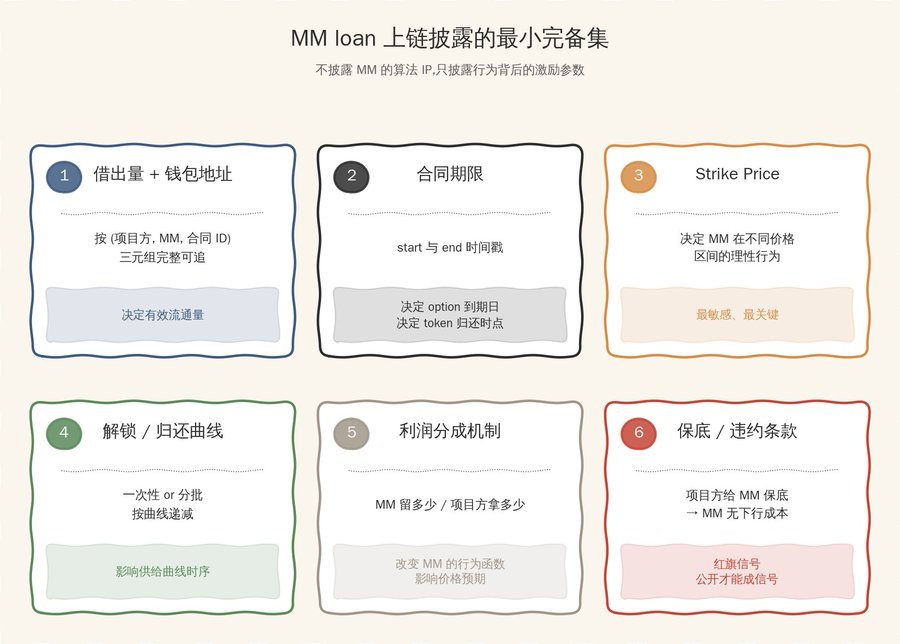
Figure: Six major fields that should be disclosed on-chain—lending quantity and addresses, contract term, strike price, unlock and repayment plan, profit sharing, downside protection and default clauses. Source: WuBlockchain
Technical implementation is not complex. A standardized schema, a contract requiring every token lending to be recorded in an on-chain registry, and an indexing service that analysts can query can all be built with a few hundred lines of EVM code. The real challenge has never been technical, but incentives: how to persuade projects and market makers to put this information on-chain. This is the issue to be discussed in the next section.
D. What Will Happen to the Altcoin Ecosystem After Disclosure?
If this disclosure becomes reality, several changes will occur immediately in the altcoin market.
The selling pressure structure will become readable. The "circulating supply" reported in tokenomics documents will for the first time be separated from the number of tokens lent to market makers. Retail investors will be able to directly calculate:
Reported Circulating Supply + Tokens Lent to Market Makers = Actual Sellable Supply
Once strike prices are public, price fluctuations near the strike price will be priced in by the market in advance. Strike prices will become new key levels in altcoin technical analysis, similar to "institutional cost basis" in stocks, but more precise because it is written in the contract. Combined with shorting tools like Shortit, retail investors will for the first time be able to build symmetric positions around strike prices.
Accountability will become enforceable. Today, when tokens plunge, projects can claim this is "market behavior", and market makers can claim this is "passive hedging". After disclosure, every outflow from a market maker wallet corresponds to a public contract, and any dumping can be attributed to a specific project-market maker pair. Reputation costs will enter the market maker's decision function for the first time. Projects will also no longer be able to say both "the team has no selling pressure" and "we are working with top market makers". After disclosure, they must choose one.
The most important second-order effect will be the "transparency premium". Once some projects start actively disclosing, those that do not will be assumed to be in the worst case, similar to proof of reserves. Retail investors will assume these projects have lent out a large number of tokens, set low strike prices, provided generous downside protection, and discount valuations accordingly. Therefore disclosure will change from a cost to a signal, from self-discipline to a tool for obtaining valuation premiums. This is the endogenous incentive that makes any disclosure mechanism sustainable. It is not driven by compliance pressure, but by market pricing pressure.
Of course, all of the above describes ideal scenarios. In reality, implementation will be extremely difficult.
Altcoin Market After the Convergence of Three Forces
Leverage, direction, and information. The three asymmetries discussed in previous chapters were solved by three different types of protocols over the past decade. When these three waves of democratization are considered together, a new market structure begins to emerge.
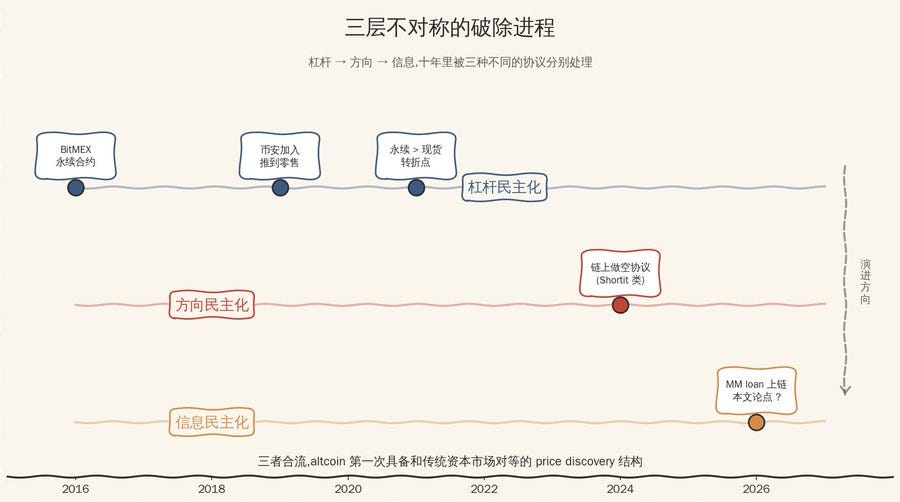
Figure: New altcoin market structure after the convergence of three waves of democratization—leverage, shorting, information; price discovery shifts from "narrative + liquidity" to "information + expectations". Source: WuBlockchain
Leverage democratization allows retail investors to amplify bets when correctly judging market direction. Shorting democratization allows them to hold positions when expecting price declines. Information democratization allows them to know for the first time at what price and what time to bet. Only when all three are present do retail investors finally have a complete set of tools to compete with institutions at the same table.
Once the three tools are in place, the price discovery mechanism itself begins to change.
Altcoin price discovery has long been dominated by two factors: narrative, i.e., whose story can attract the most attention; liquidity, i.e., who can deploy the most capital to push prices to specific levels. Before these three waves of democratization, both were always controlled through coordination between projects, VCs, and market makers. Retail investors were always the receivers of narratives and providers of liquidity. The former determined what they bought, the latter determined when others dumped on them.
Once these three asymmetries are broken, the core driver of price discovery shifts from "narrative + liquidity" to "information + expectations". Retail investors no longer see only KOL shilling and K-line charts, but can also see readable market maker contract disclosures, transparent lending pools, and a set of modellable option strike prices. Narratives will continue to exist, but will no longer drive prices alone. Information will immediately price the bubbles created by these narratives.
It should be noted that this will not eliminate the coordination space between projects and market makers. Savvy players will continue to find new strategies, such as splitting option structures into off-chain sub-protocols, dispersing strike prices through multi-leg derivatives, or using DAO governance tokens instead of direct token lending. Every evolution of disclosure rules will create new evasion methods. This is normal in any financial market.
But the marginal cost of this coordination will rise significantly. Today, the marginal cost for projects and market makers to design a contract that harms retail investors is close to zero because no one can see it. After disclosure, the market will identify and price any overly aggressive terms. Contract design itself will become an open game. Collusion will not disappear, but returns will decrease significantly.
A more important second-order effect is that the composition of market participants will be reshuffled.
The MOVE discussed in the introduction is a concrete example. But similar projects accounted for the majority of new supply in the altcoin market over the past three years. Their core business model is "low float + high FDV + aggressive market making + narrative-driven pumping". Under the disclosure mechanism, they will be immediately repriced according to the actual supply curve, eliminating the economic basis for their existence. The exit of these tokens will significantly lower the overall valuation baseline of the altcoin market.
Projects with real demand, willing to actively disclose and adopt on-chain market making, will gain valuation premiums, a more stable retail holder base, and a longer market lifecycle. Such projects are rare today, but the disclosure mechanism will create positive feedback for them in the secondary market, causing their numbers to grow exponentially.
A new type of participant will also emerge: the on-chain market making protocol itself. Once all key parameters of market making arrangements must be recorded on-chain, the market maker role will become partially protocolized. "Algorithmic market makers" driven entirely by smart contracts will appear. Projects will configure parameters based on public patterns, while contracts will automatically execute market making and token repayment, removing the intermediary layer represented by companies like GSR and Wintermute. The market making business will shift from "relationship-driven + information asymmetry" to "protocol-driven + standardized", ultimately reshaping the industrial structure of the altcoin market making industry.
Join TechFlow official community to stay tuned
Telegram:https://t.me/TechFlowDaily
X (Twitter):https://x.com/TechFlowPost
X (Twitter) EN:https://x.com/BlockFlow_News
 吴说区块链
吴说区块链