The person who killed the middleman is now acting as a middleman for AI
TechFlow Selected TechFlow Selected
The person who killed the middleman is now acting as a middleman for AI
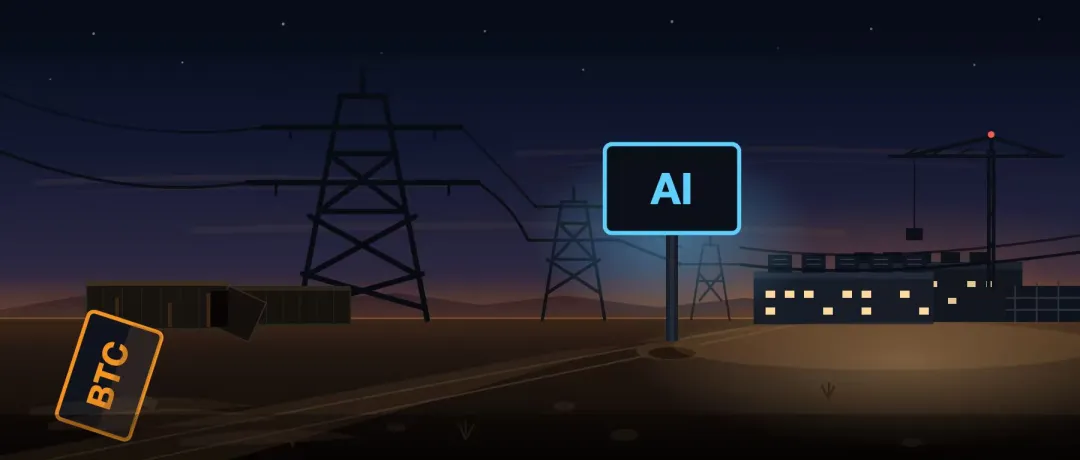
Multiple crypto enterprises are leveraging their advantages in power and data center infrastructure to pivot to AI. Capital is flowing to AI, and the industry is shifting from disintermediation to becoming AI intermediaries.
 Navigating Web3 tides with focused insights
By: Cathy
Galaxy Digital spent $65 million to buy a 180 MW Bitcoin mining farm in 2022. This year, the site started collecting rent from CoreWeave, a 15-year lease with annual revenue exceeding $1 billion.
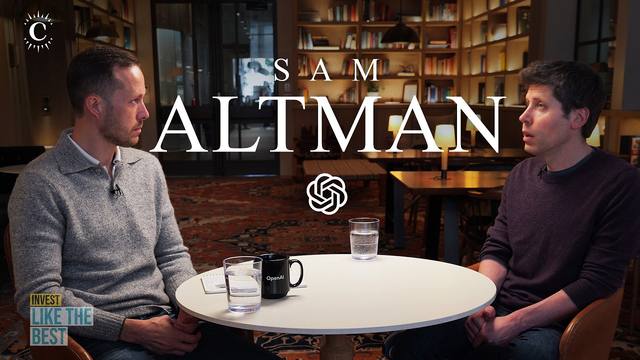
Crusoe was even more straightforward. It sold its entire portfolio of 425 Bitcoin data centers to NYDIG as a package and turned to build Stargate for OpenAI in Texas.
Crypto.com spent $70 million to buy a domain name. The domain is AI.com, the most expensive domain transaction in public records. The product was advertised on the Super Bowl.
All three companies are pivoting heavily towards AI.
This is not another story of "AI plus blockchain". They are not issuing tokens, writing white papers, or building protocols. They are selling compute power, cabinets, and AI products; their clients are OpenAI, Microsoft, and CoreWeave.
Money is running in the same direction. In the first quarter of 2026, approximately 6,000 startups globally raised $300 billion, with AI taking $242 billion of that, accounting for 80%. In the same period, only 8 new crypto funds were established, totaling $1.1 billion, the fewest in a quarter since Q3 2020.
On what basis can an industry that makes a living off Tokens claim a share in AI?
01 They Have Always Been Selling the Same Thing
Let's look at Galaxy's accounts first.
Helios is a mining farm in West Texas, bought for $65 million in 2022. Galaxy stopped mining, invested $350 million of its own capital, and borrowed $1.4 billion in debt for renovation.
The first phase was delivered this year, with 133 MW of critical IT load handed over to CoreWeave, and rent billing began. Across the first three phases, CoreWeave committed to 526 MW, a 15-year lease, plus two five-year renewal options.
An asset bought for $65 million turned into a business collecting $1 billion in rent per year.
Crusoe's path was even more thorough. The company started with stranded gas power generation from oil fields; Bitcoin mining was just its first use to consume this electricity. In 2025, it sold its entire Bitcoin business, 425 modular data centers, without keeping a single one.
The freed-up resources were used in Abilene, Texas. That is OpenAI's Stargate Campus 1, planned for 1.2 GW; Crusoe raised $11.6 billion in debt and equity for it in May 2025.
In March this year, Microsoft signed another 900 MW next door. The entire Abilene plan ultimately reaches 2.1 GW.
The timing is worth noting. Galaxy bought Helios in 2024, and Tether spent $420 million to buy NVIDIA H100s also in 2023.
At that time, ChatGPT had just become popular, and AI data centers were not yet something everyone was fighting to grab. These companies did not enter chasing the trend; they were standing there first, and then the wind blew over.
At this point, the logic of the pivot is actually very simple.
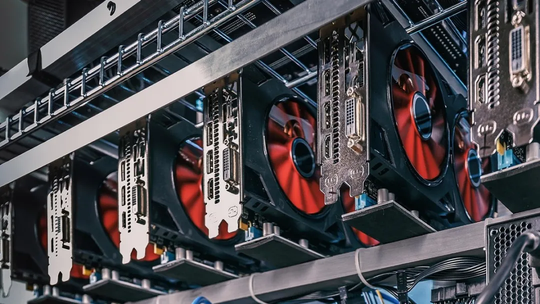
The only skill crypto companies truly learned over the past decade is one thing: how to turn cheap electricity and unwanted land into a row of cabinets that can be powered, cooled, and run at full capacity 24/7.
What AI lacks right now is exactly this.
So those holding electricity and land find it easiest to pivot. The assets are ready, the clients are new, and only a renovation stands in between.
Others are not unable to pivot, they just have to take a few more steps. They must first prove that besides issuing tokens, they can do something else.
02 Not Just Selling Land
Tether is taking another path.
Its AI department is called QVAC, and what it does has nothing to do with issuing tokens: an open-source cross-platform SDK that allows billion-parameter-level models to run directly on laptops, ordinary graphics cards, or even phones.
In March this year, QVAC released a LoRA fine-tuning framework for Microsoft's BitNet 1-bit model; in April, it released the SDK; in June, it made an open-source implementation of Google Research's VRAM compression algorithm TurboQuant. There is also a local AI desktop application called Workbench.
A stablecoin company doing edge inference optimization sounds absurd, but these things are really on GitHub.
Tether's money also took another more roundabout path. In December 2024, it strategically invested $775 million in video platform Rumble; in June this year, Rumble completed the acquisition of German listed company Northern Data, acquiring 85.2% of the shares.
Northern Data holds European cloud business with over 22,000 GPUs, plus approximately 250 MW of data center capacity by 2027. It raised its 2026 revenue guidance from €130 to 150 million to €170 to 190 million, and signed a multi-year GPU cloud contract worth $270 million, with Together AI as the client.
A sum of stablecoin profit bypassed a video company and finally became a GPU server room in Europe.
Crypto.com's $70 million was not bought to sit idle. Marszalek started building a team after acquiring AI.com in April 2025; the product launched after the Super Bowl, functioning as a personal AI agent that can send messages for users, execute operations across apps, and trade stocks. He is the CEO of both companies simultaneously.
On the money side, Paradigm closed its $1.2 billion Fund IV on July 8, explicitly writing in AI and robotics. This crypto VC, managing nearly $12 billion, has already invested in delivery drone company Zipline and space defense company True Anomaly.
The most ironic case is OpenRouter.
Founder Alex Atallah is the co-founder and CTO of OpenSea. He left in early 2023 and built something that acts as a switch for over 400 large models: developers call an API once, and it decides whether the request lands on GPT, Claude, or some open-source model.
In May this year, OpenRouter raised $113 million in Series B, valued at $1.3 billion. It has 8 million registered developers and processes 25 trillion Tokens per week.
An industry that spent ten years arguing "no intermediaries needed" produced its most successful company as an intermediary for models.
On the other side, money on the crypto end is being withdrawn at a visible speed. In April 2026, global crypto VC invested only $659 million in a single month, the lowest in two years, down 75% year-over-year.
Why the money is leaving, Paradigm itself didn't say much, but the ledger on the LP side is clear. After FTX, Terra, and Three Arrows collapsed one after another, institutional trust in crypto funds has never been repaired. Those high-valuation financing projects from the last cycle neither generated revenue nor accumulated real users.
On the AI side, there are at least bills to check.
The last time this industry collectively changed direction was after the ICO crash in 2018, when everyone turned to DeFi.
That time was changing rooms within their own home.
This time they moved away.
03 But the Report Card is Split
Not everyone successfully pivoted.
Canaan is an example of going the opposite way. This Bitcoin mining machine company also touched AI chips; in 2024, this business contributed approximately $900,000 in revenue. The company's total revenue that year was $269.3 million.
$900,000 versus $269.3 million. And this department consumed 15% of the company's operating expenses.
In June 2025, Canaan shut down its AI chip business and went back to selling mining machines.
The mining enterprise group is also stratifying. Those with electricity, grid interfaces, and ready-made server rooms got multi-year contracts from Microsoft and Google; those with only mining machines and a press release had no follow-up after the announcement.
The same MW is a fifteen-year lease in the hands of companies with delivery capability, and just a slide in the hands of those without.
There is actually only one distinguishing standard: whether someone is really paying for it.
Galaxy has CoreWeave's rent, Crusoe has the Microsoft and OpenAI campuses, OpenRouter has 8 million developers calling its API. Canaan has an annual revenue of $900,000, and then it calculated this account clearly itself.
04 Summary
What these companies are doing is not "crypto AI", it is just AI.
What was truly brought over is not technology either. It is a group of people who know how to raise billions when no one believes in you, and how to power up a wasteland in ten-odd months. These skills have little to do with blockchain; they just happened to be practiced in the crypto industry.
It must also be clear that going out does not equal winning. Crusoe's Abilene Microsoft campus will not be powered until mid-2027, Crypto.com's AI product just launched, and Rumble still has to prove it can operate server rooms after acquiring Northern Data.
None of these have reached acceptance yet. Only one thing is certain: the bets are placed, and they are placed on someone else's table.
Ten years ago they said they would eliminate intermediaries.
Now they are acting as intermediaries for AI.
Join TechFlow official community to stay tuned
Telegram:https://t.me/TechFlowDaily
X (Twitter):https://x.com/TechFlowPost
X (Twitter) EN:https://x.com/BlockFlow_News
 白话区块链
白话区块链