Nvidia Guarantees $750 Billion for AI, Default Insurance Costs Hit Record
TechFlow Selected TechFlow Selected
Nvidia Guarantees $750 Billion for AI, Default Insurance Costs Hit Record
What is more worth watching than the stock price is the reaction of the credit market.
 Navigating Web3 tides with focused insights
Author: Claude, TechFlow
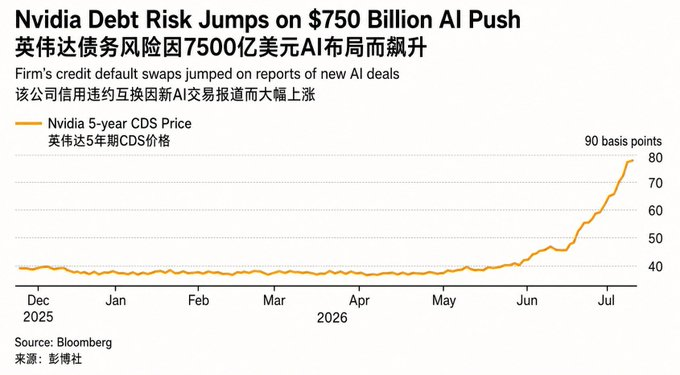
TechFlow Editor's Note: On July 27, Nvidia's five-year default insurance cost jumped about 14 basis points intraday to 82 basis points, marking the largest intraday gain since the contract became actively traded in November 2025. The trigger was The Wall Street Journal revealing that Nvidia is negotiating to provide approximately $250 billion in guarantees for OpenAI to lease a 10 GW data center in Ohio. Coupled with last week's $500 billion letter of intent with South Korea's SK Group, new exposure exceeded $750 billion within one week. Nvidia fell 4.99% that day, handing the top global market cap spot to Apple.
At the close of the US stock market on July 27, Nvidia fell 4.99% to $196.51, with market cap dropping to about $4.77 trillion. Apple rose about 1% that day, with market cap approaching $4.95 trillion, taking back the number one global market cap position. Nvidia had taken this position from Microsoft in June 2025, and its market cap once broke through $5 trillion last October.
More worth watching than the stock price is the reaction of the credit market. According to Bloomberg, ICE Data Services shows that the cost of buying five-year default protection for Nvidia debt rose about 14 basis points intraday on Monday, reaching a high of about 82 basis points annually, the largest intraday gain since the contract started active trading in November 2025.
Jumping 14 Basis Points in One Day, the Bond Market Signals on Nvidia's Signatures for the First Time
CDS is insurance bought by bondholders to protect against issuer default; the higher the quote, the higher the market thinks the probability of something going wrong is, or at least more compensation is required to bear this risk. 82 basis points means that to buy five-year protection for $100 million of Nvidia debt, one must pay $820,000 annually.
Nvidia's CDS only started active trading last November; the history is very short, so the term "record-breaking" should be taken with a grain of salt. Michael Kramer of Mott Capital Management calculated last week that a quote of 65 basis points roughly corresponds to a cumulative default probability of about 5% over five years, which is not high in absolute terms. He also mentioned an anomaly at the time: while Nvidia's CDS widened all the way, the stock price was still rising. On Monday, this divergence ended, with stocks and bonds falling in the same direction.
Nvidia's credit rating remains near the highest tier. For that June bond, Moody's gave Aa1 (positive outlook), and S&P gave AA.
$250 Billion Guarantee: OpenAI is Borrowing Nvidia's Balance Sheet
The Wall Street Journal reported on July 26 that Nvidia is negotiating to provide approximately $250 billion in financing guarantees for OpenAI to lease a 10 GW data center campus developed by SB Energy, under SoftBank, in Piketon, Ohio. The guarantee covers leases and construction debt, excluding Nvidia chips in the campus. Financing for chip procurement is another negotiation, with scale potentially reaching $350 billion. The total cost of the entire project including chips exceeds $500 billion, with the first phase of about 800 MW expected to commence production in 2028.
The function of this guarantee is very direct. OpenAI is valued at $852 billion, but lacks an investment-grade credit rating and is still losing money. Lenders are unwilling to provide money of this tenure and scale based on OpenAI's credit; with Nvidia's AA-rated balance sheet stepping up, SB Energy can borrow based on Nvidia's credit rather than the tenant's credit.
Scale is the issue. Nvidia disclosed in its Fiscal 2027 Q1 10-Q that the maximum total exposure cap for all partner facility lease guarantees is $3.5 billion, of which $712 million is held in escrow accounts; the company records these guarantees as credit derivatives and states their fair value is not significant. $250 billion is about 70 times this figure, close to Nvidia's total assets of $259.5 billion at the end of April.
The difference between a guarantee and an investment lies in the return structure. If OpenAI pays on time, Nvidia earns not a penny; if OpenAI cannot pay, Nvidia covers the bottom based on the guarantee amount. This is a contingent liability with only downside and no upside.
Adding SK Group's $500 Billion, $750 Billion Piled Up Within One Week
On July 24, Nvidia and South Korea's SK Group announced signing a letter of intent, with cooperation scale exceeding $500 billion. Content includes SK Telecom building a 2 GW AI factory, adopting Nvidia's Vera Rubin DSX platform and SK Hynix's HBM4 memory, with the first facility planned to commence production in 2027; Nvidia and SK Hynix establishing a long-term memory supply and joint development relationship. Jensen Huang announced this figure when meeting South Korean President Lee Jae-myung in San Francisco, without explaining the calculation method and execution cycle.
The two sums add up to over $750 billion. Bloomberg attributed Monday's CDS jump directly to this total amount, reasoning that the market worries Nvidia is undertaking increasingly more obligations.
External dependencies of the Ohio project also need to be noted. The campus is built on federal land, the site of a uranium enrichment plant from 1954 to 2001; SB Energy leases the land rather than buying it, bypassing the approval cycle for conventional site selection. Power supply relies on 9.2 GW of new gas-fired generation, plus a $4.2 billion transmission project with AEP Ohio, with funding coming from $33.3 billion committed by Japan under the US-Japan Trade Agreement. Commerce Secretary Lutnick holds the power allocation rights for this land; Anthropic, Microsoft, and Google have all approached him in recent weeks. That is to say, whether this guarantee can land has some variables not within the control of Nvidia and OpenAI.
Oracle is Already at 196 Basis Points, Nvidia's 82 Basis Points is Not Yet Expensive
Taking competitors in the same track as reference, Nvidia's position is still very front. Oracle's five-year CDS rose to 196.6 basis points on July 20, creating a historical high for the company, exceeding levels during the 2008 financial crisis, with stock price falling about 37% year-to-date. Kramer calculated that Oracle's CDS implies a default probability of about 16%; last September this figure was only 3.5%.
The primary market was not nervous six weeks ago either. On June 15, Nvidia priced $25 billion in investment-grade bonds, the first bond issuance since 2021; orders once reached $85 billion, seven tranches longest to 2056, coupons 4.250% to 5.625%, spreads 20 to 65 basis points above US Treasuries.
What was truly sold off is stocks. The iShares Semiconductor ETF fell 14% over the past month, Nvidia has risen only about 4% year-to-date, while Apple rose about 24% in the same period. Apple's logic is refusing heavy capital expenditure and relying on renting compute power; this strategy outperformed the self-build camp this year.
For those holding Nvidia, 82 basis points itself does not constitute a signal; the speed is. It took one trading day to go from 68 basis points to 82 basis points; it took Oracle more than half a year to reach 196 basis points.
Circular Financing Changed Shell: From Buying Equity to Signing Guarantees
Nvidia using its own money to support downstream demand is not a new practice. In January 2026, it invested an additional $2 billion in CoreWeave at $87.20 per share; in February, the original $100 billion OpenAI commitment was voided, changed to contributing $30 billion in OpenAI's $110 billion financing round in exchange for equity; in March, invested $2 billion in Nebius and participated in Thinking Machines' $2 billion financing. Jensen Huang stated at the time that the $30 billion for OpenAI and $10 billion commitment for Anthropic might be the end of the largest equity checks.
Four months later, the same structure changed to guarantees.
Matthew Bryson of Wedbush said that Nvidia's investment and construction "fall entirely within" the circular investment theme that triggers market concerns about sustainability, while believing that if executed properly, this strategy can build competitive barriers. Mizuho Chip Analyst Jordan Klein put it more directly: "It smells like you are prepaying funds to purchase your own GPUs." Nvidia has always denied that contracts require partners to use this money to buy its chips.
The difference in accounting treatment determines why the bond market reacted first this time. Equity investment goes into the balance sheet, guarantees are recorded as derivatives at fair value, only becoming real cash expenditure when triggered. Such contingent liabilities are not reflected in the liability items of current financial reports, but will be reflected in CDS quotes. Monday was this process.
Join TechFlow official community to stay tuned
Telegram:https://t.me/TechFlowDaily
X (Twitter):https://x.com/TechFlowPost
X (Twitter) EN:https://x.com/BlockFlow_News
 深潮TechFlow