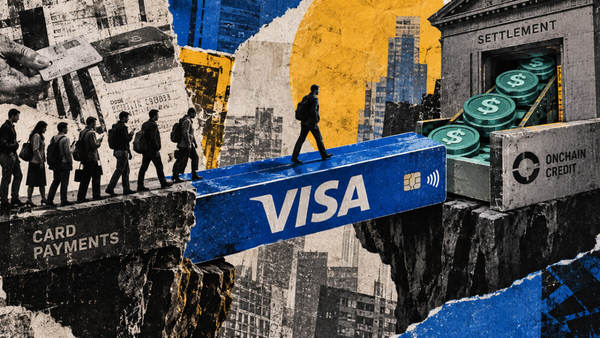
Visa's Perspective on Agentic Payment
By Will Awang
In July 2026, Visa and on-chain data firm Artemis jointly published "Agentic Payments from the Ground Up," commissioned by Visa. Just three months prior, Visa Chief Product and Strategy Officer Jack Forestell had publicly labeled Agentic Web as the largest growth opportunity he had seen in his twenty-plus years in payments—promptly followed by the card network funding the very study to tell the market: machine payments are real, here are the data points, and here lies the gap.
The nature of this document aligns more closely with the data component of a strategic narrative than with neutral research. Its most valuable contribution is Artemis's first systematic cleaning of on-chain data for x402 and MPP—revealing that roughly ninety percent of surface-level on-chain volume stems from brushing and testing. Its most restrained aspect lies in how it wraps up its analysis on liability allocation and regulatory classification, simply listing the issues vis-à-vis Visa's own entanglement without further elaboration.
TechFlow has previously addressed three unexplored questions from this report across three separate studies: the distinction between substitution and creation in Agentic Commerce, the liability adjudication vacuum when an agent makes an error, and why the machine economy is naturally immune to territorial regulation. This article uses the Visa report as its backbone, picking up where it leaves off with our own judgments—all content introduced by "TechFlow believes" reflects our independent analysis.
Report Foreword
From its inception, Visa’s goal was never merely to build a bankcard network, but to construct a global system for secure value exchange. Today, Agentic Commerce is becoming the new frontier of this system—software programs are beginning to autonomously discover, evaluate, and procure goods and services, transforming payment from a human-facing settlement tool into a foundational capability embedded within machine workflows. Driven by this need, new protocols such as x402 and MPP have rapidly emerged, with bankcard networks, stablecoins, and machine payment protocols beginning to converge.
I. What is Agentic Commerce
1.1 Two Types of Transactions
Agentic Commerce is a commercial model where software programs autonomously discover, evaluate, and execute transactions. It does not merely "automate" traditional e-commerce; rather, it enables software to become, for the first time, an economic entity capable of independent procurement, resource invocation, and continuous payment. Based on current applications, these can be categorized into two types of transactions.
Macro-Agent Transactions: Agents act on behalf of humans or enterprises to complete traditional procurement, essentially executing human business intent—for example, an IT Agent automatically adjusts SaaS seats upon employee onboarding/offboarding, or a Travel Agent books flights and hotels according to budget and policy. These transactions involve higher amounts, and their merchants and payment channels closely mirror those of traditional e-commerce.
The genuinely novel challenge is: authorization occurs before the transaction, execution happens under no human supervision, and the system must prove who the Agent represents, what it is allowed to purchase, and where the budget boundaries lie.
Micro-Machine Transactions: To accomplish tasks, Agents autonomously purchase data, compute power, models, and APIs—for instance, a Research Agent pays a few cents each to multiple data providers to retrieve and cross-verify financial reports. These transactions are high-frequency, low-cost, and instant. Buyers and sellers lack accounts, subscriptions, or long-term contracts; once an Agent discovers a service, it immediately evaluates, pays, invokes, and departs. These transactions' demand for millisecond-level response times, near-zero fees, and machine identity directly drove the emergence of new protocols like x402 and MPP.
TechFlow believes the divergence between these two transaction types warrants deeper examination: Macro is substitutive—capturing share from existing human purchasing behaviors; Micro is generative—these transactions previously did not exist, not due to lack of demand, but because human decision-making costs exceeded transaction value. Agents compress these costs to near zero, allowing transactions to emerge spontaneously. This implies that all market forecasts measuring growth solely by "the speed at which human shopping is taken over by Agents" only cover half the picture.
As for the scale of that other half, Circle CEO Jeremy Allaire provided a coordinate in The Agentic Economy: companies are essentially "branded, organized cognition." Labor costs account for a quarter to half of revenue, nearly all of it in knowledge-intensive firms—a cost segment AI specifically targets. When every function is refined into a well-defined skill, and a skill clean enough to be orchestrated internally is also clean enough to be discovered and hired externally—the open agent labor market does not need to be created; it is merely the overflow of millions of companies optimizing themselves.
By then, the smallest priceable unit will first be compressed to a granularity finer than internal corporate division of labor: a single verification, one invocation, a snippet of translation—all can be individually priced, transacted, and settled. In other words, Micro transactions do not measure shopping; they measure the hiring of machine labor. As Allaire puts it, models become line items, and agents become businesses.
1.2 Why the Explosion Now?
The HTTP 402 "Payment Required" status code was incorporated into internet standards as early as 1997, yet failed to materialize for decades: traditional payments carried high fixed costs, making micro-transactions commercially unviable, which forced the internet to rely predominantly on advertising and subscription monetization.
TechFlow argues that exorbitant settlement costs are only half the reason for failure; the deeper half lies in human psychological transaction costs. For a payment to be viable, the cost of making the decision must be lower than the payment amount itself. Humans spending several cents mentally calculating whether a few-cent expenditure is "worth it" inherently costs more than several cents. Micro-payments were not poorly executed in the human economy; they were mathematically unsound. Agents flipped this inequality.
The true inflection point arrived with AI Agents. The report anchors the crossing of the capability threshold around mid-2025—starting with models like Claude 4.5 and GPT Codex 5.2, Agents began autonomously discovering unfamiliar APIs, evaluating prices, and deciding whether to pay, without requiring manual per-transaction approval. Programmatic, on-demand purchases of data and compute saw large-scale emergence for the first time. Simultaneously, dedicated chains like Tempo offered sub-millisecond fee tiers and 500-millisecond finality, while Base and Solana gas costs dropped to fractions of a cent.
Yet the report emphasizes: dedicated chains have existed for years without spontaneously birthing pay-per-use API markets—it was Agents that created the pull; infrastructure merely enabled the demand to become commercializable.
The report simultaneously issues a blunt warning to incumbents: the risk of inaction is disintermediation. If a handful of platforms control both the demand entry points for Agents and transaction routing, they can siphon payment traffic away from existing networks—particularly in the micro-payment sector where card economics are weakest. Incumbents participating only through macro-agent transactions will miss the highest-frequency segment of the agentic economy.
II. Why Machine Transactions Require a New Payment Architecture
The difference between traditional e-commerce and micro-machine transactions extends beyond smaller amounts; the entire transaction logic has fundamentally shifted.

Subscriptions and metered billing can alleviate some issues but still require pre-registration, negotiation, and partnership establishment, failing to accommodate the Agent's ad-hoc transaction pattern of "discover interface—evaluate price—instantly pay—invoke and complete." Therefore, the value of new protocols does not lie in replacing bankcards, but in layering a machine-interaction-ready payment architecture atop existing payment systems.
TechFlow believes the weight behind this table far exceeds "smaller amounts, higher frequency": Agents are not faster consumers; they represent a entirely different species of consumption.
- Atomic Consumption — Humans consume in bundles via monthly subscriptions, annual fees, or one-time purchases, essentially using prepayments to simplify decision-making. Agents have no such need; they can precisely calculate the marginal value of each invocation;
- Streaming Decision Flow — Human payments tolerate latency; filling forms, entering passwords, and awaiting confirmations are acceptable. Agents execute hundreds of tool invocations at millisecond speeds, potentially requiring payment at every step;
- Depersonalized Entities — The most fundamental shift is that the payer is no longer a human. Every design element of traditional payment systems, from KYC and CVV verification to chargeback mechanisms, rests on the assumption that "the user is human." The first two are efficiency problems solvable by engineering; the third is an axiomatic problem requiring a complete architectural rewrite.
III. x402 & MPP: Architecture & Real-World Data
Before diving into either protocol, let's map out the landscape TechFlow previously outlined.

Today, Agents spend money via three distinct pathways, and the core difference among them fundamentally boils down to where liability resides:
- Wallets & Credits: Users preload funds and spend until depleted, prepaying liability at the cost of being trapped within a closed-loop ecosystem. This is the fastest to deploy yet most easily overestimated pathway, with most so-called "AI payments" functioning merely as in-ecosystem shopping assistants;
- Card Rails: Liability is absorbed by Visa and Mastercard's network rules. The fifty-year-old dispute framework remains fully operational, and Chapters V's TAP, AP2, ACP, and UCP are all built along this rail;
- On-Chain Direct Payments: Wallet-to-wallet, final upon receipt, leaving liability either unanchored or substituted by code and reputation.
The data section of Visa's report zeroes in on the two most critical specimens on this third pathway. x402 launched in May 2025, incubated by Coinbase and Cloudflare, and transitioned to open governance under the Linux Foundation in April 2026. MPP launched in March 2026, co-developed by Stripe and Tempo with Visa's participation in protocol development, and is currently navigating the IETF standardization process.
3.1 Common Foundation: HTTP 402
Both protocols are built upon HTTP 402. The typical workflow proceeds as follows:
- The client requests resources from the server;
- The server responds with a 402 status code, specifying price, currency, and payment terms;
- The client evaluates the terms and attaches a payment credential;
- Upon verifying payment, the server unlocks access to the resources.
Payments are directly embedded within HTTP requests and responses, eliminating the need to redirect to a checkout page or require pre-established buyer-seller account relationships. Servers merely need to return machine-readable payment requirements to function as billable endpoints.
3.2 Core Differences
x402 introduces intermediary facilitators into the transaction: after proxying payment funds, the facilitator verifies transaction conditions and completes settlement. This intermediary layer absorbs payment verification, merchant onboarding, risk management, and fund settlement, charging fees accordingly, which means industrial value under x402 is more likely to accumulate within facilitators and settlement providers.
MPP emphasizes direct settlement between buyers and sellers, with underlying Tempo achieving approximately 500 milliseconds of finality. It supports two modes: Instant Charge, where a single payment triggers immediate delivery, with individual transactions atomically splittable across up to ten recipients, settling distribution directly at the protocol level; and Session Payments, where funds are deposited into escrow, off-chain receipts are signed based on actual consumption, and batch settlement refunds the remainder upon completion. This suits ongoing services with indeterminate upfront costs, transforming "monthly subscriptions" into task-level, real-time, terminable cost structures. By de-emphasizing intermediaries, MPP's long-term value is more likely to consolidate within upper-layer applications, aggregation platforms, and developer tooling.
Both protocols remain in early stages; while functionalities may converge, their trust models and value accumulation points differ fundamentally.
3.3 x402 Data: 11 Months Post-Launch
Let's clarify the figure cited in the report. Raw on-chain data for x402 shows cumulative gross merchandise volume of $135.7 million across 178.3 million transactions—but after filtering out brushing and test transactions, only the following remain:
- $15 million in adjusted GMV
- 109.6 million valid transactions
- 422,000 active buyers
- Approximately 5,300 active merchants

(Agentic Payment from Ground Up)
The actual market is an order of magnitude smaller than surface-level on-chain data suggests. This underscores why any discussion of Agentic Commerce must undergo rigorous data cleansing—a16z crypto partner Noah Levine highlighted a more fundamental issue: for the same 30-day x402 volume, x402.org reported $24 million, Allium reported $3 million, and Artemis reported under $2 million, a tenfold discrepancy across sources. When consensus on even measuring this market is absent, all growth narratives come into question—and this report employs the strictest of the three rulers.
November 2025 marked peak transaction volume at approximately 38 million transactions monthly against $5.15 million in adjusted GMV. By March 2026, volume dropped to roughly 2.1 million transactions, yet GMV held at $1.64 million, setting a record-high average ticket size since launch—indicating x402 is expanding beyond mere "cents-tier API payments" into broader price brackets.

(Agentic Payment from Ground Up)
TechFlow interprets this curve differently: x402's boundaries are currently defined by the disputability of goods. Surviving transactions cluster around buying tokens, invoking APIs, and renting compute—deliverables consumed instantly upon provision with zero recourse. Lacking authorizations, chargebacks, or dispute channels, the "bare" nature of x402 becomes a feature for instantaneous-consumption goods; however, if any good carries error potential, bare protocols cannot penetrate.
Concentration: The top 1% of buyers contribute roughly 90% of GMV, with a mere 0.02% accounting for ~48%. Dominance by a handful of specialized institutions characterizes a prototypical nascent market.
Distribution: Base hosts approximately 90% of valid transactions and 93% of adjusted GMV. By transaction count, inter-Agent service procurement tops the category list; by GMV, numerous uncategorized long-tail endpoints dominate. The supply side remains highly fragmented, with aggregation and discovery tools still notably absent.

(Agentic Payment from Ground Up)
3.4 MPP Data: First 33 Days Post-Launch
Post-adjustment, MPP generated cumulative GMV of $25,000 across ~115,000 valid transactions involving over 2,800 active buyers and ~90 active merchants, averaging roughly 4,000 valid transactions daily. Instant Charges comprise ~97% of transaction volume at an average ticket of ~$0.17; Session mode averages ~$2.15, primarily driven by developer testing.
The current buyer-to-merchant ratio stands at approximately 32:1, indicating demand growth significantly outpacing supply. The report notes x402 merchant counts hovered at similar levels during its initial months before spiking sharply. TechFlow considers this 32:1 ratio potentially not a negative signal, but rather evidence of a supply-side lag phase.
IV. Trust, Identity & Liability
4.1 The Core Challenge Isn't Payment, It's Trust
The payments industry spent fifty years upgrading six generations of authorization tech—from signature embossing and magnetic stripes paired with real-time authorization networks, to EMV chip ciphers and NFC, to Tokenization, and finally today's Agentic Tokens. While verification methods evolved completely, what's verified remains identical: Is the person at the point of sale actually the cardholder? Agentic Payments shatters not the method, but the premise: the payer is no longer a human making real-time decisions, but a software program holding authorization and executing autonomously. Authorization and transaction decouple temporally; intent is expressed in natural language, which risk engines cannot validate. This spawns four risk categories:
- Erroneous Procurement: Misinterpretation by Agents leads to wrong vendor selection or overpayment. While humans can correct errors pre-settlement, runaway proxies can sequentially generate massive volumes of faulty transactions in short windows;
- Malicious Attacks: Prompt injection can alter agent execution logic, soliciting unauthorized purchases or fund transfers. Higher autonomy correlates directly with greater potential losses upon compromise;
- Liability Ambiguity: Authorizers, proxy platforms, model providers, wallet services, and merchants may all disclaim fault;
- Cascading Failures: When agents heavily procure services from other agents, a single link breakdown can render upstream completed payments worthless.
While x402 and MPP resolve portions of the payment-and-delivery equation, neither alone answers who bears responsibility when an agent errs.
4.2 Current Mitigations
Protocol Layer: x402 settles only after intermediary verification of delivery; MPP controls risk via session escrow; flexible limits and spending caps restrict per-transaction loss exposure.
Identity Layer: Numerous Agents still rely on API keys and wallet address authentication, proving only access rights rather than historical performance capacity. Even Visa acknowledges this openly—Forestell admitted in public discussions in March 2026 that agentic transactions carry higher risks than earlier e-commerce and mobile payments: an extra agent layer introduces complexity demanding identity, protection, validation, and expanded data security measures. The industry is addressing gaps dual-frontedly—through cross-chain identity/reputation standards in crypto ecosystems, and leveraging incumbent card networks' established authorization, KYC, and anti-fraud capabilities.
Policy Layer: Tools like Coinbase Agent wallets, Turnkey, Privy, and Safe enforce allowlists, spend caps, and merchant category restrictions; card networks bind limits and merchant constraints to agent identities via tokenized credentials.
4.3 Unresolved Issues
The industry still lacks three foundational pillars: universal agent identity standards bridging crypto and card ecosystems; dispute, refund, and burden-of-proof mechanisms tailored for high-frequency micro-payments; and explicit liability frameworks delineating responsibilities among authorizers, proxy platforms, model providers, and merchants.
These voids represent both primary risks for Agentic Commerce and the areas where traditional payment institutions possess the strongest capacity to intervene.
TechFlow posits that these three gaps stem from a single structural deficit. Legally, principal-agent payment navigates four non-negotiable questions: Was authorization granted? Where does the boundary lie? Who bears liability for breaches? Ultimately, who absorbs losses—the bedrock of agency law spanning millennia. The first two questions reside in the realm of proof; cryptography can verify existence and clarity of boundaries. The latter two occupy adjudication territory; only institutional rules can assign breach liability and loss absorption.
Yet today, nearly all participants congregate exclusively within those first two questions: signature chains, audit trails, and cryptographic proofs of fulfillment lock "what happened" down to cryptographic certainty while remaining utterly silent on "whose fault is it." This is precisely the warning issued by dispute resolution firm Chargebacks911:
The industry is building from the wrong end—the frontend authorization frameworks are fully deployed, yet virtually no progress has been made on post-transaction dispute infrastructure: how disputes are classified, how liability is allocated, or how evidence is adjudicated.
In this adjudication vacuum, the first structures rising aren't laws, but price lists: card network liability transfer conditions, insurance payout thresholds, and Amex protections for registered agents all put price tags on "who pays when things go wrong"—each anchoring the same variable. The precision of authorized boundaries dictates the cost of liability.

V. Industry Standards & Payment Network Layout
Agentic Commerce requires multi-layer protocol coordination spanning communications, identity, authorization, payment execution, and clearing; no single standard currently covers the full chain.

(Agentic Payment from Ground Up)
Visa TAP utilizes cryptographically signed HTTP payloads, enabling merchants to verify that visitors are agents possessing user authorization. It avoids forcing merchants to reconstruct payment systems, instead appending a machine identity layer atop existing web and card infrastructures—representing the most direct pathway for incumbent networks to enter Agentic Commerce.
AP2 records procurement intent, specific shopping carts, and final payment authorization separately via encrypted authorization commands, translating natural language intent into verifiable, auditable structured permissions while maintaining neutrality across card rails, transfers, and stablecoin channels. TechFlow notes its ceiling lies precisely here: fields capture budget, inventory, and time windows, but silently exclude unstated motivations—the authorization log records what was said, not why.
ACP vs. UCP: Driven by Stripe and OpenAI, ACP adopts a closed-market model requiring mutual pre-approval between proxy platforms and merchants. Pushed by Google and Shopify, UCP allows Agents to complete purchases directly within search interfaces and Gemini, letting merchants retain customer relationships. Fundamentally, both vie for the Agent commercial gateway—whoever masters the workflow of agent product discovery, transaction confirmation, and payment execution stands to control next-generation e-commerce traffic distribution.
Visa Intelligent Commerce aims to serve as a unified gateway: a single integration natively supports TAP, x402, MPP, ACP, and UCP, delivering tokenization, identity verification, and programmable spend controls. This reveals a card network strategy transcending mere bankcard transaction defense, pivoting toward becoming the intermediate nexus connecting Agents, merchants, and diverse settlement rails—demonstrated at June 2026's Visa Payments Forum, where Visa showcased concept products enabling command-line-based Agent payments using tokenized credentials. As Forestell stated, the goal is to "make cards the best payment method in the CLI"; the card network's reach now penetrates the heart of machine-native trading.
The long-term trajectory points toward convergence, not substitution. MPP natively supports both stablecoins and bankcards; Visa unveiled card specifications tailored for MPP adoption; Stripe integrated x402 stablecoin payments onto Base. Looking ahead, macro-Agent consumption will continue relying on mature card merchant networks and dispute resolution frameworks, whereas machine-native micro-payments suit low-cost on-chain settlement better. Both channel types will coexist within identical workflows—this duality mirrors the structural division between substitution and creation outlined in Chapter I: card networks haven't surrendered existing categories, nor do new categories fall within their competitive range.
Public statements from both camps align accordingly. Forestell delivered his shortest positioning at the Visa Payments Forum: AI transforms commerce's frontend, stablecoins reshape funds' backend, and Visa's role ensures both ends operate securely, reliably, and globally; report lead author and Visa on-chain data head Tim Conard crystallized the endpoint in an official companion piece: Visa intends to build infrastructure that forces no ecological sides and demands no parallel construction.
The opposing camp mirrored this stance—Circle CEO Jeremy Allaire wrote in The Agentic Economy that on-chain systems need not defeat card networks amid debate; they merely need to be the native habitat where agentic economies run. He even conceded that "stablecoins solely handle funding, while acceptance and interchange fees remain with Visa and peers" represents a genuinely plausible equilibrium. Both adversarial blocs actively leave room for one another.
TechFlow observes that reading these statements alongside the report clarifies the sequence: Forestell's positioning is the conclusion; this report supplies the evidentiary backing for that conclusion—strategy precedes data.
Beyond public posture lies a more honest ledger: investment records. Visa Ventures backed Nekuda, which automates authorization generation, and Payman, targeting bank-side approval friction points—where the former's authorizations materialize outside VisaNet during user-Agent conversations, and the latter's capital flows bypass card rails entirely. One investment buys upstream; the other purchases off-rail. These two moves signal Visa understands its own protocols only govern the interval "when money passes through me." Study an institution's protocols to see what they want you to believe; study their investments to see what they actually doubt.
Aligning CLI concepts, investment tracking, and "forced neutrality" statements reveals Visa's substantive maneuvering.
TechFlow contends Visa is executing what easily invites misunderstanding:
It isn't competing with stablecoins; it's quietly repositioning itself from a settlement network into authorization infrastructure. VIC handles tokenization, TAP manages identity, verifiable logs oversee auditing, and MPP card specs govern multi-rail access. All four lines bet simultaneously, covering exclusively authorization-chain segments.
In the Agent era, Visa doesn't truly want to sell swiped transactions; it wants to sell the assurance itself—that "this payment is legitimately authorized." Card networks might not win machine-economy settlement, but they could absolutely win machine-economy authorization.
VI. Application Scenarios
The original report's scenario chapter centers on an eight-industry matrix table alongside three mode subsections. Section 6.1 expands industries based on TechFlow's analytical framework derived from the report, reflecting independent extrapolation rather than Visa/Artemis positions; Sections 6.2–6.4 follow the source text verbatim.
6.1 Eight Industry Scenarios
The highest-value dimension of Agentic Commerce lies not in protocols themselves, but in how they unlock commercial viability for previously unviable transactions. Across industries, these cluster into eight categories:
- Corporate Procurement & Back-Office Operations: IT, admin, finance, travel, and sourcing Agents execute repetitive procurement payments within preset policies and budgets, heavily leaning on mature card networks and expense management frameworks;
- Sales & Customer Intelligence: Sales Agents purchase per-query enterprise data, email verification, and CRM enrichment for individual prospects, comparing quotes across vendors to select optimal options—converting fixed subscriptions into task-level variable costs;
- Research & Financial Data: Procuring financial reports, on-chain metrics, and regulatory intelligence around identical queries, utilizing multi-source cross-validation over single-provider lock-in, particularly suited for high-value, low-frequency, long-tail datasets;
- Content Creation: Marketing Agents pay 5 cents apiece to ten image generators, retaining only superior outputs—embedding payment directly into production and filtering workflows;
- Engineering & Compute: Code Agents temporarily procure GPUs, inference cycles, testing environments, and sandboxes, exiting immediately post-task without pre-accounting or contract signing;
- Security & Compliance: Per-query invocation of KYC, sanctions screening, on-chain risk analysis, and deepfake detection. Highest value yet most sensitive—demanding simultaneous resolution of data provenance legality and outcome liability;
- Sentiment & Surveillance: Continuous purchasing of social signals and competitive intelligence scaled by data volume, duration, or trigger frequency, offering superior flexibility for temporary campaigns over fixed monthly fees;
- Mapping & Logistics: Ongoing purchases of routing, inventory, and pricing data—funding decision-capacity first, later deciding whether to procure physical-world commodities.
TechFlow asserts these eight scenarios won't arrive synchronously. Deployment sequencing hinges not on technological maturity, but on risk-bearing parties: Protocol-backed scenarios (APIs, data, compute) accelerate fastest—instant delivery, transparent billing, zero refund friction make them ideal landing zones, explaining why nearly all live x402/MPP transactions cluster here today; Enterprise-backed scenarios (B2B procurement, internal standardized spend) trail secondarily—as budget pools and approval pipelines historically operated manually pre-Agent; Consumer-backed retail experiences lag furthest, necessitating comprehensive consumer protection architectures. The most visually intuitive scenarios ultimately face slowest adoption.
6.2 Streaming Metered Billing
Not all services lend themselves to upfront pricing: multi-hour compute sessions, minute-based transcription, continuously ingested market feeds defied total pre-transaction quoting. MPP Session Payments were engineered precisely for this—merchants earn proportionally to actual delivery, sparing buyers from committing to rigid subscriptions amid fluctuating demand.
6.3 Inter-Agent Procurement
Inter-Agent service swapping represents the quintessential Agentic Commerce paradigm and already dominates x402 by transaction count. An Agent needn't possess universal capabilities; instead, it outsources subtasks to specialized peers—Primary Agents purchasing search from Retrieval Agents, which subsequently buy reports from Data Agents, creating cascading external procurement across analysis, compliance, and reporting layers. A single user request thus generates multi-tiered machine supply chains.
TechFlow views payment here functioning doubly as a settlement tool and a coordination mechanism for resource allocation and specialized division of labor among Agents. This explains why transaction volumes surge disproportionately ahead of GMV growth: a single task costing mere dollars mechanically fragments behind-the-scenes into dozens or hundreds of machine-to-machine payments.
6.4 Long-Tail Services & "API-as-Merchant"
Machine payments drastically lower barriers for digital services achieving merchant status: developers bypass constructing full SaaS suites, merely packaging capabilities into machine-readable billable endpoints. Countless formerly uncommercializable services materialize—single-document conversions, country-specific business registration lookups, individual image authenticity checks, geolocation risk scoring. This model faces active productization: Merit Systems' AgentCash bundles wallet management, merchant discovery, and 420+ paid APIs into singular integrations interfacing with Claude Code and similar Agent frameworks.
However, low deployment friction simultaneously invites service replication—individual long-tail merchants struggle erecting defensive moats. Pinpointing where genuine barriers reside awaits conclusion discussion.
VII. Compliance & Regulation
7.1 Qualifying Protocol Roles
x402 facilitators temporarily hold funds, verify deliveries, and route settlements, risking classification as money transmitters, payment processors, or custodians across varying jurisdictions. Conversely, MPP's lack of centralized intermediation spawns alternative dilemmas: lacking explicit brokerage entities, determining KYC, AML, transaction monitoring, and dispute resolution obligations becomes complex.
Cross-border transactions further magnify ambiguity: proxies, service providers, wallets, and infrastructure span multiple nations, clashing with legacy regulatory frameworks predicated on defined counterparties, clear territorial jurisdiction, and low-frequency activity.

Circle CEO Jeremy Allaire offers a more radical framing in The Agentic Economy: the economy's three strata—currency, contracts, operating agents—are purely software running atop the internet. None possesses inherent geographic attributes; cloud-executed work is "homeland-less." Globalization isn't a bolt-on feature but a structural property baked into constituent materials.
Extending this logic, TechFlow identifies two collapsed premises on fiat rails: agents lack legal personhood (human dimension); actions lack physical occurrence locations (spatial dimension). Crucially, this isn't a regulatory vacuum but regulatory overload—a single action simultaneously triggers overlapping jurisdictions spanning consumer residence, data subject domicile, and market location, with no geographical epicenter serving as tiebreaker. For payment institutions, compliance architecture may evolve from back-office functions into primary competitive differentiation vectors.
7.2 Stablecoin Regulation
x402 relies heavily on USDC, while MPP incorporates on-chain settlement as a core component, meaning stablecoin regulatory clarity directly impacts Agentic Commerce expansion velocity. Within the U.S., the GENIUS Act establishes federal licensing and reserve frameworks for payment stablecoins; transparent regulatory standing transforms stablecoins into trustworthy infrastructure banks and acquirers can confidently deploy. Persistent fragmentation across alternate jurisdictions would substantially inflate cross-border deployment costs.
Allaire proposes another dichotomy explaining Washington's legislative willingness: the channel money traverses differs fundamentally from the monetary value flowing through it—the protocol layer maintains neutrality and statelessness, while traversing values remain sovereign-denominated fiat liabilities issued under domestic jurisprudence.
Viewing through this lens, TechFlow argues stablecoins aren't fiat antagonists; they are fiat. What gets replaced never was currency itself, but the insular national banking conduits historically welding monetary value within borders. Stablecoins triumph not by defeating fiat, but liberating it from nation-state conduits—presenting Washington with effectively a dollar globalization blueprint bypassing CBDC prerequisites. The GENIUS Act functions less as novelty acceptance and more as formal ratification of this architecture.
7.3 AI Agent-Specific Dilemmas
Legacy KYC and AML regulations center exclusively on human clientele. Agentic Commerce forces renewed interrogation: Does verification target authorizers, proxy platforms, wallets, or model providers? Who monitors sequential agent transactions? Who bears suspicious activity reporting and tax filing duties? How do thousands of cross-border micropayments survive auditing and tracing?
Consequently, traceable, auditable, batch-reporting compliant agent transaction infrastructure emerges as paramount commercial value drivers.
Vacuums rarely abstract themselves. The U.S. lacks dedicated agent transaction oversight; forcing Reg E/Reg Z's binary authorized/unauthorized framework onto gray zones misfires—contract formation itself faces minimal hurdles (ESIGN legally recognized electronic agents in 2000); the void sits post-contractual. Agency overreach liability distribution operates without specialized statutes or precedent. The EU's AI Liability Directive formally expired October 2025 mere weeks before mass commercial deployment, citing irreconcilable member state fragmentation; PSD3's strong customer authentication architecturally serves smartphone-holding humans, granting zero utility to fingerprint-less agents.
Private order fills the voids: governing rules closest to global alignment capable of direct payment chain execution remain interchange network standards—their enforcement derives not from judicial decree, but from "we reject this transaction"; American Express allocates liability via commercial undertakings, while Munich Re and peer insurers actively underwrite emerging AI liability policies.
TechFlow concludes agent payment liability frameworks draft themselves through protocol specifications, interchange rules, and insurance clauses—legislation manifests extralegally.
VIII. Future Opportunities
For financial institutions, the most pragmatic machine payment entry vector entails hybrid settlement: preserving familiar card-based merchant experiences front-end while deploying stablecoin back-end mechanics for 7x24 processing, accelerated liquidity turnaround, and reduced cross-border friction. Ascending one tier further, x402, MPP, AP2, TAP, and ACP currently operate siloed; future Agents require autonomous authorization, identity, and settlement routing within unified workflows. Platforms mastering cross-protocol recognition and traffic direction will establish pivotal control layers.
Borderless execution will characterize machine transactions natively rather than marginally, yet FX conversion, compliance adaptation, and cross-border settlement optimized for machine velocities remain immature—marking the clearest near-term acquisition avenue for global payment networks.
Supply dynamics will similarly invert: presently Agent heavyweights dominate procurement, yet declining deployment costs catalyze direct data, model, and specialist service provisioning Agent-to-Agent, accelerating supply-side scaling. However, TechFlow flags an unspoken legal prerequisite undermining this forecast—the exact personhood deficit discussed in Chapter VII lands concretely here: fiat account architectures rest foundationally on "holders must be natural or juridical persons"; within traditional banking, Agents permanently reduce to API permission sets layered atop external accounts. They facilitate third-party spending but cannot autonomously hold balances, receive funds, or post collateral. Enabling third-party expenditure solves purely as a payment integration challenge; autonomous treasury ownership demands legal personhood that conventional fiat banking structurally denies. To transition merchant-bound, Agents await legislative personhood grants or bypass entirely via on-chain wallets—explaining why supply-side "Agent-to-Merchant" proliferation probabilistically surfaces on-chain first.
IX. Conclusion
Agentic Commerce has transitioned from conceptualization to live transactional reality: x402 and MPP now route substantive GMV, while per-query fetching, streaming billing, and inter-agent service swapping solidify. New protocols successfully resolve low-cost, machine-speed, and programmable payment requirements, yet mainstream financial system integration remains inextricably dependent upon traditional payment institutions' historically cultivated identity verification, risk management, compliance, and dispute resolution capabilities.
Revisiting the tri-pathway schematic from Chapter III, distinct boundaries now materialize. TechFlow maintains these routes don't compete for identical slices; instead, they partition territories horizontally aligned with dispute density: zero-dispute flows revert to on-chain/stablecoin rails, complex disputes anchor to card networks, avoided controversies default to wallet escrows. Actual battlegrounds concentrate at intersectional nodes—Agents initially compare pricing via credits, submit orders through card rails, settle supplier invoices utilizing stablecoins, harmonizing three paths within singular transaction lifecycles.
Given supply-side replicability accelerates, enduring value won't cement at isolated transactions or individual merchants, but consolidates across three strata: traffic distribution (gatekeepers controlling agent service discovery and transaction routing), identity & trust (validators certifying agents, merchants, and authorization chains), and underlying clearing (providers executing cheap, secure, compliant global settlement).
Incumbent institutions possess decades of compounding advantage across latter two tiers, while novel protocols triumph operationally via velocity, unit economics, and programmability—the eventual market architects will likely synthesize both competency clusters. Competition finale transcends individual transaction margins, focusing instead on mastery over agent identity paradigms, commerce gateways, cross-protocol routing engines, and globally scalable compliance infrastructure.
Join TechFlow official community to stay tuned
Telegram:https://t.me/TechFlowDaily
X (Twitter):https://x.com/TechFlowPost
X (Twitter) EN:https://x.com/BlockFlow_News
 0xWillmfer