S&P Dow Jones Partners with Pantera to Launch Crypto Index, Bitcoin Excluded Due to "Not Profitable"
TechFlow Selected TechFlow Selected
S&P Dow Jones Partners with Pantera to Launch Crypto Index, Bitcoin Excluded Due to "Not Profitable"
Is this absurd? Only crypto tokens that generate real revenue count.
 Navigating Web3 tides with focused insights
Author: Claude, TechFlow
TechFlow Editor's Note: S&P Dow Jones Indices partnered with Pantera Capital to launch the S&P Pantera Digital Asset Index, including 18 tokens, but excluding Bitcoin, XRP, and meme coins entirely.
The screening criteria draw on the S&P 500's "financial viability" threshold, requiring protocols to record positive revenue for consecutive multiple quarters and distribute value to token holders. This marks the first time the world's largest index provider has introduced a fundamental screening framework in the crypto sector, with ETH, BNB, SOL, TRX, and HYPE ranking as the top five holdings.
The world's largest index provider has officially turned "revenue" into the entry ticket for crypto assets, and Bitcoin did not get one.
According to an official press release from S&P Global on July 21, S&P Dow Jones Indices jointly launched the S&P Pantera Digital Asset Index with Pantera Capital. The index includes only tokens and companies with actual use cases and real revenue, excluding Bitcoin and meme coins.
S&P Dow Jones Indices CEO Cathy Clay stated that Bitcoin failed the index's core test, namely generating real protocol revenue. Pantera Founder Dan Morehead pointed out in his July Blockchain Letter that institutional allocators repeatedly ask only two questions: "What service does this protocol provide" and "Does it make money."
Drawing on the S&P 500, "Financial Viability" Becomes New Benchmark for Crypto Indices
The core inspiration for this screening method comes from the S&P 500.
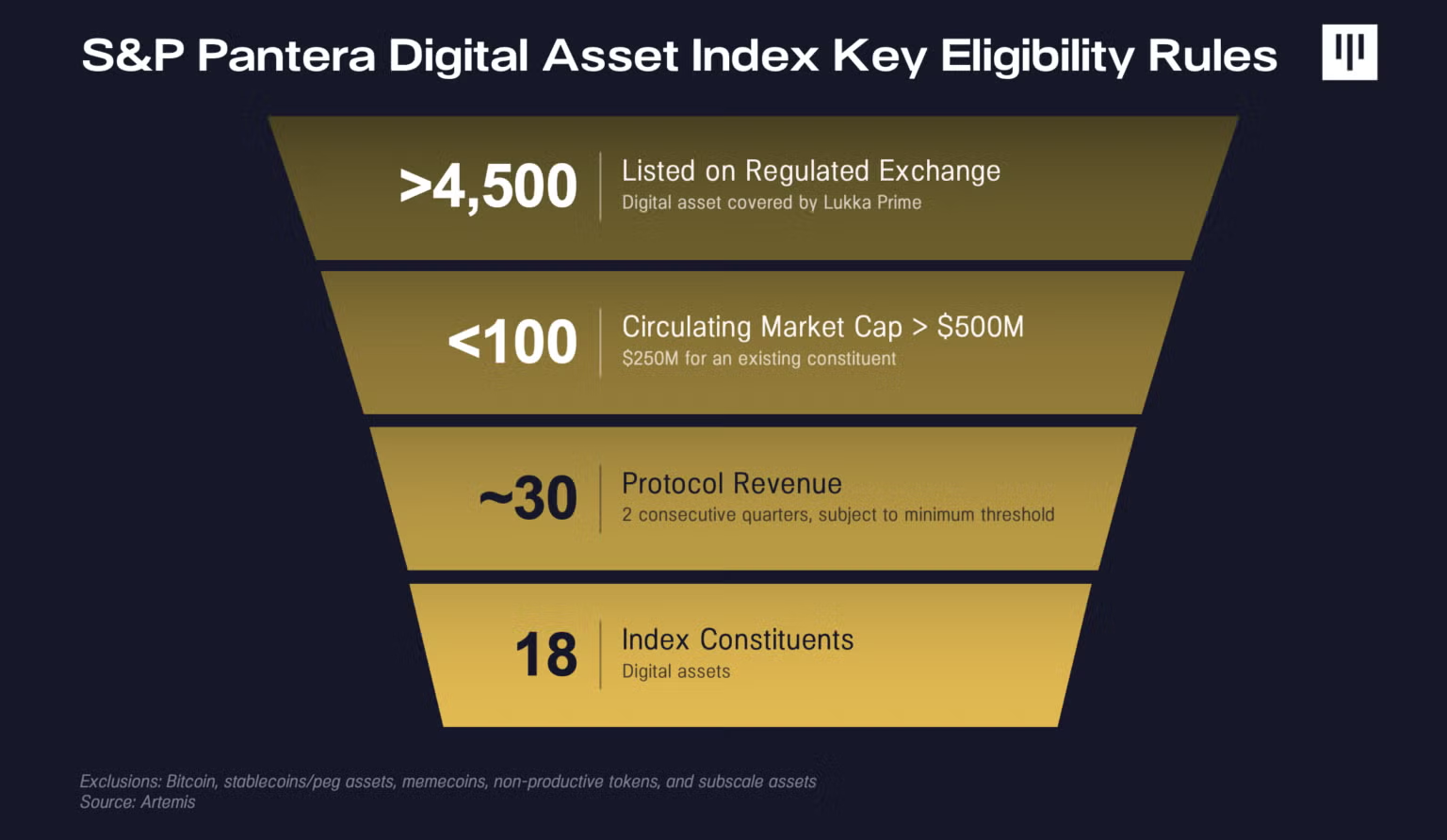
The S&P 500 requires component stocks to record positive GAAP profits for four consecutive quarters. The S&P Pantera Digital Asset Index transplants the same principle to the crypto sector, requiring protocols to record positive protocol revenue for multiple consecutive quarters (exceeding a minimum threshold), verified by on-chain data provider Artemis, and revenue must flow to token holders through mechanisms such as buybacks, staking yields after deducting inflation, distributions, or treasuries controlled by token holders.
After the initial screening, the index ranks qualified assets based on revenue from the previous two quarters, gradually including them until covering 99% of the total revenue of qualified assets.
The index contains 18 component assets, float-adjusted market capitalization weighted, with quarterly rebalancing. The single token weight cap is 35%, and the cap for remaining tokens is 20%. These weight limits are consistent with the rules S&P uses in stock indices.
Top Five Holdings: ETH, BNB, SOL, TRX, HYPE
The index's top five holdings are Ethereum (ETH), BNB, Solana (SOL), TRON (TRX), and Hyperliquid (HYPE). Pantera revealed in the Blockchain Letter that Aave is also one of the index components.
Pantera stated that the annualized revenue of all protocols in the index over the past two quarters totals over $3 billion. Every selected protocol is providing services paid for by customers, and their tokens possess demonstrable value accumulation mechanisms.
The full list of 18 component tokens has not yet been publicly disclosed.
Why Was Bitcoin Excluded? Pantera Gives Three Reasons
Pantera explained in detail in its Blockchain Letter why Bitcoin was excluded.
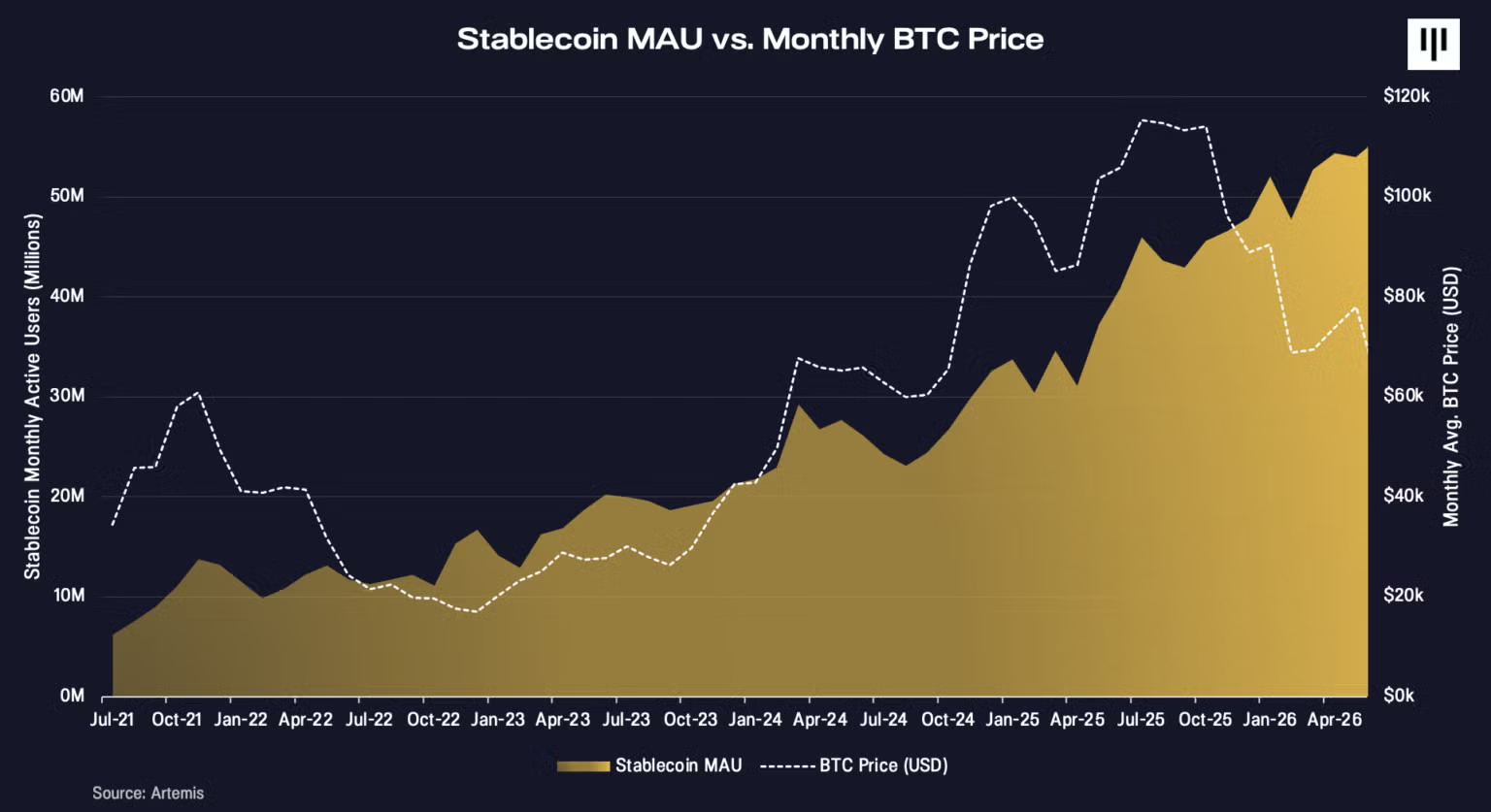
First, Bitcoin is a monetary asset, and institutional allocators usually already have BTC exposure through single-asset ETFs, with established policies for its allocation. Second, existing crypto indices mix Bitcoin, meme coins, and protocols that truly generate revenue in one basket, making it difficult for institutions to perform fundamental underwriting on them. Third, Bitcoin does not generate protocol revenue and cannot pass the financial viability screening set by the index.
Pantera believes that the narrative dilemma in the digital asset industry lies in the measurement benchmark itself. Current mainstream benchmarks can only see the Bitcoin price, but cannot distinguish between a protocol with real user payments and a token with no economic function.
Only a Benchmark Index, ETF Products Under Development
The index is currently released only as a benchmark index, and no ETFs or investment products tracking this index have been launched yet. Pantera stated that it has begun discussions with asset management companies regarding ETFs and other products based on this index.
A detail worth noting is that Pantera Fund V is now live on the Morgan Stanley Alternative Investment Platform, becoming the first blockchain venture capital fund offered through a top-tier global wealth management platform; over 16,000 financial advisors under Morgan Stanley and their clients can access this fund. The partnership between Pantera and Morgan Stanley provides a ready-made distribution channel for developing products targeting high-net-worth clients around this index in the future.
Community Discussion: Is the Bitcoin "Digital Gold" Narrative Therefore More Solidified?
This news sparked heated discussion in the Reddit r/CryptoCurrency community (380+ upvotes), with the discussion focus concentrated on two directions.
Some Reddit users believe that future non-BTC ETFs based on this index could allow altcoins to gain greater institutional exposure, and investors can use Bitcoin ETFs combined with separate altcoin allocations. Other users believe that the exclusion of Bitcoin will instead reinforce its identity positioning as "Digital Gold," while other crypto assets are increasingly viewed as utility networks or revenue-generating technology platforms.
Some users also pointed out that the index is currently just a benchmark, cannot be bought or shorted, and the actual market impact will only become apparent after the launch of ETF products.
Broader Context: Huge Product Gap in Institutional Crypto Allocation
Pantera cited a set of data in the Blockchain Letter to illustrate the market gap: Bank of America and Fidelity currently recommend clients allocate 1% to 4% of their investment portfolios to digital assets, but J.P. Morgan Private Bank found that 89% of family offices still do not hold any digital assets; an EY survey shows 60% of institutions prefer to gain exposure through registered investment products rather than directly via exchanges or on-chain.
Pantera believes this is not a gap in belief, but a gap in products. Existing multi-asset products are overly concentrated on Bitcoin, purely market-cap weighted, and list meme coins alongside protocols with real revenue.
The launch of this index occurred during a period when altcoin season signals were not yet confirmed but were improving. The CoinGlass Altcoin Season Index climbed to 58 in mid-July, higher than the neutral watershed but still below the 75 threshold confirming rotation.
Join TechFlow official community to stay tuned
Telegram:https://t.me/TechFlowDaily
X (Twitter):https://x.com/TechFlowPost
X (Twitter) EN:https://x.com/BlockFlow_News
 深潮TechFlow