Tiger Research Report: The Crypto Market Has Changed, the Era of Narrative-Driven Wealth Creation Is Over, Product Strength Is the Entry Ticket
TechFlow Selected TechFlow Selected
Tiger Research Report: The Crypto Market Has Changed, the Era of Narrative-Driven Wealth Creation Is Over, Product Strength Is the Entry Ticket
The crypto market in 2026 is no longer driven by a single narrative, but instead seeks product-market fit across multiple segments.
 Navigating Web3 tides with focused insights
Author: Tiger Research Reports
Compiled by: TechFlow
TechFlow Editor's Note: GameFi once attracted $2.5 billion in two months, but finally player count plummeted 99.7%; in 2025, a new narrative emerged every month, all eventually collapsed. In the first half of 2026, "old things" like stablecoins, DeFi, and RWA survived instead—because they finally started solving real demands instead of making up stories to raise money. This report tells you why the crypto market is shifting from narrative-driven to product-driven, and which sectors really found product-market fit.
In the first half of 2026, no single narrative could drive the entire market. But even so, stablecoins, RWA, meme tokens, DeFi, and prediction markets survived and even achieved growth during the market downturn. This report argues that the 2026 crypto market is no longer driven by a single narrative, but is seeking product-market fit in multiple segments.
Key Points
- A single narrative once could drive the entire market; now the market moves based on real demand.
- Even in a downturn market, mature sectors like stablecoins, DeFi, RWA, and meme tokens continue to survive.
- Ultimately, only projects that find product-market fit and generate real revenue from real users can survive.
1. The Past Narrative-Driven Crypto Market
In the crypto market, narratives have always been the core force concentrating participant attention and attracting liquidity. Sectors driving major market cycles, such as DeFi Summer, were all endowed with unique narratives, and the market repeated a cyclical pattern where once the previous narrative faded, liquidity would shift to the next narrative.
From a macro perspective, the crypto market has experienced four major cycles, each dominated by a single narrative driving the entire market:
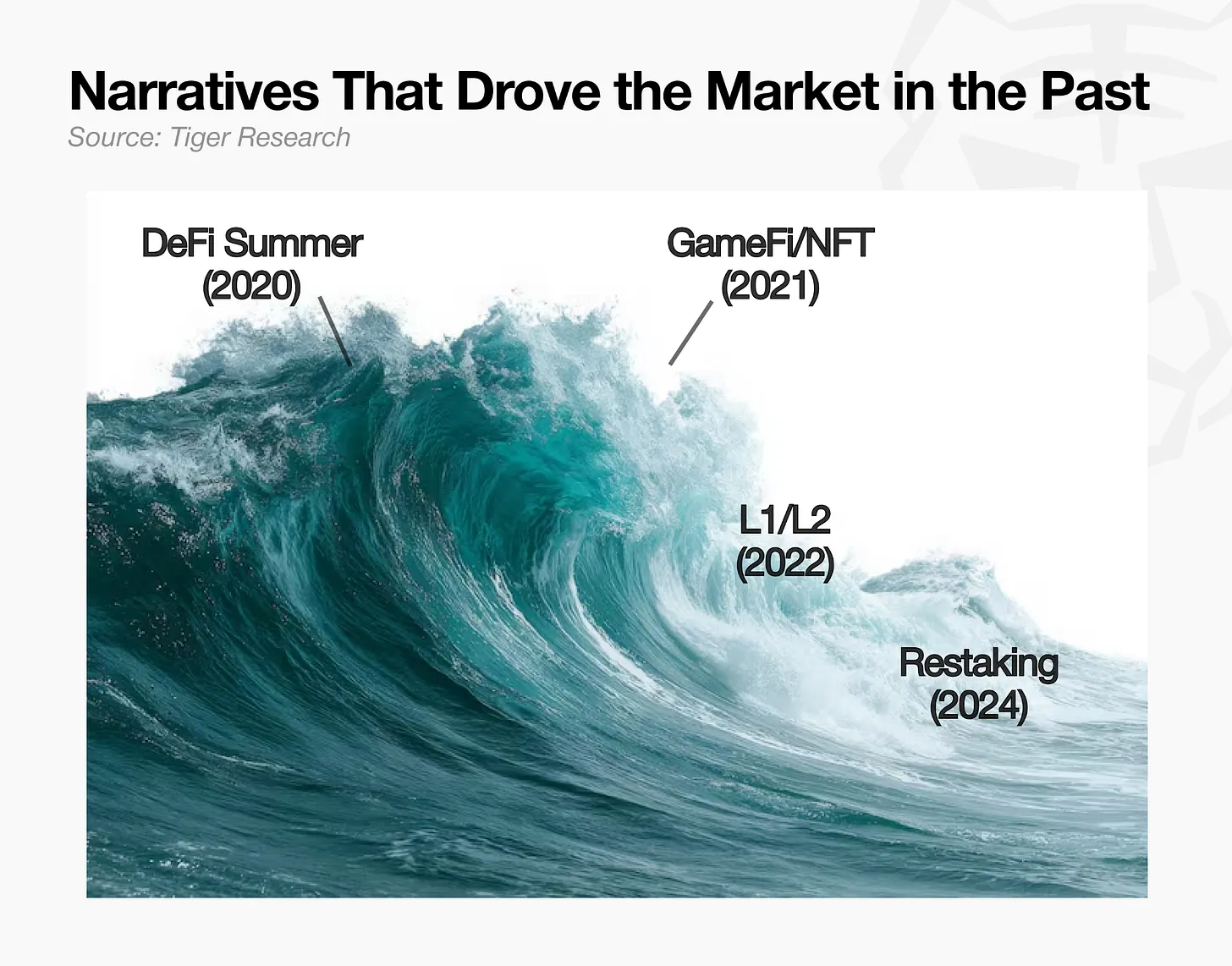
2020: DeFi
2021: NFT/P2E/GameFi
2022: L1/L2 Competition
2024: Restaking
In narrative-driven growth stories, GameFi produced the most extreme results.
Major traditional game publishers like Square Enix and Ubisoft entered this field; in the first quarter of 2022 alone, the gaming sector attracted $2.5 billion in capital inflows. But sectors unable to demonstrate real product-market fit could not last. The sector's flagship game Axie Infinity's average monthly active players dropped 99.7%, from a peak of 2.8 million in January 2022 to about 8,000 in May 2026. This clearly illustrates how quickly narratives built primarily on rationale and capital can collapse.
2. Narratives Consumed Last Year
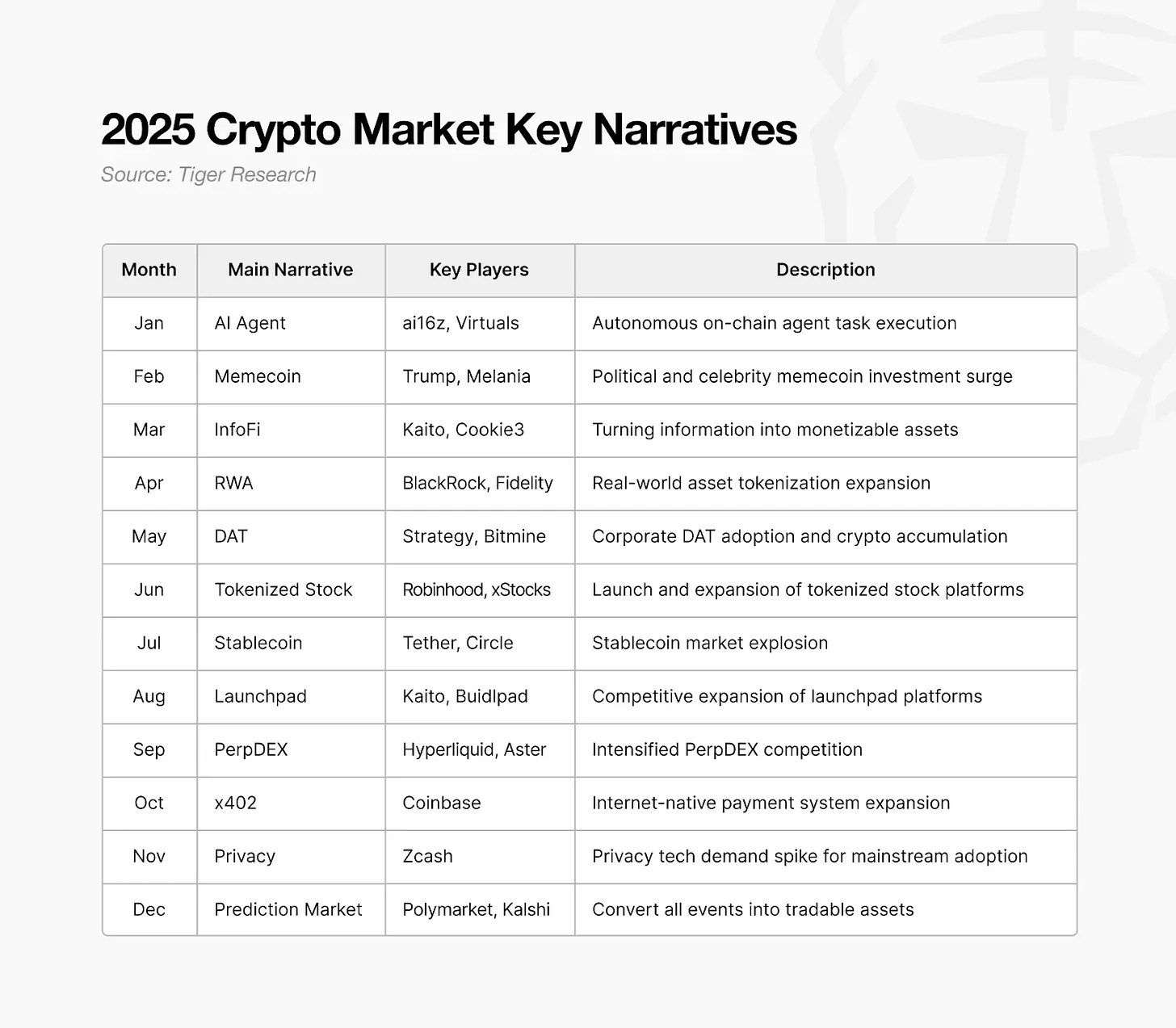
As stated in our previous reports, 2025 marked the peak of this narrative consumption pattern. After the AI Agent narrative, almost every month a new narrative emerged, and the rotation speed continuously accelerated.
On the surface this seems very wasteful, but it is hard to deny that this rapid narrative rotation is exactly the key to maintaining retail investor attention, and thus becomes the core driver of today's market. Even so, the market's underlying demand for these past narratives was for the tokens themselves, not for the problems the products aimed to solve.
3. Supply Innovation Without Demand
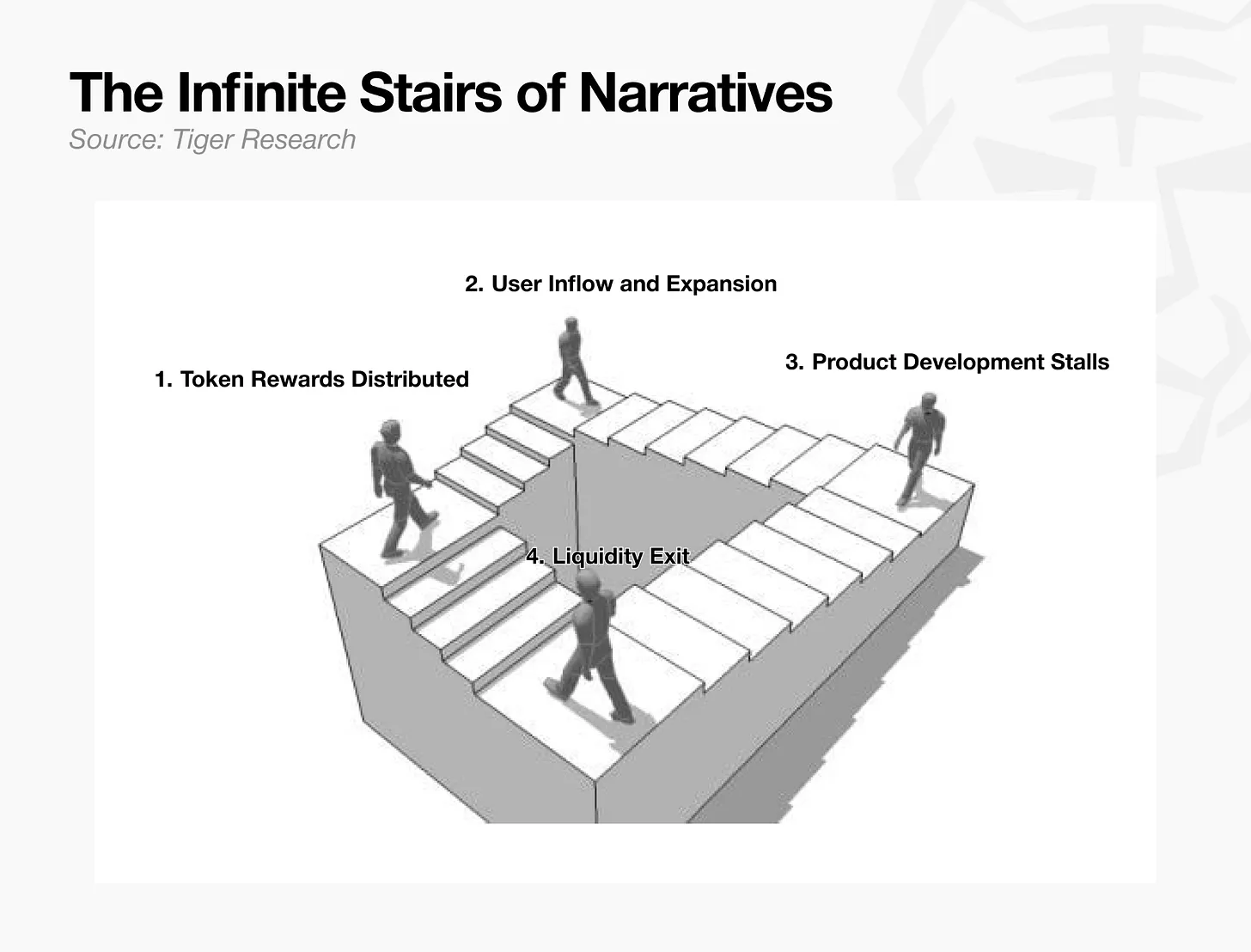
One example illustrates how most past narratives developed.
A decentralized social media project emerged, revolving around the issue of existing platforms monopolizing revenue and leaving creators undercompensated. It proposed a vision of reducing fees and returning content ownership and revenue to creators.
Token Rewards: Early participants received token rewards; as the story spread that people could earn money just by being active on the platform, market interest grew.
User Inflow and Expansion: Similar projects followed, issuing tokens around minimum viable products, attracting users through airdrops and liquidity incentives, and the ecosystem's market cap and trading volume expanded rapidly.
Product Development Stagnation: Token prices and reward scales began to surpass the product itself. Once fundraising and initial distribution were completed, development and user growth stagnated, and the original issue of creator compensation remained unresolved.
Liquidity Exit: There were never enough user groups who felt this problem strongly; inflowing capital chased price appreciation rather than the product, so once the narrative peaked, liquidity and users would leave just as quickly.
This pattern repeated in several narratives; the market eventually recognized that supply innovation without underlying demand means little. The market began to confirm that only projects generating real revenue and maintaining a stable user base matter, and only projects demonstrating true product-market fit can survive.
4. 2026: The PMF Era of Creating Demand
Past narratives built and provided solutions without underlying demand, and attempted to create demand afterwards, while the PMF era operates the opposite way: products are built to match demand that already exists among customers. The market is shifting towards real products, where user count and revenue grow along with the product and brand, rather than only token market cap rising.
The five sectors covered here were selected based on three criteria: usage metrics in the first half of 2026 such as trading volume and revenue, the trajectory of new players entering the sector, and market cap growth. These criteria are important because they are difficult to artificially manufacture simultaneously in a short period.
The following sections trace the problems each sector initially aimed to solve and the direction its leading players are now expanding towards.
4.1. Stablecoins: From Volatility-Free Payment Tools to Cross-Border Settlement Infrastructure
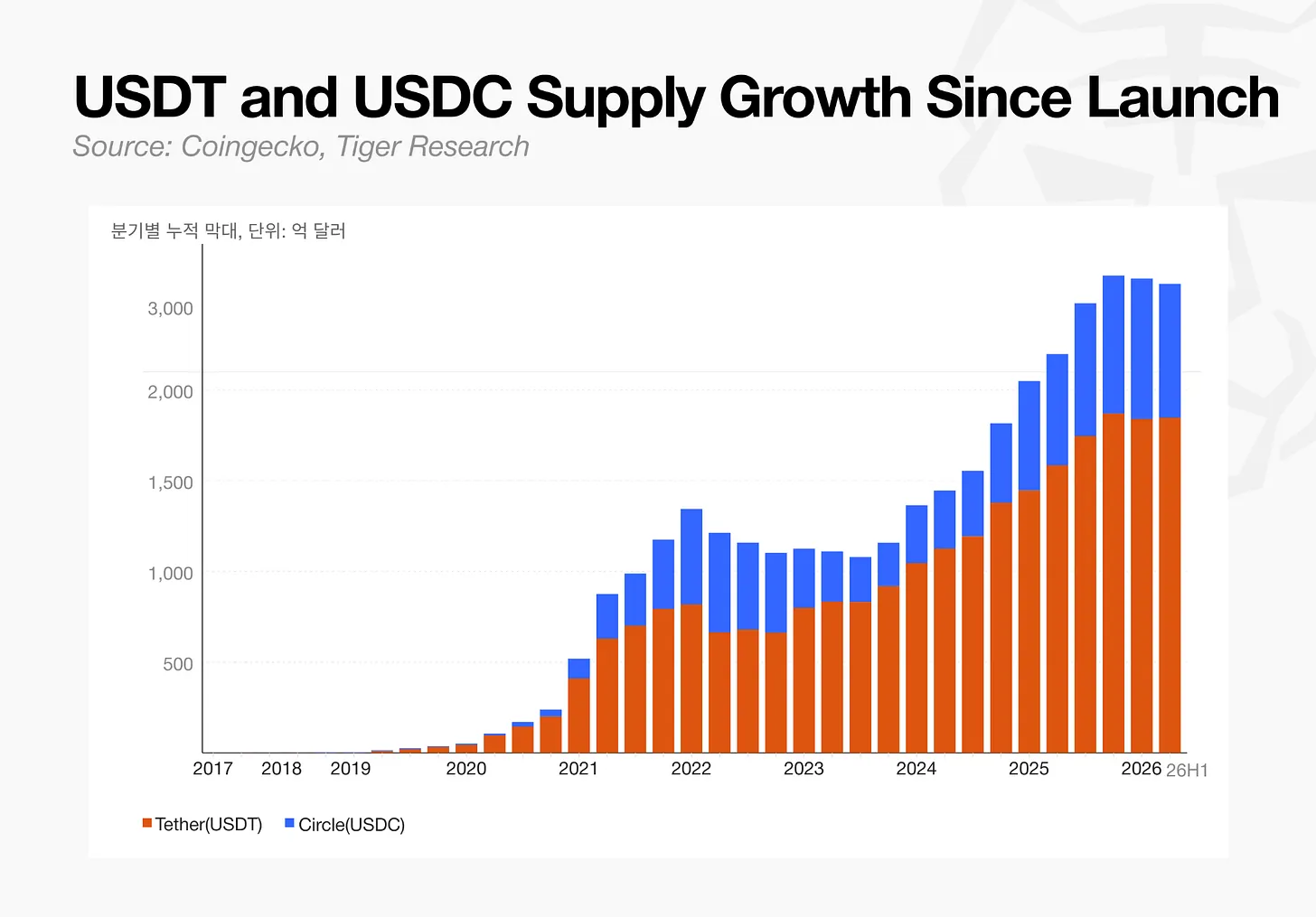
Stablecoins are tokens pegged to fiat currency value, used as means of payment and settlement. The market cap of this category is $304.2 billion, close to the all-time high of $321 billion.
Tether (USDT): Market cap $184.08 billion, monthly settlement volume $1.79 trillion (up 63% month-over-month), cumulative settlement $10.2 trillion over the past 12 months, net income over $10 billion in 2025, holding $141 billion in Treasury bonds.
Circle (USDC): Market cap $73.25 billion, is the default stablecoin for major exchanges like Coinbase and institutional settlement channels.
Stablecoins were initially a way to trade cryptocurrencies without exposure to volatility. Their role has expanded to cross-border remittances and on-chain payment infrastructure.
Growth now presents in more diversified forms. In June 2026, over 140 traditional companies including Visa, Mastercard, Stripe, Coinbase, and BlackRock announced the formation of the OUSD (Open USD, from Open Standard) alliance. Non-USD stablecoins pegged to national currencies like the Korean Won, Japanese Yen, and Euro have also become more common. Their total market cap is still small, only $1.2 billion, but the number of wallets holding them grew 30 times, from 40,000 in January 2023 to 1.2 million in March 2026.
Stablecoins are no longer just fixed-value payment tools. They are evolving into settlement infrastructure operating independently of borders and time zones.
4.2. DeFi: Built to Replace Banks, Now Becoming Part of Financial Infrastructure
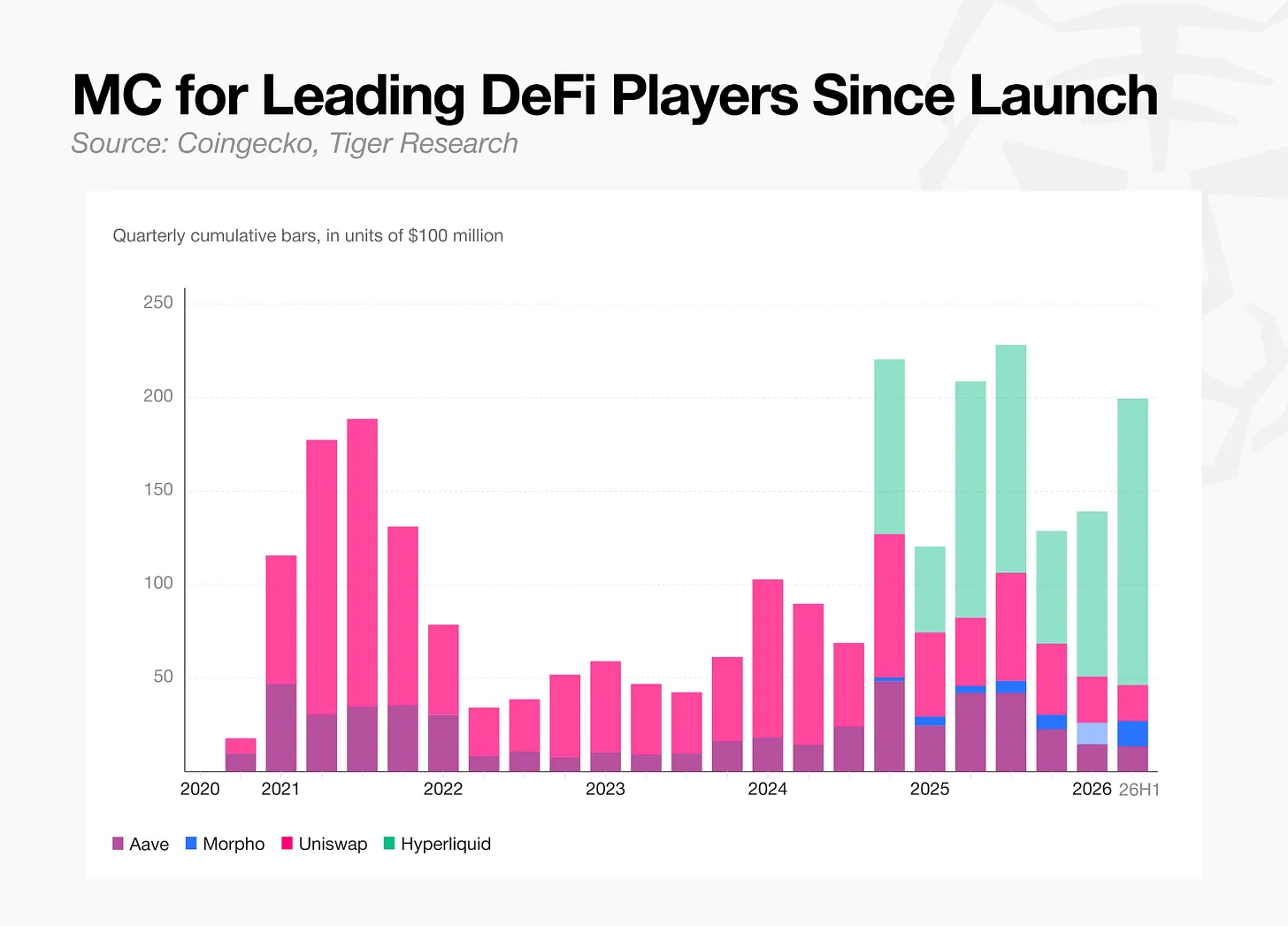
DeFi refers to finance based on smart contracts, enabling lending, trading, and derivatives without centralized intermediaries.
Aave: Market cap $1.397 billion, TVL $14.53 billion, annual revenue $119 million, leading DeFi lending protocol.
Morpho: Market cap $1.302 billion, TVL $7.497 billion, annual revenue $0 (its annual fees of $222 million all go to lenders), briefly surpassed Aave's market cap from late May to June, Aave regained the lead in July.
Uniswap: Market cap $2.287 billion, TVL $3.14 billion, annual revenue $850 million, leading decentralized exchange, 24-hour trading volume $2.66 billion.
Hyperliquid: Market cap $13.47 billion, TVL $6.07 billion, annual revenue $874 million, accounting for about 76% of the perpetual contract DEX category market cap and about 20% of DeFi overall, on-chain perpetual contract market share as high as 70%.
DeFi started in 2020, based on the premise of decentralization, directly returning profits earned by intermediaries like banks to users.
Today, its continuation is not based on that ideology, but on institutional demand for on-chain financial infrastructure. Morpho and Aave provide treasury risk management and lending infrastructure that institutions want, Uniswap supports asset trading that institutions want to trade, Hyperliquid supports traditional asset trading not just cryptocurrencies.
Each is developing in a direction somewhat different from its founding ideology, but it is precisely this willingness to decisively shift towards real demand that enables these protocols to survive and grow.
4.3. RWA: From Traditional Asset Democratization to Efficiency
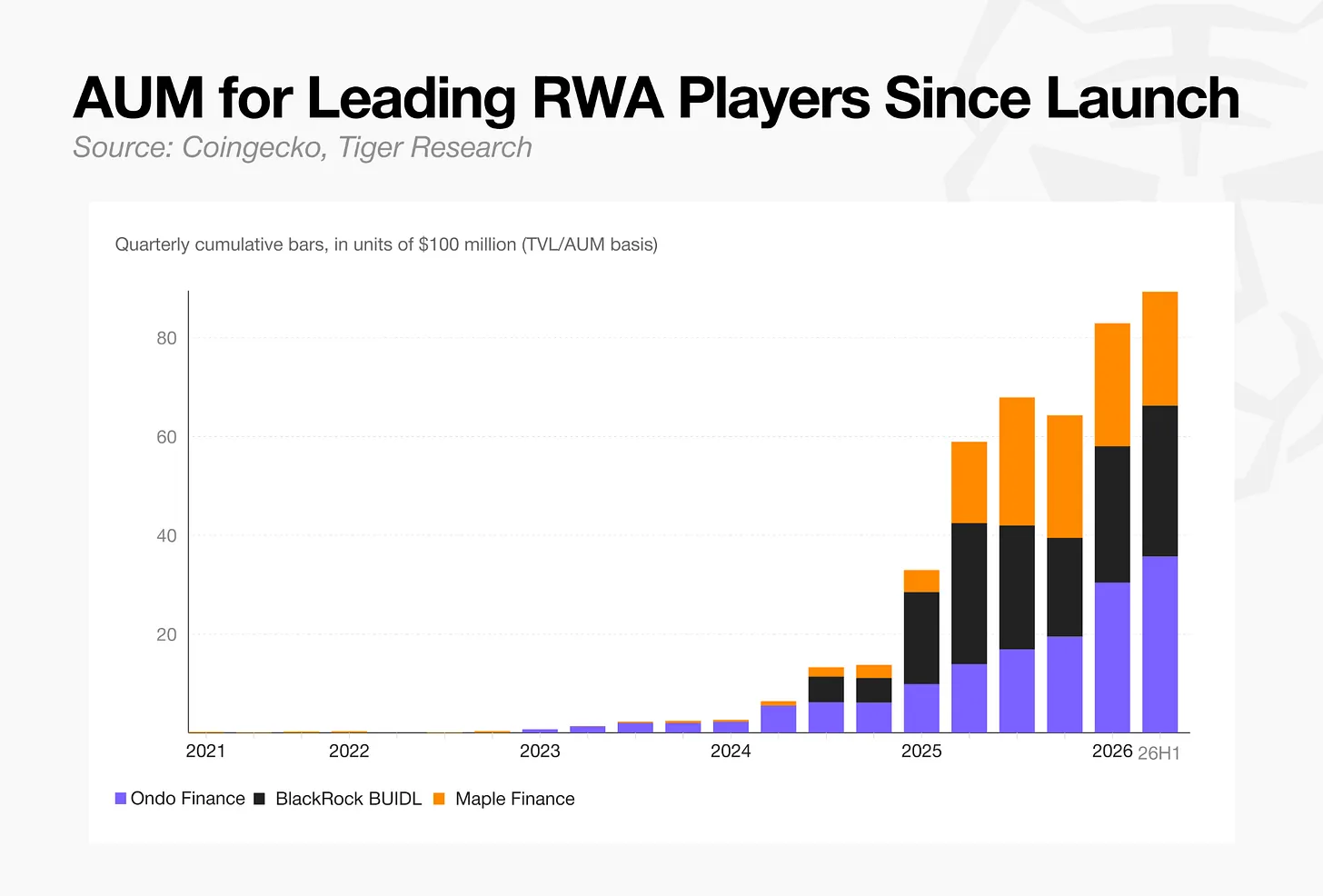
RWA refers to tokenizing traditional real-world assets like Treasury bonds and private credit and distributing them on-chain. The market cap of this category is $65.2 billion, tokenized Treasury bonds are the largest subcategory at $13.4 billion.
Ondo Finance: TVL $3.52 billion, ONDO market cap $1.75 billion, leading tokenized Treasury bond infrastructure provider.
BlackRock BUIDL: AUM $2.4 billion, as it is a fund token pegged to net asset value, it has no market cap in the traditional sense, is the largest single tokenized Treasury bond fund.
Maple Finance: SYRUP market cap $218 million, private credit AUM $4 billion, exceeding BlackRock BUIDL.
RWA set out to bring traditional asset management on-chain to improve settlement speed and accessibility. Its initial customer base was not institutions. The sector started with synthetic asset exchanges, leveraging the fact that on-chain markets were outside existing regulations to lower the threshold for trading real-world assets. However today, institutions constitute the largest user base in this sector.
Tokenized stocks are a development worth close attention. Adoption by traditional institutions like Securitize and DTCC is increasing. In July 2026, DTCC began real-time trading of tokenized securities with over 50 institutions, Securitize listed its own stock SECZ on the New York Stock Exchange, while issuing tokenized stocks on multiple chains including Avalanche and Solana. Binance (bStocks) and Kraken (xStocks) are also expanding their tokenized stock products in multiple countries. In mid-July 2026, the market cap of the tokenized stock category reached $2.3 billion, nearly doubling since first breaking $1 billion in March.
Trading volume of these assets on decentralized exchanges is still small compared to DeFi, most collateral usage still relies on permissioned and whitelist structures. Deeper on-chain integration, comparable to DeFi's Lego-like composability, may still require more time. Currently, the industry is still at the stage of proving the utility of on-chain asset management.
4.4. Prediction Markets: From Simple Gambling to Market-Dominating Trends
Prediction markets are on-chain contract markets where participants bet on the outcomes of real-world events. The market cap of this category is $9.58 billion, it is the newest formed among the five sectors covered here.
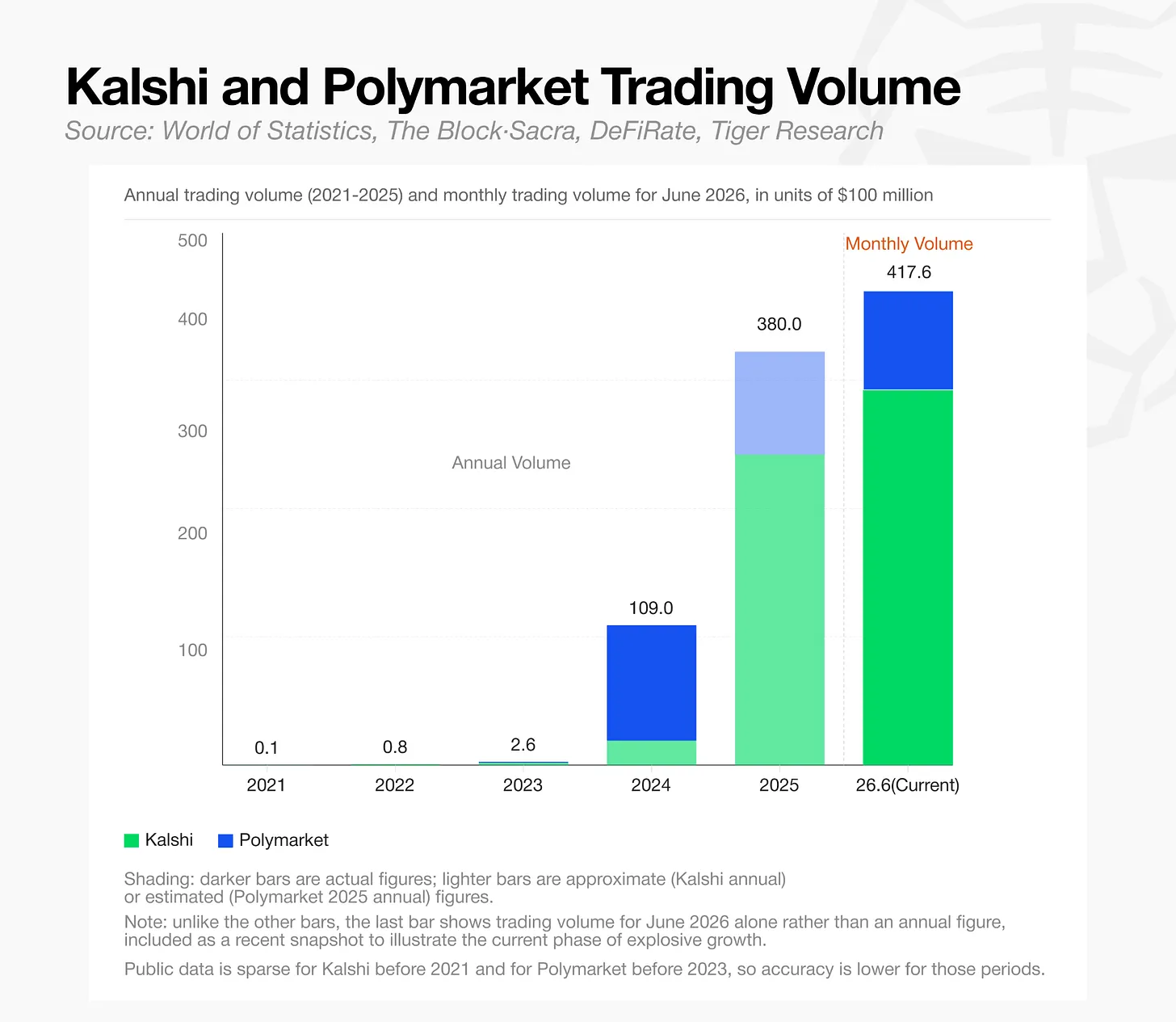
Also worth noting is that the two platforms actually dominating the industry, Kalshi and Polymarket, have not yet issued tokens.
Kalshi: Cumulative financing $2 billion, valuation $22 billion, 11 times the financing amount. Its June trading volume was $31.5 billion (up 87.4% month-over-month), exceeding that valuation.
Polymarket: Cumulative financing about $1.6 billion, valuation $9 billion. In June its main platform outside the US reached trading volume of $10.26 billion (up 45% month-over-month), since being approved to operate in the US, annualized revenue has exceeded $1 billion.
The World Cup was both an opportunity and a challenge for prediction market platforms. It drove a sharp growth in June trading volume, but after the final on July 19, the total open interest of the two platforms dropped nearly 20% from the peak of about $2 billion in early July. Since sports contracts accounted for about 80% of total trading volume during the competition, trading volume may remain weak before the next major event, the US midterm elections.
Regulatory risks also remain. On July 21, 2026, a Washington State court issued a preliminary injunction prohibiting Kalshi from selling sports event contracts, reasoning that this constitutes illegal gambling under state law.
Before 2024, prediction markets did not even exist as a separate category. Today, they are the fastest-growing segment of the crypto market. The uniqueness of this sector lies in the fact that its growth is not proven by token market cap or TVL, but by real trading volume and revenue, this revenue comes from attracting users outside the crypto circle to the on-chain ecosystem. This is one of the clearest examples so far of blockchain technology becoming part of the daily use of a broad audience.
4.5. Meme Tokens: From Simple Speculative Assets to Liquidity Bootstrapping Strategies
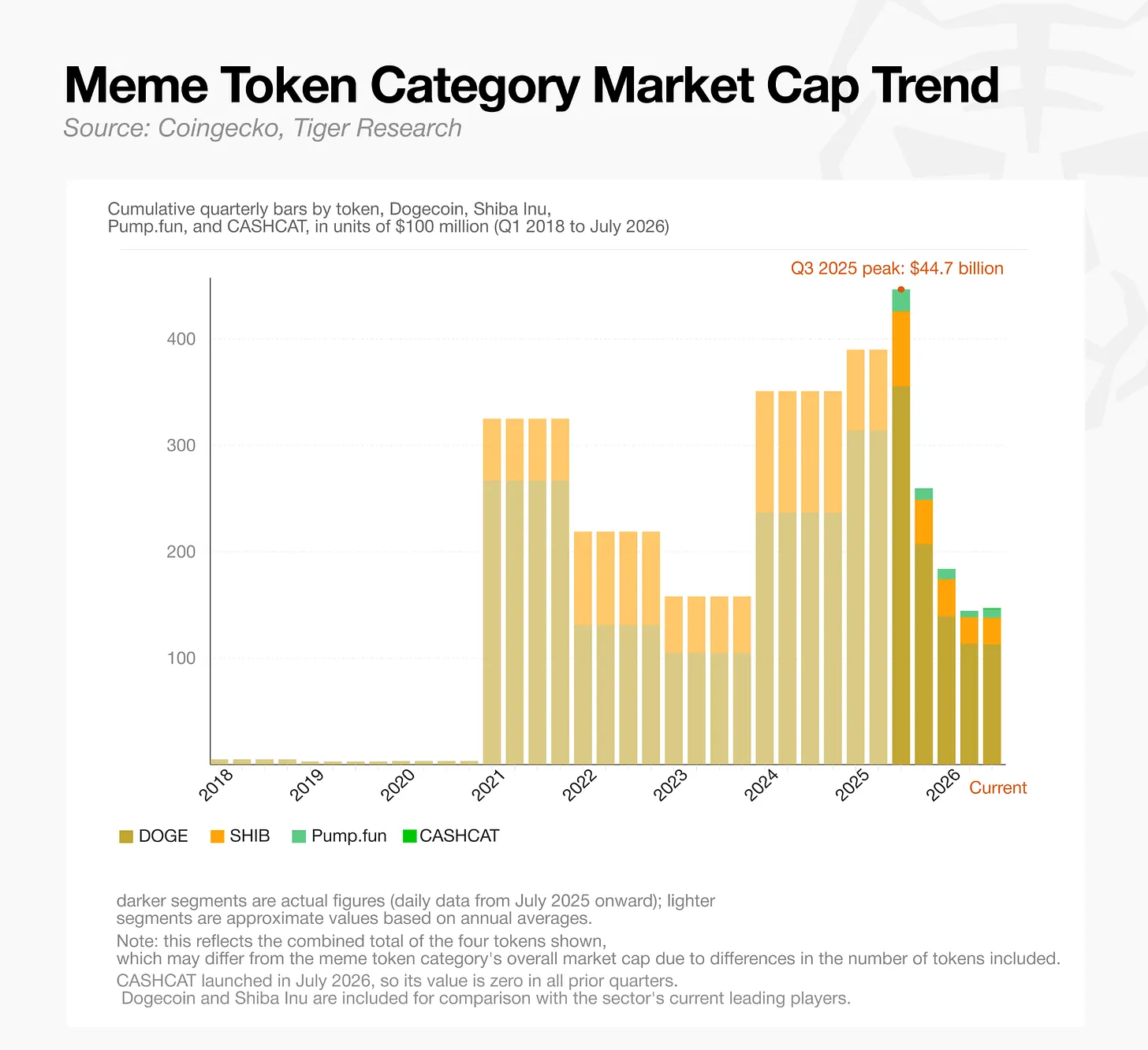
The last sector is meme tokens. Unlike the other sectors above, meme tokens have no clear utility. Their value comes from community and attention. The market cap of this category is $25.68 billion, larger than prediction markets.
Dogecoin ranks first with $11.22 billion, followed by Shiba Inu with $2.5 billion. These two tokens combined account for 53.4% of the entire meme token category market cap, indicating that once a token occupies a symbolic position in this sector, even if loosely, it tends to maintain that position.
Pump.fun and CASHCAT are highlighted here not because of their market cap ranking, but because of their symbolic significance.
Pump.fun: Market cap $806 million, notably the public sale in July 2025 raised $600 million in 12 minutes.
CASHCAT (Robinhood chain): Its market cap rose over 2100% within a week of launch, peaking over $200 million, then fell about 75% from that peak to $59 million on July 17.
As the July 2026 Robinhood chain case shows, meme token narratives can still temporarily attract liquidity for an entire chain, this is a pattern seen in past cycles. Robinhood chain's TVL expanded sharply, from $17 million on July 3 to $312 million on July 13, July 10 DEX daily trading volume climbed to $846.8 million, mainly driven by meme token $CASHCAT.
The practical value of meme tokens lies in attracting early users and simplifying onboarding. New chains or applications can use meme tokens to quickly build communities, and naturally encourage activities like bridging assets or trading on DEXs. Some users attracted in this way will continue to use other DeFi services or applications within the ecosystem and remain active, making meme tokens an effective entry point and marketing channel.
Ultimately, the function of meme tokens is more like an initial tool for quickly gathering users and liquidity, rather than long-term hold assets. Whether early attention can be converted into real product usage and lasting retention within the ecosystem is the key to determining success or failure.
5. What Projects Need to Survive
Projects that have survived to now have gained real demand that allows users to return repeatedly, and proved this through clear performance metrics such as trading volume, TVL, and fee revenue.
Market demand in 2026 is concentrated at two different ends of the spectrum. One end is speculative demand seeking high volatility and immediate returns. Meme tokens, perpetual contract DEXs, and prediction markets effectively absorb this demand through fast trading cycles and high capital turnover. The other end is real financial demand for stable custody, transfer, and efficient management of assets. Stablecoins, RWA, and DeFi infrastructure are fulfilling core financial functions such as payment, collateral, yield generation, and risk management.
When sustainable revenue structures and network effects are added to this foundation, true product-market fit is formed. Token prices can generate initial attention, but long-term survival is determined by usage frequency, retained capital, revenue, and operational capability.
KBW held in late September 2026 will provide a close-up view of this shift. Tether U.S. CEO Bo Hines, Hyperliquid co-founder Jeff Yan, Robinhood Crypto Senior Vice President Johann Kerbrat, and Apollo's Christine Moy are the key figures driving these changes, and they will take the stage together. Through dialogues with key leaders in stablecoins, perpetual contract DEXs, and asset tokenization and RWA sectors, attendees will be able to see with their own eyes the shift that until now has only been visible in data.
Join TechFlow official community to stay tuned
Telegram:https://t.me/TechFlowDaily
X (Twitter):https://x.com/TechFlowPost
X (Twitter) EN:https://x.com/BlockFlow_News
 @tiger_research