Selling Block Space Is Dead: Public Chains Must Find a New Way to Survive
TechFlow Selected TechFlow Selected
Selling Block Space Is Dead: Public Chains Must Find a New Way to Survive
The era of neutral infrastructure is coming to an end.
 Navigating Web3 tides with focused insights
Author: Castle Labs
Compiled: TechFlow
TechFlow Intro: Over the past two years, 14 crypto companies have achieved annual revenues exceeding $200 million, with only one being a public chain—Hyperliquid. When Arbitrum's monthly revenue is $430,000 while Hyperliquid achieves $58 million (a 100x gap), public chains finally realize: selling block space is no longer a viable business. Either transform into product studios, app distributors, or focus on vertical industries for SaaS—the era of neutral infrastructure is ending.
We recently spent significant time researching revenue issues, covering both applications and public chains.
Applications have always been strong revenue generators; they reach customers directly and must provide value.
Public chains have long supported ecosystems through grants and protocol upgrades, but now they must also adjust direction, shifting towards serving paying customers, otherwise they risk depleting their treasuries.
Over the past two years, 14 crypto companies have exceeded $200 million in revenue, with only one being a public chain.
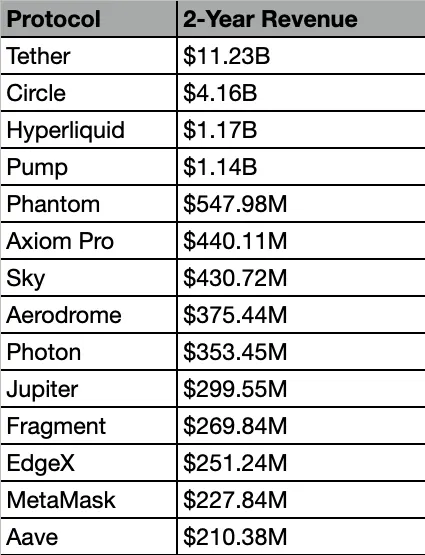
That is Hyperliquid.
To illustrate the gap between public chains: Arbitrum generated only $430,000 in revenue over the past 30 days, while Hyperliquid achieved approximately $58 million (over 100x).
But the situation is changing. Public chains understand that block space is no longer a business model; they need to focus on other revenue sources. We have already seen the first movers striving to become product studios, app distributors, payment rails, or vertical SaaS stacks. This will undoubtedly continue, with more public chains moving away from neutral infrastructure towards ownership in specific verticals.
Ostium Vulnerability Leads to Over 40% TVL Loss
Last week, Ostium's LP vault was attacked, losing 23,752,746 USDC; the attacker compromised the off-chain infrastructure that inputs prices to the protocol.
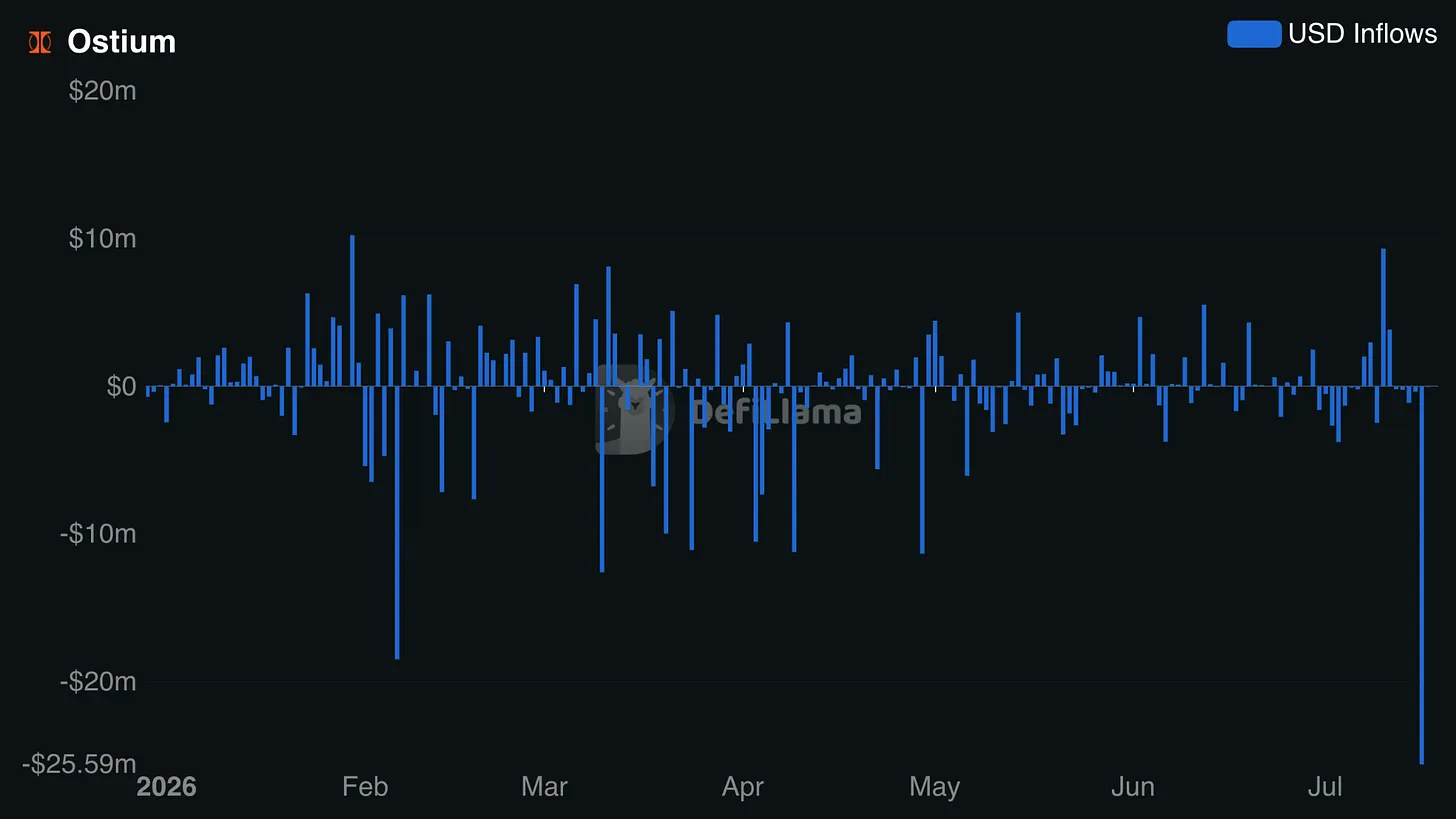
The attacker submitted seemingly valid but illegal price reports, then used them to open and immediately close large positions, extracting artificial profits from the vault. Essentially, the attacker found a way to push false price updates through approved paths, making losing trades appear profitable, thereby draining the LP vault.
This is particularly painful for Ostium, as the core of its entire product is bringing off-chain markets on-chain. Stocks, commodities, and forex on Ostium do not have native on-chain prices; the protocol must import them, and more importantly, must trust them.
Contracts on the protocol rely on this trust, and so do users, meaning false prices that pass checks can quickly evolve from bad data to bad execution, bad vault accounting, and real LP losses. For Ostium, oversight of this off-chain to on-chain journey is core to the product.
Ostium stated that trader collateral was isolated and unaffected, and trading contracts were frozen within 60 minutes. This is quite fast, but the question is: before the protocol captures it, how much damage should a bad price input be able to cause?
More frustratingly, Ostium is already accepting TradFi trade-offs. Many markets it offers are not truly 24/7 because the underlying assets themselves are not 24/7. If you have already accepted market trading hours, stale prices, closures, and liquidity gaps, this should make stricter controls around price updates, trade size, withdrawals, and timing easier to justify, not harder.
The industry needs to adapt to this, and I believe Ostium is in the lead. If an authorized path can update prices, shouldn't this path be strictly controlled and monitored? If new price updates can support large trades or withdrawals, shouldn't there be circuit breakers regarding size and timing? If attackers test the system with small trades first, shouldn't monitoring capture the pattern before the vault is drained?
For protocols bringing off-chain markets on-chain, these controls should not be optional security features; they should be embedded and marketed as part of the product.
Options Need Abstraction
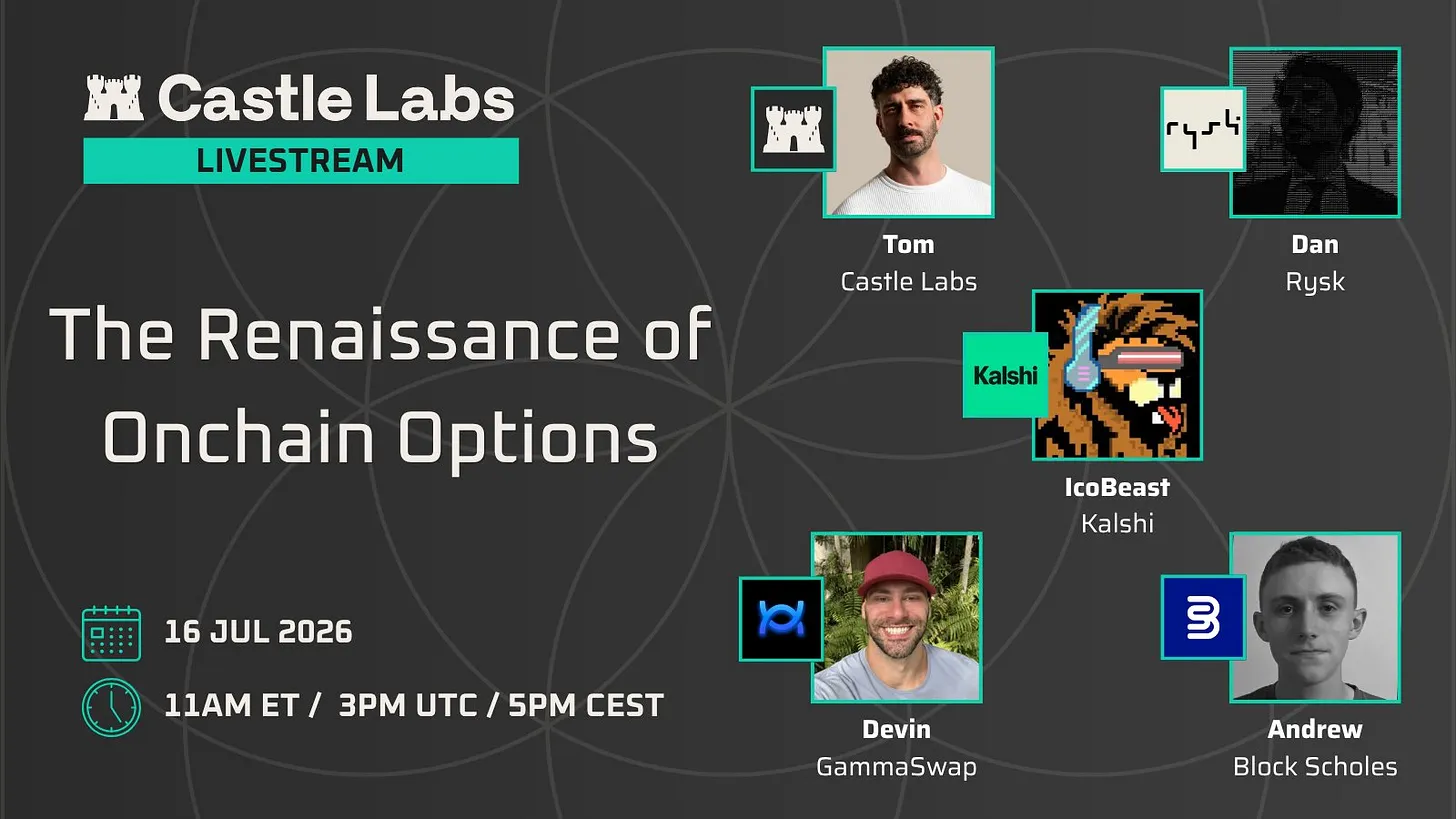
Last week, after releasing the "Renaissance of On-Chain Options" report, we invited Kalshi, Rysk, GammaSwap, and Block Scholes to participate in a livestream. These builders repeatedly mentioned a point: options are powerful, but marketing them as "options" is often the worst way to sell them.
Most users do not want to think in terms of Greeks, expiration dates, strike prices, or volatility surfaces; they want yield, leverage, protection, or simple ways to express views. This is why the most promising products in terms of user adoption are often not plain vanilla option venues, but yield vaults, short-term binary options, structured products, and prediction markets.
Dan from Rysk summarized this almost perfectly: options are not the product; the benefits of options are the product.
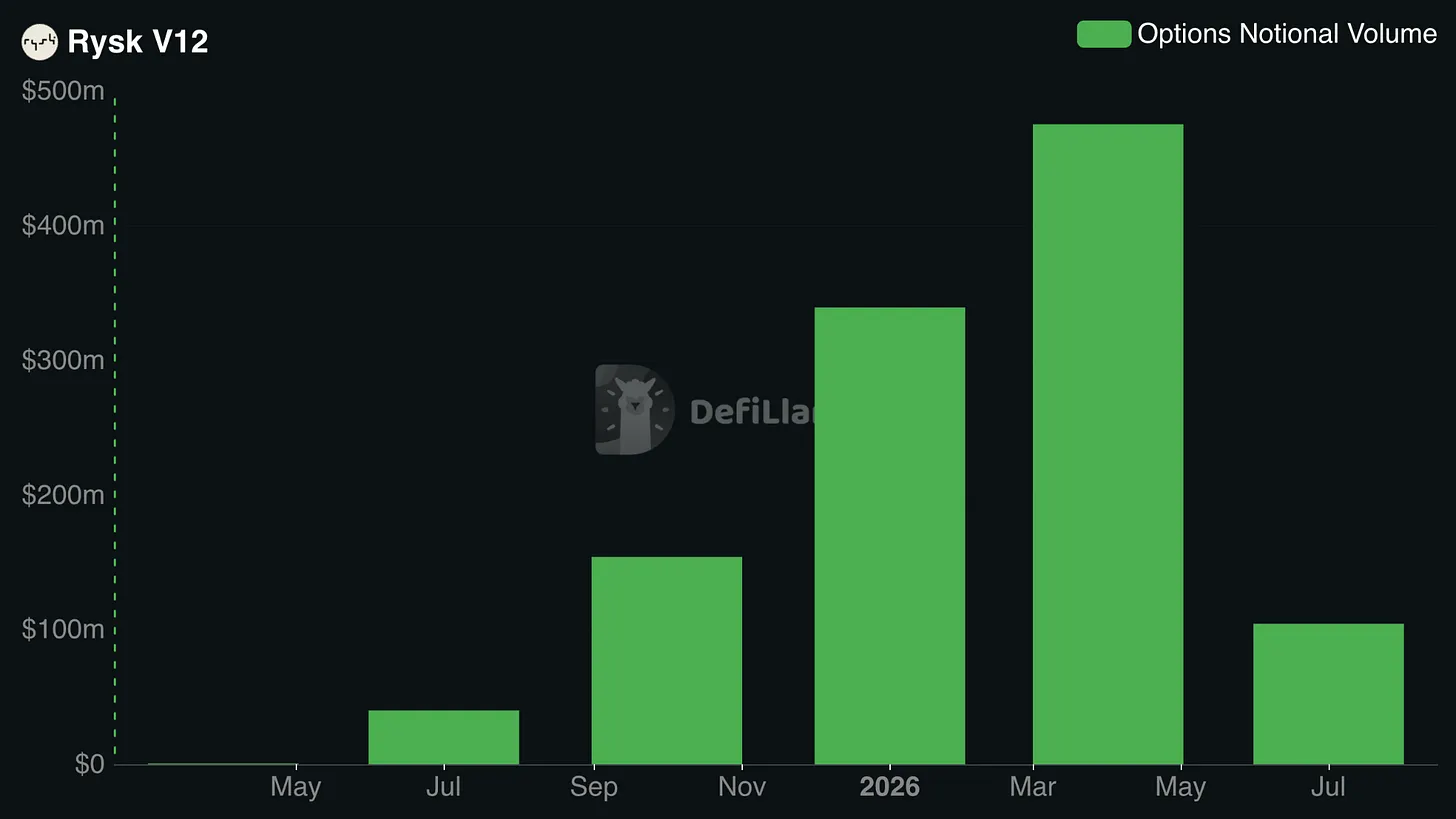
Rysk stated that its newer product exceeded $1 billion in open interest last year, mainly from DeFi veterans seeking asset yield, rather than people arriving as options traders. The quarterly notional amount chart shows how quickly the product found demand.
Kalshi stated it now handles 86% of the volume of global crypto binary options, and about 70% of the volume of global prediction markets; the 15-minute market appears to be the best time window for crypto binary options because users easily understand returns, time windows, and risks.
GammaSwap is an excellent example of abstracting options away from end users. Its V1 allowed users to borrow liquidity from an AMM, where the AMM behaved much like an option seller, but once Greeks, exotic payoffs, and fragmented liquidity had to become part of every user journey, the product became capital inefficient and difficult to use. V2 is in development, shifting towards prediction markets, order books, and known returns, focusing on providing a clear question that is easier to sell than another complex options product.
Block Scholes brought perspective from an infrastructure angle, as they support about 90% of on-chain options volume through venues like Derive. Traditional options exchanges might retain niche user bases through their native UX, but structured products are the way more users will access them in the future, without knowing they are even touching options.
To grow options further on-chain, they need to stop being sold as options. The widespread view is that the next wave may be achieved by packaging returns into easier-to-understand products.
Our Radar
Flex, Yearn's Fixed-Rate Lending: Yearn's Flex product is a fixed-rate money market where borrowers choose their own fixed rate. Follow the new protocol on DefiLlama.
How Base Bounces Back: Two announcements from Jesse and Brian sparked widespread community dissatisfaction on X. Jesse admitted his failed strategy regarding social and creator tokens, and is now handing over the Base App to Cobie, the Crypto Twitter trader and Echo founder (acquired by Coinbase for $400 million). On the other hand, Brian takes no responsibility for the pump and dump of the memecoin related to his avatar last week. Posts like this from Rune summarize the sentiment well. Cobie taking over the Base App is actually their last straw to save face with crypto-native users.
Plether, On-Chain US Dollar Index Perpetual Contracts: Plether is building a perpetual contract DEX for the US Dollar Index (DXY), allowing users to go long or short synthetic dollar exposure on-chain. Interestingly, positions have maximum returns defined at opening, LPs are divided into senior and junior tranches, and the protocol will prevent new openings if it cannot enforce solvency.
Starknet's Security Focus: Yesterday we released a report on the two major obstacles for the next phase of institutional on-chain growth: privacy and persistence against quantum threats. Starknet is a useful perspective here, as its recent work touches both areas: privacy improves what institutions can safely disclose on-chain, and quantum persistence asks whether today's infrastructure can survive in the next security cycle.
Join TechFlow official community to stay tuned
Telegram:https://t.me/TechFlowDaily
X (Twitter):https://x.com/TechFlowPost
X (Twitter) EN:https://x.com/BlockFlow_News
 @castle_labs