Account War: When USD Accounts Are Born Outside Banks
Written by: Emily Sun, Researcher at Bitget Wallet
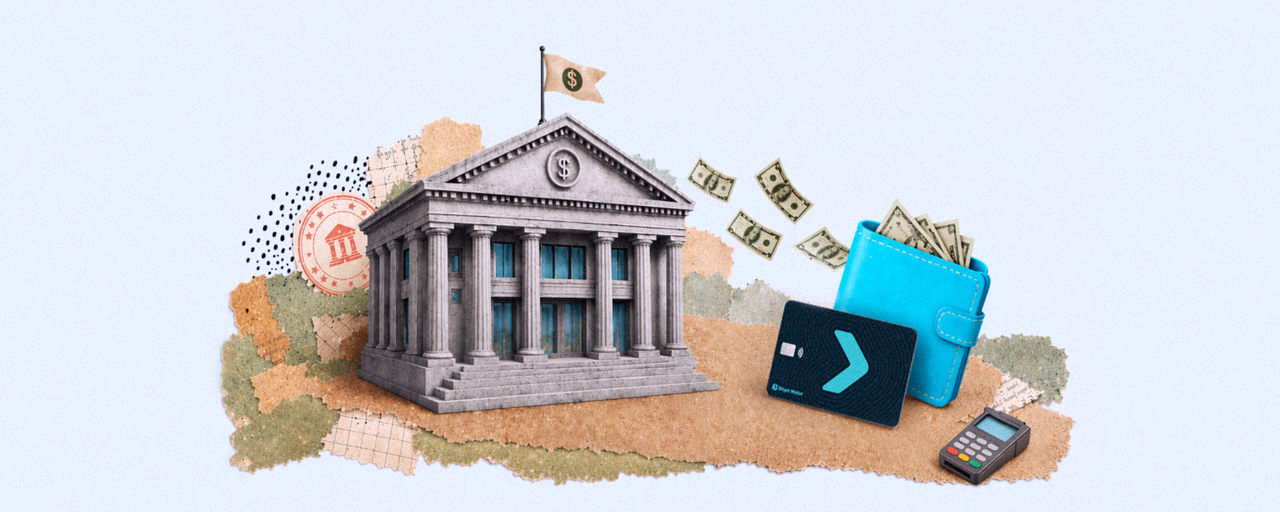
In the past financial system, "who owns an account" was never a separate issue requiring discussion, because accounts inherently belonged to banks; this was the default setting of the entire system.
When a user opens an account, they see their own balance, but the legal and regulatory authorities truly recognize the bank as the owner. A bank account is a debt-type financial instrument issued by the bank and confirmed by the regulatory framework; the bank obtains the right to use the funds, while the user gains the right to claim deposits. The banks hold assets that are regulated, license-constrained, and subject to capital adequacy ratios and customer fund segregation obligations. This arrangement has operated for decades, so much so that people even forgot it could have been different, because aside from banks, it seemed no other entity could simultaneously meet the two conditions of "custody of funds" and "regulatory oversight."
The emergence of stablecoins allowed these two conditions to be viewed separately for the first time. When dollars can exist in the form of USDT or USDC within blockchain addresses, without needing to reside on a bank's balance sheet, the question of "who holds the funds" can finally occur independently of "who is subject to banking regulation." This is not a technical detail, but a structural loosening: for decades, the issue of account ownership never truly surfaced because the answer was always singular; now, it has become an open question that every company must design itself and bear the consequences for.
The controversy surrounding the KAST terms of service erupted in July 2026, placing this open question squarely before the public for the first time. On the surface, it was merely a wording dispute in a service agreement: when users deposit stablecoins, the funds are legally defined as a "sale" rather than a "deposit." But if we only interpret this as a PR misstep, we will miss its true signal: the clause design of KAST is actually clearly answering the question of "who owns the next-generation dollar account," only the answer it gives is completely opposite to what users intuitively expect. Once this answer was laid bare, the entire industry realized for the first time that this question had remained unresolved, and nearly every company calling itself a Neobank had already quietly answered it through its respective product architecture, though most users never noticed.
To understand why the KAST incident caused such significant shockwaves, we must first return to an earlier question: Today, when dollar accounts operate outside of banks, who actually owns them?
Dollars in Emerging Markets: From Survival Necessity to Financial Innovation
If you explain "why a dollar account is needed" to an American, the answer would likely involve receiving salaries, paying rent, or investing in stocks; accounts are background infrastructure for life and don't require special attention. But for a much larger portion of the global population, the meaning of a dollar account is entirely different, because it solves not an investment problem, but a survival one.
Argentina is the most straightforward example. In 2023, Argentina's inflation rate once exceeded 200%, meaning that if a household held its salary in local fiat currency for more than a few days, purchasing power would noticeably shrink. Therefore, the first thing many do upon receiving wages is immediately convert them into dollars. Nigeria demonstrates another version of the same logic: due to the long-standing coexistence of official exchange rates and parallel market rates, import businesses struggle to obtain sufficient dollars through formal channels for procurement, making USDT a de facto trade settlement tool. Chainalysis has ranked Nigeria among the world's most active crypto markets for consecutive years in its global cryptocurrency adoption index, not due to speculation, but because of real-world dollar shortages. Together, these cases illustrate that when a currency cannot be held stably, people bypass official channels and carve out their own path to the dollar. Once this path scales, it spawns business models built to serve it.
Meanwhile, another structural demand for dollars is growing within the internet economy. Statistics from the World Bank and the International Labour Organization show that India, the Philippines, Pakistan, and Bangladesh have become major global exporters of digital labor. Countless programmers, designers, and freelancers earn dollars through platforms like Upwork or Fiverr, or directly for overseas SaaS companies, yet their receiving accounts remain trapped within local financial systems. A Filipino designer might wait several days for a US client's payment to clear, while a Pakistani developer might pay over 5% in fees for a single cross-border remittance.
According to World Bank estimates, the global scale of personal remittances reached approximately $905 billion in 2024, with official recorded remittances flowing to low- and middle-income countries totaling around $685 billion. Completing these transfers still takes an average of several days, with global average fees hovering around 6%. Work has been globalized for nearly twenty years, yet the account system remains stuck in a previous era characterized by clear geographical boundaries.
A noteworthy contradiction emerges here: If demand for dollars is so massive and continuously growing, why haven't banks proactively met it? The answer lies not in unwillingness, but in the fact that banks' cost structures are designed per country, whereas dollar demand in the internet age originates globally. For every additional jurisdiction served, a bank must establish a full suite of KYC, anti-money laundering reviews, foreign exchange control compliance, and capital requirements. These costs cannot be amortized by a freelancer earning a few hundred dollars a month, nor by the daily currency exchange needs of an Argentine household. Consequently, a huge supply-demand gap was left for companies outside the traditional banking system.
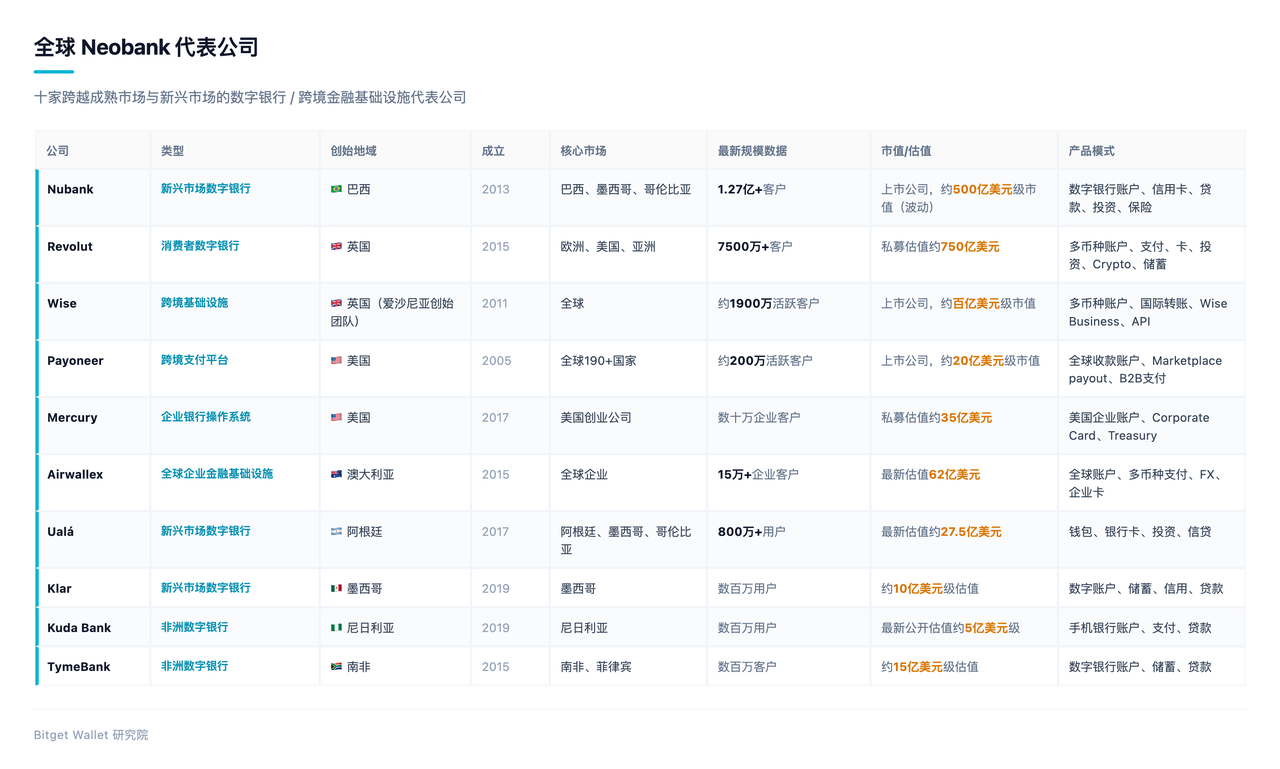
First-generation Neobanks like Nubank, Revolut, Wise, Payoneer, and Mercury precisely grew out of this gap. Their common approach was not to reinvent the dollar, but to repackage banking:
- Wise breaks a cross-border remittance into two domestic transfers, using a global network of accounts to complete fund hedging, thereby bypassing the traditional correspondent banking system;
- Payoneer partners with US licensed banks, allowing global freelancers to remotely apply for a US dollar account capable of receiving ACH transfers for the first time;
- Mercury digitizes US corporate bank accounts as internet products, enabling founders located in Singapore or Brazil to access a convenient and comprehensive US financial gateway.
These companies changed account opening experiences and remittance costs, but the funds behind the accounts still sit in regulated commercial banks, with regulatory responsibility remaining squarely on the banks themselves. Essentially, they are an internet interface layered over the banking system, not a new entity outside of it. This is the ceiling: no matter how modern the interface becomes, as long as funding sovereignty remains in bank hands, the compliance costs of serving global small-amount, high-frequency, cross-border users persist, failing to fundamentally solve the core issue of "banks' unwillingness to serve these demographics at low cost."
What truly broke this ceiling was not better product design, but a technological breakthrough at the asset level: when dollars could first detach from bank accounts and exist independently in the form of on-chain assets, the issue of account ownership—previously locked by default under banks—was finally loosened.
Stablecoins and the Dissolution of Account Ownership
When Tether launched USDT in 2014 and Circle partnered with Coinbase to launch USDC in 2018, on the surface, they merely issued new digital dollars. In reality, they accomplished something far more profound: they enabled dollars to exist independently on a blockchain address for the first time, detached from bank accounts. For a Nigerian entrepreneur, this meant receiving payments from US clients no longer required a US bank account; for an Argentine family, it meant converting salaries into digital dollars no longer required approval from a local bank.
But the most profound impact of dollars beginning to truly detach from banks is not faster transfer speeds or lower fees. Rather, it is that three functions previously bundled by banks—account assets, clearing, and payment—can now be unbundled and operated by different entities respectively.
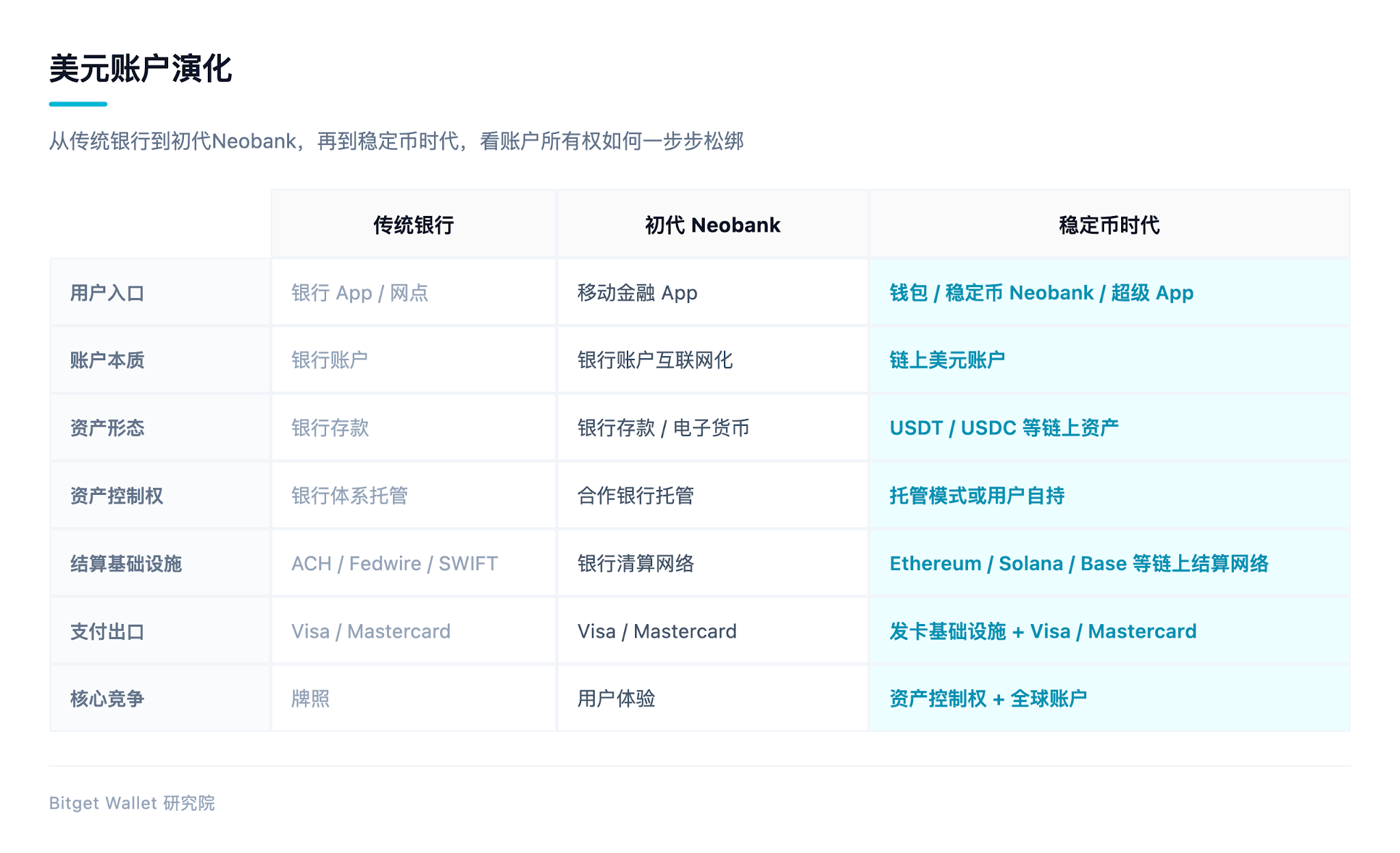
In the banking era, accounts, clearing, and payment were virtually the same thing: funds sit in banks, which handle interbank clearing via ACH, Fedwire, and SWIFT. Consumption relies on Visa and Mastercard connecting bank accounts to global merchant networks. All three layers are uniformly handled by a single regulated entity, allowing regulators to simply focus oversight on the bank alone.
But when the asset layer becomes on-chain USDT or USDC, the clearing layer can execute real-time settlement directly on public chains like Ethereum, Solana, or Base, and the payment layer relies on card infrastructure and Visa/Mastercard to convert digital dollars into fiat accepted by merchants. These three layers now belong to three distinct participants—wallets, public chains, and card networks—for the first time. Regulators had never before had to consider how to redistribute the responsibilities previously borne solely by banks across these three separated layers.
This unresolved question directly dictated a shift in the core capabilities of second-generation Neobanks: the first generation competed on how smoothly to integrate with banks, while the second generation competes on how to assign matching, regulator-friendly liability structures to each layer during the recomposition of assets, clearing, and payments. RedotPay attempts to directly link stablecoin accounts with global bank cards; Gnosis Pay connects Visa networks via smart contract wallets, keeping payment authority firmly in users' hands; Ether.fi Cash integrates stablecoins, staking yields, and spending accounts into a single on-chain account; and Plasma links on-chain accounts with the fiat infrastructure of Stripe's Bridge.
While these products all appear to be doing the same thing—providing a better-dollar account—their true divergence lies in how they answer the newly loosened, standard-free question of "who owns the account." This is precisely why the KAST incident sent shockwaves through the industry: it is not an isolated product dispute, but this open question exposed for the first time in its sharpest form.
The KAST Controversy: When Users Become Creditors
On the surface, KAST's product experience is flawless: a global dollar account, a Visa card bindable to Apple Pay and Google Pay, stablecoin holdings, and USD yields. It functions identically to any modern banking app. Precisely because of this seamless experience, users easily overlook a definition buried deep in the terms of service: when users deposit USDC into their card account, legally this transaction is classified not as a deposit, but as a "sale."
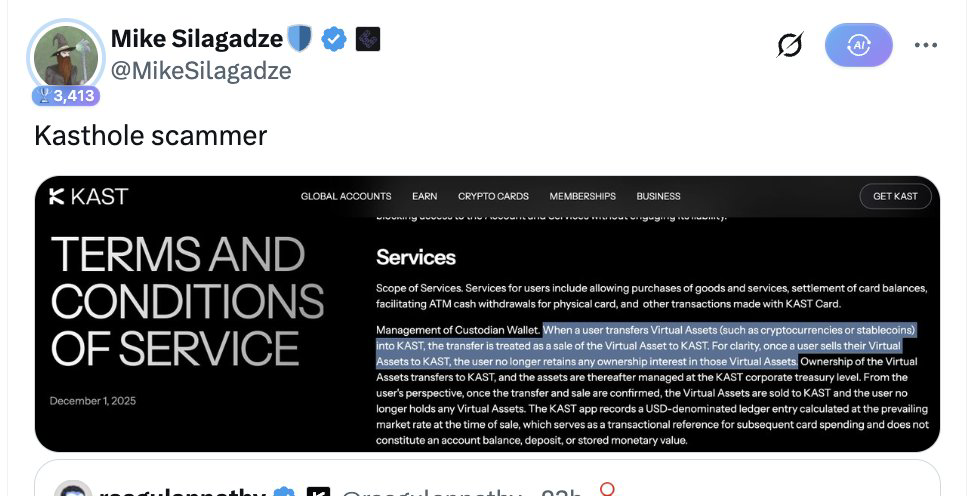
This single definition alters realities far more severely than its wording suggests. If the top-up is a deposit, the funds legally remain the property of the user, and the company merely acts as custodian; but if it is a sale, the user effectively transfers ownership of those stablecoins to KAST, and the funds immediately enter the company's corporate treasury. The balance shown in the user's account then represents only a payment obligation owed by the company to the user—in essence, a digital IOU. This distinction is almost imperceptible during normal operations, but if the company faces a liquidity crisis or bankruptcy, it determines whether users recover their money as asset owners or as creditors queued behind others. Furthermore, KAST's terms capped the company's liability at $500, further confirming that users' position in this structure aligns closer to that of ordinary creditors rather than asset owners.
Misinterpreting this merely as an oversight in legal drafting would drastically underestimate the sophistication of the design. What truly drives it is a highly specific regulatory reality: If a fintech company safeguards user funds long-term, it would be deemed to operate e-money or stored-value accounts in most jurisdictions, requiring licenses such as a European Electronic Money Institution (EMI) permit to meet a comprehensive set of rules including customer fund segregation, capital adequacy, and continuous audits. Such licenses are expensive and nearly impossible to replicate cost-effectively on a global scale. By shifting a legal definition, KAST sidestepped this entire regulatory framework. Since top-ups are treated as sales, the company acquires its own assets rather than customer deposits, meaning regulations centered on "customer funds" simply do not apply to this structure. This was not an oversight, but a calculated regulatory arbitrage.
This structure also quietly rewrote the company's profit source. Once funds enter the corporate treasury, they can be allocated into short-term US treasuries or money market funds. At short-term bond yields of 4% to 5%, $100 million in idle funds generates $4 to $5 million annually, income that hardly depends on whether users make purchases. This mirrors the exact logic used by Circle and Tether to profit from reserve assets, now transplanted into a Neobank account structure. Put differently, while other products only monetize when users spend, KAST profits even when users do nothing, earning deposit interest rather than transaction commissions. Regulatory costs dropped, commercial model potential expanded, but the cost was that users transitioned from asset owners to counterparties on the company's balance sheet liabilities.
KAST chose the answer: the company holds the funds, users hold the creditor rights, trading off simpler compliance paths and richer reserve yields. But this is merely one solution to the equation; another batch of products opted for the completely opposite answer.
An Alternative Answer from Crypto
Ether.fi Cash, Avici, Plasma, and Bitget Wallet follow an almost mirror-symmetric route. While their payment experiences similarly connect to Visa or Mastercard and support stablecoin spending, they share a unifying principle: a company's business model must be built on providing payment services, not on holding user assets, avoiding from the design outset any role as the fund owner at any stage.
In practice, this principle manifests as minimizing the time window in which the company controls user funds. Ether.fi Cash uses smart contracts to lock user assets as consumption collateral, meaning actual payments draw on credit lines provided by issuing banks rather than directly sweeping stablecoins from wallets; Plasma delegates fiat conversion to licensed entities like Stripe's acquired Bridge, handling only on-chain accounts and networking; Avici leverages banking partners to provide virtual accounts, instantly converting incoming fiat into stablecoins held in user wallets, preventing prolonged platform custody. The shared logic across these designs is clear: instead of applying for a single license covering the triple roles of "wallet + bank + payment institution," it is wiser to precisely delegate each layer's responsibility back to the entity best suited and most understandable to regulators.
The architecture of Bitget Wallet Card implements this principle even more thoroughly: it splits accounts, funds, and payments into three layers, ensuring each layer corresponds to its own regulatory obligations rather than attempting for one company to cover everything. Bitget Wallet itself maintains its positioning as a non-custodial wallet; users' on-chain USDT and USDC remain securely in their own wallet addresses, with private keys controlled exclusively by users. The platform neither has the ability nor the intention to actively transfer or centrally custody them, meaning at the wallet layer, the platform does not establish a client fund custody relationship whatsoever, thus falling outside corresponding custodial regulatory frameworks. Only when a user initiates a top-up, transferring partial funds into a card account managed by a licensed issuer do the funds enter the second layer. This tier is handled by licensed institutions, inherently requiring compliance with local payment institution regulations. The final layer comprises Visa's or Mastercard's global merchant networks, responsible for converting funds into real-world consumption, with regulatory responsibility for this tier resting permanently with the two major card networks.
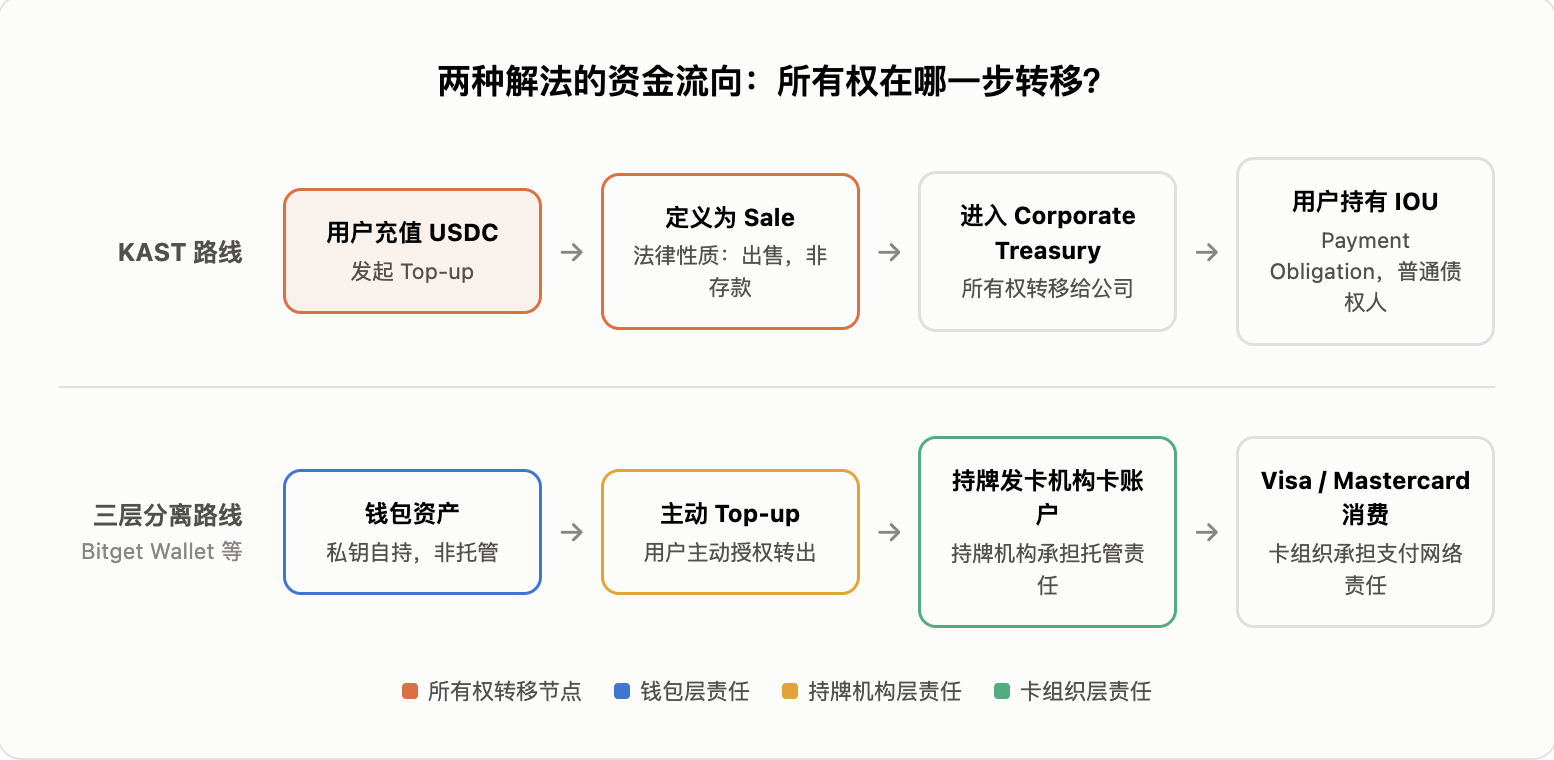
The result of this three-layer separation is that no single node bears the full regulatory weight of all three roles, and ultimate control over user assets remains firmly with the users themselves, albeit requiring one extra step of explicit authorization. While this step appears to detract slightly from product convenience, it secures the user's position in the worst-case scenario: not as a creditor in a bankrupt company's liquidation queue, but as an asset owner who always holds the private key and whose assets remain in their own on-chain address. KAST traded asset ownership transfer for regulatory simplification, while products like Bitget Wallet exchanged precise regulatory liability allocation for retained user asset control. These are two solutions to the same equation, and determining which travels further globally hinges not on superior product UX, but on what regulators actually prioritize.
The Regulatory Choice: Where Does the Money Actually Rest?
Examining stablecoin regulatory policies across major economies over recent years reveals a pattern: virtually no nation treats the wallet software itself as the primary regulatory focus. Because the core concern of regulators has consistently been singular: who controls the user's money, and which entity's balance sheet currently hosts those funds.
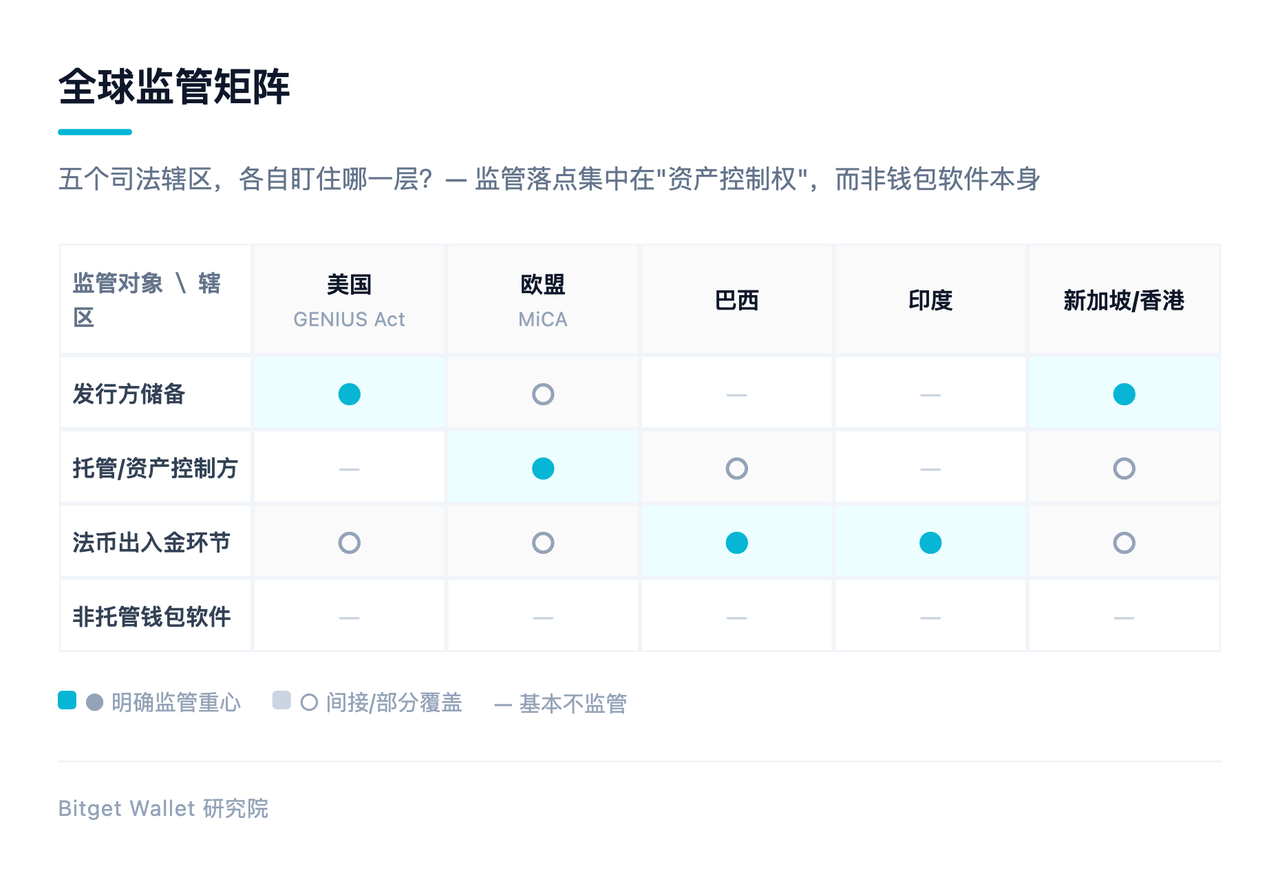
The US GENIUS Act passed in 2025 did not ban stablecoins or non-custodial wallets, but instead shifted regulatory focus onto stablecoin issuers, mandating secure reserves subject to audits, and prohibiting direct interest payments to token holders. The real question America seeks to answer is "who is issuing dollars," rather than "who wrote the code for this wallet."
Europe's MiCA took a different path. Instead of requiring all wallets to obtain financial licenses, it targeted Crypto-Asset Service Providers (CASPs): any company holding customer assets, executing transactions on behalf of clients, or managing funds must secure relevant authorizations. For pure software wallets where users retain sole control of private keys, MiCA adopted a relatively restrained stance. European regulators scrutinize the control of assets themselves, not the software format hosting them. This precisely explains why asset ownership transfers like KAST's invite stricter scrutiny, while non-custodial layered models are more readily identified and accommodated within existing regulatory frameworks.
Emerging markets like Brazil and India instead emphasize fiat on-ramps/off-ramps and capital flows. The Brazilian Central Bank, while driving Pix to become one of the world's most successful real-time payment networks, is gradually tightening oversight on stablecoin-fiat conversion processes, aiming for all funds to ultimately move through-regulated channels for deposits and withdrawals rather than lingering outside the banking system indefinitely. India avoids outright wallet restrictions, instead raising the cost of on-chain transactions through substantial capital gains taxes and withholding taxes, placing regulatory pressure directly on the flow of capital, rather than targeting the software layer of wallets.
Singapore and Hong Kong embrace stablecoin innovation while demanding licensed issuers, guaranteed reserve security, and segregating roles like wallets, payments, and custody into distinct regulatory frameworks.
Across multiple jurisdictions and varied specific rules, a shared underlying logic prevails: regulators increasingly care less about which public chain facilitates the funds, and increasingly care about whose balance sheet currently houses this capital.
Consequently, what dictates which regulatory framework a modern Neobank falls under is not brand messaging, but the underlying capital structure itself. KAST positions itself as a stablecoin-backed dollar account rather than a crypto wallet, but what truly determines its fate is the "top-up equals sale" contractual design, not the vocabulary it chooses to describe itself. Regulation has not halted the development of second-generation dollar accounts; it has fundamentally altered how responsibilities are distributed among the various entities behind them. Whoever sits closest to user funds must sit closest to corresponding regulatory obligations—a rule that will not be voided by elegantly worded terms of service.
The Endgame of the Account Wars: Not Issuing Dollars, But Holding Them Trustingly
Over the past two decades, the internet transformed nearly every industry yet failed to genuinely disrupt banks. The reason was not insufficient technological advancement, but the immutability of account ownership structures. As long as funding ownership remains anchored to a bank's balance sheet, no matter how polished an internet company makes its app, it remains fundamentally just an interface layered atop a bank. Stablecoins finally loosened this anchor, allowing dollars to exist independently outside traditional banking. Yet loosening the anchor does not equate to solving the "who is responsible" question; it merely transforms it from a problem with an automatic default answer into an open-ended challenge where each company must formulate its own solution and bear full consequences.
The divergence between KAST and Bitget Wallet, Ether.fi Cash, and Plasma represents the two clearest solutions to this open question today: one trades asset ownership transfer for simplified compliance and reserve yields, at the cost of turning users into creditors; the other retains user asset control through three-layer separation and distinct licensing, at the cost of sacrificing some immediate convenience. Neither solution is inherently wrong. They simply choose different coordinates along the axes of "regulatory friendliness" and "user asset sovereignty." Both the market and regulators continue observing which coordinate proves most viable over extended time horizons.
Taking this reasoning one step further reveals an approaching new reality: the variety of on-chain dollar denominations will only multiply. As of January 2026, USDT exceeds $180 billion and USDC surpasses $70 billion. PayPal launched PYUSD, Open Standard introduced OUSD, and major US banks are exploring joint issuance of tokenized deposits. When dozens of digital dollars circulate simultaneously worldwide, users clearly do not need to memorize more stablecoin names. Just as nobody today cares which telecom carrier's network powers their mobile payments, infrastructure will inevitably recede from end-user visibility—and stablecoins are no exception.
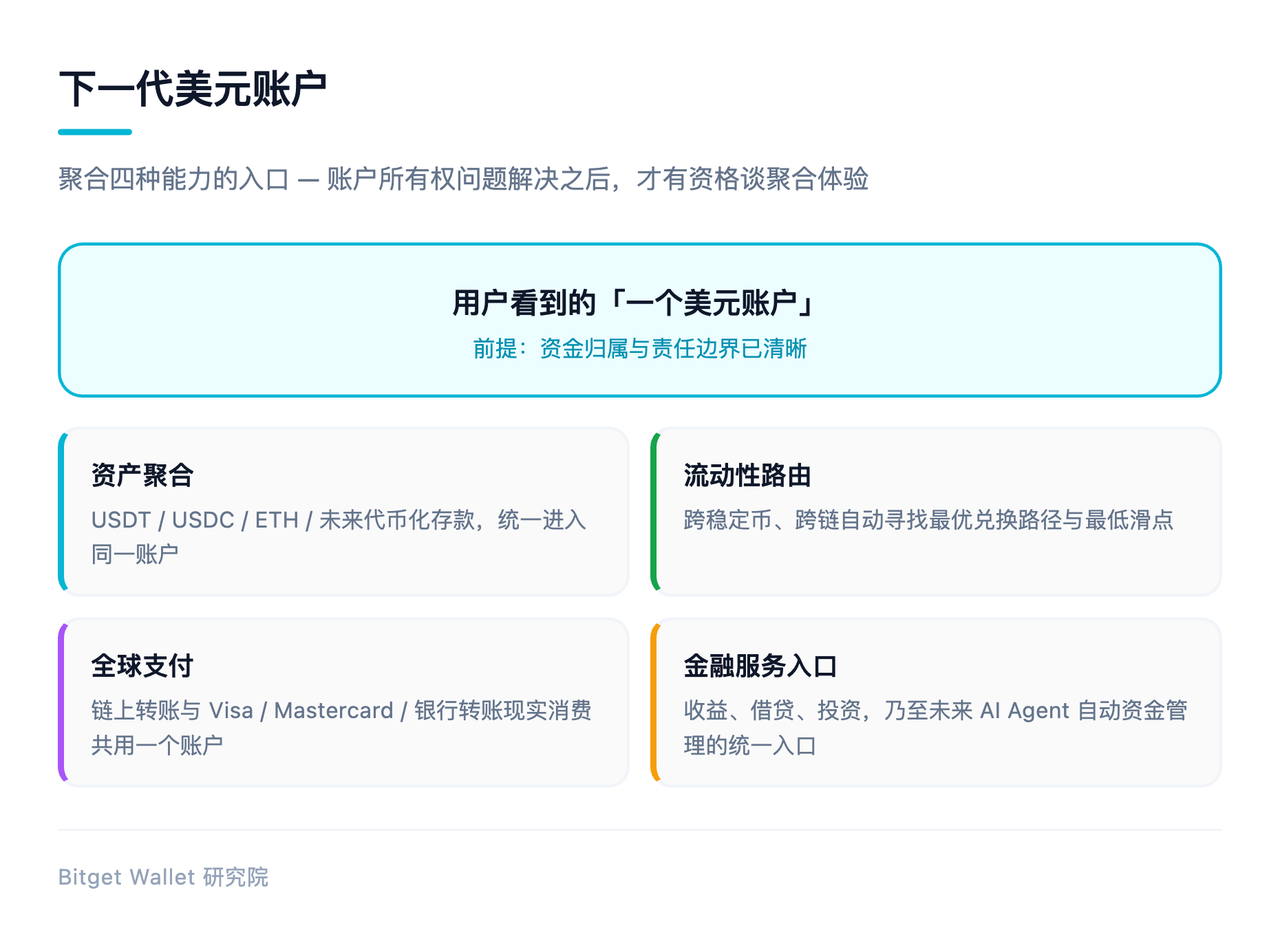
This means the question of "who owns the account," under the pressure of exploding stablecoin quantities, will further evolve into "who can re-aggregate dozens of dollars into a single dollar in users' eyes." Products achieving this are simultaneously developing four capabilities: aggregating USDT, USDC, ETH, and future tokenized deposits into a unified account; automatically finding optimal swap paths and minimal slippage across varying stablecoins and chains; enabling the same account to execute both on-chain transfers and real-world consumption via Visa, Mastercard, or bank transfers; and consolidating yields, lending, payments, investments, and even future AI agent autonomous fund management into a single entry point. All four capabilities inherently rely on solving the prior equation addressed above. Only after clarifying "who owns the funds and who bears the responsibility" can discussions about "how to aggregate diverse dollars into a singular experience" even begin, because the prerequisite for aggregation is user trust that this entry point will not quietly transfer asset ownership deep within contractual clauses, as KAST did.
In the future, users will not care whether they hold USDT, USDC, or tokenized deposits issued by a specific bank, just as nobody today questions which bank's clearing system underpins their balances. What will truly determine the ownership of next-generation dollar accounts will never be which issuer boasts the largest volume. Instead, it will belong to whoever finds the equilibrium between "detaching from banks" and "withstanding regulatory scrutiny"—a balance point users are willing to entrust and regulators are willing to endorse. This is the true prize in the ongoing account wars.
Join TechFlow official community to stay tuned
Telegram:https://t.me/TechFlowDaily
X (Twitter):https://x.com/TechFlowPost
X (Twitter) EN:https://x.com/BlockFlow_News
 @BitgetWallet