GitHub Code "Leak", Anthropic Becomes AMD Customer? NVIDIA GPU Monopoly Faces Biggest Variable
TechFlow Selected TechFlow Selected
GitHub Code "Leak", Anthropic Becomes AMD Customer? NVIDIA GPU Monopoly Faces Biggest Variable
Investment research has become so fiercely competitive that practitioners have now resorted to scraping code leaks to find client lists.
 Navigating Web3 tides with focused insights
Author: Claude, TechFlow
TechFlow Editor's Note: An AMD executive listed Anthropic as a "customer" in a YAML code file uploaded to GitHub, granting it the highest priority equal to Meta. Jefferies had previously noted that Anthropic was hiring ROCm engineers. If AMD officially announces the partnership at the Advancing AI conference on July 22, this will be the third top-tier AI lab client AMD has secured after OpenAI and Meta, potentially without paying the price of 10% company equity. NVIDIA still holds 80% to 90% share in the AI accelerator market, but supply chain diversification has shifted from a "strategic vision" to "actual procurement".
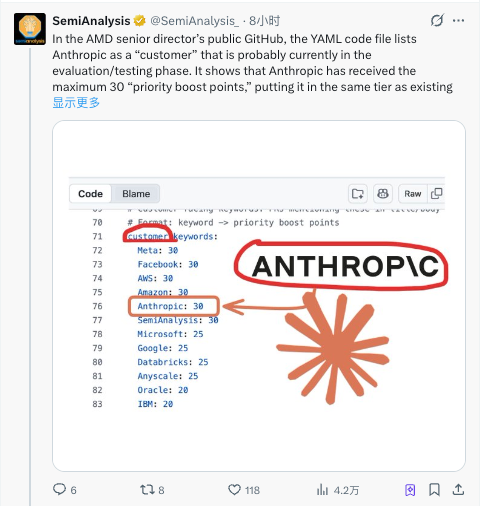
A YAML code file on GitHub has brought the undisclosed customer relationship between AMD and Anthropic to the forefront.
According to a Stocktwits report on July 19, semiconductor research firm SemiAnalysis discovered that in a code file submitted by AMD AI Software Vice President Anush Elangovan on GitHub, Anthropic was listed as a "customer" and granted the highest 30 "priority boost points," enjoying the same treatment as publicly disclosed hyperscale customers like Meta.
AMD's after-hours stock price subsequently rose by 1.3%.
SemiAnalysis also pointed out that Anthropic is currently still in the evaluation phase. "If AMD fails to announce Anthropic at the upcoming Advancing AI conference, it means Elangovan's field engineering team has not yet resolved all of Anthropic's concerns regarding software quality."
The AMD Advancing AI 2026 conference is scheduled to be held at the Moscone Center in San Francisco from July 22 to 23, only two days after the code exposure.
Multiple Clues Point in the Same Direction
The GitHub code is not an isolated signal.
As early as April this year, SDxCentral reported that Anthropic published a job posting for engineers in its reinforcement learning team, explicitly requiring candidates to have experience using ROCm (AMD's AI software stack) and the ability to migrate workloads between different types of accelerators. The starting salary was $350,000.
Jefferies analyst Blayne Curtis further pointed out in a research report on July 17 that Anthropic has been hiring engineers with ROCm experience, indicating that the company is preparing to further diversify its computing infrastructure. Curtis views this as a key signal that a customer announcement may occur at the AMD Advancing AI conference.
Anthropic's current public computing architecture consists of three legs: NVIDIA GPUs, Amazon's self-developed chip Trainium, and Google TPUs. In October 2025, Anthropic reached an agreement with Google to obtain usage rights for up to 1 million seventh-generation TPUs. In November 2025, NVIDIA and Microsoft invested $15 billion in Anthropic, and Anthropic accordingly committed to purchasing $30 billion worth of NVIDIA computing power from Microsoft Azure.
If AMD becomes the fourth leg, Anthropic will become the AI lab with the most diversified computing power sources in the industry.
AMD's "Equity for Orders" Model Reaches a Crossroads
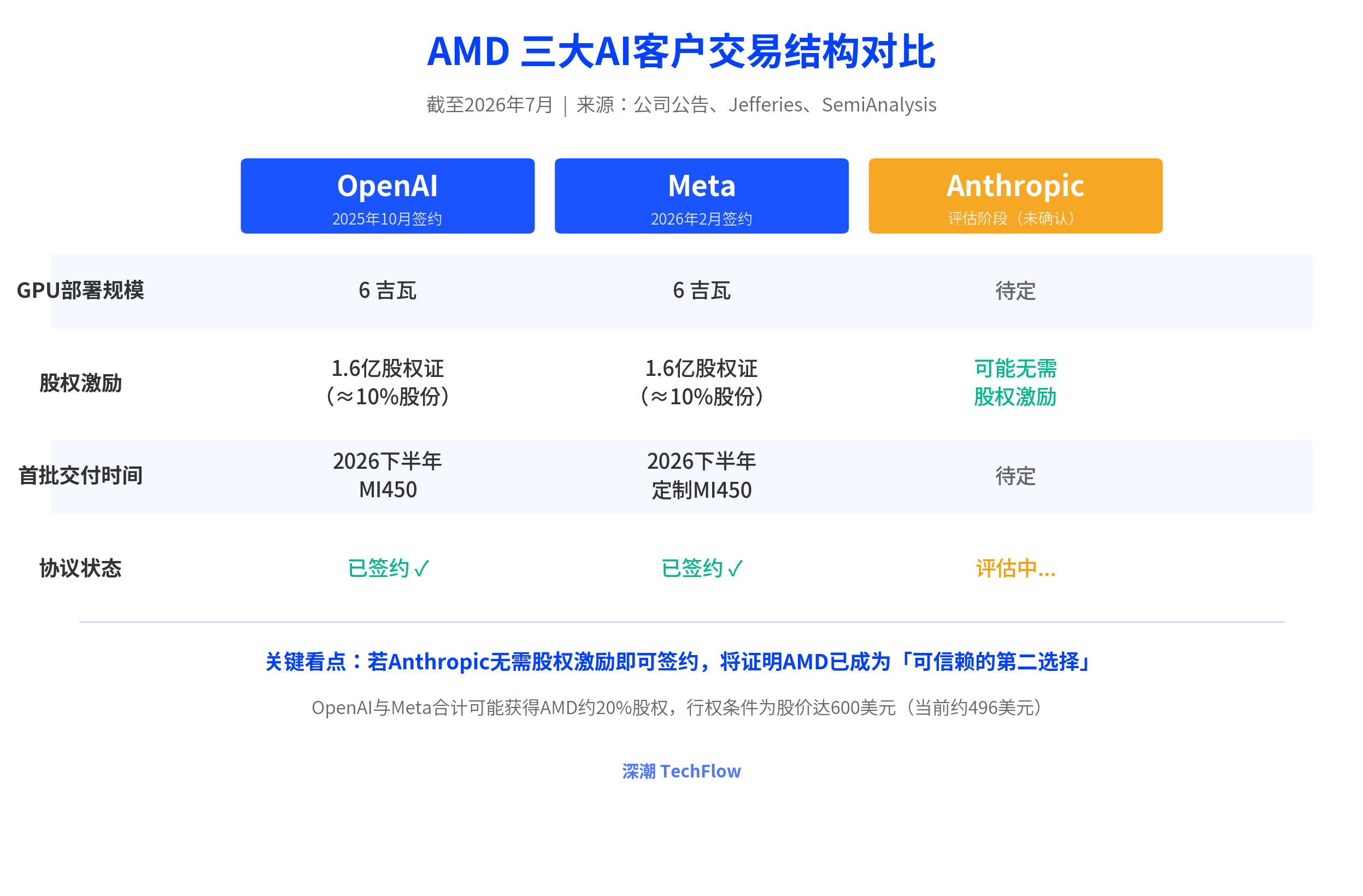
AMD previously secured two mega-clients, OpenAI and Meta, relying on an aggressive equity incentive plan.
In October 2025, AMD signed a 6 GW GPU deployment agreement with OpenAI, issuing warrants for up to 160 million shares to OpenAI, with an exercise price of only 1 cent, but vesting only after AMD's stock price reaches $600 (approximately $210 at the time) and delivery milestones are met. In February 2026, AMD signed a nearly identical agreement with Meta: same 6 GW, same 160 million share warrants, same $600 stock price threshold.
Combined, the two deals mean AMD may concede approximately 20% of company equity in exchange for locking in 12 GW of GPU orders. Based on NVIDIA GPU pricing estimates, each GW is worth about $35 billion, and the potential revenue scale of 12 GW far exceeds AMD's full-year 2025 revenue of $34.6 billion.
Jefferies explicitly stated in a research report on July 17 that since AMD has already committed 20% of company equity to OpenAI and Meta, future deals require smaller incentive packages. A more traditional Anthropic agreement (i.e., without large equity stakes) will boost market confidence, proving AMD's ability to win top-tier clients without diluting shareholder equity.
As of the close on July 18, AMD's stock price was $495.76, still about 21% short of the $600 warrant vesting threshold.
NVIDIA Remains the Absolute Dominator, but the "Runner-Up" is Catching Up
For AMD, the strategic significance of securing Anthropic goes beyond revenue itself.
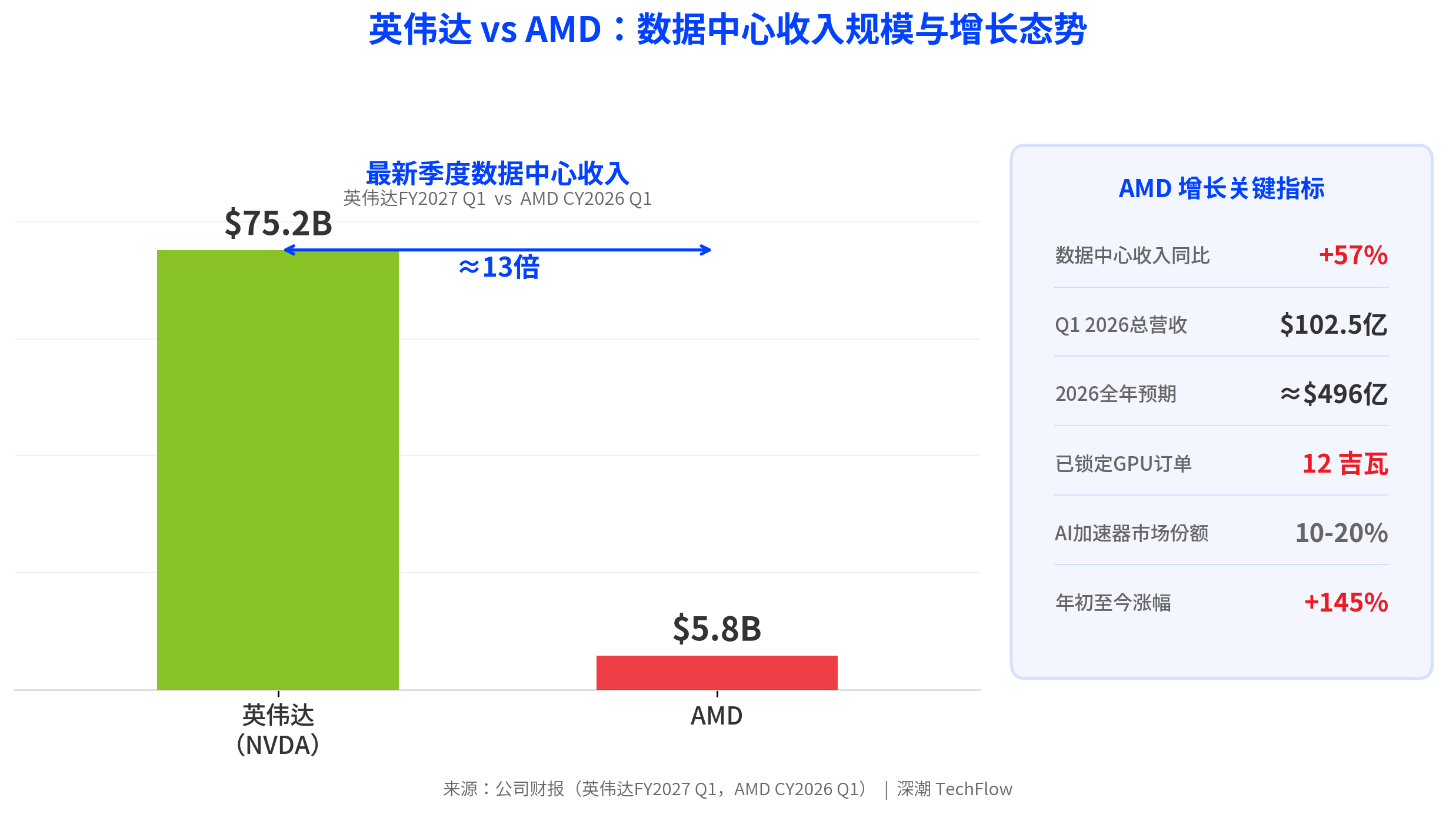
NVIDIA's data center revenue for the first quarter of fiscal year 2027 reached $75.2 billion, a year-over-year increase of 92%, equivalent to approximately 13 times AMD's data center revenue of $5.8 billion for the same period. NVIDIA's share in the AI accelerator market remains as high as 80% to 90%.
The gap remains huge. But AMD's growth curve is steepening. In the first quarter of 2026, AMD's data center revenue increased by 57% year-over-year, with full-year revenue consensus expectations of approximately $49.6 billion, an increase of about 43% compared to 2025. GPU orders of 6 GW each from OpenAI and Meta have locked in years of visible revenue pipeline for AMD. Microsoft has also become a customer of the AMD MI400 series.
SemiAnalysis's previous analysis pointed out that the AMD MI355X is already competitive in terms of cost-performance in small and medium model inference scenarios. The total cost of ownership of the MI355X is about 33% lower than NVIDIA's HGX B200, offering larger HBM memory capacity. However, in frontier model training and rack-level inference scenarios, the MI355X still cannot compete with NVIDIA's GB200 NVL72.
AMD plans to start mass production of the MI450 series GPUs in the second half of 2026, based on the CDNA 5 architecture. The next-generation MI500 series is based on 2nm process and HBM4E memory, expected to launch in 2027.
The Real Battlefield is Software, Not Just Chips
SemiAnalysis's analysis released on July 13 brought the focus of competition back to the software level. In performance tests of the open-source inference engine vLLM, NVIDIA's GB200 NVL72 significantly led AMD's MI355X, with the gap being particularly prominent in large model scenarios.
This conclusion contrasts with SemiAnalysis's analysis from two weeks ago. At that time, the institution pointed out that Anthropic's Claude model training runs heavily on Google TPUs, and Claude Code inference is increasingly deployed on Amazon Trainium, with NVIDIA GPU share within Anthropic being slowly eroded by self-developed chips.
AMD AI Software Vice President Elangovan previously told SDxCentral that after a series of updates, ROCm has "almost caught up" with NVIDIA, even leading in FP4 (4-bit floating point) scenarios. ROCm 7 performance improved 3.5 times compared to ROCm 6 and now supports all mainstream AI frameworks.
But there is still a distance between "almost caught up" and "production-ready." The Anthropic evaluation phase mentioned by SemiAnalysis likely has its core bottleneck in whether the ROCm software stack can meet the stability and performance requirements of its production workloads.
For investors, the AMD Advancing AI conference on July 22 is the nearest validation node. If Anthropic is announced as an official customer, AMD will prove it has become a "trusted second choice" without diluting equity. If not, it means the software gap remains, and the parameter advantages on GPU hardware are not yet sufficient to convert into actual orders.
Join TechFlow official community to stay tuned
Telegram:https://t.me/TechFlowDaily
X (Twitter):https://x.com/TechFlowPost
X (Twitter) EN:https://x.com/BlockFlow_News
 深潮TechFlow