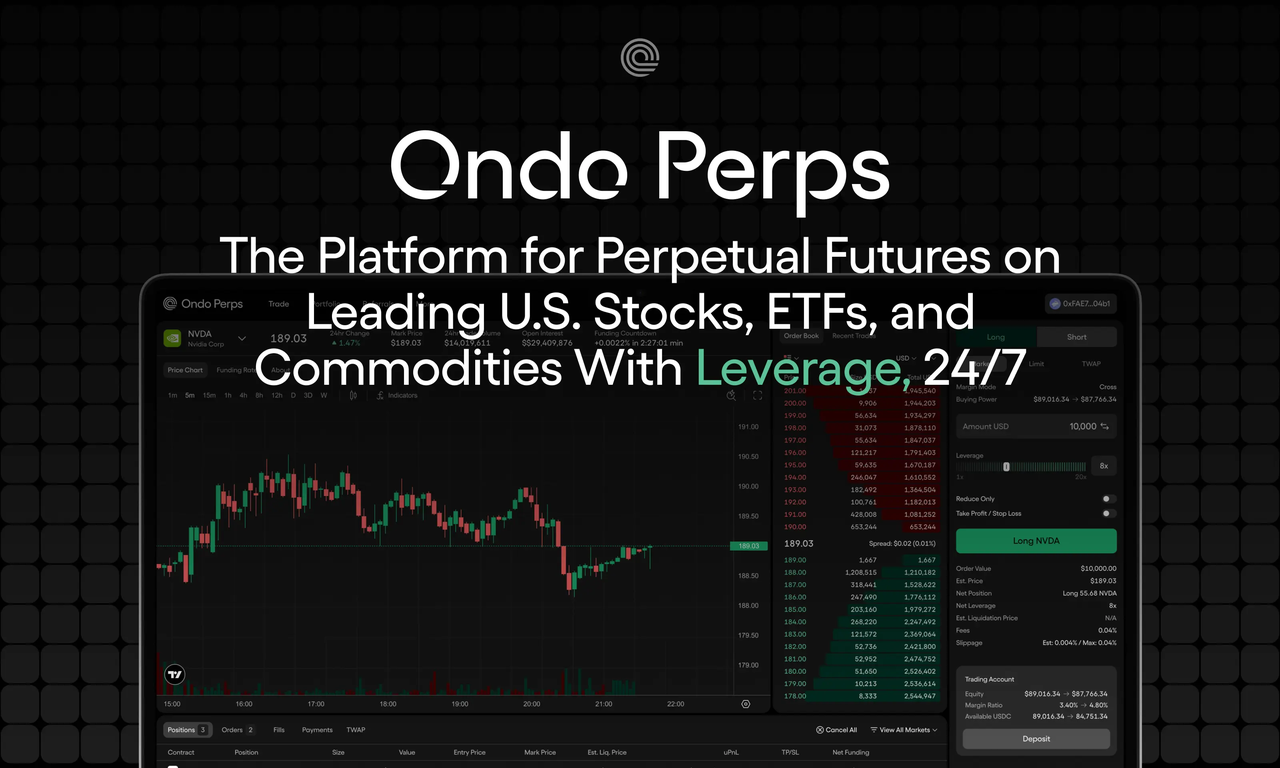
Ondo Perps Live Test: US Stocks as Margin, 20x Long/Short US Stocks, Gold, and Crude Oil
Author: TechFlow
Playing US stocks on-chain is no longer novel.
Eight months ago, Ondo Finance and Ondo Foundation launched Ondo Global Markets, enabling more investors to truly hold US stocks on-chain without restrictions of time, geography, or cost.
According to RWA.xyz data, the current on-chain total value locked in tokenized stocks has surpassed $1.44 billion, an increase of over 110% compared to the beginning of the year. Among them, Ondo Global Markets, the first tokenized stock and ETF platform to reach $1 billion in TVL, accounts for approximately 70% of the share.
Behind these numbers lies genuine user enthusiasm for tokenized US stocks and Ondo’s undisputed dominance in this sector.
But this is only the first half of the "playing US stocks on-chain" story.
Ondo Global Markets allows everyone to buy US stocks just like buying tokens, but there is still a gap between "buying" and "using."
Only with capabilities such as collateralization, leverage, short selling, and hedging can they truly become mature financial assets.
This is an area that has seen continuous attempts but remains largely uncharted:
For a long time, the focus of the on-chain derivatives market has almost always revolved around crypto-native assets;
At the same time, in the process of bringing real-world assets into on-chain contract markets, issues such as how to integrate liquidity, how to improve capital efficiency, and how to achieve more effective risk control under complex logics like leveraged liquidation will face immense challenges.
These are not problems that can be solved simply by listing a few US stock perp trading pairs.
What the market lacks is a complete underlying infrastructure to better integrate tokenized real-world assets into on-chain derivatives markets.
On June 9, 2026, eight months after launching Ondo Global Markets, Ondo Perps, a public testnet perpetual contract trading platform focused on stocks, ETFs, and commodities, officially went live:
It supports eligible users to directly use tokenized real-world assets as collateral, inherits real liquidity from traditional markets, supports up to 20x leverage, and enables 7 x 24 all-day trading...
From "being able to buy" to "being able to master," the second half of the "playing US stocks on-chain" story is unfolding via Ondo Perps.
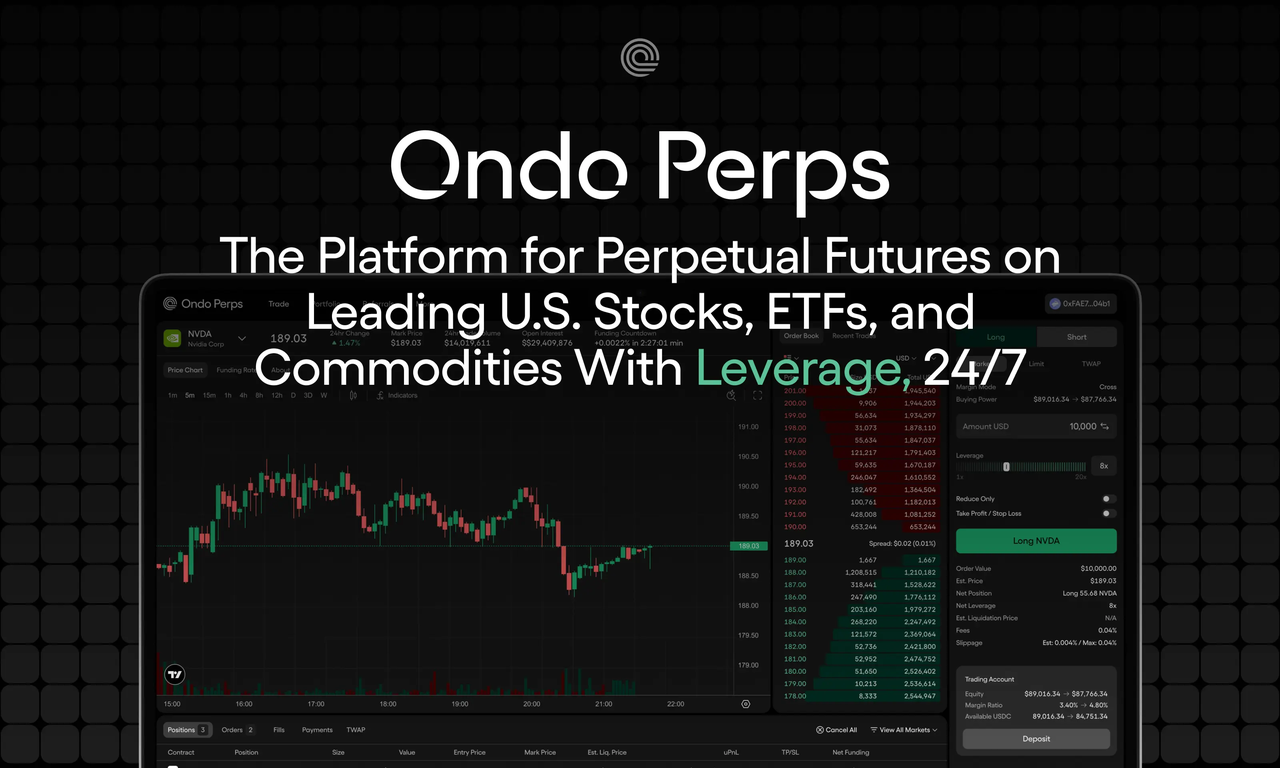
The Real Face: Ondo Perps Product Unboxing
Upon entering the Ondo Perps interface, familiarity strikes immediately.
Whether it's the candlestick charts on the left or the order book on the right, this UI layout and interaction logic require virtually no additional learning curve for users with contract trading experience.
First, let's look at what can be traded.
Users can select assets from the top left corner. Ondo Perps currently supports 7 x 24 hour trading across 22 perpetual contract markets:
- US Stocks: NVDA, TSLA, AAPL, MSFT, GOOGL, AMZN, META, NFLX, AMD, INTC, ORCL, PLTR, COIN, HOOD, MSTR, CRCL
- Commodities: XAU (Gold), XAG (Silver), WTI (Crude Oil)
- Indices: US 500, US 100
- ETFs: Roundhill Memory ETF (DRAM)
The selection logic is very clear: prioritizing highly liquid, widely followed assets with clear demand from global investors.
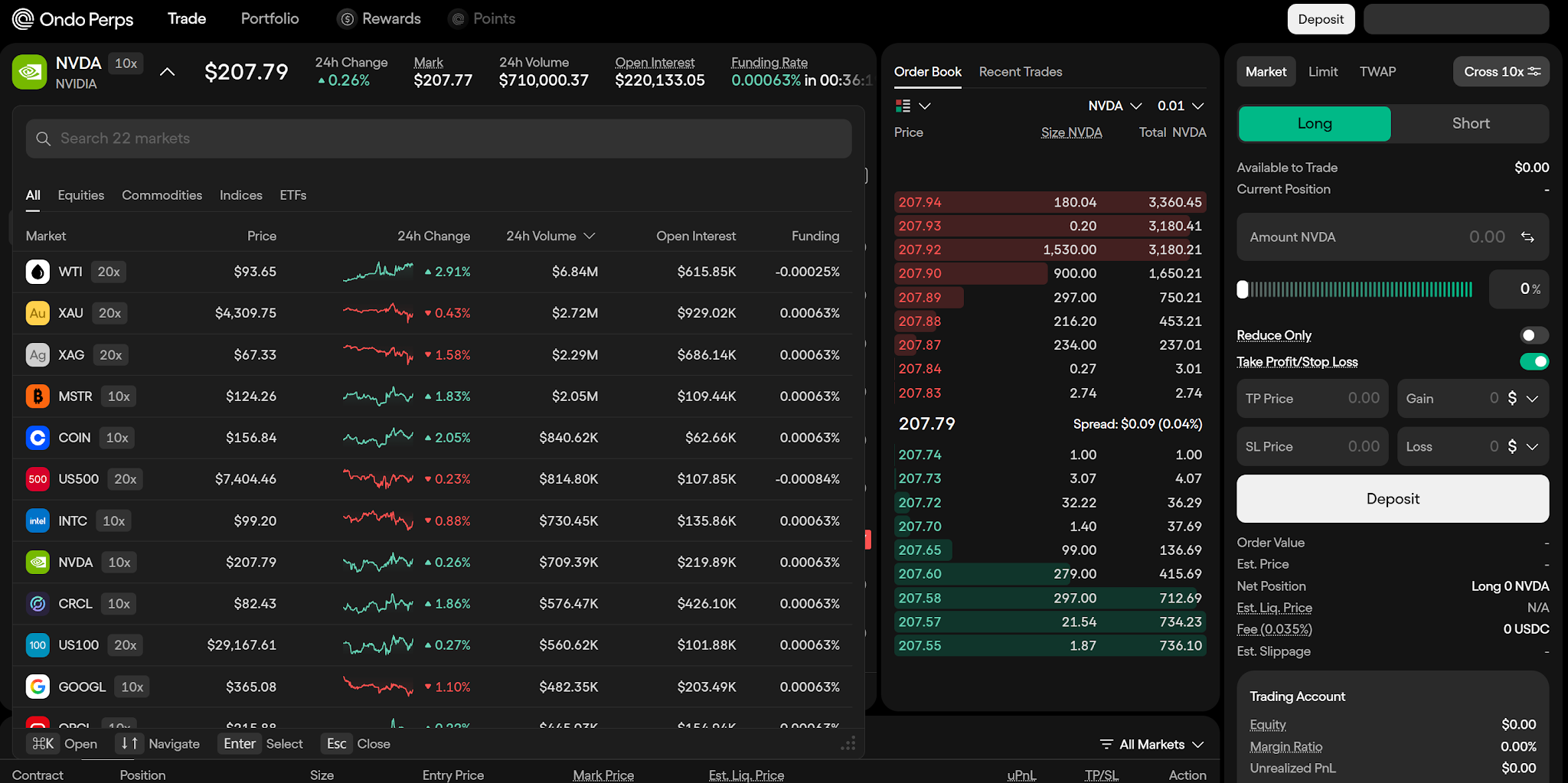
After selecting a market, information such as the current price, 24-hour price change, 24-hour volume, and funding rate appears at the top.
Taking NVDA as an example, the current trade price on Ondo Perps is 207.79, while the Mark Price is 207.77, showing a very tight spread.
Next, let's look at how to trade.
Moving our attention to the order placement area in the upper right corner, we first see two buttons for Long (Go Long) or Short (Go Short), meaning users can establish directional positions around US stocks, indices, and commodities, with current support for up to 20x leverage.
Regarding order types, Ondo Perps currently offers three options: Market Order, Limit Order, and TWAP.
Market orders execute at the best available current market price, while limit orders execute at a user-specified target price, both being relatively basic functions. For users who have already established positions, Ondo Perps also supports take-profit and stop-loss orders. When the mark price hits a preset level set by the user, the system can automatically trigger liquidation to manage profit targets and downside risk.
Worth noting is the TWAP order: it splits a large order into multiple smaller ones and executes them in batches within a specified time window to reduce the market impact of a single large trade. Ondo Perps' TWAP further refines execution parameters: supporting a maximum execution period of 7 days, each sub-order features a maximum slippage protection of 3 bps, and each account can run up to 20 active TWAP orders simultaneously.
In traditional financial markets, TWAP orders are commonly used by institutional traders to handle large positions. By supporting TWAP, Ondo Perps broadens its audience further from retail traders to institutional-grade professional traders with higher demands for precise execution.
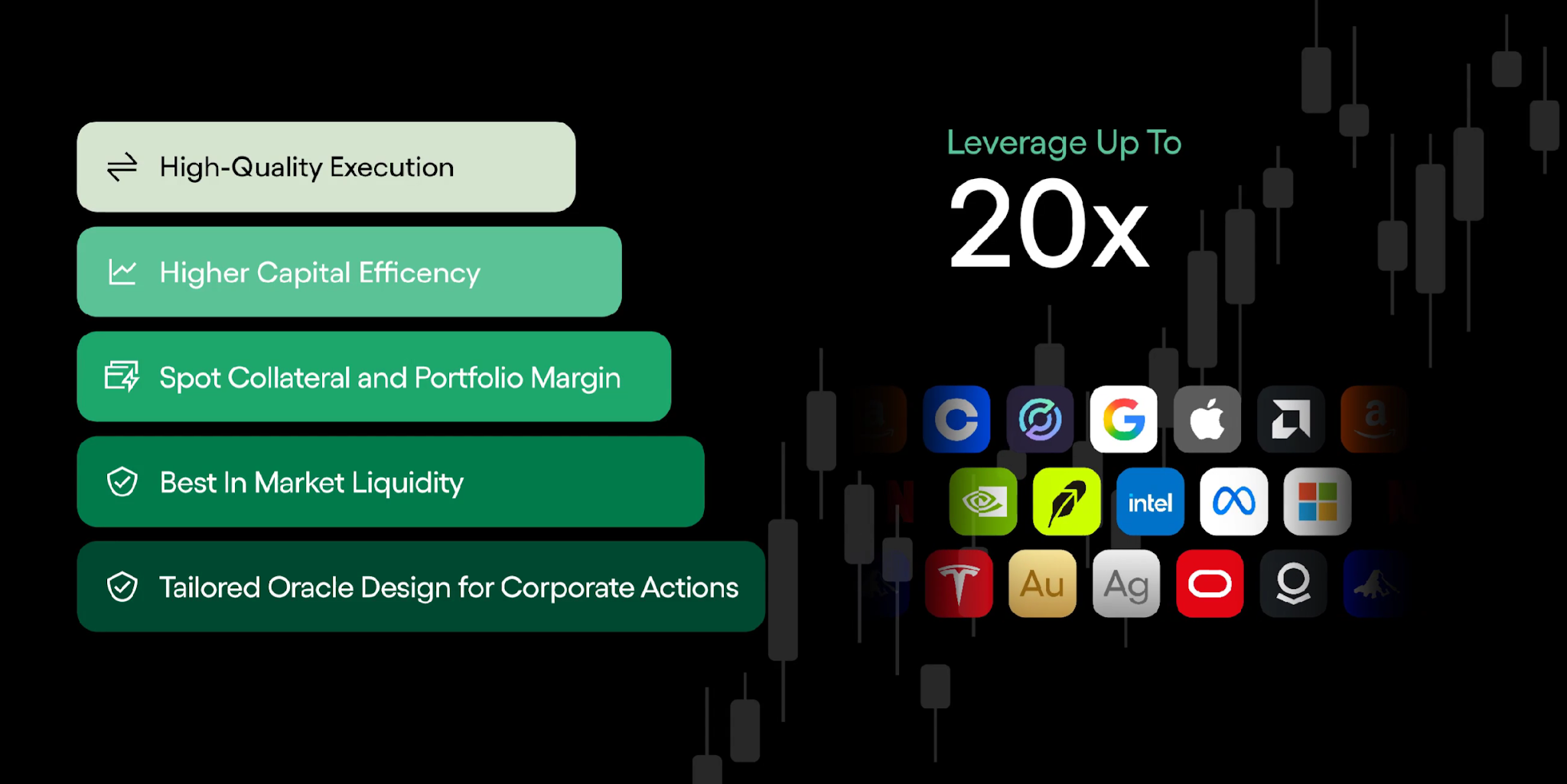
Meanwhile, trading costs are also a focal point.
In terms of fees, Ondo Perps charges a Maker fee of 1.5 bps (0.015%) and a Taker fee of 3.5 bps (0.035%), which is relatively low compared to other contract platforms, making it quite friendly to high-frequency traders and institutional users.
After submitting an order, users can view information such as current positions, unrealized P&L, margin usage, funding rates, and liquidation prices in the position panel.
Please note that Ondo Perps is provided by Ondo Global Panama Inc., utilizing technology developed by Ondo Finance Inc. This service is unavailable in the United States, Panama, and other jurisdictions where trading is prohibited.
Simply browsing the product page reveals that Ondo Perps has initially built out the basic framework for trading perpetual contracts on stocks, indices, and commodities.
However, for contract platforms, competition always comes down to capital efficiency and liquidity.
At this point, you will realize that Ondo Perps' advantage lies not in individual components, but in synergy.
As the leader in RWAs, Ondo's choice to launch Ondo Perps eight months after Ondo Global Markets suggests that its market foresight, functional innovation, and product delivery capabilities may be even stronger than we imagined.
As early as eight months ago, Ondo had already laid the groundwork for the launch of Ondo Perps.
Using Tokenized Stocks as Margin: How Does Ondo Perps Achieve High Capital Efficiency?
Rather than crudely dumping popular assets like NVDA, TSLA, US500, gold, and crude oil into the Perps market, Ondo Perps aims to fundamentally alter the role of these assets within the on-chain financial system.
The underlying design of Ondo Perps revolves around this core concept.
Collateral Restructuring: Elevating Tokenized Stocks from "Exposure" to "Asset"
Users will immediately notice upon making their first deposit on Ondo Perps:
Beyond USDC, Ondo Perps also allows Pre-alpha users to use tokenized stocks from Ondo Global Markets as collateral. Although currently limited to SPYon and QQQon and open only to eligible users, officials state that access will be expanded to more users soon.
This represents the key differentiator setting Ondo Perps apart from other perpetual contract platforms.
Restructuring collateral logic is essentially a mandatory move for Ondo.
For a long time, on-chain derivatives markets have heavily relied on stablecoins as margin. Users must first convert their tokenized stocks into stablecoins before participating in derivatives trading. This not only reduces efficiency but also leaves assets isolated in silos, lacking direct connections.
Ondo Perps' support for using tokenized stocks directly as collateral is a critical step moving them from "on-chain" to "usable." It not only boosts capital efficiency but also upgrades tokenized stocks from "simple holding" to "efficient participation in derivatives markets": the spot holdings remain, the exposure remains, and they simultaneously function as margin to back long or short positions.
This further breaks down asset boundaries. Historically, stablecoins, stocks, gold, and other assets belonged to separate systems, but on Ondo Perps, they can interact within the same account, creating opportunities to spawn more innovative strategies and products.
Cross-Asset Margin: Maximizing Capital Efficiency
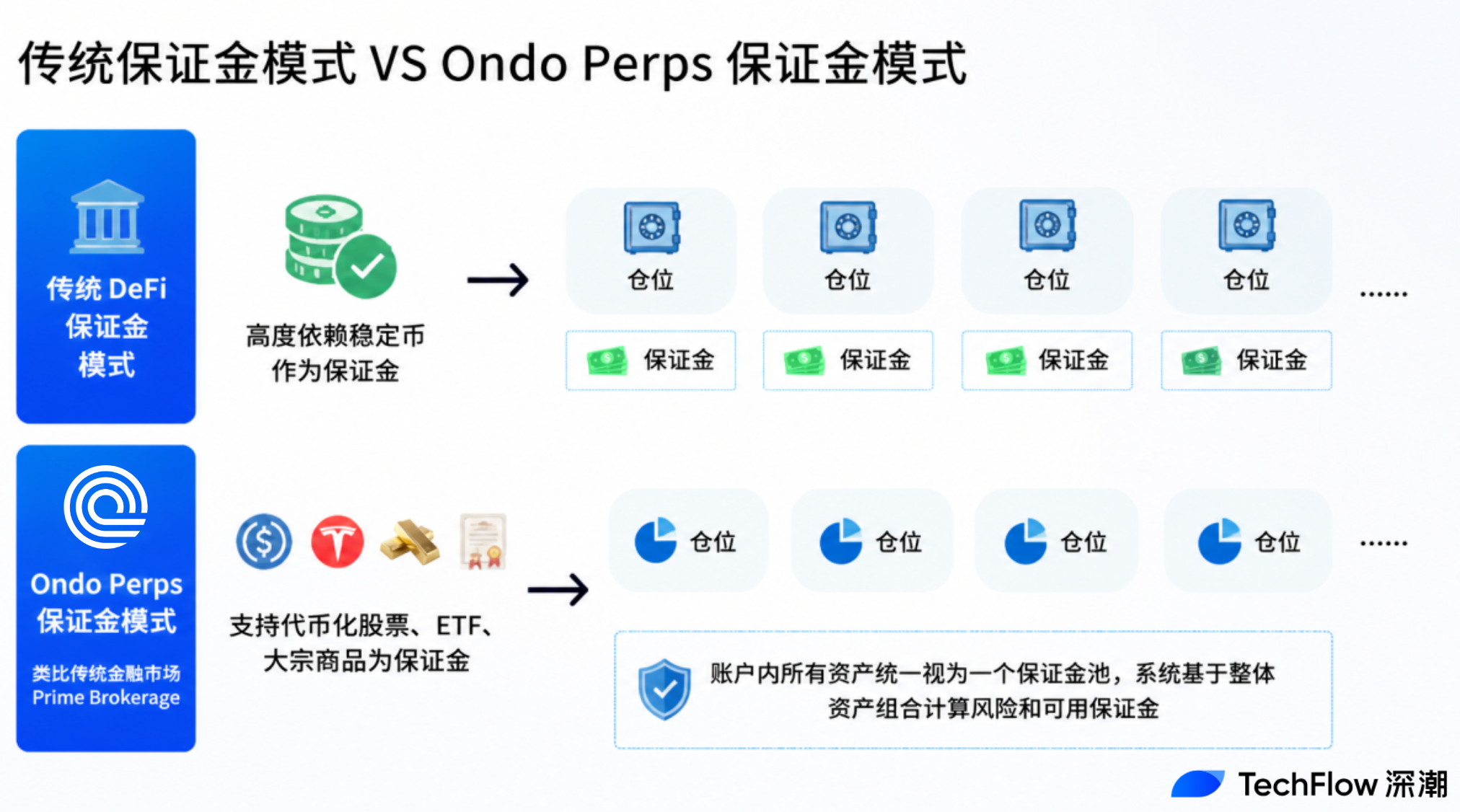
On most DeFi derivatives platforms, margin is calculated in isolation, meaning each position independently locks up a specific amount of funds, resulting in highly limited capital utilization.
Cross-asset portfolio margin is another core feature of Ondo Perps: all assets within an account are treated as a unified margin pool, including USDC and tokenized stocks. The system calculates risk and available margin based on the overall asset portfolio.
We can find benchmarks for this model in traditional financial markets, specifically the Prime Brokerage system: Wall Street does not allocate separate capital for each trade but hands the entire balance sheet to a prime broker for unified management. The system dynamically allocates margin based on portfolio risk, offering far greater capital efficiency than the isolated margin mode used by retail traders.
This model delivers immediate improvements in capital efficiency: the same amount of capital supports larger positions, or the same position requires less margin, freeing up funds for other uses.
Liquidity Advantage: Inheriting Traditional Markets
Due to limited on-chain scale, assets like stocks, indices, and commodities have long faced numerous challenges in securing sufficient on-chain liquidity.
In many prior attempts, most platforms resorted to flooding the chain with capital to inject liquidity. However, against the sheer scale of traditional financial markets, this approach proved insufficient, often trapping platforms in cycles of low liquidity, high slippage, and wide spreads.
Learning from past lessons, Ondo Perps takes the opposite approach by inheriting traditional market liquidity.
Returning to the issuance layer, Ondo Global Market employs an "instant atomic minting and burning" model: when users have demand, the platform purchases actual stocks and mints tokens; when users want to sell, it immediately burns the tokens and sells the underlying stocks. This allows Ondo Global Market to directly tap into the trillions in traditional financial markets.
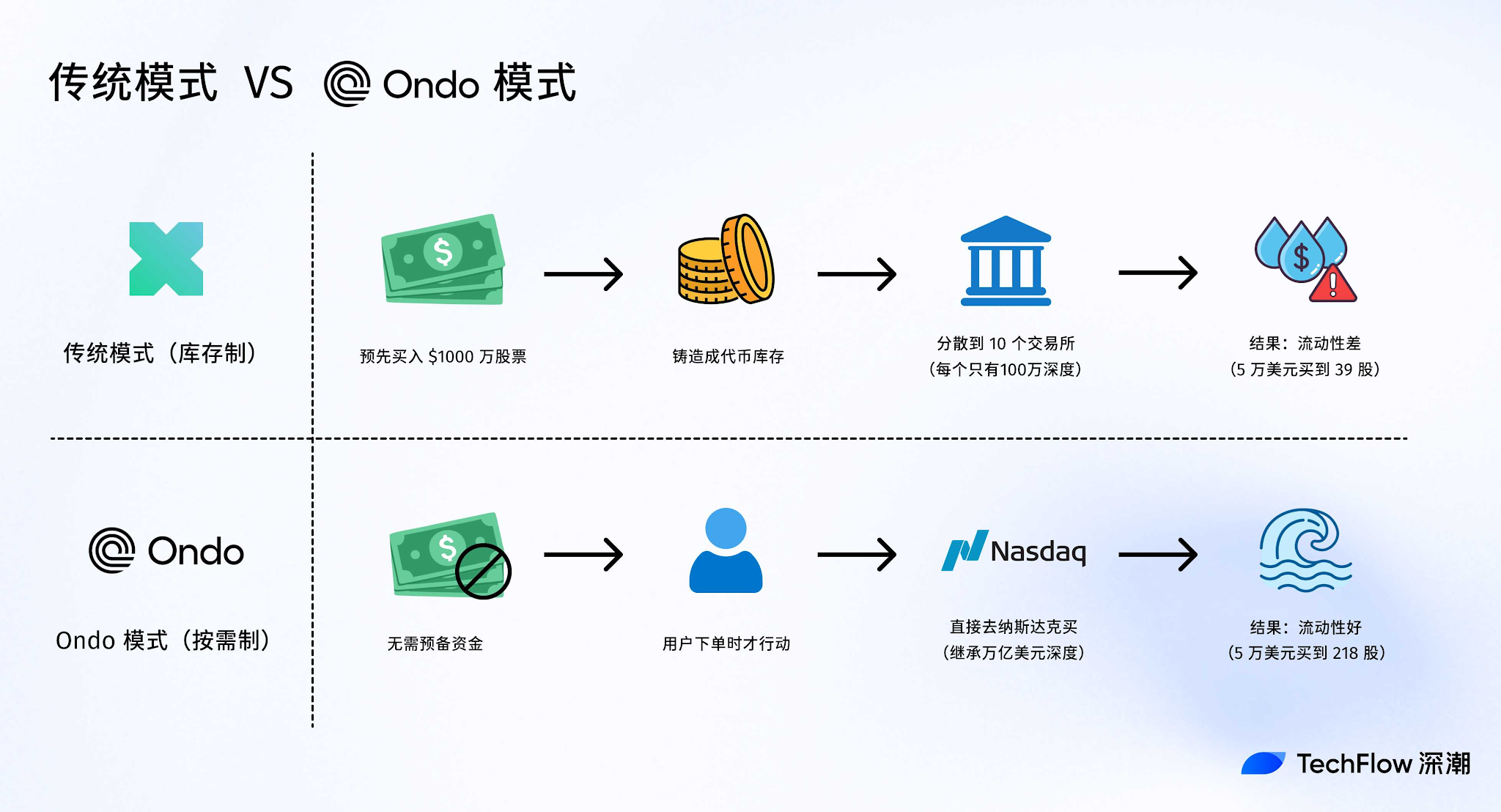
By supporting Ondo Global Market tokenized stocks as collateral, Ondo Perps further creates a positive liquidity attraction loop: higher capital efficiency makes it more attractive to market makers and institutional users, thereby driving overall platform liquidity growth.
High-Performance Execution: Balancing Speed and Fairness
"Ondo Perps is a decentralized off-chain exchange."
A single sentence in the official documentation points directly to the two core trade-offs in contract trading:
- On-chain perpetual contract platforms: Transparent but suffer from latency, unable to support high-frequency contract trading.
- Centralized perpetual contract exchanges: Efficient but opaque, carrying front-running risks and lacking verifiable trust.
How to get the best of both worlds? Ondo Perps solves this with a Trusted Execution Environment (TEE) based on Intel SGX.
A TEE is essentially a hardware-level encrypted isolation region inside a CPU chip, known as an enclave. Code and data running within the enclave, including Ondo's own operations, cannot be accessed or modified without approval from an independent attestor network.
Ondo Perps places core operations like order matching, margin calculation, and liquidation triggering inside the enclave: On one hand, off-chain execution achieves speed comparable to CEXs; on the other, because the data becomes inaccessible once inside the enclave, transaction history is only disclosed after orders are fully processed, preventing anyone from "dark pattern" manipulation.
Meanwhile, user deposits do not reside within the enclave. Each user has a permanent on-chain address linked to their assets: when users wish to use these assets on the platform, they transfer them to the platform's wallet; when they no longer wish to use them, they can request a withdrawal, and the assets are transferred back to their wallet. All transfers are transparent on-chain. Similar to self-custodied blockchain wallets, no one except the user themselves can control their assets.
Of course, while TEE guarantees execution, who supervises and oversees the TEE?
To address this, Ondo Perps introduces a decentralized attester network responsible for verifying whether unauthorized code changes exist within the enclave, while any modifications to the TEE require review and approval from a majority of independent validators.
Risk Management Mechanisms: Multiple "Brake Pads" for Extreme Scenarios
Having addressed "how fast capital moves," the risk management mechanism now focuses on "whether the system can withstand extreme scenarios."
With real-world assets combined with cross-margin, the risks Ondo Perps faces are more complex than those of standard Perps platforms.
The first line of defense in risk management is to avoid triggering liquidations whenever possible.
Ondo Perps continuously monitors margins, providing users with strong data support to assess account safety. Meanwhile, funding rates continuously adjust long-to-short ratios, incentivizing traders to pull contract prices back to a reasonable range when they deviate from the mark price.
Additionally, Ondo Perps uses aggregated external oracle prices as the Mark Price, making price manipulation extremely costly and further ensuring platform price credibility. Simultaneously, tokenized stocks face a hair discount when used as collateral, preserving an additional safety buffer for the system.
Once preliminary safeguards are in place, if liquidation becomes unavoidable, Ondo Perps follows a five-tier liquidation process:
- Cancellation: Cancel all open orders and release all margin.
- Standard Liquidation: Place limit IOC orders at bankruptcy prices to close positions.
- Third-Party Liquidation: External third-party liquidators take over positions at market prices.
- Insurance Fund Backstop: Cover shortfalls to prevent systemic contagion (insurance fund capital originates from the 1.5% fee charged during forced liquidations).
- ADL Auto-Deleveraging: Automatically reduce profitable counterparty positions to maintain overall system stability.
These five layered brake pads work progressively to minimize account risk.
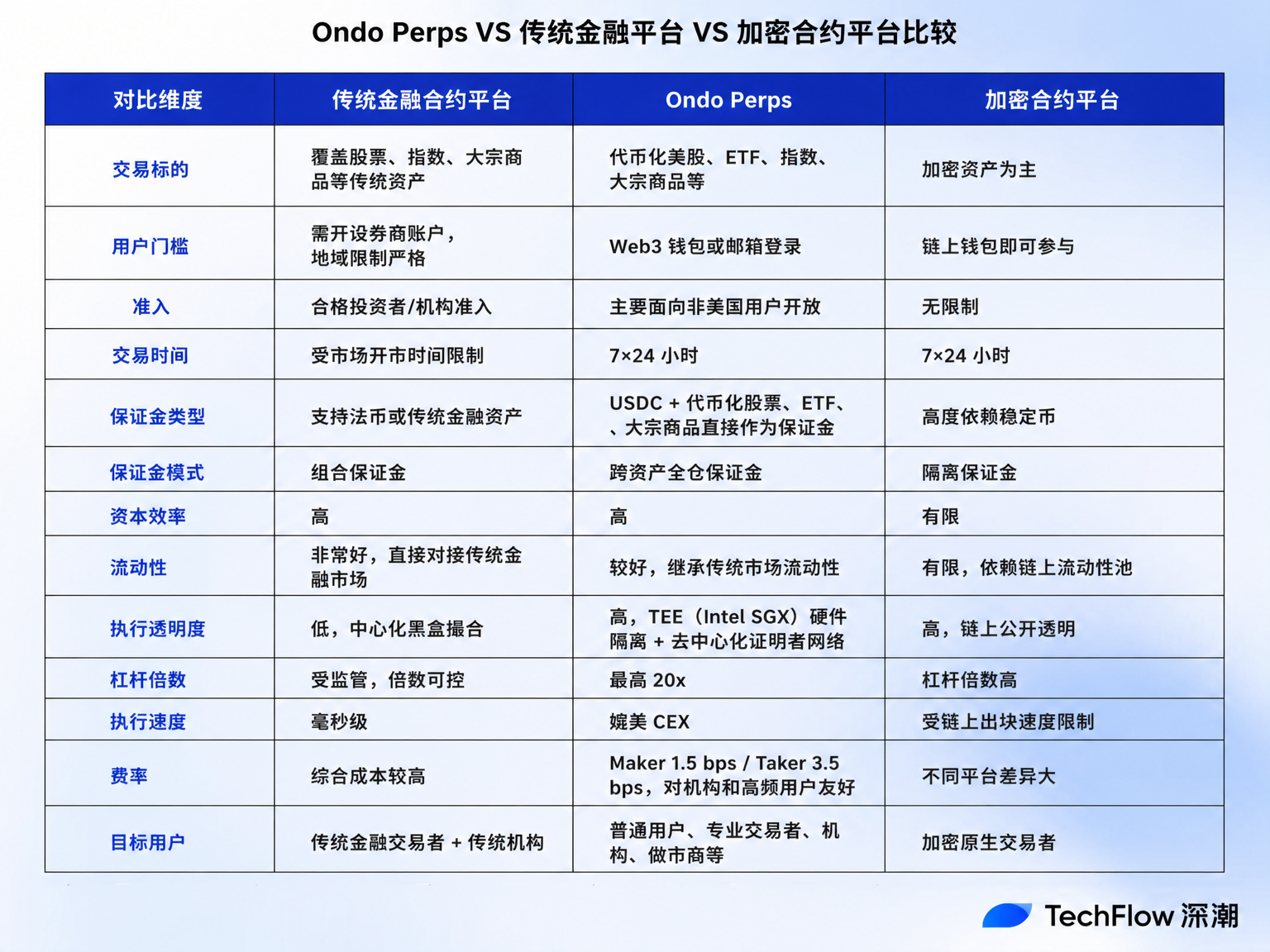
Through a comparative table, we can clearly perceive the differences between Ondo Perps, traditional financial contract platforms, and crypto contract platforms.
From Issuance to Contracts: Ondo's Two Key Steps Toward a "Full-Stack On-Chain Capital Market"
Looking across the entire tokenized stock sector, Ondo Perps is undoubtedly a unique presence.
The ability for tokenized stocks to enter the contract market as margin is Ondo Perps' core innovation.
In this high-capital-efficiency, high-liquidity contract trading system, the asset issuance layer and the derivatives trading layer must be seamlessly connected: the issuance layer dictates the minting and redemption logic for stocks, while the derivatives layer governs margin calculation and liquidation rules. With the two tightly intertwined, the system can accurately determine "the value of these stocks and the precise conditions that trigger liquidation."
Ondo, possessing both Ondo Global Market and Ondo Perps, is the only player that simultaneously controls both the "issuance layer" and the "derivatives layer." In other words, Ondo is the only entity equipped with the necessary conditions to make this happen.
More importantly, these two layers are not statically stacked but structurally reinforce each other.
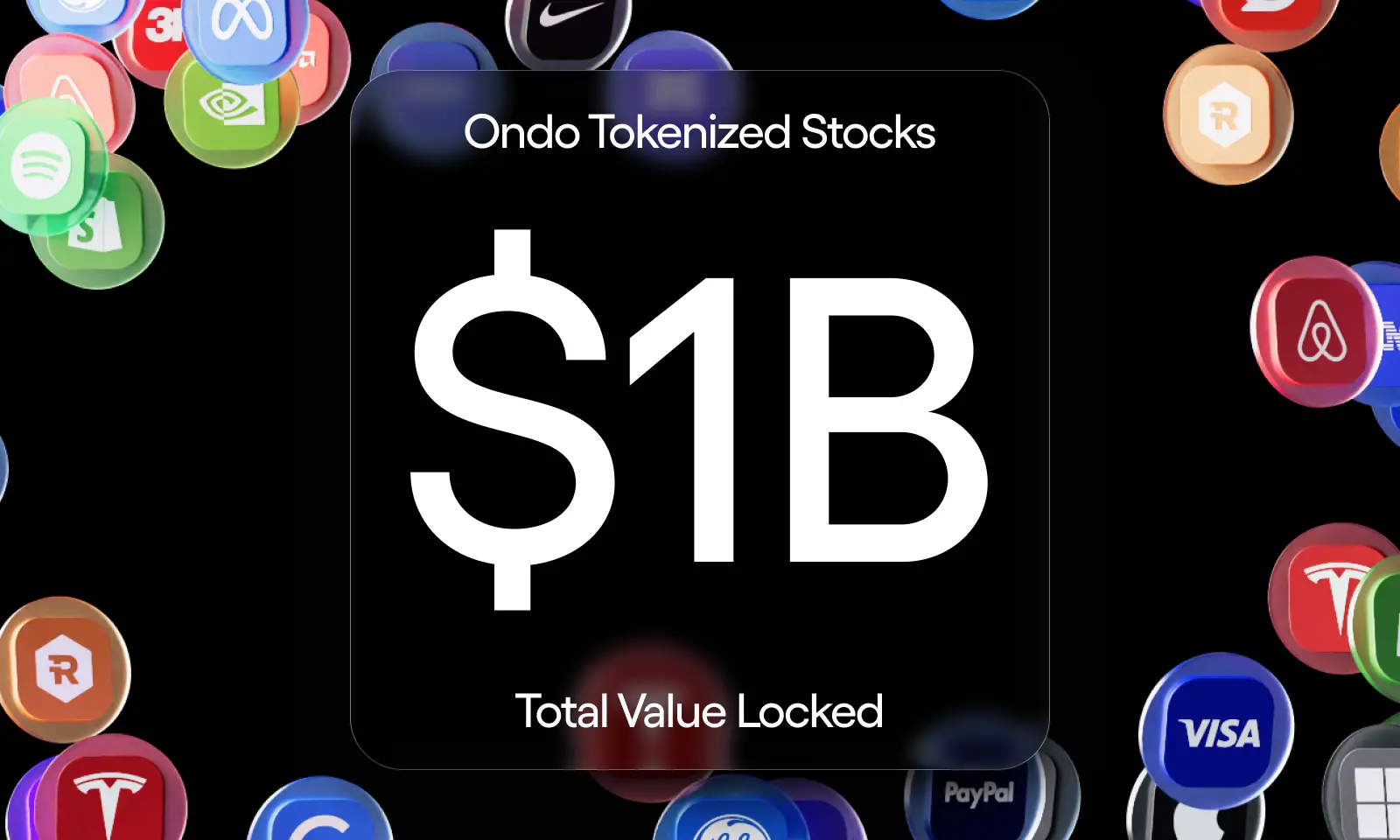
The larger the scale of Global Markets, the more users hold tokenized stocks on-chain, and the greater the potential user base and collateral pool for Ondo Perps. Currently, Ondo Global Markets has accumulated over $1 billion in TVL and tens of thousands of users.
Conversely, the more active trading becomes on Ondo Perps, the stronger the use cases for tokenized stocks, thereby driving minting volumes and holding demand for Ondo Global Markets.
Although Ondo Perps is still in its early stages, and its liquidity and liquidation/risk management performance in real markets remain to be observed under its multi-asset, cross-market model, once the asset layer and trading layer grow together—and the virtuous flywheel between Ondo Global Markets and Ondo Perps begins to turn—it will build barriers that competitors cannot easily replicate in the short term.
Beyond this, Ondo's long-term accumulation in the RWA sector, including product experience from Ondo Global Markets, as well as internal reserves in market-making resources and institutional trust, will naturally migrate to Ondo Perps, becoming a formidable force in its long-term competition.
Returning to the Ondo Summit in February 2026, when the Ondo team first introduced Ondo Perps, they described it as a crucial step in expanding from RWA tokenization to a "full-stack on-chain capital market."
Ondo Global Markets solves the "on-chain" problem, enabling global investors to hold authentic US stock assets on-chain without restrictions of time, geography, or cost;
Ondo Perps solves the "usability" problem, allowing these already on-chain assets to truly enter the financial system, enabling collateralization, leverage, short selling, and hedging.
From "on-chain" to "usable," the two key steps under a full-stack philosophy are now clearly visible.
So, in the upcoming expansion of the "full-stack on-chain capital market," where will Ondo place its next moves?
The easiest to predict is the market "expansion" for Ondo Perps:
Currently, Ondo Perps supports 22 perpetual contract markets and 3 major asset classes as collateral, while Ondo Global Markets already supports over 260+ tokenized stocks and ETFs. This numerical gap itself serves as a roadmap. To further foster market prosperity, Ondo Perps will drive the expansion of more trading listings and collateral support in the future.
Furthermore, tokenized stocks as collateral are currently only open to whitelisted users. As this feature gradually opens up, professional traders, market makers, and institutions will progressively enter. Their influx will directly propel leaps in liquidity depth and trading volume.
However, once Ondo Perps, as the first perpetual contract trading platform to use tokenized stocks as margin, endows tokenized stocks with truly complete financial attributes, the imaginative space for derivatives extends far beyond this.
Building on perpetual contracts, are Ondo's additional options, structured products, and cross-asset portfolio strategy gameplay already underway?
The second half of the "playing US stocks on-chain" story may prove far more exciting than the first.
Join TechFlow official community to stay tuned
Telegram:https://t.me/TechFlowDaily
X (Twitter):https://x.com/TechFlowPost
X (Twitter) EN:https://x.com/BlockFlow_News
 深潮TechFlow