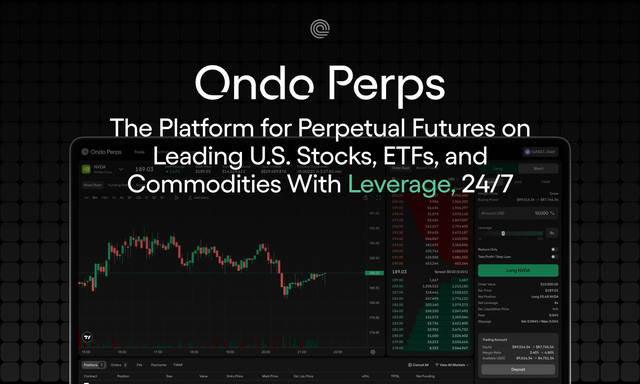
Ondo Perps: Bringing Wall Street’s Prime Brokerage On-Chain?
TechFlow Selected TechFlow Selected
Ondo Perps: Bringing Wall Street’s Prime Brokerage On-Chain?
When different types of assets can serve as collateral for one another and participate in a unified market, does the traditional boundary between “money” and “assets” still exist?
 Navigating Web3 tides with focused insights
Author: 137 Labs
I. The Starting Point: Why Have Stock Perpetuals Consistently Underperformed?
Reviewing DeFi’s development trajectory over the past few years reveals a clear divergence: derivatives markets for crypto-native assets (BTC, ETH) have matured significantly, whereas derivatives tied to real-world assets (RWA) remain stuck in the “experimental phase.”
Stock perpetual contracts are a prime example.
From the demand side, the market need is unambiguous: global users want lower-barrier, higher-efficiency access to U.S. equities—combined with leverage and hedging tools for risk management. Yet from the supply side, neither early synthetic asset protocols (e.g., Synthetix) nor later onchain orderbooks or AMM-based models have meaningfully resolved the core issues.
These attempts often deliver initial price exposure but struggle to sustain active trading, eventually collapsing into a vicious cycle of liquidity depletion, widening slippage, and user attrition.
Meanwhile, tokenized stocks—pursued via an alternative path—are advancing rapidly. As widely reported by mainstream media, such assets already offer 24/7 trading and instant settlement. Yet their total market size remains limited, and they largely function as “holding instruments” rather than integral components of a full-fledged financial system.
Thus, the crux of the problem isn’t whether anyone wants to trade stocks—it’s:
Why can’t these assets form a self-sustaining, continuously expanding market structure?
In other words, what’s truly missing isn’t the product—but the underlying mechanisms that enable it to operate.
II. Current State: Structural Deficiencies in DeFi and Tokenized Stocks
A deeper breakdown of existing systems reveals two focal points of failure: collateral architecture and liquidity architecture.
First, in DeFi derivatives, collateral is highly homogenized. Major protocols rely almost exclusively on stablecoins as margin, meaning all trading activity must be intermediated through stablecoins. Users holding other assets—whether ETH or tokenized stocks—must first convert them into stablecoins before participating in derivatives trading.
This design was reasonable in DeFi’s early days—stablecoins offered price stability and straightforward liquidation—but as asset diversity expands, it has evolved into a structural constraint. Assets cannot directly interact, resulting in a fragmented, “island-like” system.
Second, while tokenized stocks have made progress in asset mapping, their financial functionality remains severely limited. They can be held, transferred, and—in some cases—used for basic lending. But they lack more advanced utility: serving as efficient collateral for derivatives, or playing a role within multi-asset portfolios.
A deeper issue lies in liquidity. Most tokenized stock projects attempt to “rebuild a market onchain,” using AMMs or synthetic orderbooks to generate depth. Yet this approach is inherently constrained by onchain capital scale—and cannot compete with traditional exchanges’ liquidity. The result is persistent price deviation, slippage, and elevated trading costs.
Hence, the core deficiency of today’s system can be summarized as follows:
Assets have been tokenized—but cannot establish effective financial relationships among themselves, nor does the market possess sufficient liquidity to support them.
III. What Ondo Perps Does: Three Structural Innovations
Against this backdrop, Ondo Perps doesn’t merely launch another trading platform—it seeks to simultaneously reengineer collateral logic, asset relationships, and liquidity sourcing.
First, it introduces a pivotal shift: enabling tokenized stocks to serve directly as margin. This change may appear superficial—a simple parameter tweak—but fundamentally reshapes capital flows. Users no longer need to sell assets into stablecoins; instead, they can deploy existing holdings directly for leveraged positions or hedging.
The impact goes beyond efficiency gains: it transforms asset attributes. Equities cease being mere “yield-generating assets” and evolve into “credit foundations” capable of supporting other risk exposures. In financial terms, this means assets acquire “collateral utility.”
Second, Ondo introduces cross-asset margining. Traditional DeFi protocols typically employ isolated margin, calculating risk per position independently. Ondo, by contrast, treats the entire asset portfolio as a unified whole—a design closely mirroring portfolio margining in traditional finance. This allows assets to hedge and reinforce one another.
The underlying shift is structural: risk is no longer assessed per asset, but across the portfolio. The result is markedly improved capital efficiency—and, simultaneously, more complex pathways for risk transmission.
Third—and most critically—it overhauls the liquidity model. Rather than attempting to bootstrap liquidity from scratch onchain, Ondo links onchain markets to traditional exchanges via tokenized stocks’ issuance and redemption mechanics. Price discovery and liquidity depth are thus inherited directly from Nasdaq and NYSE—not reliant on finite onchain liquidity pools.
If this mechanism operates stably, onchain trading will no longer be bounded by TVL—but will tap into a multi-trillion-dollar market.
IV. Essence: What It’s Really Doing
At a higher level, Ondo Perps isn’t about “improving the trading experience”—it’s about redefining the foundational architecture of financial systems.
Traditional DeFi resembles a “collection of trading tools”: users hop between protocols to lend, trade, or stake. These operations remain siloed, lacking unified risk management or holistic asset visibility.
Ondo’s direction, however, aligns more closely with traditional finance’s prime brokerage model. Here, users don’t operate individual products—they manage a complete balance sheet. All assets and liabilities fall under a unified risk framework, dynamically adjusted via portfolio margining.
Thus, Ondo can be understood as the convergence of three functions:
· A multi-asset collateral system
· A portfolio risk management engine
· A clearing layer bridging onchain and traditional markets
Viewed this way, it functions more like a “financial account system” than a standalone trading platform.
V. Why This Matters: Three Layers of Impact
If successfully implemented, this model’s implications extend far beyond a single protocol—potentially reshaping DeFi’s entire developmental trajectory.
First, capital efficiency improves. Assets participate directly in diverse financial activities without conversion—reducing intermediation steps, transaction costs, and accelerating capital turnover. In high-frequency trading and hedging contexts, this advantage compounds significantly.
Second, asset boundaries dissolve. Historically, crypto, equities, and bonds resided in separate ecosystems. Under Ondo’s model, they coexist and interact within a single account. This convergence enables more flexible asset allocation—and may catalyze novel strategies and products.
Third, user composition shifts. As system complexity rises, retail users may struggle to fully harness its capabilities—while institutional investors and professional traders become primary participants. This signals DeFi’s gradual evolution toward “institutionalization,” with market behavior increasingly mirroring traditional finance.
VI. Risks and Uncertainties: Greater Complexity, Hidden Risks
Despite its promise, this model introduces new risk dimensions.
The most fundamental uncertainty remains liquidity. If onchain markets fail to reliably tap into traditional exchange liquidity, all mechanisms built upon it—including pricing and liquidation—will falter, amplifying price deviation and liquidation risk.
Second, liquidation mechanics grow more intricate. Across multi-asset, cross-market environments, risk transmission paths become vastly more complex. A price shock in one asset may propagate via collateral linkages to others—triggering cascading effects. Such systemic risk remains untested in DeFi.
Finally, regulatory challenges persist. Tokenized stocks carry securities attributes, and their compliance status varies across jurisdictions. Regulatory shifts could directly jeopardize asset issuance and trading sustainability.
VII. Conclusion: Paradigm Shift—or Sophisticated Packaging?
In sum, Ondo Perps’ core innovation isn’t launching a new derivative—it’s constructing a new financial architecture where assets mutually support and price one another, settling within a unified system.
Its success hinges on two critical factors: whether liquidity can authentically bridge real-world markets, and whether the risk system remains stable amid complexity.
Thus, a relatively clear assessment emerges:
If the liquidity model holds—and risk controls withstand market volatility—Ondo could become a cornerstone of onchain financial infrastructure. Conversely, if these prerequisites fail, it may remain little more than a functionally richer—but conceptually unchanged—derivatives platform.
At a broader level, this experiment’s significance may lie in posing a more fundamental question:
When diverse asset classes can serve as mutual collateral and trade within a unified market—does the traditional distinction between “money” and “assets” retain any meaningful relevance?
That, perhaps, is the true proposition Ondo engages.
Join TechFlow official community to stay tuned
Telegram:https://t.me/TechFlowDaily
X (Twitter):https://x.com/TechFlowPost
X (Twitter) EN:https://x.com/BlockFlow_News
 @137LabsCn