
Morgan Stanley Tells Clients: It's Time to "Sell Chips, Buy Cloud", "Storage" Similar to "Silver" Has Peaked
TechFlow Selected TechFlow Selected
Morgan Stanley Tells Clients: It's Time to "Sell Chips, Buy Cloud", "Storage" Similar to "Silver" Has Peaked
He is also bullish on consumer discretionary, regional banks, transportation, and biotechnology, believing that market leadership should spread from beneficiaries of AI capital expenditure to broader sectors.
 Navigating Web3 tides with focused insights
Author:Long Yue
Morgan Stanley says AI is not over, but it is now time for Hyperscalers to lead the rally.
Morgan Stanley's Chief US Equity Strategist Michael Wilson sent a clear signal to clients in the latest weekly report: reduce semiconductors, shift to hyperscale cloud providers. This is not bearish on AI, but a rotation—three similar adjustments have occurred within the AI investment cycle, and Wilson believes this is the fourth.
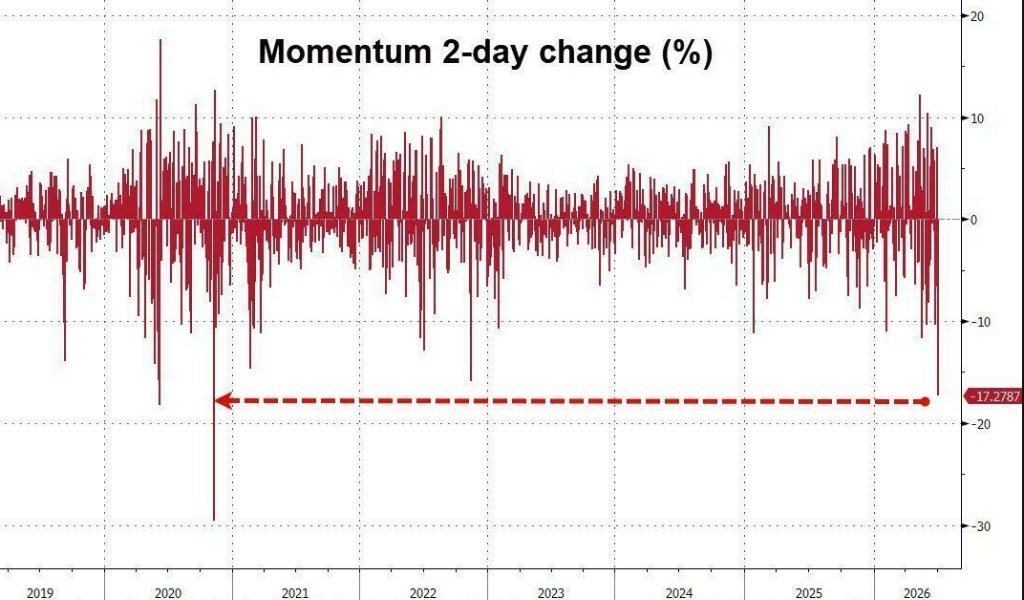
After experiencing historic gains since the end of March, chip stocks have recently cooled off significantly. The high-beta momentum portfolio (i.e., memory and chip stocks) recorded the largest two-day decline since the COVID-19 pandemic. Wilson judges that this pullback "may have further room".
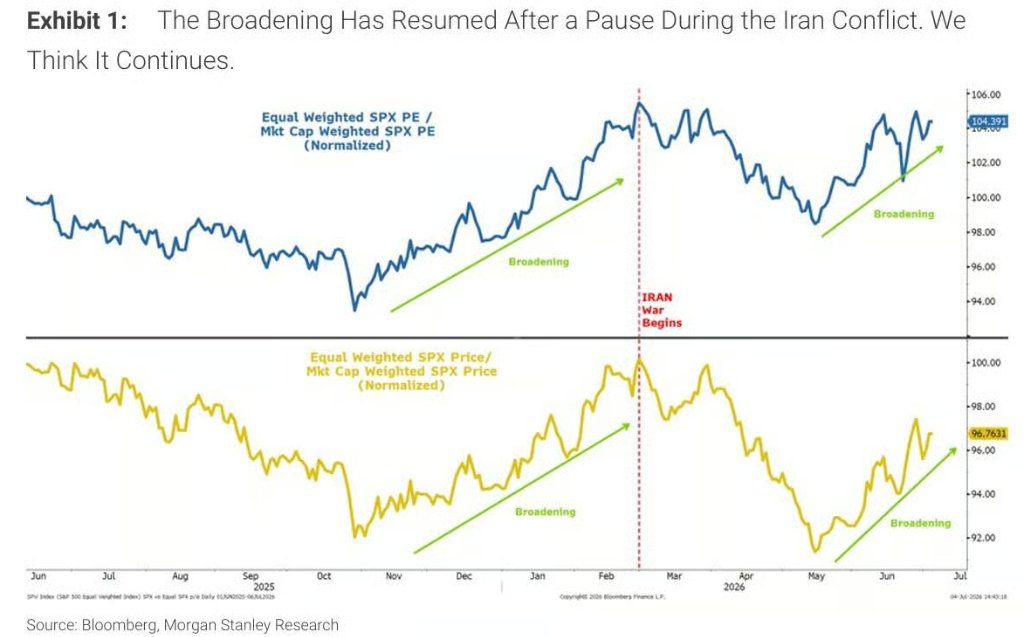
This judgment was not made impromptu—Wilson proposed the framework of the "Market Broadening" Trade (broadening trade) as early as the annual outlook in November 2025. The core logic is: after the US economy completes a rolling recession in April 2025, it will enter a new expansion cycle, earnings growth will be better than expected, and the market's leading force should diffuse from AI capital expenditure beneficiaries to broader sectors.
This judgment was interrupted by the Iran War in February 2026. Oil prices soared, the market repriced Fed rate hikes, the broadening trade fizzled out, and semiconductor stocks once again stood out alone riding the AI computing power narrative. Now, with oil prices falling and inflation expectations stabilizing, Wilson believes conditions have matured again.
Similar to "Silver Peaking": Memory Chips Are the Biggest Risk Point
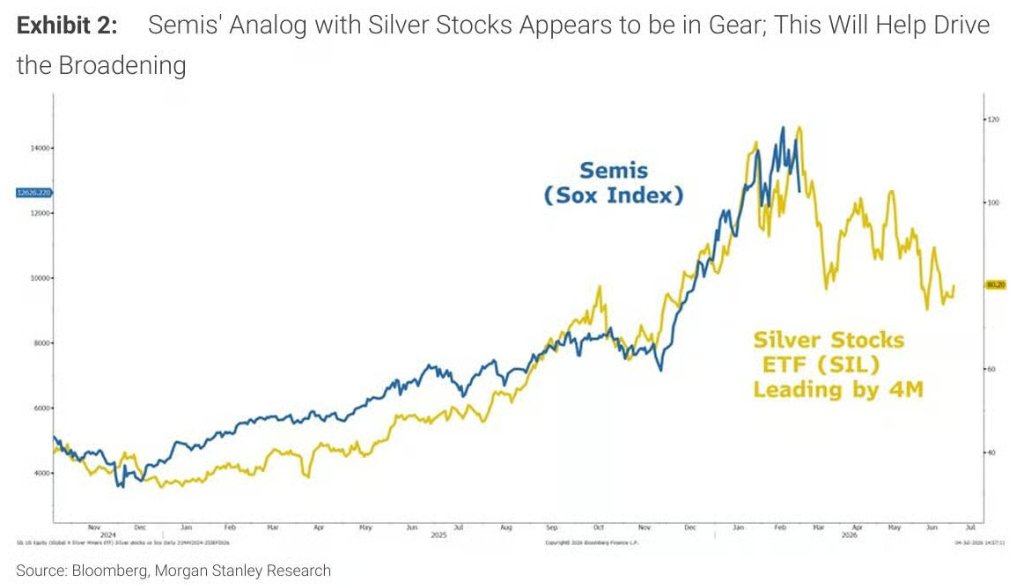
Wilson proposed a specific analogy in the report: semiconductor trends are highly similar to Silver.
There are two reasons: first, both have experienced parabolic price surges; second, both are highly linked to the commodity market, and commodity prices have historically been volatile.
Morgan Stanley first proposed this analogy in early June, and it now appears to be coming true. He further pointed out that this round of adjustment will be led by the Memory (Memory) sub-sector—because memory is the category "most like commodities" in the semiconductor complex, with high price elasticity and fast reversal.
After Micron's earnings report was released, semiconductor stocks immediately saw a significant decline. Wilson believes this confirms that the market has listed "the peak rate of change in earnings expectation revision" as a core focus.
That Statement from Meta Lit the Fuse
The direct catalyst triggering this rotation was an announcement from Meta.
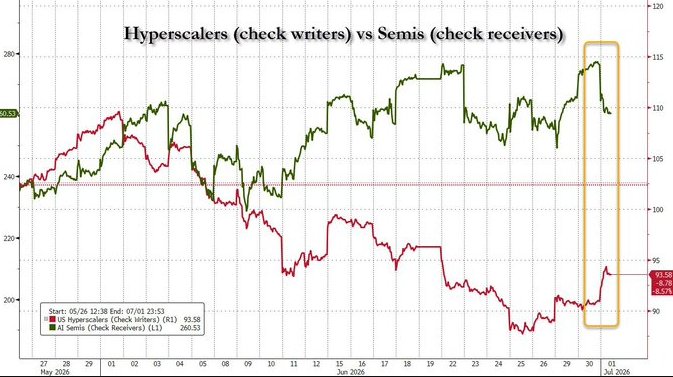
Last week, Meta announced it would begin selling its excess capacity (excess capacity) to external customers. This move sent a signal to the market: the growth rate of capital expenditure by hyperscale cloud providers may be touching a phased turning point.
Wilson wrote in the report that the severe divergence in performance between Hyperscalers (Hyperscalers, i.e., Microsoft, Google, Amazon, Meta, etc.) and semiconductor stocks is essentially unsustainable—because chipmakers' demand fundamentally relies on cloud providers' willingness to spend on capital expenditure. Historical patterns show that whenever the divergence between the two goes to extremes, "mean reversion" often occurs: cloud providers either lower capital expenditure guidance or announce a change in direction, thereby triggering a correction in semiconductor stocks.
Meta has provided exactly such a reason this time.
It needs to be pointed out specifically that Wilson clearly stated this does not mean the end of the AI capital expenditure cycle, but meaningful resets and rotations will occur midway through the cycle. His exact words were: "This is a phased peaking of the rate of correction (rate of change), not the peaking of the entire capital expenditure cycle."
In fact, since the release of ChatGPT in November 2022, such phased corrections have occurred three times, and this is the fourth.
Why Buy Cloud Now, Not Chips?
Wilson's logic is: Hyperscale cloud providers (such as Amazon AWS, Microsoft Azure, Google Cloud, etc.) have underperformed in stock price in recent months, but fundamental support remains strong.
He listed three reasons:
First, core business is robust. Cloud providers themselves have a strong business foundation and do not rely entirely on the AI capital expenditure narrative.
Second, they hold a unique position in the AI application layer. Wilson believes cloud providers have a leading advantage in the "development and implementation of the agentic application layer (agentic application layer)," a value underestimated by the market.
Third, cost-cutting space is overlooked. Wilson calls it "an underestimated cost-cutting lever."
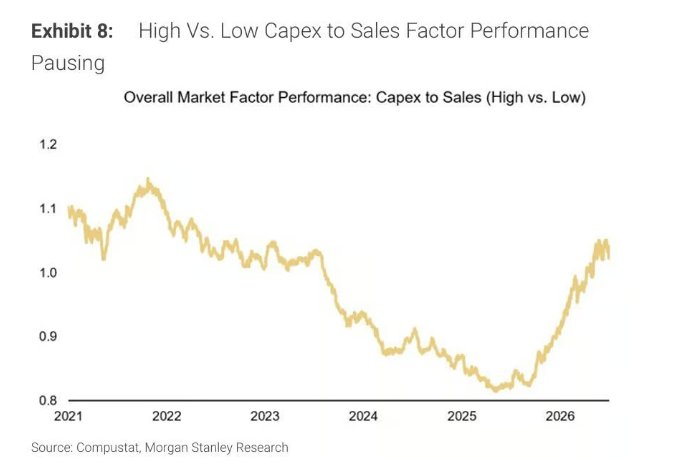
At the same time, the "High Capex/Sales Ratio" Factor (high capex/sales factor) tracked by Morgan Stanley, after experiencing strong performance over the past year, has currently shown peaking signals. Cloud providers have already undergone a round of relative underperformance, digesting this pressure; chip stocks may be just beginning.
"Broadening Market" Restarts: Not Just Buying Cloud
In addition to hyperscale cloud providers, Wilson also listed other preferred directions under the broadening market:
Consumer Discretionary (Discretionary Goods) is Wilson's most favored direction. The logic lies in: consumer spending is shifting from services to goods, goods pricing is improving, coupled with strong earnings per share revisions. He believes this is the "most compelling expression" in the broadening earnings story.
Transportation (Transports) also benefit from the arrival of the economic expansion cycle.
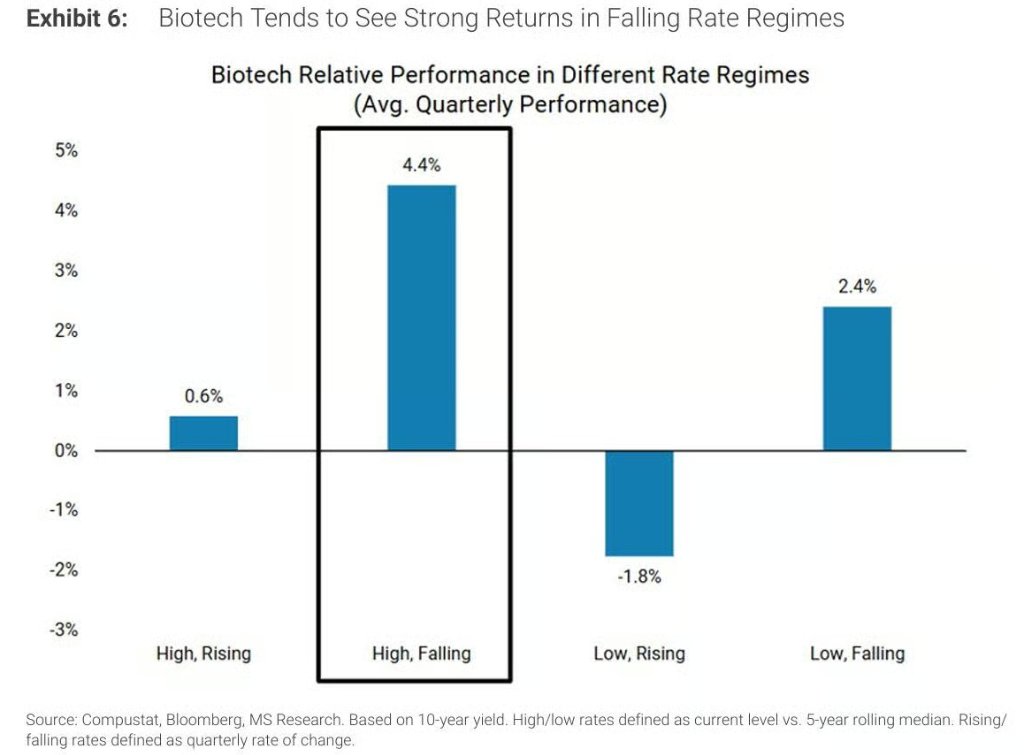
Biotechnology (Biotech) is the representative of interest rate-sensitive sectors. Historical data shows that in an environment where interest rates are high and declining, Biotech annualized returns are close to 20%. Morgan Stanley expects core CPI to remain below 3%, policy rate expectations are still too hawkish, and once corrected, Biotech will benefit directly. In addition, the continuously heating M&A cycle will also provide additional catalysts for this sector.
Macro Background: Falling Oil Prices Stabilize Interest Rates, Providing Soil for Rotation
Wilson's broadening logic has another important macro support: a significant drop in oil prices.
Falling oil prices help stabilize bond interest rates, and interest rate stability is one of the key drivers of the broadening market. Morgan Stanley's baseline forecast is: falling energy prices, peaking tariff-related inflation, and controllable services and housing inflation; the combination of the three will cause the Fed to keep interest rates unchanged this year, rather than raising them.
Currently, the bond market is still pricing in 1.5 rate hikes before the first quarter of next year. Wilson believes that once this overly hawkish expectation is corrected, it will constitute a positive surprise for the stock market.
He also specifically mentioned that Fed Chair Wash stated at the Sintra conference that "inflation risks have declined," and reiterated the dual mandate of employment and prices. Combined with last week's weaker-than-expected non-farm payroll data, Wilson believes this helps to further suppress hawkish interest rate expectations, providing support for the broadening market.
This Is Rotation, Not Termination
Wilson clearly summarized at the end of the report:
"The market will begin to broaden, and the index is also beginning to enter a consolidation/adjustment phase, this is happening.""Among AI winners, the leading sectors have rotated for years. This is just the next rotation development in the cycle.""This is just the next rotation—from semiconductors to hyperscale cloud providers, and the other broadening market targets mentioned above."
The relative underperformance of semiconductor stocks after Micron's earnings report made the market realize that "peaking rate of correction" has become a core issue of market concern. Meta's surprise announcement of selling excess capacity solidified this expectation. The consolidation of the high capex/sales factor may further prompt other cloud providers to lower capital expenditure guidance expectations.
All of this is providing fuel for the broadening market.
Join TechFlow official community to stay tuned
Telegram:https://t.me/TechFlowDaily
X (Twitter):https://x.com/TechFlowPost
X (Twitter) EN:https://x.com/BlockFlow_News