This Week's Crypto Watch | Jupiter, NEAR, Jito Among 7 Projects Making Moves; See Who's Worth Watching with a "Catalyst Calendar"
TechFlow Selected TechFlow Selected
This Week's Crypto Watch | Jupiter, NEAR, Jito Among 7 Projects Making Moves; See Who's Worth Watching with a "Catalyst Calendar"
Solana ecosystem season is back again? Legacy coins are also making moves.
 Navigating Web3 tides with focused insights
Author: Claude, TechFlow
TechFlow Insights: If you are holding these altcoins, or planning to catch a wave as the SOL ecosystem warms up, this week's schedule is worth marking on your calendar. Crypto KOL @TheDeFinvestor compiled a catalyst checklist for this week, with seven projects releasing positive news densely from July 6 to next week: Jupiter launches the private beta of the Unified Market GUM today, NEAR starts the "The Big Reveal" livestream tomorrow, Berachain hard forks to rewrite the token model on July 7-8, Zcash upgrades to Ironwood at the end of the month...
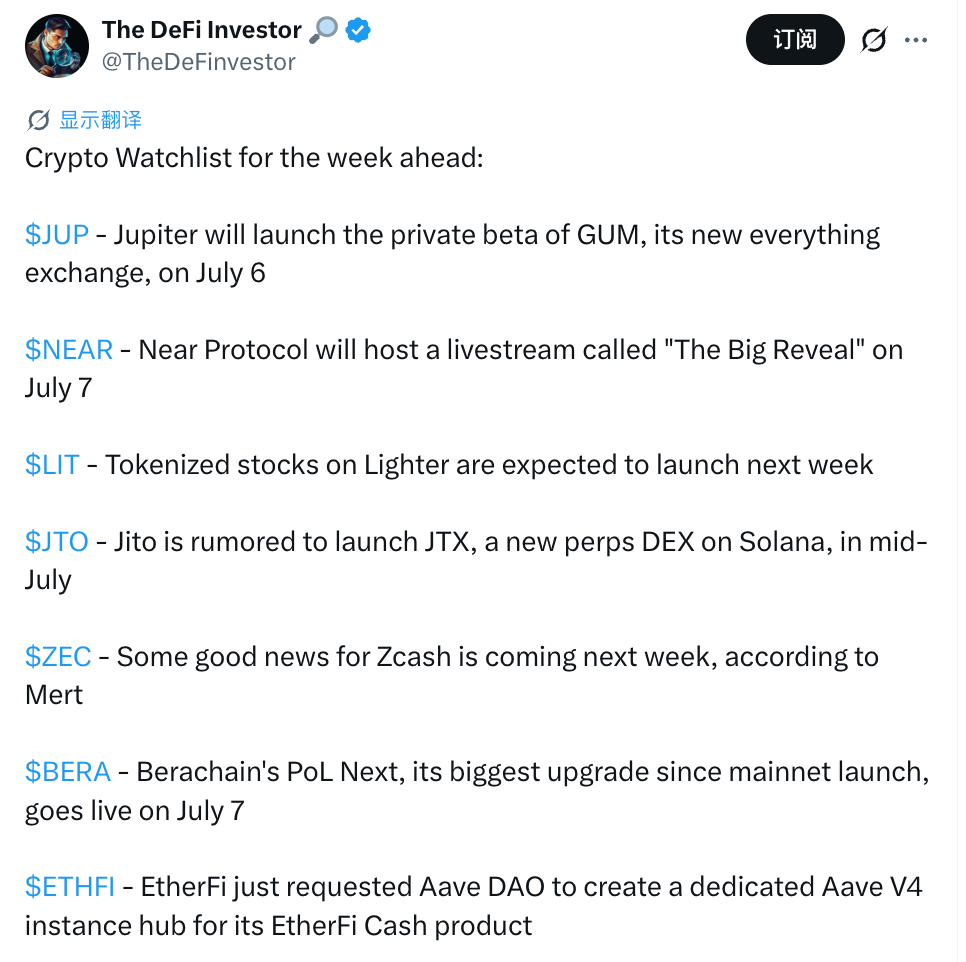
We have further summarized the context and overall timeline behind each item below.
Jupiter Launches GUM Private Beta Today, Taking a Substantial Step Towards the "Exchange for Everything" Vision
The tightest timeline belongs to JUP. Jupiter is launching the private beta of GUM on July 6 (today).
Jupiter is the largest DEX aggregator on Solana, simply put, a tool that helps users automatically find the best prices to swap tokens across dozens of trading venues. GUM (Giant Unified Market) is its core strategy launched in May 2024, aiming to bring assets like meme coins, stocks, forex, and real estate on-chain, stuffing them into a unified interface where users can swap them for less than one cent. DinariGlobal has committed to providing 1:1 US stock tokens pegged to Apple, Coinbase, etc., on Solana.
This private beta tests GUM's Unified Market API, which will integrate login, deposits, cross-chain spot, and perpetual contracts. The market reaction to this expectation has been significant; JUP rose by 13% at one point in the past 24 hours, making it one of the few major coins bucking the trend in an overall cautious market. A research report listed Jupiter among the top 15 highest-revenue crypto protocols, estimating its revenue over the past 12 months at approximately $130 million. There are also proposals on the governance forum requesting that more protocol fees be distributed to JUP buybacks.
However, the most concerning aspect for JUP is supply. According to the public unlock schedule, approximately 253 million JUP tokens will unlock at the end of February 2026. Product milestones can boost sentiment, but the increased circulating supply will create offsetting selling pressure; the gains from "buying the expectation" may not withstand the unlock event.
NEAR Starts "The Big Reveal" Livestream Tomorrow, Focusing on Enterprise-Grade "Black Box"
On July 7 at 16:00 UTC (11 AM ET), NEAR will host a livestream named "The Big Reveal" on X and YouTube, hosted by founders Illia Polosukhin and Alex Shevchenko, with the theme "Unveiling the Black Box for Enterprise Users."
NEAR's recent main themes are Intents (intent-based trading, where users only need to state the desired outcome and the system automatically completes the path), AI integration, and confidential computing. Data from last month shows that NEAR Intents cumulative trading volume has exceeded $22 billion. The team previously teased the next major protocol upgrade SPICE; this livestream is likely about that, or about black box technology for commercial clients.
Risk warning for holders: This type of "reveal livestream" is a typical expectation event. Sentiment leads before the realization; after the realization, it depends on whether the announced content has substance. If it is just concepts and roadmaps without substantial products or partner names, the impact may be limited.

Berachain Hard Forks on July 7-8, Directly Cutting the BGT Token
Also on July 7-8, Berachain will launch its largest upgrade since mainnet launch, PoL Next. This is not a patch, but a hard fork rewriting the core incentive layer.
Berachain's core mechanism is called Proof of Liquidity (using providing liquidity rather than simple staking to distribute rewards and governance rights). The old model had two tokens, BGT and BERA, plus a Boost mechanism, which confused many traditional capital providers.
PoL Next simplifies this into one token: BGT and Boost are gradually phased out, all emissions convert to BERA, and value accumulation unifies to sWBERA (staked version of BERA). The new emission mechanism ERAs requires projects to present real on-chain revenue and usage data to receive incentives, replacing the past practice of voting to pull emissions.
This is a structurally positive direction for BERA tokenomics, but implementation comes with clear risks. Currently, BERA's market cap and on-chain locked value are severely inverted (previously DeFi TVL was about $55 million, while market cap was once only in the $66 million range). During the mechanism switch, position adjustments by old incentive recipients may bring selling pressure. Redeeming sWBERA to BERA still has a 7-day unlock period, sacrificing flexibility.

Zcash Ironwood Upgrade at End of Month, Climbing Out of "Counterfeit Coin Panic"
The wording for this ZEC catalyst is the vaguest. The original list only said "According to Mert (Helius Labs CEO), there is good news next week." This requires some background to understand.
At the end of May this year, security researcher Taylor Hornby discovered a four-year-old vulnerability hidden in Zcash's Orchard privacy pool, which theoretically could allow attackers to mint unlimited fake ZEC out of thin air without being detected. Due to the nature of privacy coins, developers simply cannot confirm whether anyone actually created fake coins before the vulnerability was exploited. After the news broke, ZEC halved from over $600 to around $250 within two days, and BitMEX co-founder Arthur Hayes cleared all his ZEC positions.
Reference reading: "Zcash Privacy Coin Trust Crisis: After Claude Discovers Vulnerability, Arthur Hayes Clears Position, Full Interpretation of Core Developer Josh Swihart's Latest Response"
The remedy for this problem is the Ironwood upgrade, currently scheduled for mainnet activation on July 21.
It opens a new privacy pool, seals the old Orchard pool, and relies on the existing turnstile mechanism to allow any node to independently verify the circulating supply, equivalent to providing verifiable evidence for the matter of "no fake coins created." After the fix was implemented, ZEC has rebounded over 50% from the bottom, reporting $462 on July 4, up 13.3% in the past seven days. (Note: It is worth mentioning that Hornby originally discovered this vulnerability using Anthropic's Claude Opus 4.8.)
Risk warning for holders: The truly confirmed schedule is the mainnet upgrade on July 21; before that, the "good news" is more of sentiment catalyst, do not treat a retweet as realization.
Lighter Tokenized Stocks Launch Next Week, Tapping into the Robinhood Pipeline
The catalyst for LIT is that tokenized stocks are expected to launch on Lighter next week.
Lighter is a perpetual contract DEX based on zero-knowledge proofs (processing transactions off the Ethereum main chain, then using cryptography to prove each one is legal, in exchange for low cost and high speed). Its real highlight is the binding with Robinhood: Robinhood's Ethereum L2 "Robinhood Chain" launched mainnet on July 1, and Lighter became the default perpetual DEX on this chain.
Users can throw stock tokens like Nvidia and Apple into lending pools as collateral, something ordinary brokerage accounts cannot do.
Robinhood has about 24 million funded accounts; even if only a small portion migrates on-chain, it would be a magnitude increase for Lighter's trading volume. Lighter also set aside $11 million worth of LIT tokens to incentivize the Robinhood community, and Robinhood will cover gas fees for users for 90 days. After the news broke, LIT rose by 24% at one point, reporting $2.14 to create a new phase high.
Risk warning for holders: Robinhood explicitly excluded regions such as the UK, US, Canada, Switzerland, UAE, and Singapore from perpetual contract services, so the actual user base that can be activated will be discounted. Additionally, in the perp DEX sector, Hyperliquid, Aster, and dYdX's Arcus are competing for the same order flow, and token unlocks are also a downside risk hanging overhead.
Jito Launches JTX in Mid-July, Moving from "Behind-the-Scenes Toll Booth" to the Front to Grab Order Flow
The catalyst for JTO is the rumor of launching the new trading platform JTX in mid-July.
Jito is a core infrastructure provider on Solana, simultaneously doing liquid staking (JitoSOL) and MEV (Miner Extractable Value, referring to extra money earned by rearranging transaction order, money that originally partly belonged to ordinary traders).
Its MEV client is already running on over 95% of active staking on Solana, equivalent to installing a toll booth on the entire chain. JitoSOL's TVL broke through $2.9 billion in Q1 2026.
JTX is a step for Jito from the backend to the application layer: a self-custody trading terminal, aiming to give professional traders CEX-level execution speed and tools, while users hold their own assets.
Early access opened on June 26, with full public launch planned for July, starting with spot, followed by perpetuals and prediction markets through integration. The key lies in token capture; according to Jito's materials, JTX approximately 80% of protocol revenue will flow back to JTO holders through buybacks.
Risk warning for holders: The 80% revenue flowback is the hardest part of the JTX narrative, but the premise is that JTX can truly generate trading volume. In the perpetual sector, Hyperliquid dominates alone; how much order flow JTX can get as a new entrant has not been verified by data. Jito revenue is highly bound to Solana on-chain activity; once on-chain trading volume falls, the fee flow will be compressed quickly.
Ether.fi Requests an Exclusive V4 Instance from Aave to Serve as Credit Backend for Visa Card
Finally, there is ETHFI. It just submitted a proposal to Aave DAO on July 1, requesting to deploy an exclusive Aave V4 instance (whitelabel hub) fully managed by Ether.fi, deployed on OP mainnet, to serve as the backend for the EtherFi Cash product.
EtherFi Cash is a physical Visa card that allows users to borrow stablecoins directly for spending using yield-bearing assets (such as restaked ETH). Previously, it used a self-built Debt Manager system; now it wants to switch to the more mature and liquid Aave V4 infrastructure. Proposal details: Isolated whitelist mode, GHO as the main lending asset, initial liquidity target up to $175 million, revenue split 80/20 (Aave DAO takes about 20%), Optimism Foundation may contribute $20 million in supply and $1.2 million in incentives.
Risk warning for holders: This is the earliest one among the seven. Currently, it is only at the temp check stage; it needs to complete DAO voting to land, and whether it will pass or when it will pass is undecided. Treat it as a directional signal, rather than a catalyst that can be realized this week.
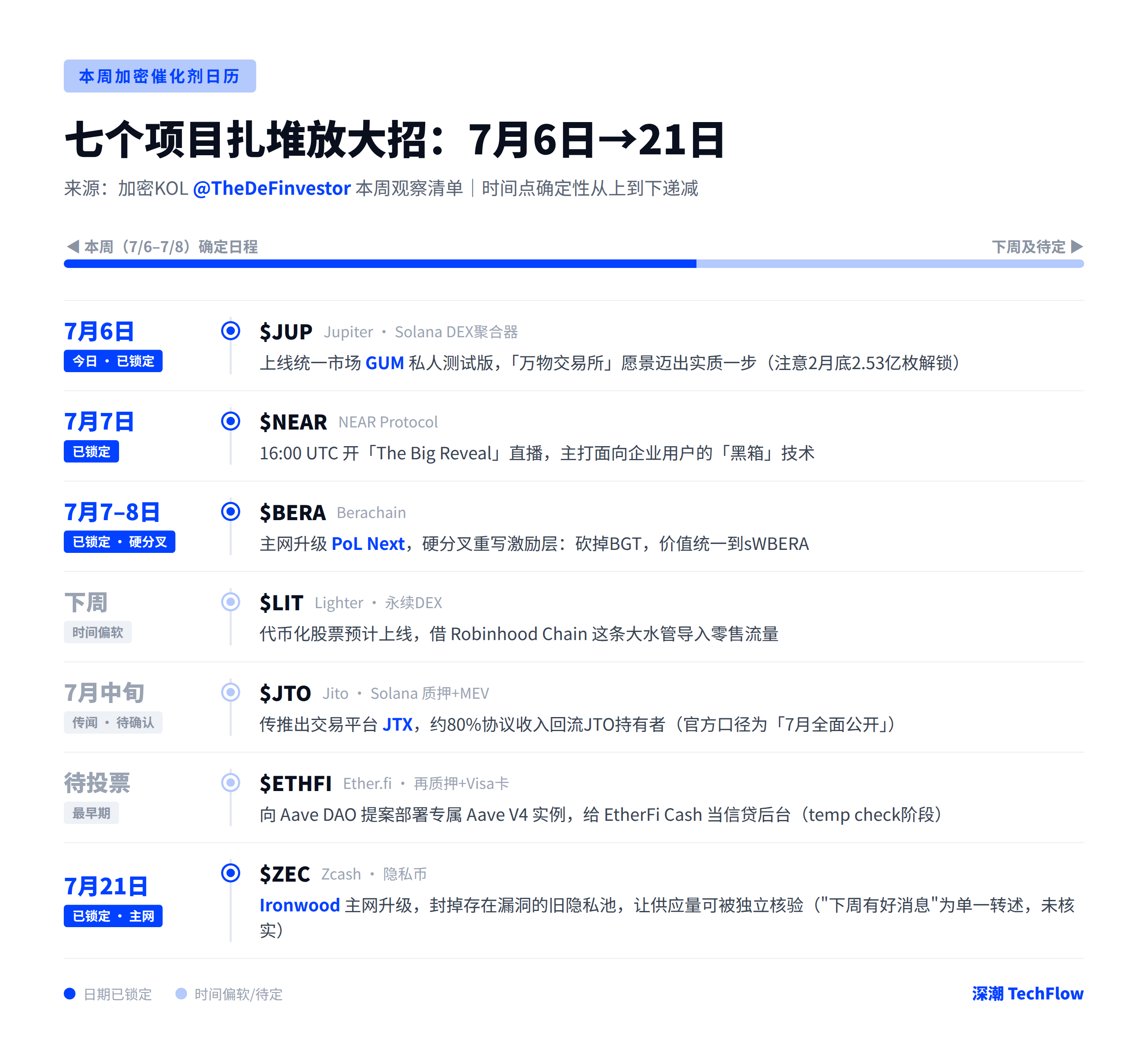
Finally, here is a one-chart summary to help you quickly lock in relevant events and timestamps.
Join TechFlow official community to stay tuned
Telegram:https://t.me/TechFlowDaily
X (Twitter):https://x.com/TechFlowPost
X (Twitter) EN:https://x.com/BlockFlow_News
 深潮TechFlow