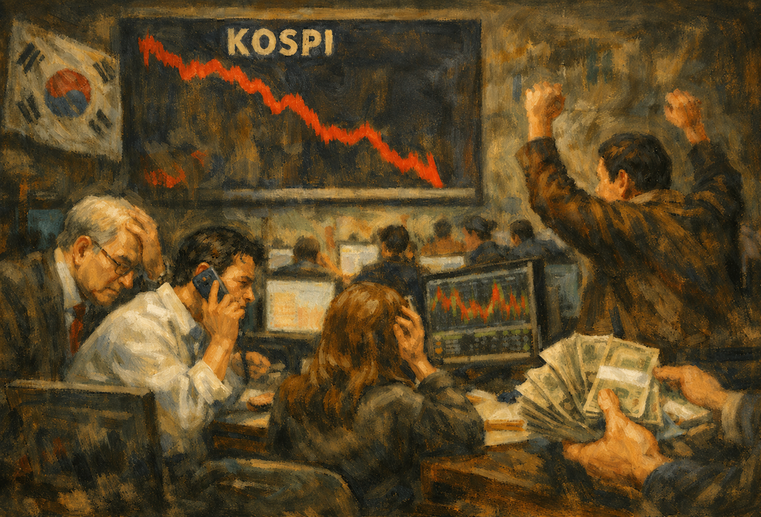
Goldman Sachs Reviews the South Korean Stock Market Crash: Pension Fund Withdrawals and Retail Investor Margin Calls Trigger a Semiconductor Stock Collapse
TechFlow Selected TechFlow Selected
Goldman Sachs Reviews the South Korean Stock Market Crash: Pension Fund Withdrawals and Retail Investor Margin Calls Trigger a Semiconductor Stock Collapse
When pension funds shifted from buyers to sellers and retail leveraged funds were subject to forced liquidation, the marginal buying pressure that had previously supported the rally instantly collapsed.
 Navigating Web3 tides with focused insights
Author:Bu Shuqing
South Korea’s stock market plunged sharply from historic highs—a long-accumulating structural vulnerability that erupted amid a confluence of triggering factors.
The Korea Composite Stock Price Index (KOSPI) fell 10% in a single day on Tuesday. Samsung Electronics and SK Hynix both tumbled over 12%, collectively accounting for 71% of the index’s decline. The Korea Exchange triggered its 20-minute circuit breaker in the afternoon—but failed to halt the downward spiral. Foreign investors net sold over $2.5 billion worth of KOSPI-listed stocks that day.

In a post-mortem report, Chris Cha, Head of High-Touch Trading for Korea at Goldman Sachs, pointed out that the root cause of this plunge was not deteriorating fundamentals—but rather deep-seated structural fragility in the market: when pension funds shifted from buyers to sellers, and retail leveraged positions were forcibly liquidated, the marginal buying power previously supporting gains instantly collapsed.
The warning signal this plunge sends about market structure may far outweigh the significance of the single-day drop itself. Goldman Sachs’ report explicitly states that recent gains in the Korean equity market have become increasingly driven by technical factors and liquidity—not by meaningful new fundamental demand. Once this fragile support is disturbed, outsized, index-level volatility becomes virtually inevitable.

Imbalanced Liquidity Structure: Retail Investors Become the Last Buyers
The deeper backdrop to this plunge is the ongoing narrowing of the Korean equity market’s buying base.
Chris Cha notes in his report that foreign investors were never the primary drivers of the rally, while domestic institutional buying capacity has also become increasingly constrained. In practice, retail investor capital has been effectively cemented as the dominant source of marginal demand. This structure can hold during calm markets—but is highly susceptible to cascading effects once external shocks hit.
Alexander Redman, CLSA Singapore’s Chief Equity Strategist, stated at a briefing: “The magnitude of this volatility correlates closely with the degree of inherent bubble-like conditions in the Korean market—because it is now almost entirely retail-driven.”
He added bluntly: “Seeing volatility of this magnitude is genuinely unsettling.”
According to data from the Korea Financial Investment Association, retail margin debt (i.e., borrowed funds used to buy stocks) rose to a record 38.5 trillion won (~$25 billion) this month.
Kim Namho, Portfolio Manager at Seoul-based Timefolio Investment Management, said: “Forced liquidations appear to have kicked in around 2–3 p.m., accelerating the downward momentum.”
Leveraged ETF Regulatory Risk: Policy Signals Undermine Technical Buying
Another critical thread in this plunge was regulators’ shifting stance toward single-stock leveraged ETFs.
South Korea’s top financial regulator publicly expressed regret over failing to prevent the listing of single-stock leveraged ETFs tied to Samsung Electronics and SK Hynix—and highlighted their adverse side effects. This statement came precisely when the market was already in a fragile state, making its impact nontrivial.
According to Goldman Sachs’ report, assets under management (AUM) across 16 domestic leveraged ETFs have grown to $9.1 billion—while the CSOP 2x leveraged ETFs tracking SK Hynix and Samsung alone command $21 billion in AUM. Notably, 92% of domestic leveraged ETF AUM comes from retail investors.
Chris Cha points out that single-stock leveraged ETFs amplify price swings bidirectionally—both on the way up and down—via rebalancing mechanisms. This effect is especially pronounced in large-cap stocks with high retail participation. Even without immediate regulatory action, the official expression of “regret” alone was sufficient to prompt investors to reassess the sustainability of recent technical buying.
Goldman Sachs’ report outlines potential stabilizing measures the Financial Services Commission (FSC) could adopt—including raising minimum margin requirements for retail participation in leveraged ETFs, strengthening qualification exam requirements, imposing AUM caps on individual ETFs, restricting new product launches, and tightening trading suspension mechanisms when ETF prices deviate significantly from net asset value.
Pension Fund Rebalancing: The Largest Stabilizer Turns into Mechanical Selling Pressure
A pivotal pressure point emphasized in Goldman Sachs’ report was the changing role of South Korea’s largest pension fund—the National Pension Service (NPS).
Having pushed domestic equity allocations above 30%—well above its target ceiling of ~28.8% due to prior market rallies—the NPS has proactively net sold approximately $1 billion worth of KOSPI stocks over the past six trading days (including the day of the crash). Since June, its net sales have reached $1.5 billion—the largest monthly net outflow since April 2021.
Chris Cha observes that pension funds are typically viewed as domestic anchoring forces stabilizing markets—but once actual holdings significantly exceed targets, this investor group transforms from passive support into mechanical supply. Against a backdrop where the market is heavily concentrated in a few large-cap tech stocks and technical indicators are clearly overstretched, this shift delivers an especially pronounced shock.
Pre-Micron Earnings Chip Sector De-Risking
The outsized declines of Samsung Electronics and SK Hynix—far exceeding the broader index—also relate closely to Micron Technology’s upcoming earnings release, scheduled for early Thursday morning local time in Asia.
Goldman Sachs’ report notes that investor expectations ahead of Micron’s results had already reached extremely high levels—creating fertile ground for preemptive de-risking.
When market gains rely increasingly on tactical enthusiasm rather than fresh, substantive buying, event-driven risks often trigger profit-taking far larger than what fundamentals alone would justify.
Fundamentals Unchanged—but Near-Term Path More Cautious
Goldman Sachs’ report clearly distinguishes between structural risk and fundamental assessment.
Chris Cha affirms that the memory chip cycle remains in an upward phase, AI-related demand continues to provide support, earnings expectations at the index level keep improving, and KOSPI valuations remain relatively low. He maintains a constructive medium-term outlook for the Korean equity market—but adopts a more cautious stance on near-term performance.
He notes that the next attractive entry point will not simply emerge because the market looks cheaper after a sharp drop—but only after forced selling visibly subsides, Samsung and SK Hynix stabilize post-Micron earnings, and the market builds a more robust base of buying support over multiple trading sessions.
“Today’s decline is less a verdict on Korea’s fundamentals—and more a reminder of how recently the rally has been ‘financed,’” Chris Cha writes. “Even markets whose medium-term logic remains intact can undergo sharp corrections once their market structure becomes excessively stretched.”
Join TechFlow official community to stay tuned
Telegram:https://t.me/TechFlowDaily
X (Twitter):https://x.com/TechFlowPost
X (Twitter) EN:https://x.com/BlockFlow_News