Microsoft CEO Nadella’s Latest Long-form Article: The Future of Companies in the AI Era Depends on This “Cognitive Loop”
TechFlow Selected TechFlow Selected
Microsoft CEO Nadella’s Latest Long-form Article: The Future of Companies in the AI Era Depends on This “Cognitive Loop”
Without building your own AI learning loop, your knowledge will be consumed by large models.
 Navigating Web3 tides with focused insights
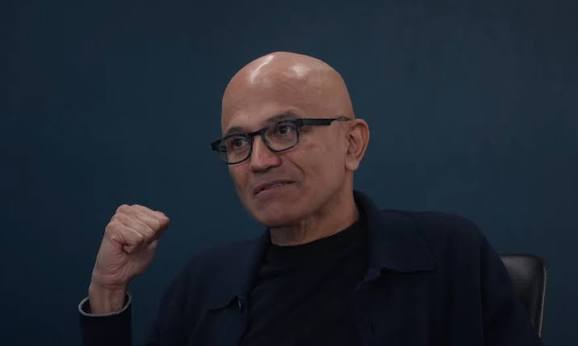
Author: Satya Nadella
Translated and edited by TechFlow
TechFlow Insight: Satya Nadella, CEO of Microsoft, has rarely published a lengthy article warning of new crises in the AI era. He argues that if all value is captured by just a few large models, the political and economic systems simply won’t tolerate it—just as the first wave of globalization hollowed out entire industrial economies. Companies must build their own “token capital” learning loops, encoding domain expertise into AI systems; otherwise, they risk being directly commoditized by models.
I’ve been thinking deeply about what the future of enterprises will look like in an AI-driven economy.
This transformation differs fundamentally from any previous platform shift. In the past, we used digital systems to augment human capital. This is the first time we can establish a genuine cognitive loop between people and digital systems—a bewildering shift, because it reshapes how we conceptualize work inside organizations.
The real question isn’t about any particular digital tool or system—or how it’s used—but rather: How can organizations continue learning, building intellectual property, achieving differentiation, and thriving in a world where AI models continuously absorb human and organizational expertise and commoditize it?
Every company must build what I call human capital and token capital. Human capital includes employees’ knowledge, judgment, relationships, creativity, and pattern recognition abilities; token capital refers to the AI capabilities a company builds and owns.
Crucially, as token capital grows, human capital doesn’t become less valuable—it becomes *more* valuable! I believe human agency will be the driving force behind token capital growth. Humans set ambitious goals, connect dots across domains, build relationships, and identify the most critical patterns. Without human guidance, you’re merely spinning compute cycles in place.
That means the true opportunity lies not in selecting the best model—but in building a learning loop atop models that enables compounding growth of both human and token capital. You can outsource a task—or even an entire job—but you can never outsource your learning. The future of enterprise lies in compounding this learning between humans and AI.
This requires a new architectural approach—one that lets every company build intelligent agent systems that improve over time while retaining full control over its intellectual property. Companies should be able to swap out “generic” models without losing the “institutional veterans’” domain expertise embedded within their learning systems. This will be the defining “test” of control and sovereignty in the coming era.
Companies need to translate their workflows, domain knowledge, and accumulated judgment into AI systems that improve with every use. Private evaluation must measure whether models are genuinely improving on business-critical outcomes—not just external benchmarks! Private reinforcement learning environments should let models grow stronger on real organizational trajectories. Their knowledge bases make institutional memory queryable and token usage more efficient.
This loop becomes the company’s new intellectual property. I envision it as a mountain-climbing machine. Unlike most assets, it compounds. Each improved workflow generates better training signals, accelerating the accumulation of proprietary tacit knowledge. Early adopters of this architecture will gain advantages that are extremely difficult to replicate—regardless of any new standalone model capability.
None of us want a world where every company in every industry surrenders value to just a handful of models that devour everything in sight. If all value flows exclusively to a few models, the political economy simply won’t tolerate it. Society won’t accept an AI future that hollows out entire industries.
Recall what happened during the first phase of globalization—the entire industrial economy was hollowed out through offshoring. On the surface, GDP figures looked healthy, but displacement was real—and its consequences are still felt today. Let’s not repeat this dynamic in the AI era, letting a handful of AI systems capture all economic returns while entire industries watch their hard-won knowledge commoditized right under their noses.
In my view, our priority must be building a frontier *ecosystem*—not just a frontier *model*—so value flows broadly across every company, every industry, and every nation. An ecosystem where every organization owns a learning loop that encodes its institutional knowledge and compounds both its human and token capital.
This reflects the philosophy I developed growing up: platforms create more value at the top than they capture internally, enabling every company to innovate continuously and build its own value.
When this happens, companies generate value for themselves—and for the broader economy. Employees see their expertise amplified; their judgment becomes part of the system, making it replicable and scalable—with benefits flowing to both the company and surrounding communities.
This is how companies create value—for themselves and for the wider economy. This is the stable equilibrium we must collectively build.
Join TechFlow official community to stay tuned
Telegram:https://t.me/TechFlowDaily
X (Twitter):https://x.com/TechFlowPost
X (Twitter) EN:https://x.com/BlockFlow_News
 @satyanadella