








Crypto Morning Brief: Stripe, Visa, and Mastercard Plan to Launch Stablecoin Platform; U.S. CLARITY Act Added to Senate Agenda
TechFlow Selected TechFlow Selected
Crypto Morning Brief: Stripe, Visa, and Mastercard Plan to Launch Stablecoin Platform; U.S. CLARITY Act Added to Senate Agenda
SpaceX’s IPO is expected to be priced at $135 per share, potentially raising $75 billion.
 Navigating Web3 tides with focused insights
Author: TechFlow
Yesterday’s Market Highlights
Qingdao Bitcoin Theft Case Ruled; Court Affirms Virtual Currency’s Property Status
According to Shandong Legal Daily, the Jiaocheng District Procuratorate in Qingdao City successfully handled a Bitcoin theft case. The defendant, Zhang Moumou, exploited the victim Feng Moumou’s delegation of wallet management to steal his mnemonic phrase and stole 107 Bitcoins during the early hours. Valued at approximately RMB 22.54 million (USD ~3.1 million) based on the market price on the day of the incident, the stolen assets were subsequently laundered across multiple platforms before being converted into RMB 660,000 (USD ~91,000).
After arrest, Zhang attempted to justify his actions as a “protective takeover,” but prosecutors refuted this claim point-by-point using fund flow tracing. The court sentenced Zhang to 10 years and 9 months’ imprisonment for theft, plus a fine of RMB 100,000 (USD ~13,800). The verdict was upheld on appeal. This ruling explicitly affirms virtual currency’s status as property protected under criminal law, providing judicial guidance for combating similar emerging cybercrimes.
U.S. Clarity Act Officially Added to Senate Legislative Calendar
According to Bitcoin News, the U.S. Clarity Act has formally advanced from the Senate Banking Committee to the Senate legislative calendar. On May 14, the Senate Banking Committee approved the bill by a vote of 15–9. It officially entered the Senate calendar on June 1 and is now eligible for full Senate consideration. The next key hurdle is the full Senate vote.
SEC Releases Draft Strategic Plan (2026–2030), Proposing Regulatory Framework for Digital Assets
Per the SEC’s official website, the U.S. Securities and Exchange Commission released its Draft Strategic Plan for Fiscal Years 2026–2030 on June 2 and opened it for public comment. The plan centers on three goals: (1) supporting innovation and capital formation by clarifying the regulatory framework for digital assets and distributed ledger technologies; (2) enhancing engagement with market participants and refocusing enforcement efforts on fraud and market manipulation; and (3) advancing technological modernization—including upgrading the EDGAR system and integrating AI and blockchain technologies to improve regulatory efficiency. SEC Chair Paul S. Atkins stated the Commission remains committed to its core mission of protecting investors, maintaining fair markets, and facilitating capital formation. Public comments are due by July 2, 2026; the document number is DSP-3.
MiCA Transition Period Ends July 1; Unlicensed Crypto Firms Must Cease Serving EU Customers
According to Cointelegraph, the transition period for the EU’s Markets in Crypto-Assets Regulation (MiCA) ends on July 1, 2026. The European Securities and Markets Authority (ESMA) stated that crypto-asset service providers lacking MiCA authorization—even those whose applications remain under review—must halt services to EU customers effective that date and initiate wind-down and customer migration arrangements.
France’s financial regulator, AMF, warned that unauthorized provision of such services may constitute a criminal offense; Germany requires relevant entities to obtain authorization no later than June 30. Reports indicate a substantial share of EU users still rely on unlicensed platforms, including Bitget and Binance, whose MiCA application statuses remain pending regulatory review.
Payment Giants Stripe, Visa, and Mastercard to Launch Stablecoin Platform
According to CoinDesk, sources indicate Stripe, Visa, and Mastercard are nearing the launch of a new stablecoin platform, while Coinbase is evaluating participation. Stablecoins have become a strategic priority for major card networks and payment firms. Per CoinGecko data, the current total stablecoin market capitalization stands at approximately $325 billion, with USDT at ~$115 billion and USDC at ~$76 billion.
Revolut Plans U.S. Banking Services Launch in 2026, Including Stablecoin and Crypto Trading
According to CoinDesk, Revolut plans to launch its U.S. banking services in 2026, offering FDIC-insured accounts, stablecoin services, multi-currency deposits, and cryptocurrency trading.
Coinbase Completes Investment in Ethena via Public Market ENA Purchase; Joint On-Chain Savings Product Announced
According to The Block, Coinbase Ventures confirmed completion of its investment in Ethena through a public-market purchase of ENA tokens. The two parties simultaneously announced a partnership to jointly expand on-chain financial and savings products. Guy Young, Ethena’s founder, revealed integration will go live next week, granting Ethena’s products access—for the first time—to Coinbase’s over 100 million users. Circle’s USDC stablecoin is also involved in the collaboration, though specific implementation details remain undisclosed.
Bitmine Acquired 25,000 ETH via BitGo Early Today, Worth ~$47.98 Million
Per on-chain analyst Embers (@EmberCN), amid broad institutional ETH selling, Bitmine acquired 25,000 ETH (~$47.98 million) via BitGo early today—countering the prevailing trend.
Bitcoin Spot ETFs Saw $519 Million Net Outflow Yesterday
Per Trader T (@thepfund), Bitcoin spot ETFs recorded a $519 million net outflow yesterday—the 12th consecutive day of outflows, totaling ~$3.97 billion (~62,000 BTC). BlackRock’s IBIT saw $389 million in outflows, Grayscale’s GBTC $83.51 million, and Fidelity’s FBTC $45.14 million. Morgan Stanley’s MSBT was the sole ETF with net inflows, recording $14.77 million.
SpaceX IPO Target Price Set at $135 per Share, Potentially Raising $75 Billion
Sources report SpaceX intends to price its IPO shares at $135 each. The company plans to issue 555.6 million shares, potentially raising $75 billion. (Jinshi)
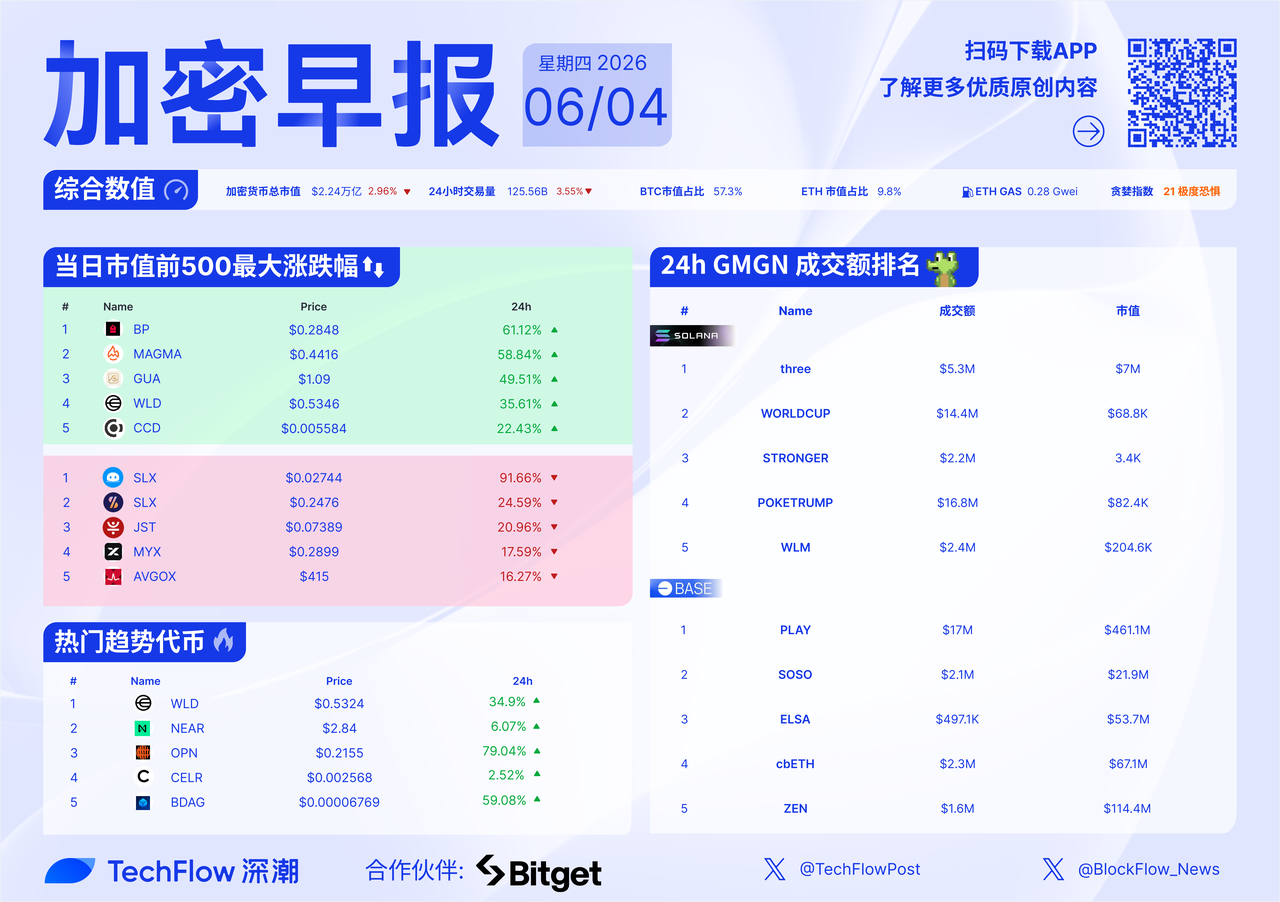
Market Data
Recommended Reading
TechFlow Intelligence Brief: NVIDIA Endorses Marvell, Shares Surge >30%; Institutions Continue Contrarian Accumulation of HYPE
https://www.techflowpost.com/zh-CN/article/31897
This article summarizes recent developments across AI, cryptocurrency, U.S. equities, and the broader tech sector—and highlights the clearest current market theme: AI assets continue attracting robust capital inflows, while the crypto market faces mounting pressure.
In AI, MiniMax launched its new M3 model, excelling in long-context and browser-task benchmarks; Microsoft unveiled several new models and quantum computing advancements at its Build conference, underscoring continued large-tech acceleration in AI infrastructure development. Meanwhile, companies including GitLab and Cloudflare are restructuring around AI—sparking market debate about AI’s potential displacement of white-collar roles.
In crypto, Bitcoin fell below $70,000; Strategy sold Bitcoin for the first time since 2022, intensifying bearish sentiment; and successive Cardano ecosystem project shutdowns further eroded market confidence. Yet amid the downturn, institutional buyers—including Galaxy Digital—continued accumulating HYPE, signaling contrarian positioning by some capital.
Tech stocks sustained strong performance. Jensen Huang publicly praised Marvell as a potential “next trillion-dollar company,” propelling its stock up over 30% in a single day; Microsoft’s quantum chip breakthrough reinforced optimistic expectations for the AI and compute infrastructure supply chain.
The article argues markets are now clearly bifurcated into an “AI bull market” and a “crypto bear market.” On one side, models, chips, and compute capacity continue drawing intense capital interest; on the other, crypto faces capital outflows and weakening narratives. Against rising global geopolitical risks, this divergence between AI and crypto storylines has become one of the most critical phenomena in today’s capital markets.
After Marvell’s 32% Rally, the Chinese Semiconductor Family Behind the Scenes Emerges
https://www.techflowpost.com/zh-CN/article/31896
Marvell’s stock surged 32.5% in a single day, hitting a new all-time high—not only buoyed by NVIDIA CEO Jensen Huang’s public endorsement of its AI data-center business, but also spotlighting the semiconductor empire built by founder Dr. Weili Dai and her family. The article traces the three Dai siblings’ 30-year entrepreneurial and investment journey—from Marvell and VeriSilicon to Dream Big and Silicon Box—spanning critical domains including chip IP, EDA tools, AI ASICs, optical interconnects, and advanced packaging. The author argues the Dai family does not bet on isolated “star” companies; instead, they strategically position themselves at pivotal nodes across every semiconductor paradigm shift—building, through investment, acquisition, and entrepreneurship, a comprehensive industrial network covering core AI infrastructure segments—and thereby capturing long-term dividends from the AI wave.
When Google Starts “Printing Stock” for AI, Who Broke Neocloud’s High-Valuation Narrative?
https://www.techflowpost.com/zh-CN/article/31889
Google recently launched an $80 billion financing initiative while simultaneously commercializing its TPUs externally and forming a compute joint venture with Blackstone—signaling its intent to challenge NVIDIA’s dominant AI compute ecosystem across chips, cloud services, and compute leasing. The article argues Google aims not merely to expand data centers, but to reshape the AI compute market structure—and dismantle the prevailing market perception that NVIDIA GPUs are the sole viable option. This poses long-term pressure on “Neocloud” firms highly reliant on the NVIDIA GPU narrative—such as CoreWeave, Nebius, and IREN. Though these companies currently enjoy strong order backlogs, their elevated valuations rest on assumptions of persistent GPU scarcity and surging demand. Yet TPU commercialization, in-house capacity expansion, and cost-of-capital advantages are gradually undermining this foundational narrative. The author contends the AI compute market is shifting from shortage-driven dynamics toward diversified competition—and Neocloud growth stories may face fundamental revaluation.
Industry Divergence Under AI Impact: Intuit Down 50%, Worst S&P 500 Performer; Victoria’s Secret Up 47% in One Day
https://www.techflowpost.com/zh-CN/article/31885
Amid AI narratives dominating markets, sharp divergences emerged within U.S. equities. Tax-software giant Intuit—despite beating revenue, profit, and full-year guidance estimates—plunged ~50% year-to-date as investors fretted generative AI would erode moats around core products like TurboTax, making it one of the worst-performing S&P 500 components. Simultaneously, the broader SaaS software sector faced systemic valuation compression, prompting market reassessment of traditional software firms’ long-term competitiveness.
In stark contrast, Victoria’s Secret surged 47% in a single day following an unexpectedly strong earnings report. Revenue and profits both rose thanks to product refreshes, brand revitalization, and international expansion—and the company raised its full-year guidance. The article argues this diametrically opposed market reaction reflects a core shift in investor logic: capital is no longer paying premiums solely for AI-related stories, but increasingly prioritizing firms that can deliver tangible, visible profit growth even amid AI disruption. AI is reshaping valuation frameworks—and earnings certainty is becoming an ever-scarcer asset.
Morningstar Values SpaceX at Just $78B—Less Than Half Its IPO Target. Is the “Largest IPO Ever” Overpriced?
https://www.techflowpost.com/zh-CN/article/31884
This article examines the valuation controversy surrounding SpaceX’s upcoming IPO. Research firm Morningstar applied a discounted cash flow (DCF) model to assign SpaceX a fair value of ~$78 billion—just 45% of its $175 billion IPO target—deeming the company significantly overvalued. Morningstar valued SpaceX’s launch and Starlink businesses at ~$61.1 billion, assigning only a probability-weighted $17 billion to its AI ventures (including xAI and X), questioning their commercial viability. The article also analyzes post-IPO catalysts for share appreciation—including extremely low float, rapid inclusion in the Nasdaq-100 Index, and market enthusiasm for AI infrastructure assets—but cautions investors about risks such as future large-scale share unlocks, AI valuation bubbles, debt burdens, and Elon Musk’s highly concentrated governance structure. Ultimately, the central debate isn’t whether SpaceX is exceptional—but whether the market is willing to pay an excessive premium today for growth expected over the next decade.
Join TechFlow official community to stay tuned
Telegram:https://t.me/TechFlowDaily
X (Twitter):https://x.com/TechFlowPost
X (Twitter) EN:https://x.com/BlockFlow_News
 深潮TechFlow


