

$1 Billion in Iranian Cryptocurrency Seized by the U.S.—Can It Be Added to the U.S. Strategic Bitcoin Reserve?
TechFlow Selected TechFlow Selected
$1 Billion in Iranian Cryptocurrency Seized by the U.S.—Can It Be Added to the U.S. Strategic Bitcoin Reserve?
344 million USDT has been frozen, while the whereabouts of the remaining 656 million USDT remains unknown.
 Navigating Web3 tides with focused insights
By: Gino Matos
Translated by: Saoirse, Foresight News
Key Takeaways
- Treasury Secretary Scott Bessent stated that the U.S. has seized approximately $1 billion in Iranian cryptocurrency assets but did not disclose the associated wallet addresses or token composition.
- Asset classification is critical: Bitcoin seized via legal forfeiture may be deposited into Trump’s Strategic Bitcoin Reserve; all other tokens will be handled separately.
- It remains unclear whether these assets are frozen, seized, or formally forfeited—their precise legal status directly determines whether they can be added to the reserve.
Treasury Secretary Scott Bessent announced at the Reagan National Economic Forum that the U.S. has seized roughly $1 billion in Iranian cryptocurrency assets. This seizure marks the first real-world test of Trump’s cryptocurrency reserve framework since its implementation. Bessent added that U.S. authorities have “taken direct control of the involved wallets.” According to CBS News, he characterized these assets as funds stolen from the Iranian people. However, Bessent did not reveal the asset types or corresponding wallet information—details essential for determining whether the funds qualify for inclusion in Trump’s Strategic Bitcoin Reserve.
Under Trump’s 2025 executive order, U.S. government-held digital assets are divided into two distinct accounts: the Strategic Bitcoin Reserve, which exclusively holds Bitcoin obtained through civil or criminal judicial forfeiture or civil penalties; the order explicitly prohibits the sale of Bitcoin deposited into this account. The second account—the U.S. Digital Asset Reserve—holds non-Bitcoin digital assets that have undergone final, legally confirmed forfeiture. This classification framework turns the current Iranian crypto seizure into a practical classification exercise: only Bitcoin that completes the final forfeiture process qualifies for the Strategic Bitcoin Reserve; all other tokens go to the U.S. Digital Asset Reserve.
If the seized Iranian assets include Bitcoin and successfully complete the legal forfeiture process, they may be added to the reserve. If they consist of stablecoins or other tokens, they will most likely be assigned to the Digital Asset Reserve. Another possibility exists: the assets may merely be frozen—in which case, the U.S. has not yet acquired legal title.
Clarifying the Legal Meaning of “Seizure”
As early as April, the U.S. Department of the Treasury imposed sanctions on multiple Iran-linked wallets. Tether subsequently disclosed that it had cooperated with U.S. regulators to freeze $344 million worth of USDT across two addresses. Blockchain risk-intelligence firm TRM Labs confirmed that these wallets are linked to the Central Bank of Iran, the Islamic Revolutionary Guard Corps’ Quds Force, and Hezbollah in Lebanon. The remaining ~$656 million in assets lacks any publicly available breakdown by wallet or token type.
“Actual seizure” ≠ “legal ownership.” OFAC’s sanctions rules explicitly state that blocked assets are subject only to account freezing—the U.S. does not automatically acquire property rights. For stablecoins like USDT, issuer cooperation to lock an address constitutes regulatory freezing—not judicial forfeiture under criminal law. Law enforcement seizure and detention represent only temporary government control over assets; legal ownership still requires a court ruling following formal forfeiture proceedings.
Final forfeiture is the mandatory threshold for asset deposit into reserves: after forfeiture, assets must first cover victim compensation, law enforcement operational expenses, allocations to state-level enforcement agencies, and legally mandated exemptions or returns. Only the residual balance qualifies for deposit into either the Strategic Bitcoin Reserve or the Digital Asset Reserve. Yet Bessent’s public statements leave the legal status of this $1 billion entirely ambiguous.
Assuming a Bitcoin price of ~$73,000, if the entire $1 billion were Bitcoin, it would amount to approximately 13,632 BTC. According to 2025 statistics, the U.S. government holds roughly 200,000 compliant Bitcoin accumulated through prior judicial proceedings. A full BTC deposit from this seizure would increase the existing reserve by 6.8%. To date, only the $344 million USDT freeze has been officially documented; no public information discloses the token composition or legal title confirmation status of the remaining $656 million—and none of the assets have completed formal forfeiture procedures.
Industry-Scale Basis for the $1 Billion Seizure Figure
From the perspective of Iran’s crypto industry scale, a $1 billion seizure figure is plausible—though the asset composition remains opaque.
Chainalysis estimates Iran’s total annual crypto transaction volume reached $7.78 billion in 2025; during Q4 2025, IRGC-linked fund flows accounted for half of Iran’s total crypto transaction volume. TRM Labs estimates Iran’s overall annual crypto activity approached $10 billion. Nobitex, Iran’s leading exchange, serves 11 million users and handles 70% of domestic crypto transactions. Investigations indicate the platform has long facilitated hundreds of millions of dollars in transfers for sanctioned entities—including the Central Bank of Iran and the IRGC.
Given these industry data points, the combined effect of multiple U.S. enforcement actions and issuer-led freezes locking up $1 billion in assets is logically coherent—but specific asset details remain unverifiable. The publicly confirmed $344 million USDT freeze accounts for only 33% of Bessent’s claimed $1 billion seizure; the destination and composition of the remaining 65.6% remains unknown.
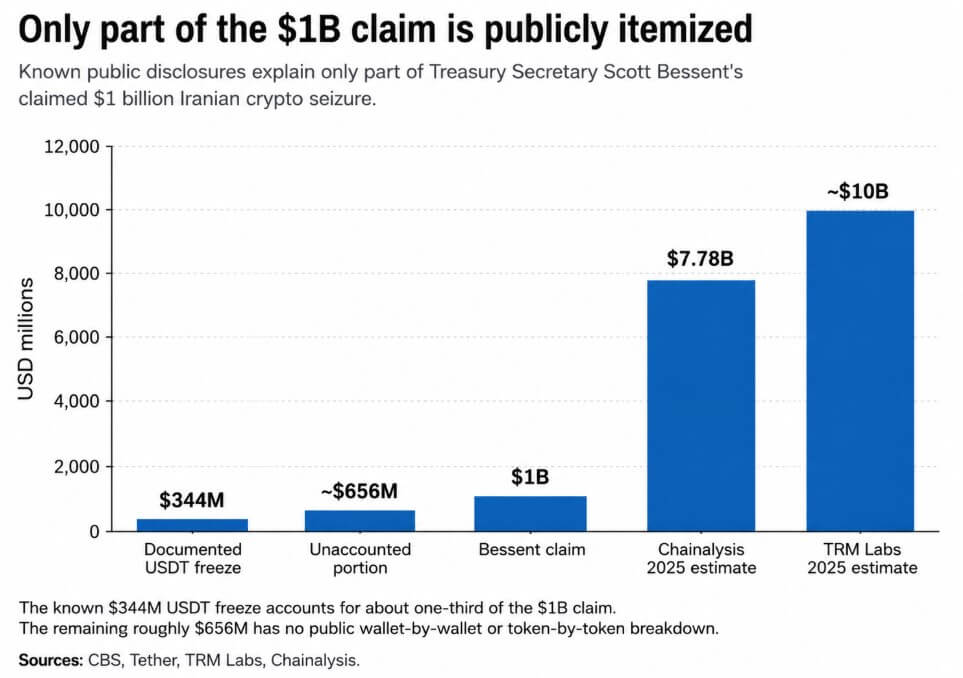
The known $344 million USDT freeze represents only 33% of Bessent’s claimed $1 billion Iranian cryptocurrency seizure; the whereabouts of the remaining $656 million remain undisclosed.
Inferred Token Composition and Disposition of Seized Assets
If the $1 billion includes substantial Bitcoin holdings and the U.S. completes legal forfeiture without obligations to compensate victims or allocate funds for law enforcement costs, the corresponding Bitcoin will enter the Strategic Reserve—where sales are prohibited. Cryptocurrency originally used by Iran to circumvent U.S. financial sanctions would thus be transformed—via enforcement action—into sovereign U.S. treasury reserves.
The only verified asset to date is the $344 million USDT freeze, executed by Tether in coordination with regulators. If the remaining $656 million consists predominantly of stablecoins, the incident effectively becomes a case study in stablecoin regulatory compliance. Frozen USDT remains locked indefinitely; non-Bitcoin assets, once forfeited, will be transferred to the U.S. Digital Asset Reserve, with subsequent disposition fully determined by the Treasury Secretary. A complete wallet and token inventory would fundamentally alter the event’s characterization: it could signify either the materialization of U.S. sovereign Bitcoin accumulation—or simply another milestone in stablecoin regulatory enforcement. At present, Bessent has disclosed no such details.
The executive order also stipulates that legally confirmed assets may be returned to victims, allocated to investigative expenses, shared with state law enforcement agencies, or exempted from forfeiture per statutory provisions. Any of these outcomes would prevent assets from entering the reserve. These clauses constitute multiple procedural checkpoints between “seizure” and “treasury reserve”—each potentially triggered before or after forfeiture.
Trump’s reserve framework transforms every future crypto seizure targeting adversarial nations into a matter of U.S. sovereign asset management.
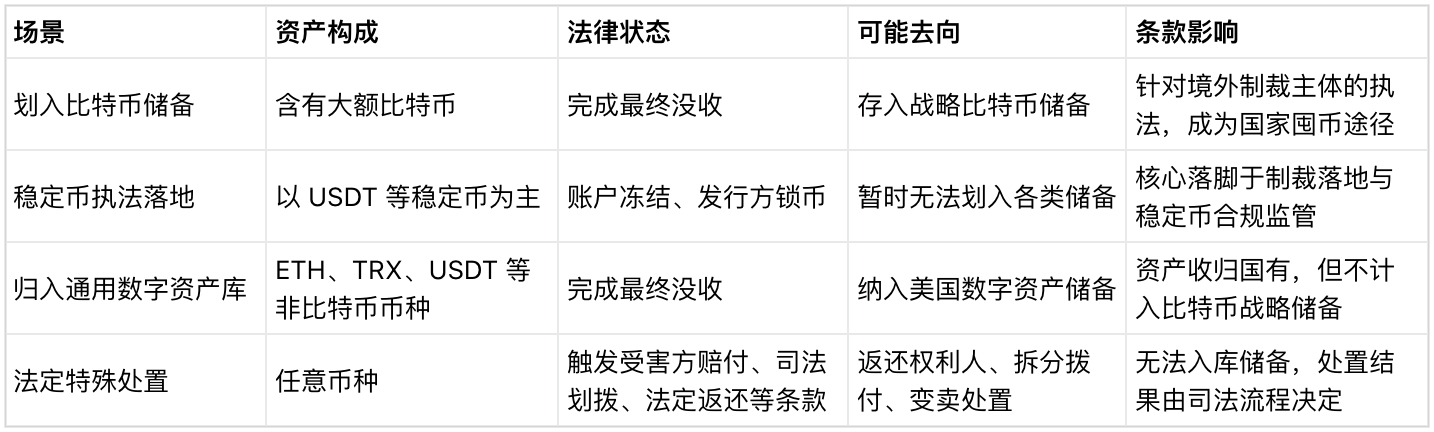
Every future U.S. crypto enforcement action against sanctioned entities—including Iran and North Korea—will hinge on three determinations: token type, legal status, and applicable treasury account. Only when all three conditions are simultaneously satisfied—i.e., the asset is Bitcoin, final legal forfeiture is completed, and no exemption clauses (e.g., victim compensation or expense allocation) apply—could this Iranian seizure contribute to the U.S. Strategic Bitcoin Reserve. Successfully clearing both the forfeiture process and exemption clauses would convert crypto assets originally intended to evade U.S. financial controls into components of U.S. sovereign assets.
Join TechFlow official community to stay tuned
Telegram:https://t.me/TechFlowDaily
X (Twitter):https://x.com/TechFlowPost
X (Twitter) EN:https://x.com/BlockFlow_News
 @CryptoSlate















