Technology has no barriers; round-the-clock trading is Hyperliquid’s key to success.
TechFlow Selected TechFlow Selected
Technology has no barriers; round-the-clock trading is Hyperliquid’s key to success.
Capital never sleeps.
 Navigating Web3 tides with focused insights
By Thejaswini M A
Translated by Chopper, Foresight News
I’m based in Bengaluru, which observes Indian Standard Time (IST), a time zone offset by 5.5 hours ahead of Eastern Time. When U.S. equities open, it’s already 7 p.m. locally. For five years, I’ve covered the cryptocurrency markets—and for those five years, I’ve watched trading screens that never sleep. There are no circuit breakers, no pre-market or after-hours sessions—prices fluctuate continuously, day or night, weekday or holiday.
Traditional financial markets operate very differently. The New York Stock Exchange (NYSE) is open Monday through Friday from 9:30 a.m. to 4:00 p.m. Eastern Time; the London Stock Exchange (LSE) runs from 8:00 a.m. to 4:30 p.m. local time; and the Tokyo Stock Exchange (TSE) operates from 9:00 a.m. to 3:30 p.m., with a lunch break.
Major exchanges open and close in sequence across global time zones. In theory, as the Earth rotates, capital should flow without interruption—but in practice, mainstream exchanges enforce rigid trading hours, leaving regulated markets idle for extended periods.
This schedule originates from the physical constraints of early floor-based trading, where human traders shouted orders in person. While computerization could have shattered temporal barriers, it only accelerated order matching—leaving fixed trading hours firmly intact.
Physics tells us an object remains at rest unless acted upon by an external force. Financial market trading hours remain unchanged precisely because no such force has emerged—until this past May, when, on a Sunday morning, the market priced SpaceX—a space exploration company—before traditional investment banks did, breaking the established order.
Hyperliquid operates around the clock. Its related derivatives contract launched at 5:16 a.m. Coordinated Universal Time (UTC) and generated $33 million in trading volume within 24 hours—well before institutions like Morgan Stanley opened for business.
India’s time zone happened to witness this unconventional pricing battle firsthand. U.S. financial media didn’t begin reporting until 9:30 a.m. Eastern Time—by which point, I’d already been tracking the market for an entire afternoon.
The Chicago Mercantile Exchange (CME Group) is the world’s largest derivatives marketplace. Institutional traders use it to trade crude oil, gold, interest rates, equity indices, and Bitcoin futures, with daily turnover reaching several trillion dollars. Its brand traces back to 1898.
Intercontinental Exchange (ICE), owner of the NYSE and multiple global derivatives platforms, is likewise an industry giant.
Together, these two institutions control top-tier global financial infrastructure. Their risk warnings carry significant weight with regulators. Today, both are lobbying the U.S. Commodity Futures Trading Commission (CFTC) and Congress to rein in Hyperliquid, accusing it of enabling market manipulation due to its lack of identity verification—and potentially serving as a conduit for sanctions evasion.
Hyperliquid does not implement user identity verification. While its frontend website blocks sanctioned addresses, its underlying protocol is fully open and permissionless. Users can interact directly with smart contracts—bypassing the web interface entirely—without undergoing any identity checks.
The platform imposes no position limits. By contrast, the CME enforces maximum position size caps per contract to prevent market manipulation and systemic risk. The CME also monitors trading patterns to detect spoofing, wash trading, and other violations—Hyperliquid lacks any comparable risk-monitoring infrastructure.
These concerns are well-founded. Following adverse regulatory news, the HYPE token dropped 9% on May 15; on May 18, two market makers withdrew $100 million in liquidity.
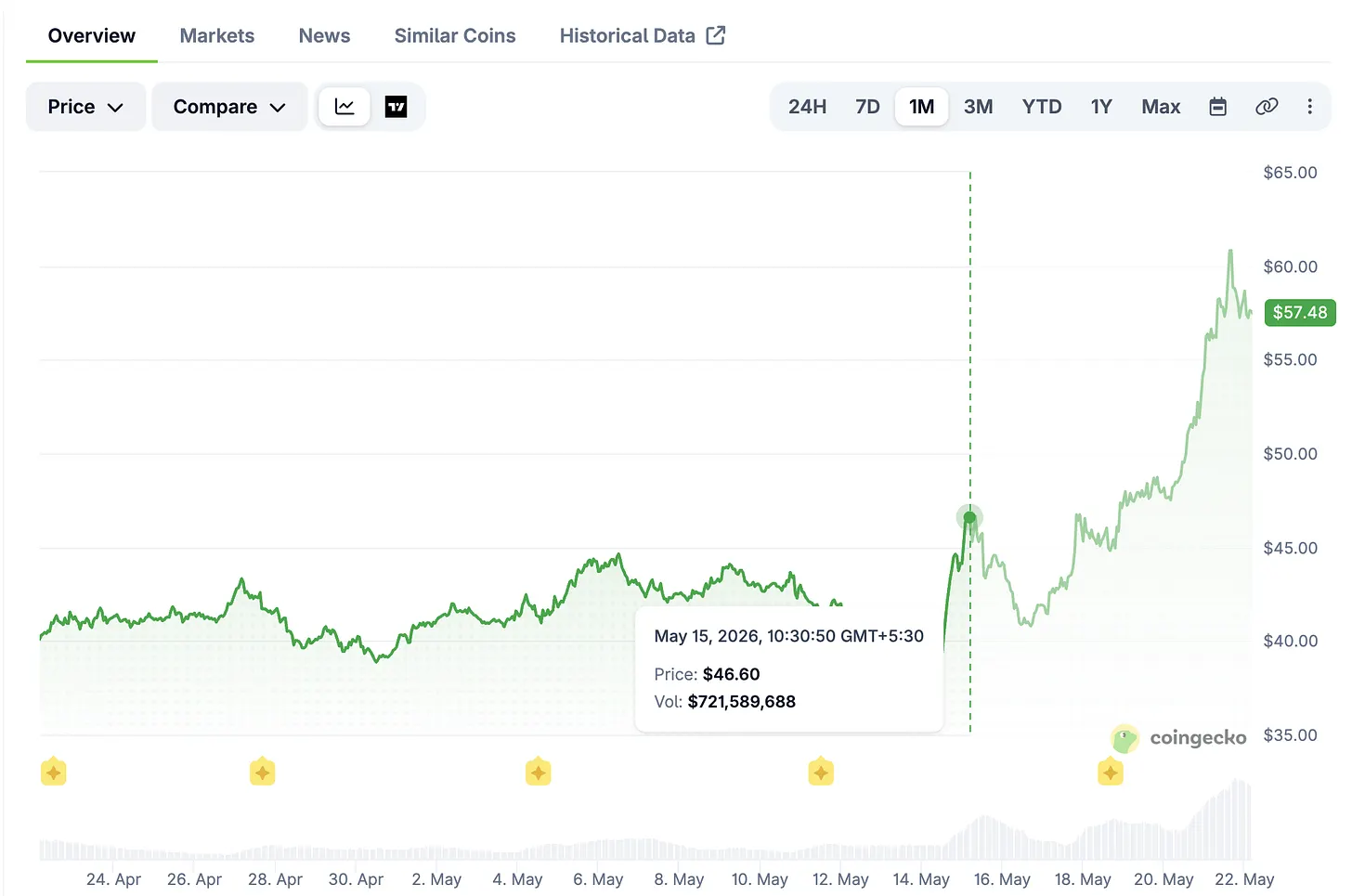
Yet the regulatory focus isn’t on crypto perpetuals—long-established products that have never drawn regulatory intervention—but rather on crude oil derivatives. That contract generated $720 million in trading volume over a weekend—while the CME was closed—directly threatening traditional institutional interests.
CME and ICE’s concerns are understandable—but neither is a neutral observer. Their business models rely on legally enforced trading-hour monopolies. Technological competition is tolerable; cross-temporal competition is not.
By launching crude oil trading during traditional markets’ off-hours, Hyperliquid has fundamentally disrupted finance’s temporal operating system. Legacy institutions are pressuring regulators to standardize trading hours—while new entrants demand legal recognition of weekend trading.
Hyperliquid’s team comprises just 11 people, headquartered in Singapore. As of May 21, 2026, the platform generated $51 million in revenue over the prior 30 days; in March alone, its derivatives notional trading volume reached $2.6 trillion.
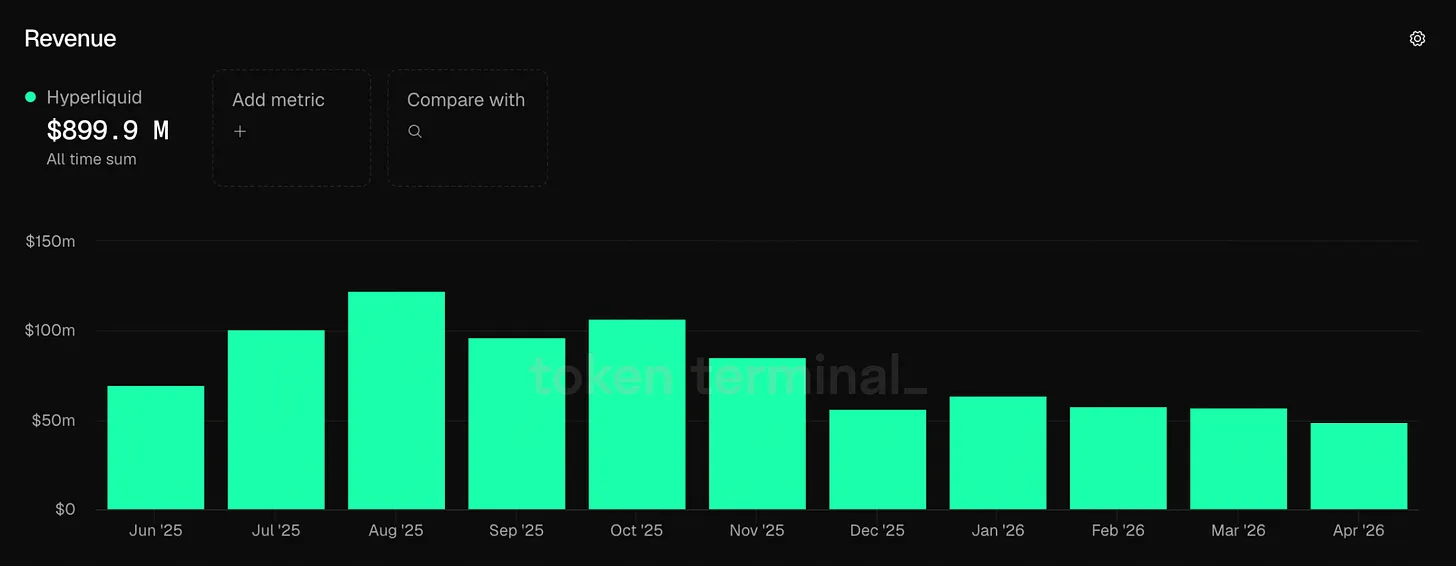
It allocates 97% of trading fees to an on-chain treasury used to repurchase HYPE tokens. A tiny team generating outsized revenue is exceptionally rare—both in traditional finance and crypto. As of late May, HYPE had surged 101% year-to-date.
This competitiveness stems not merely from superior derivatives technology—but from its core advantage: 24/7, uninterrupted trading. Subsequent new contract categories have further amplified this differentiation.
On May 1, Trade.xyz—a platform built atop Hyperliquid—launched a pre-IPO perpetual contract for AI chipmaker Cerebras, covering the two weeks leading up to its official IPO.
Early market consensus valued the stock at a 50% premium over its $185 IPO price—implying an opening price near $277. As information evolved, the platform’s contract price rose to $340 one hour before Nasdaq’s official open—just 3% below the actual $350 opening price. Post-listing, the stock soared 89% above its IPO price.
In contrast, traditional secondary-market platforms like Forge and EquityZen missed the mark by 35%—highlighting Hyperliquid’s superior price discovery. Markets refine prices incrementally as new information emerges—that’s how efficient price discovery works.
On Sunday, May 17, Trade.xyz launched another pre-IPO perpetual contract—this time for SpaceX. Starting from an initial reference price of $150, the contract surged to $216 within hours, then settled at $203—implying a $2.4 trillion enterprise valuation.
At that time, SpaceX hadn’t yet filed its S-1 registration statement, Wall Street analysts hadn’t published valuation reports, and the company hadn’t even begun its roadshow. Traders were unaware that, as early as April, SpaceX had secretly submitted documents to the U.S. Securities and Exchange Commission (SEC), proposing a valuation range of $1.75–2.0 trillion.
The market’s self-derived valuation hit the upper bound of SpaceX’s internal range—without referencing any official disclosures. It wasn’t until May 20—several days later—that SpaceX publicly released its 277-page S-1 filing.
Today, three distinct products offer investors exposure to SpaceX—each governed by different compliance frameworks and legally distinct strategies.
PreStocks employs a special-purpose investment fund structure: it purchases real company equity and tokenizes shares on-chain, enabling retail investors to hold indirect stakes. At one point, it served as a convenient channel for gaining exposure to private tech companies.
But just before Hyperliquid’s related contracts launched, AI firms Anthropic and OpenAI publicly denied third-party tokenization of their equity. Platforms in Hong Kong and the UAE had issued such tokens without corporate authorization; both companies declared those equity-token transfers legally invalid. Upon this news, PreStocks’ token price halved. Once the underlying company objects, derivative products tied to that equity lose their foundational legitimacy.
Ondo Global Markets issues stock tokens via licensed U.S. broker-dealers. Each token is backed by corresponding underlying securities, supported by a robust compliance framework—and the U.S. Depository Trust & Clearing Corporation (DTCC) is building dedicated clearing infrastructure.
Yet Ondo’s greatest strength is also its greatest vulnerability: its legal entity is clearly identifiable. Should regulators halt operations—or if the company files an infringement claim—the issuer and custodian face direct liability. Precisely because it operates transparently and compliantly, it becomes an easier regulatory target.
Hyperliquid’s SpaceX synthetic perpetual contract, however, operates entirely independent of physical assets. It has no underlying equity, no licensed intermediary, and no tangible asset ownership—it’s a purely synthetic derivative, settled exclusively in USDC on a decentralized network, with trading focused solely on price movements.
Even if SpaceX wanted to halt related valuation trading, it would have no leverage. There’s no legal entity to hold accountable, nor any centralized issuer to pressure.
This model elegantly sidesteps accountability—no physical anchor means no direct regulatory blow to land.
Yet its pros and cons remain ambiguous. Anonymous trading channels enable massive capital flows outside the global banking system—posing genuine national security risks. On May 17, Hyperliquid co-founder Jeff Yan traveled to Washington, D.C., to meet with policymakers—an implicit sign the platform faces mounting regulatory pressure.
The founders have public identities and backgrounds. If SpaceX sued for trademark or intellectual property infringement, legal documents could be duly served.
Still, holding individuals accountable cannot stop smart contracts from running. PreStocks collapses if its underlying equity is invalidated; Ondo grinds to a halt if accounts are frozen.
Hyperliquid’s contracts run autonomously on code. Even if founders face litigation, once deployed, smart contracts are immutable—and on-chain order execution continues independently.
This embodies decentralization’s ideal—but real-world operation still has shortcomings. Ondo’s network relies on only 20 globally verified nodes—not a large-scale distributed set—and those nodes remain traceable. Past token incidents also confirm that project teams retain discretion to intervene—nodes aren’t absolutely unchangeable.
Ultimately, 24/7, uninterrupted trading represents an irreplicable core moat—one traditional finance simply cannot replicate.
Join TechFlow official community to stay tuned
Telegram:https://t.me/TechFlowDaily
X (Twitter):https://x.com/TechFlowPost
X (Twitter) EN:https://x.com/BlockFlow_News