Web3 is dead; Web2+3 must rise
TechFlow Selected TechFlow Selected
Web3 is dead; Web2+3 must rise
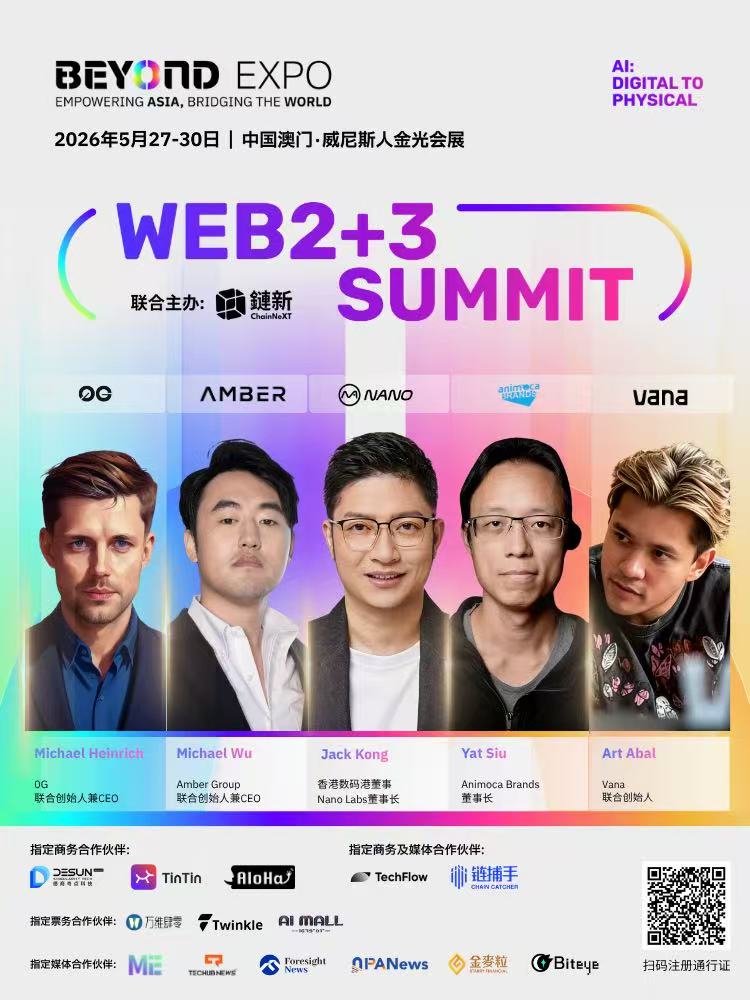
Trev Ng, founder of ChainNeXT, will join Web3 leaders including Animoca Brands, 0G, Vana, and Nano Labs to host the Web2+3 Summit at BEYOND Expo Macao from May 27–30, 2026. Against the backdrop of four converging signals—HKD-pegged stablecoin adoption, RWA growth, DeAI emergence, and more—the summit declares that Web3 is entering a new era transitioning from speculative narratives to genuine industrial implementation.
 Navigating Web3 tides with focused insights
“You may have long wondered: After all these years of Web3 builders’ efforts, what have they actually accomplished—beyond just trading crypto?”
Before this year, the answer was indeed underwhelming. But this year, several signals have convinced me that it’s time to revisit—and reanswer—that question.
This May, I—Trev Ng, founder of ChainNeXT—was deep in preparations for the Web2+3 Summit at BEYOND Expo 2026. In my mind, I’d compiled a long list of speakers: Yat Siu, Chairman of Animoca Brands; Michael Heinrich, CEO of 0G; Art Abal, Co-Founder of Vana; and Jack Kong, Founder of Nano Labs and Director of Hong Kong Cyberport.
This speaker list is telling. Look closely, and you’ll notice they don’t represent last cycle’s “get-rich-quick myths.” Instead, they embody an entirely new wave: the deep integration of Web2 and Web3. This year, my team—ChainNeXT Group—also officially became the Chief Partner of the Web3 track at BEYOND Expo 2026, jointly advancing the deep integration of Web3 technology and industrial innovation.
As I scrambled to finalize the summit, one encounter after another reinforced my conviction: We’re standing at a historic inflection point.
I. Jack Kong: That Half-Hour Changed My Life Trajectory
My first meeting with Jack Kong dates back many years—to when I was still an undergraduate student. I attended Consensus in Austin, Texas, for the first time. At a small dinner on the sidelines of the conference, I instantly recognized him—he had just been appointed a Director of Hong Kong Cyberport.
At the time, I was pitching a startup with a PowerPoint deck I’d revised over a dozen times—desperately seeking investors across the globe. Coincidentally, sitting beside me was the CEO of a major legacy internet company. Yet instead of rushing to greet that industry heavyweight, Jack turned to me—a complete unknown—and listened intently to my entrepreneurial vision for a full thirty minutes. His advice and encouragement were an invaluable enlightenment for a young, wide-eyed newcomer like me.
Later, during the OpenClaw boom, Jack organized an OpenClaw China Tour. When it came to Macau, I immediately volunteered to help organize the event. In my eyes, Jack has always been a leader who champions young talent—and who actively embraces the convergence of Web2 and Web3. He doesn’t obsess over token prices; he looks ahead to the future of every “super individual” in the digital age.
II. Art Abal: The Moment I Was the Only One Clapping
I first met Art last year at a side event of Consensus Hong Kong. It was a panel discussion where several Web3 luminaries were enthusiastically debating ZK, decentralized AI infrastructure, and other highly technical terms—leaving the audience visibly bewildered, in that awkward silence where “I don’t get it—but I’m too shy to ask.”
Then Art took the mic. Rather than piling on more jargon, he asked two disarmingly simple questions.
He asked: “How many people here have used AI?” Everyone raised their hands.
Then he asked: “How many people here truly own their own data?” Dead silence. Not a single hand went up.
He smiled and said: “That’s exactly what Vana enables—you’ll finally own your data.”
In that moment, I was the first person in the room to burst into applause. With plain, human language, he ripped away Web3’s most dazzling veil—exposing Web2’s greatest pain point: data extraction. Later, we learned Vana was the first DeAI project invested in by CZ (Changpeng Zhao) after his release from prison—and secured backing from top-tier VCs including Paradigm, Coinbase Ventures, and Polychain. Last year, when he spoke at BEYOND Expo, he told me: “This is the first time I’ve presented Web3 right in front of Nvidia’s booth!” That kind of forward-looking vision is precisely the voice BEYOND Expo has always sought.
III. Yat Siu: I Asked Him, “If Qwen Can Order Takeout with Fiat, Why Does AI Need Crypto?”
I first met Yat Siu during this year’s Consensus conference. I was honored to be invited to an internal investor gathering—normally accessible only to shareholders.
I was thrilled to meet him because he’s the rare figure who rode every metaverse wave—and now deeply invests in DeAI. Some insiders jokingly call him “Web3’s Jesus,” as he constantly preaches grand, future-oriented visions.
That day, he spoke extensively about the future of Web3-AI convergence—and dropped a phrase: “Crypto is AI’s native currency.” I couldn’t resist raising my hand with what some might call a contrarian question:
“Yat, if Qwen can order takeout using fiat, why does AI need crypto?”
His answer was fascinating—not technical, but philosophical. He painted a scenario that Web2 simply cannot solve. In that moment, I knew: Yat isn’t just shouting slogans. He’s constructing the foundational economic rules of a Web2–Web3 integrated world—with profound philosophical rigor.
IV. Michael Heinrich: Amid This Deep Bear Market, a Silicon Valley Executive Visited Factories in Shenzhen
Michael Heinrich is Co-Founder and CEO of 0G. I first met him at a dinner in Shenzhen—hosted by JT, 0G’s APAC Head—who also happened to be our guest last year.
To be honest, amid this seemingly bottomless bear market, it’s rare to see foreign founders travel all the way to mainland China just to explore the market. Michael usually works out of the U.S., so seeing him sit down at that Shenzhen dinner table both surprised and moved me.
Over dinner, he didn’t talk about token prices or exchange listings. Instead, he shared what he’d been doing in China: visiting major tech firms—and even industrial players in the automotive sector. He was thinking hard about how to embed 0G’s DeAI infrastructure directly into the production lines of real-world enterprises.
In today’s hyper-speculative Web3 market, a foreign founder like Michael—so grounded, so committed to real Chinese use cases—is truly a rarity. He doesn’t treat China as just another retail market. To him, it’s a tangible world—boasting massive manufacturing capacity and rich AI application scenarios.
V. What Kind of Stage Is the Upcoming BEYOND Expo?
Organized by the Macau Science and Technology Association, BEYOND Expo was launched in 2021 and has now held five consecutive editions—making it Asia’s largest international science & technology innovation and ecosystem expo.
The fifth edition—BEYOND Expo 2025—attracted over 25,000 attendees from more than 120 countries and regions, 800+ exhibitors, 300+ media outlets, and over 800 professional investors—including 40% from overseas and an average of 55% at Director level or above. The sixth edition—BEYOND Expo 2026—will take place from May 27–30 at the Venetian Macao’s Cotai Expo, expecting over 1,200 exhibitors and 30,000+ attendees.
Past speakers on this stage read like a who’s-who of global industry: Joseph Tsai, Chairman of Alibaba Group; Zeng Yuqun, Founder and Chairman of CATL; Nanpeng Shen, Founding Partner of Sequoia Capital China; Guangchang Guo, Chairman of Fosun International. Global tech leaders—including Nvidia, Huawei, Alibaba Cloud, Tencent, Douyin (TikTok), and Foxconn—have all participated deeply.
So why launch the Web2+3 Summit this year? Because the inflection point has truly arrived.
VI. Four Signals Sound the Call for Integration
Signal 1: The HKD Stablecoin Has Officially Launched. On April 10, the Hong Kong Monetary Authority (HKMA) granted the first stablecoin issuer licenses—under the Stablecoin Ordinance—to HSBC and Anchorpoint Financial (a joint venture among Standard Chartered Hong Kong, HKT, and Animoca Brands). Compliant stablecoins are now entering mainstream payment channels—a landmark event signaling true integration of Web2–Web3 financial infrastructure.
Signal 2: Hong Kong’s Crypto Exchange Regulation Is Mature. As of Q1 2026, the Securities and Futures Commission (SFC) of Hong Kong has formally approved 12 virtual asset trading platform licenses. Hong Kong’s virtual asset ecosystem has fully exited its “transitional cleanup phase” and entered a new era of “routine expansion.”
Signal 3: The U.S. Enacts the GENIUS Act. On July 18, 2025, President Trump signed the Guidance and Establishment of National Innovation for U.S. Stablecoins Act (GENIUS Act), establishing America’s federal stablecoin regulatory framework. The world’s largest economy has officially greenlit compliant stablecoins—providing unprecedented institutional foundations for Web2+3 integration.
Signal 4: Real-World Use Cases Emerge Amid Geopolitical Shifts. In April 2026, the Iranian Oil Exporters Alliance announced that, during the temporary U.S.–Iran ceasefire, tankers passing through the Strait of Hormuz must pay tolls in Bitcoin. In January 2026, Iran’s government explicitly confirmed that overseas military contracts may be settled in “digital currencies.”
Beyond these four signals, three key sectors are accelerating Web2+3 convergence: tokenization of Real-World Assets (RWA) continues growing in finance; PayFi (stablecoin-based finance) is bridging crypto payments with traditional supply chains in cross-border payments; and DeAI (decentralized AI) is dismantling centralized AI’s monopolies over data, compute, and algorithms. These three domains form the core themes of this Web2+3 Summit.
VII. Web2+3: A Bullish Narrative Amid a Bear Market
What has Web3 been over the past few years?
A carnival of meme coins. A feast for rug pulls. A casino promising “overnight riches, overnight ruin.” That was speculation-driven Web3—a zero-sum game where a few harvest from the many.
I’ve attended many Web3 conferences over the years—and witnessed countless “seemingly vibrant” industry consensus moments. But look closer: Most participants already work in the space. They discuss the future within a shared jargon-laden bubble—rarely engaging with users and needs beyond the industry. That’s why so many narratives sound grand yet remain stuck in echo chambers.
BEYOND Expo’s significance lies precisely in breaking this pattern.
The Web2+3 Summit isn’t just for Web3 insiders—it’s Asia’s premier tech ecosystem, drawing over 30,000 builders across the tech industry. Here gather Web2 enterprises, traditional financial institutions, cross-sector decision-makers, and real procurement officers—the very users Web3 has historically struggled hardest to reach, yet whose adoption matters most. When Web3 enters this setting, it stops preaching to the choir—and enters a broader commercial system, tested by real demand.
That’s why this Web2+3 Summit deserves your attention. Here, you won’t just hear what the industry says—you’ll see what’s already being used, and which directions are showing scalable potential. Past Web3 ran on emotion-driven consensus; Web2+3’s future depends on actual usage. And BEYOND is where that “usage” begins—on a massive scale.
Yes, the current Web3 market is in a bear phase—trading volumes are depressed, and many projects have collapsed. But simultaneously, HKD stablecoins are rolling out on PayMe; RWA tokenization is steadily expanding; pre-IPO SpaceX shares are entering DeFi via tokenization—these unfolding Web2+3 integration stories *are* the real future. Web3’s bull runs thrive on FOMO (fear of missing out); Web2+3’s future hinges on Adoption (real-world usage).
That’s why the BEYOND Expo 2026 Web2+3 Summit adopts “practical implementation, commercial viability, and regulatory compliance” as its core principles. We’re not hosting a self-congratulatory party for Web3 practitioners—we’re building a rational bridge between Web2 and Web3.
From May 27–30, over 30,000 attendees will gather at the Venetian Macao’s Cotai Expo. This summit may not deliver 100x token price surges—but it *will* mark the end of one era and the dawn of another.
There, you’ll see Jack—demonstrating selfless mentorship across generations; Art—offering hope for data sovereignty; Yat—revealing the philosophical logic behind AI–crypto symbiosis; and Michael—showcasing Silicon Valley’s respect and humility toward China’s physical industries. Their foresight and execution transform Web3 from a PPT concept into tangible, real-world Web2+3 business.
It’s a bear market for Web3—but the starting point for Web2+3 stories. And I’m honored to witness this convergence unfold—alongside you. I’m Trev. Share this article—and become part of Web3’s “Yellow Turban Rebellion.”
BEYOND Expo 2026 Official Website: www.beyondexpo.com
Customer Support: [email protected]
Registration Link: https://portal.BEYONDexpo.com/reg/BEYOND26/web/#/en/ticket/mall?track=tk19
Join TechFlow official community to stay tuned
Telegram:https://t.me/TechFlowDaily
X (Twitter):https://x.com/TechFlowPost
X (Twitter) EN:https://x.com/BlockFlow_News