Onchain ≠ Liquidity: RWAs Still Need That Final Leap
TechFlow Selected TechFlow Selected
Onchain ≠ Liquidity: RWAs Still Need That Final Leap
Swap Liquidity for Yield: A Comprehensive Guide to the RWA Path
 Navigating Web3 tides with focused insights
By: Zuoye Web3
Liquidity for Yield: A Comprehensive Guide to the RWA Pathway
The world shares the same economic climate—both on-chain and off-chain, liquidity is the ultimate pursuit. Looking eastward, equities markets are competing with bank wealth management products; looking westward, major AI firms are scrambling for capital to save themselves.
After 2008, banks were confined within regulatory cages—but “private credit” underwent a transformation, becoming a vital source of corporate lending.
Since 2018, private equity (PE), business development companies (BDCs), and private credit have drawn $300 billion from banks—most of it flowing to internet giants, especially SaaS companies.
Then came the pandemic in 2020, causing a complete bifurcation of global financial markets. Everyone needed to find a new anchor. China’s equity market embraced the “hard tech” narrative; U.S. equities went all-in on AI. But having assets alone was insufficient—what mattered was an appropriate liquidity-organizing mechanism.
Liquidity first arrived via massive monetary easing: China cut reserve requirements three times in 2020; the U.S. Federal Reserve restarted QE and slashed interest rates to near-zero. The “everyone buys mutual funds” trend even turned fund manager Zhang Kun into a Weibo celebrity.
But in 2026, artillery fire in the Persian Gulf shattered that illusion. User psychology shifted: immediate access to liquid funds became more important than future returns. Seeking liquidity thus forms the grand backdrop for the current RWA boom.
Wall Street has begun its on-chain migration—needing to convert its vast AUM into trading volume, or else face insolvency pressures that could collapse the system outright.
Assets aren’t money—liquidity is what confers tradability. This is the core significance of RWAfi: tokenization creates liabilities; only after trading does it become an asset.
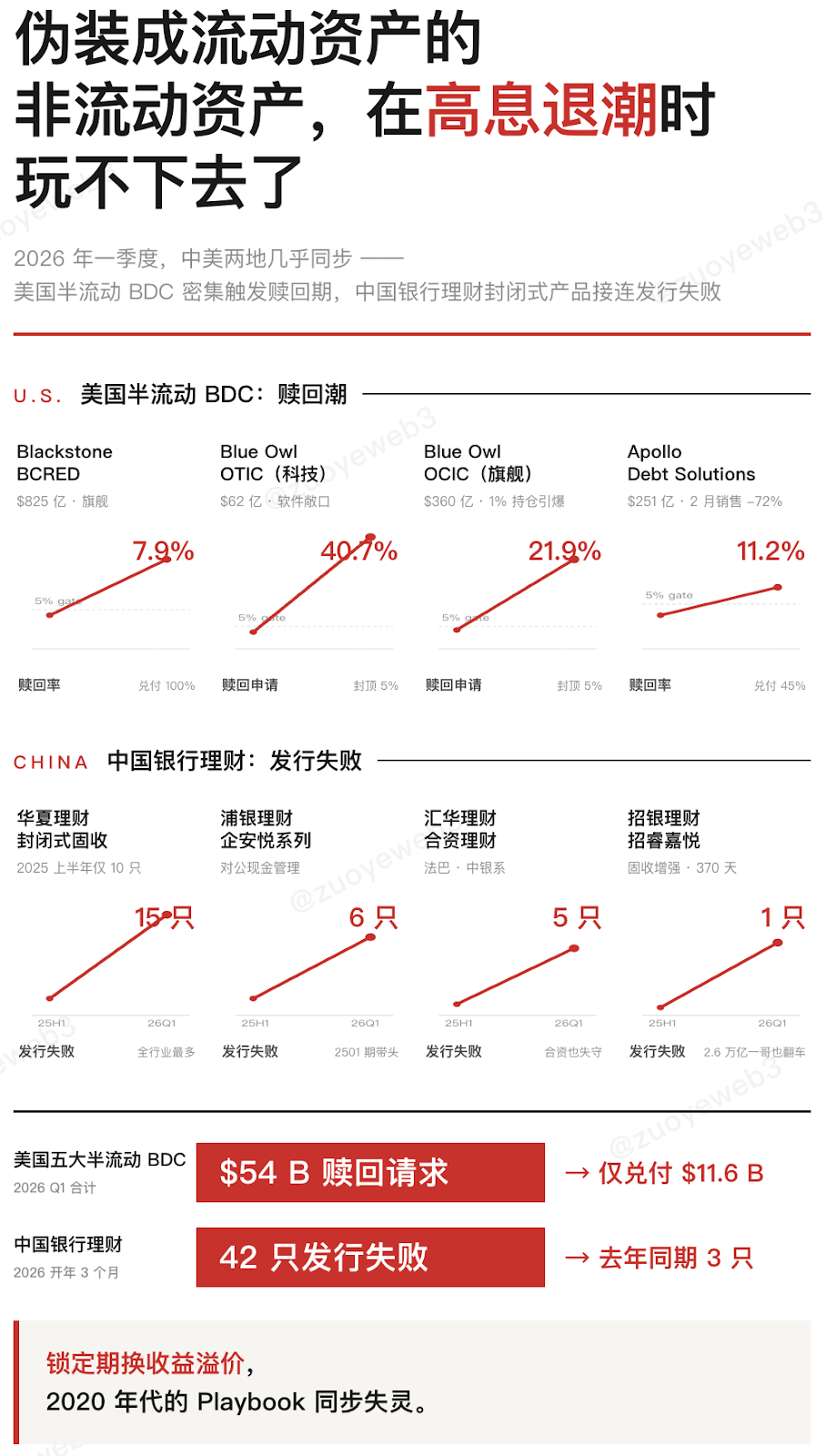
Caption: Liquidity trumps yield. Source: @zuoyeweb3
Or put another way: markets are re-pricing the “liquidity premium.” The U.S. private credit redemption wave and sluggish issuance of closed-end fixed-income products by Chinese banks both signal that liquidity is overtaking yield as the primary value driver.
This transmission—or shadow—means global financial markets require a new connector. China’s Circular No. 42 leaves a loophole for “onshore assets + offshore issuance”; clear legislation will likely provide pathways for yield-bearing arrangements—mutual understanding prevails, competition coexists without rupture.
Undoubtedly, blockchain will shape the future of global finance—but U.S. on-chain finance runs on Canton, China’s on digital RMB, while truly global finance operates on Ethereum and Solana. The greater the divergence, the more urgent the need for a “Peace Hotel.”
Seeking liquidity globally is the ultimate purpose of this RWAfi cycle.
Yield as the Driver: Sourcing High-Quality Assets
What happened before won’t be forgotten—it’s just temporarily out of mind.
Many still associate RWAs with the early “everything-on-chain” era. Yet Stani Kulechov, co-founder of Aave, remains enthusiastic about solar power tokenization. On one hand, he warns that DeFi risks falling into a passive role—merely providing liquidity for private credit. On the other, he passionately advocates for DeFi to pursue abundant assets like solar energy, worth an estimated $30 trillion.
Unfortunately, current DeFi practice centers precisely on private credit—and all electronically represented assets: U.S. Treasuries, equities, CLOs (collateralized loan obligations), and even OnRe’s tokenized reinsurance business, which absorbs on-chain liquidity to generate yield.
Physical RWAs are already passé; energy-related real-world assets going on-chain remain aspirational.
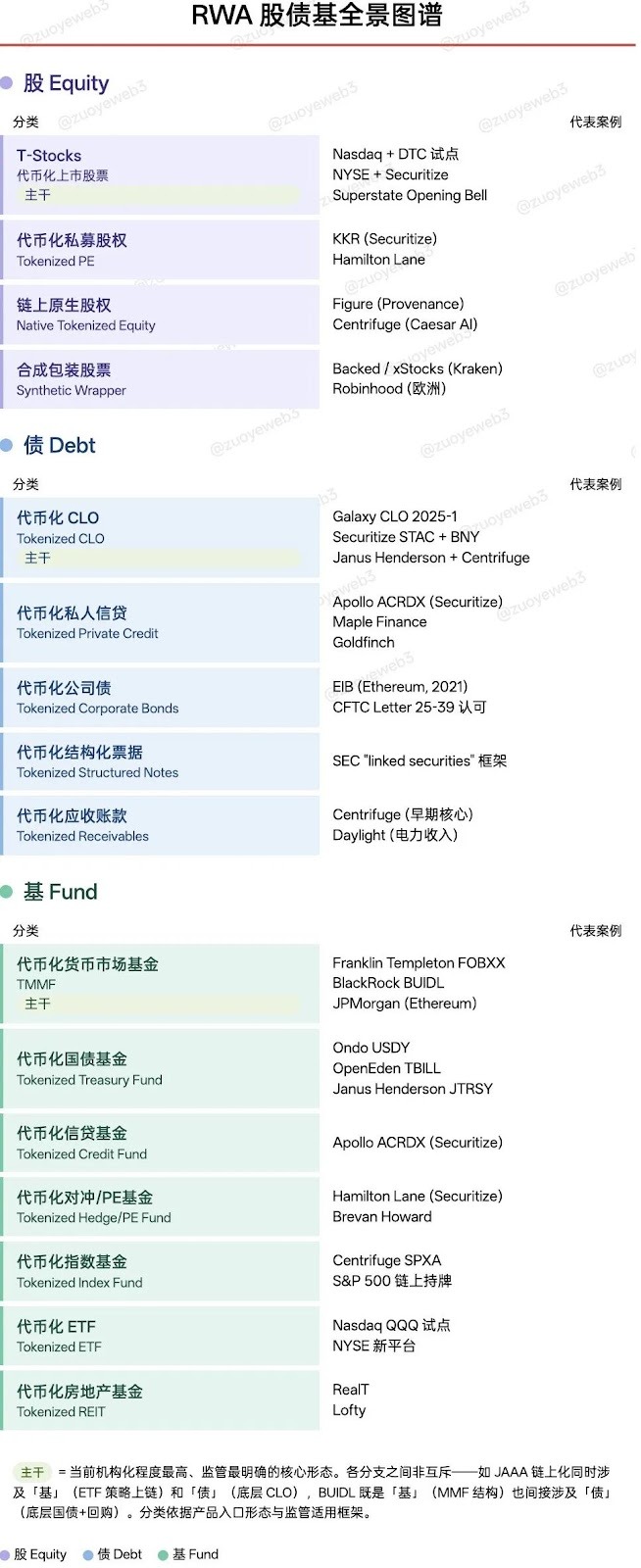
Caption: RWA equity, debt, and fund landscape. Source: @zuoyeweb3
To summarize: RWAs are assets backed by assets—an exceedingly rare construct. ETH derives value from user adoption; BNB from Binance’s trading volume; BTC from decentralized consensus narratives.
That’s precisely the problem: RWA project teams often assume merely putting an asset on-chain automatically confers liquidity. But like antiques—which were luxuries even in their time—high-quality projects rarely lack off-chain liquidity. Tokenization ≠ liquidity.
Tokenization belongs to the technical domain; liquidity belongs to the financial domain—they must not be conflated.
Only one condition enables tokenization to deliver liquidity: when the act of tokenization fulfills users’ expectations for liquidity access—for instance, transforming an institutional-only off-chain wealth product into a stablecoin vault accessible to retail investors.
Accordingly, the RWA framework can be understood as three layers—from top to bottom: Asset layer → Tokenized RWA assets → RWAfi (liquid RWA assets).
- Asset
- RWA: Asset-backed assets
- RWAfi: Liquid, asset-backed assets
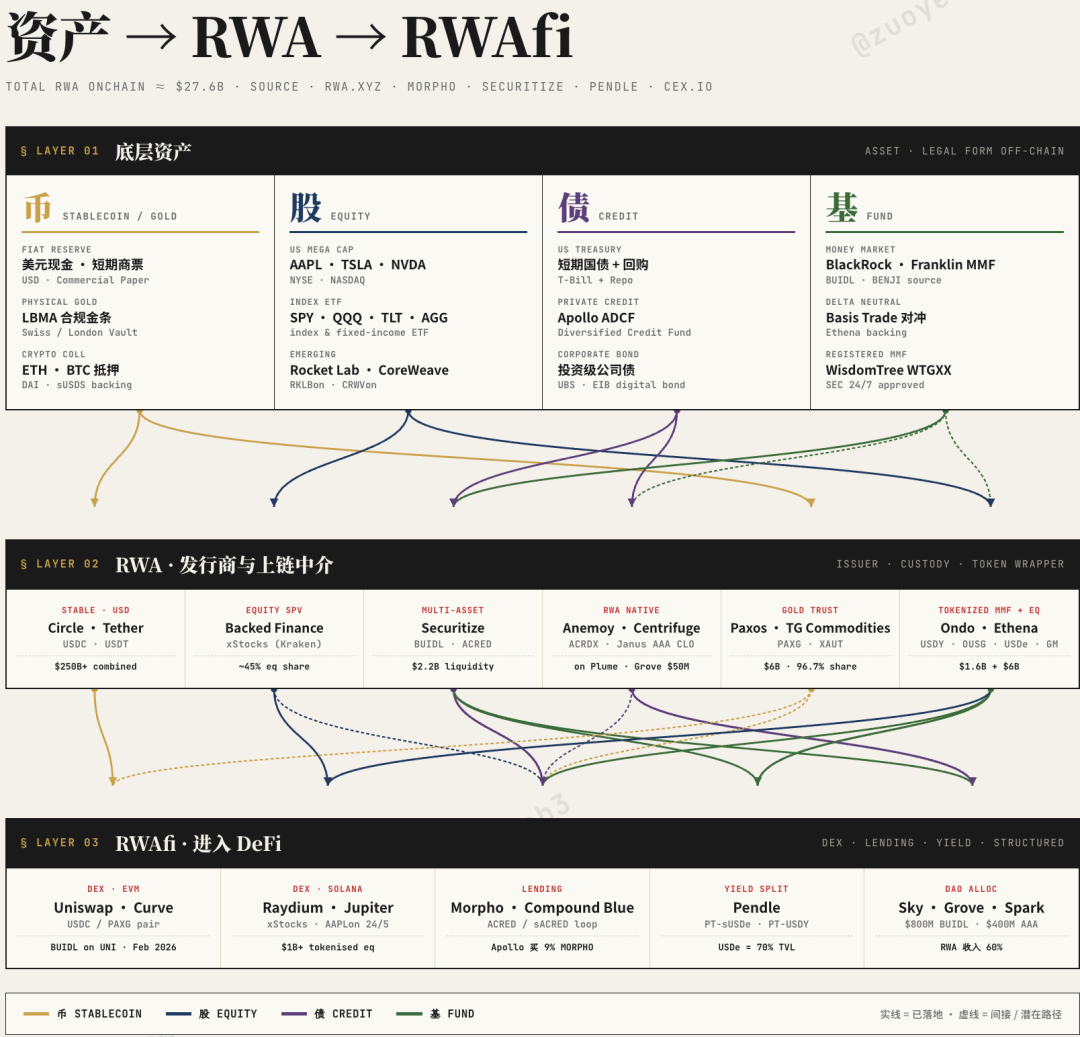
Caption: Three-tier RWA framework. Source: @zuoyeweb3
Setting aside physical assets and future prospects like photovoltaics, real-world assets today fall into four categories: stablecoins, equities, debt, and funds. USD-pegged stablecoins like USDT/USDC and U.S. equities are most familiar to users.
Yet debt and fund categories hold stronger growth potential—precisely because their current liquidity is weakest. Even moving institutional purchase processes on-chain doesn’t enable direct retail participation.
A typical example is Hashkey’s tokenized Guotai Junan funds—GUSDT and GHKDT—where users cannot trade or withdraw. Overall, they lag behind the U.S. market by one generation.
At least according to BlackRock, tokenized funds will disrupt Wall Street as the internet disrupted the postal system—a simple concept: tokenized funds target global markets, erasing national boundaries entirely.
Of course, each category—stablecoins, equities, debt, funds—can be infinitely subdivided. Stablecoins may differ by peg (USD ↔ crypto assets) or currency (USD ↔ non-USD). Debt may be segmented by issuer (sovereign ↔ municipal ↔ corporate) or collateral (CLOs backed by loans ↔ CDOs backed by real estate).
But none of this matters much—not even specialized comparative analysis of U.S., Shenzhen, and Singapore regulatory frameworks. Countless research reports already exist; these details aren’t central to capital deployment decisions.
Instead, focus on the technology service providers enabling real-world asset tokenization—especially U.S.-based players like Securites, SuperState, Canton, and Ondo. Their practical implementations will clear our path forward.
After the SEC issued guidance clarifying how securities laws apply to tokenized products, Securites recruited Giang Bui—former Nasdaq lead for the spot Bitcoin ETF—and Brett Redfearn—former SEC senior official.
Beyond the revolving door between regulators and industry, traditional finance is also stepping in.
Traditional asset manager Invesco acquired SuperState’s $USTB tokenized Treasury product, while Circle’s USYC product surpassed industry heavyweights like BlackRock’s BUIDL in issuance volume.
Even Canton—a chain backed by Goldman Sachs—has reportedly “defeated” Ethereum in DTCC’s on-chain pilot experiments.
Beyond technical paradigms, the RWA middle layer has devolved into an institutional “coloring book” game—vying for dominance across the four core RWA product lines, with no clearly defined spheres of influence yet.
However, at the RWAfi layer, DeFi demonstrates broader tolerance—understanding that increasing asset liquidity benefits itself.
Yet bridging RWA to RWAfi requires deliberate creation of initial liquidity. Merely embedding RWAs as underlying assets within existing stacks still leads to “no takers.”
Where Does Liquidity Come From?
On-chain liquidity has become a high-premium commodity.
If RWAs seek liquidity from DeFi, a 10% yield is the baseline. Compared to sub-4% U.S. Treasury yields, current RWAs struggle to close this gap—let alone offer higher returns—leaving retail investors with little incentive to buy.
So “sand” gets mixed in to artificially boost yields.
- Embedded funding withdrawal costs or time restrictions—e.g., Ethena’s sUSDe redemption window recently shifted from 7 days to dynamic, with underlying assets increasingly including non-Treasury instruments. Fundamentally, this leverages user funds—though with less volatility than perpetual contracts.
- Greater subsidy components—e.g., revenue from native token sales. This constitutes a controllable “Ponzi-like” structure: Treasury-backed assets ensure minimum payouts; high yields attract liquidity, which is then locked up—generating scale-based revenue for the project team.
Yet 2025–2026 experience shows persistent gaps between off-chain and on-chain operations—from Huma to Pharos and Bitway. Non-real-time third-party audits still only lend legitimacy to illiquidity—not enhance on-chain liquidity.
Though all appear as yield-bearing stablecoins, their underlying structures remain opaque.
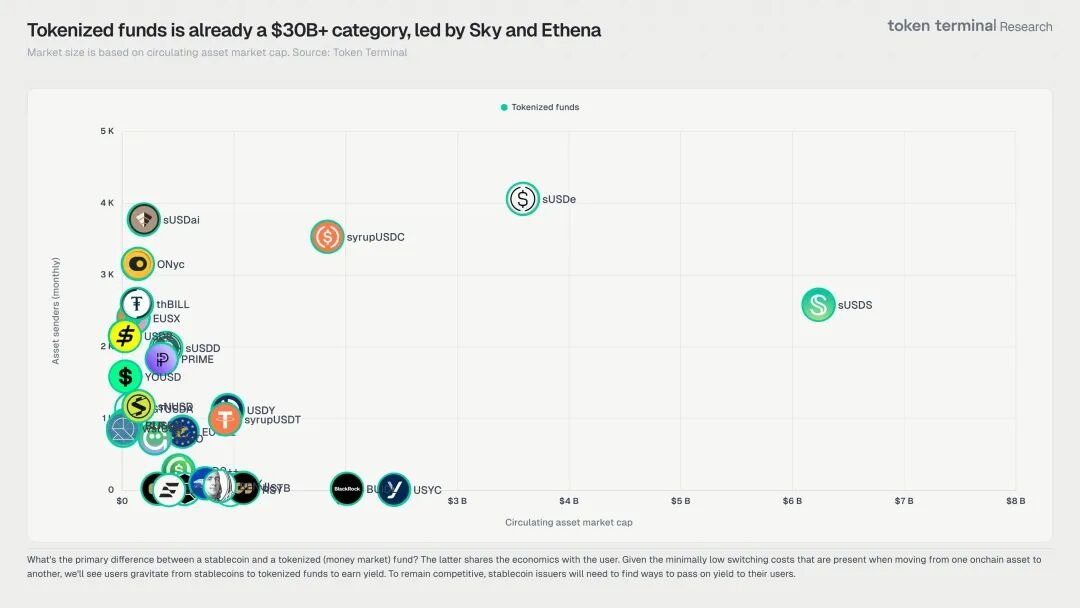
Caption: Tokenized funds. Source: @tokenterminal
Moreover, adding leverage to TradFi also generates pseudo-on-chain liquidity—the most notable case being Trade.xyz on Hyperliquid, which adds trading leverage to oil and precious metals, expanding into RWAfi.
But we must recognize: liquidity generated through trading and illiquidity inherent in private credit constitute two sides of the same crisis. The logic is straightforward: any mature market requires three elements:
- Low-cost capital
- High-leverage strategies
- Large-scale markets
Warren Buffett dominates U.S. financial markets using insurance float and ultra-long-term time leverage. Similarly, U.S. banks resist yield-bearing stablecoin mechanisms to monopolize customer demand deposits.
Yet perpetual contracts in crypto carry extremely high capital costs to sustain market viability—this is the price of perpetuity, necessitating delta-neutral mechanisms. Now, Ethena partially abandons fee-arbitrage strategies.
Projects like Saturn and APyx even reverse-engineer MicroStrategy stock ($MSTR) as underlying assets to build on-chain yield products—revealing crypto’s trading crisis.
While celebrating Trade.xyz’s trading volume growth, don’t overlook Binance’s crisis signal—its drastic VIP tier downgrade.
In summary, the current challenge is bridging the gap between 10% and Treasury yields using U.S. Treasuries + token subsidies + market-making strategies—even aiming higher, or worse, enabling oddities like Phraos and Gaib raising on-chain funds to issue microloans in developing countries.
Thus, non-leveraged payment, fund, and bond markets matter more for RWAfi development—e.g., payment processors’ idle cash reserves, Galaxy’s BTC-collateralized CLO loans.
Especially the latter: Galaxy’s VC arm invested in Arch Lending, which allows users to borrow stablecoins against over-collateralized BTC—avoiding capital gains tax from selling. Galaxy then packages Arch’s debt into CLO products, with Sky investing via Grove to earn returns. In this process:
- Users: retain BTC holdings and avoid capital gains tax
- Arch: accesses institutional-grade “low-cost capital” without selling tokens to scale
- Galaxy: expands the “large-scale market”—BTC-backed CLOs are readily accepted by DeFi protocols
- Sky/Grove: deploys “high-leverage strategies”—non-Treasury RWAs promise higher expected returns
Of course, perfection is unlikely—this case succeeded partly due to Galaxy’s multi-stakeholder alignment. Yet across the broader RWAfi market, it represents one of the safer, more effective yield-enhancement strategies.
Galaxy’s CLOs use BTC as collateral; earlier, we noted Saturn and others use U.S. equities. Let’s now imagine a DeFi pathway using U.S. equities as collateral.
U.S. Treasuries, the dollar, and U.S. equities—currently the world’s strongest financial assets—evolve at different paces. Treasuries and the dollar underpin the explosive growth of dollar-pegged stablecoins and tokenized money market funds (TMMFs). Yet equity tokenization has only just begun.
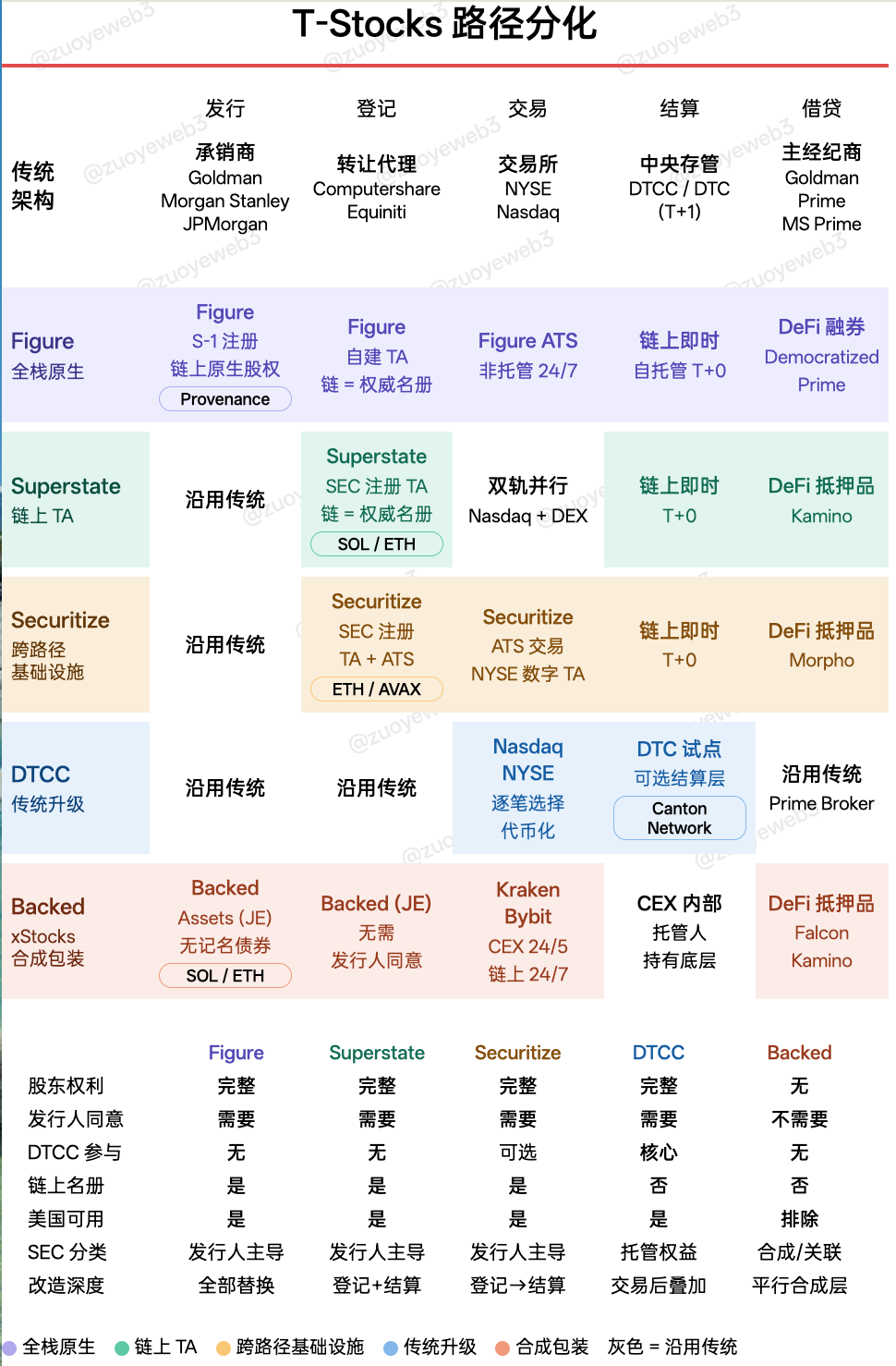
Caption: Divergent T-Stocks pathways. Source: @zuoyeweb3
Beyond standard processes—issuance, custody, auditing, settlement—U.S. equity margin trading offers rich diversity. Following holding horizons, options range from broker margin trading, to leveraged ETFs, to highly flexible options—largely satisfying retail investor needs.
For institutions or professional investors, futures closely mirror crypto’s perpetual contract paradigm.
Furthermore, despite concentration among the “Magnificent Seven,” U.S. equities inherently possess deeper liquidity. T+0 settlement and similar technical features—unrelated to asset issuance—need no further discussion. DeFi’s opportunity lies in becoming a lending service provider.
It’s not U.S. equities seeking liquidity on-chain—it’s DeFi actively incorporating U.S. equity assets.
This rests on a counterintuitive assumption: DeFi actually suffers from a shortage of quality assets to expand its market size—otherwise BTCFi wouldn’t keep being reinvented. Yet large holders prioritize principal preservation, leaving the gap unfilled.
Similar to Kamino and Morpho vaults, SuperState-backed solutions could use U.S. equities as more flexible rebalancing assets—bridging bidirectional TradFi and DeFi demands.
Compare: U.S. Treasuries serve as the risk-free yield foundation; U.S. equities represent more liquid, volatile assets.
In short, blockchain shouldn’t merely function as infrastructure for TradFi—it must reverse-engineer TradFi assets to grow itself.
Conclusion
The path toward large-scale markets.
Due to space constraints, stablecoins receive limited discussion here. First, stablecoins have already matured into large-scale markets with abundant liquidity. Second, yield-bearing stablecoins, non-USD stablecoins, and stablecoins pegged to on-chain assets are all rapidly evolving—and warrant dedicated coverage later.
Join TechFlow official community to stay tuned
Telegram:https://t.me/TechFlowDaily
X (Twitter):https://x.com/TechFlowPost
X (Twitter) EN:https://x.com/BlockFlow_News
 @zuoyeweb3