The Largest IPO in History: In-Depth Analysis — Valuation Logic for SpaceX/xAI, Passive Buying Structure, and Tokenized Entry Path
TechFlow Selected TechFlow Selected
The Largest IPO in History: In-Depth Analysis — Valuation Logic for SpaceX/xAI, Passive Buying Structure, and Tokenized Entry Path
The most cost-effective liquid entry point currently is Bitget preSPAX, priced at $650, implying a valuation of $1.54T—lower than all comparable benchmarks.
 Navigating Web3 tides with focused insights
Author: Bitget
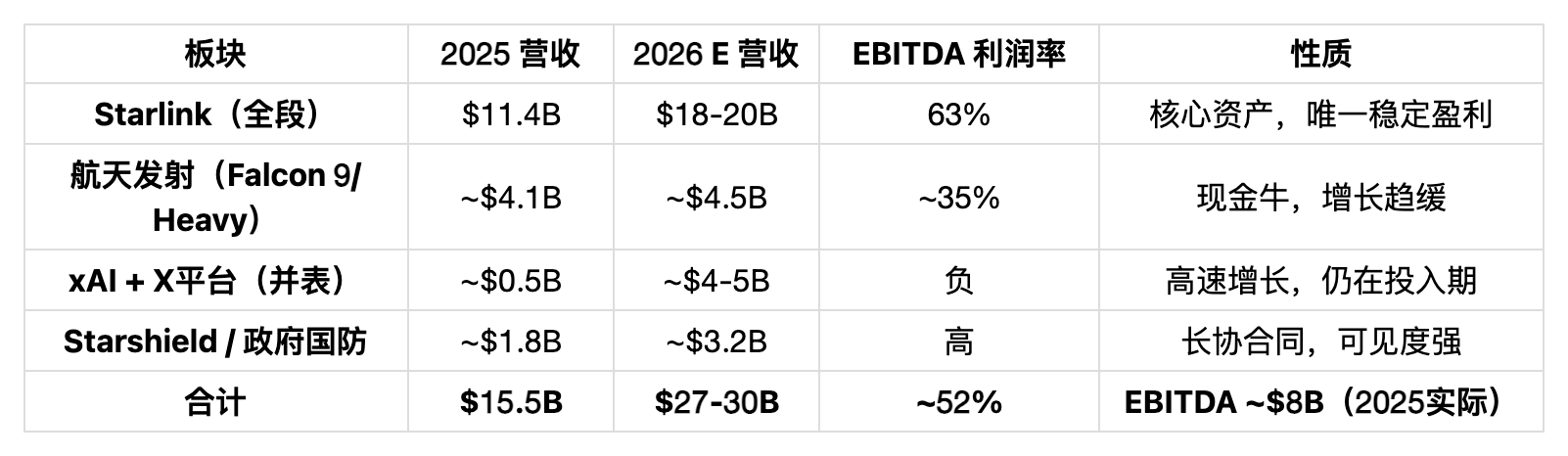
SpaceX is projected to generate $15.5 billion in revenue and $8 billion in EBITDA in 2025. Starlink is currently the world’s most profitable satellite network. Following its merger with xAI, SpaceX now controls launch capability, global low-Earth-orbit (LEO) bandwidth, and AI inference capacity—three pillars forming a complete闭环 for its orbital data center (ODC) strategy. The $1.75 trillion IPO target price is fundamentally justified, and index inclusion mechanisms will generate sustained structural buying pressure post-listing. The most cost-effective liquid entry point today is Bitget’s preSPAX, priced at $650 per share, implying a valuation of $1.54 trillion—below all comparable benchmarks.

What Is SpaceX? Three Moats, One Vertical Loop
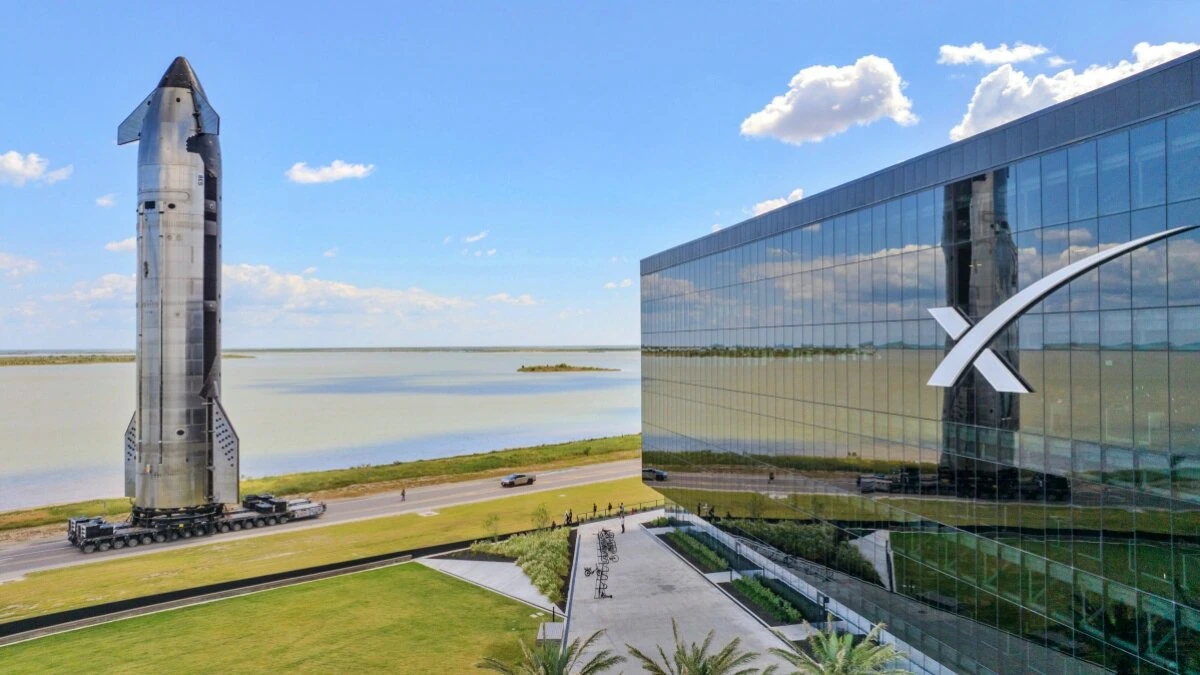
SpaceX cannot be understood through a single lens. It operates simultaneously as a rocket company (global commercial launch market share >60%), a satellite operator (Starlink has over 9 million users across 100+ countries), a defense contractor (Starshield, U.S. Space Force contracts), and—since February 2026—an AI company (xAI fully consolidated). These four identities are not parallel but strategically interdependent.
Falcon 9 is a cash cow—not a growth engine. With ~130 launches in 2025 and commercial pricing ranging from $67M–$97M per mission, Falcon 9 holds over 60% market share. However, this business is nearing saturation, and internal competition will emerge once Starship matures. Its value lies in generating stable cash flow to fund the company’s broader capital expenditures.
Starlink is the current core asset. In 2025, Starlink is expected to generate $11.4 billion in revenue with a 63% EBITDA margin—the only business unit capable of independently supporting the company’s valuation. Users grew from 4.5 million at year-start to over 9 million by year-end, surpassing 10 million in February 2026. Revenue is segmented into three tiers: consumer broadband ($120/month), enterprise/maritime/aviation ($5,000+/month), and government/defense (Starshield, long-term contractual agreements). Quilty Space forecasts Starlink’s full-year 2026 revenue at $20 billion and EBITDA at ~$14 billion—based on scalable Direct-to-Cell (D2C) adoption and continued enterprise penetration, not aggressive assumptions.
xAI is the source of platform premium—not valuation froth. Upon consolidation, SpaceX gains access to Grok’s 64 million monthly active users (MAUs), X Platform’s $3.3+ billion annual recurring revenue (ARR) from advertising and subscriptions, and Elon Musk’s full-stack AI compute strategy. The exchange ratio of 0.1433 implies xAI was acquired at a $250 billion valuation—a figure justified when benchmarked against Anthropic ($61.5B/$3B ARR, 20x) and OpenAI ($157B/$11B ARR, 14x). The premium reflects X Platform’s revenue support and Grok’s rapid growth—not narrative alone.
Spectrum and orbital slots are invisible assets—not reflected on financial statements. SpaceX’s $17 billion acquisition of EchoStar’s spectrum assets in 2025 secured regulatory clearance for Direct-to-Cell operations. The FCC has shifted spectrum allocation from “first-come, first-served” to competitive bidding—making SpaceX’s early positioning a critical regulatory moat amid tightening oversight. The U.S. Space Force PLEO contract ceiling stands at $13 billion over 10 years; the Pentagon’s Ukraine military communications contract totals $537 million. Strategic irreplaceability—not commercial value—defines the true worth of these government orders.
Orbital Data Centers: When AI’s Bottleneck Shifts from Compute to Power
Between 2025 and 2026, AI development hits its first hard constraint—not chips, but power. U.S. transmission grid build-out takes 10–15 years; distribution infrastructure lags severely. Data center siting is increasingly constrained by grid capacity—not geography or labor availability. Jensen Huang and Sam Altman have both cited this bottleneck repeatedly—not as complaint, but as a binding constraint on capital allocation decisions.
The logic behind Orbital Data Centers (ODCs) starts with physical constraint removal—not engineering spectacle. Deploying compute nodes in geosynchronous orbit (GEO) or low Earth orbit (LEO) bypasses three core terrestrial grid constraints: power capacity, thermal management, and data sovereignty compliance.
Google’s 2025 paper highlights a key finding: If LEO launch costs fall below $200/kg, ODC energy costs range from $810–$7,500/kW/year—comparable to terrestrial data centers’ $570–$3,000/kW/year. Economic feasibility has thus been reached. Starship’s target cost: $100/kg.
Orbital energy density significantly exceeds terrestrial levels. GEO receives ~1.4× peak solar irradiance compared to ground level—with no atmospheric attenuation. LEO theoretically enables 24/7 uninterrupted solar generation (vs. terrestrial photovoltaics averaging <4 hours of effective daily generation). Thermal management relies on vacuum-radiative cooling—not mechanical systems—allowing specialized, orbit-optimized heat dissipation designs independent of terrestrial HVAC infrastructure.
Technical feasibility is empirically proven—not hypothetical. Google’s 2025 test used V6e Trillium cloud TPUs paired with AMD servers to conduct Total Ionizing Dose (TID) and Single-Event Effect (SEE) testing. Results showed end-to-end computing functionality remained intact except for brief HBM disarray at 2 krad (Si)—a dose already three times the required threshold. Commercial AI chips are thus viable in orbit with appropriate shielding. This is peer-reviewed Google Research—not Musk’s slide deck.
SpaceX is already executing. By end-2025, it filed an application with the FCC proposing an ODC system spanning 1 million satellites. Musk publicly stated AI satellites will begin launching within 2–3 years. Concurrently, SpaceX is scaling solar panel manufacturing capacity to 100 GW—preparing its supply chain for massive orbital photovoltaic array deployment.
The engineering challenges ahead are real—and must be explicitly acknowledged:
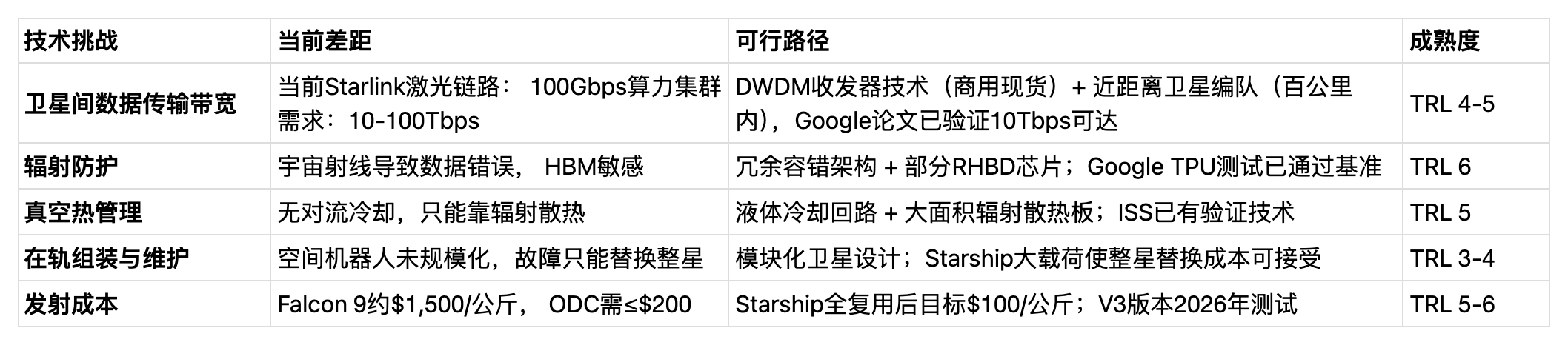
Each challenge listed above has a known engineering solution in principle—none requires undiscovered physics. Compare this to reusable rockets pre-2015: skeptics argued first-stage recovery was “theoretically possible but practically unfeasible.” SpaceX achieved ocean recovery in 2016 and began routine reuse in 2017. While ODC engineering complexity is higher, SpaceX’s resources dwarf those available in 2015: world-leading satellite constellation operations experience, lowest-cost global launch infrastructure, and—post-xAI consolidation—top-tier AI engineering capability.
Even more critical is uniqueness. No other company possesses all four: high-volume, low-cost launch capability (Starship), globally pervasive LEO bandwidth (Starlink’s 6,000+ satellites), AI model and inference capability (xAI/Grok), and proven in-orbit operational experience (real-time management of thousands of satellites). Amazon has Kuiper and AWS—but depends on third-party launch, making costs uncontrollable. Google lacks launch capability and has instead forged a strategic 5% equity stake in SpaceX. This combination’s moat isn’t technical superiority—it’s vertical integration-driven irreproducibility.
ODC’s weight in current valuation should be viewed as an in-the-money option—not discounted core operations. Even if ODC never materializes, Starlink’s cash flows alone justify a $1 trillion+ valuation. ODC represents the option value enabling valuation expansion toward $1.75 trillion and beyond—and options increase in certainty as time shortens and technical maturity rises.
Sum-of-the-Parts Valuation: Does $1.75T Have Fundamental Support?
$1.75 trillion corresponds to $737/share—representing a 40% premium over the $527 merger anchor price. Below is a Sum-of-the-Parts (SOTP) valuation based on 2026 forward financial projections, designed to assess whether the IPO price sits within a reasonable range—not to reassert historical merger anchors.
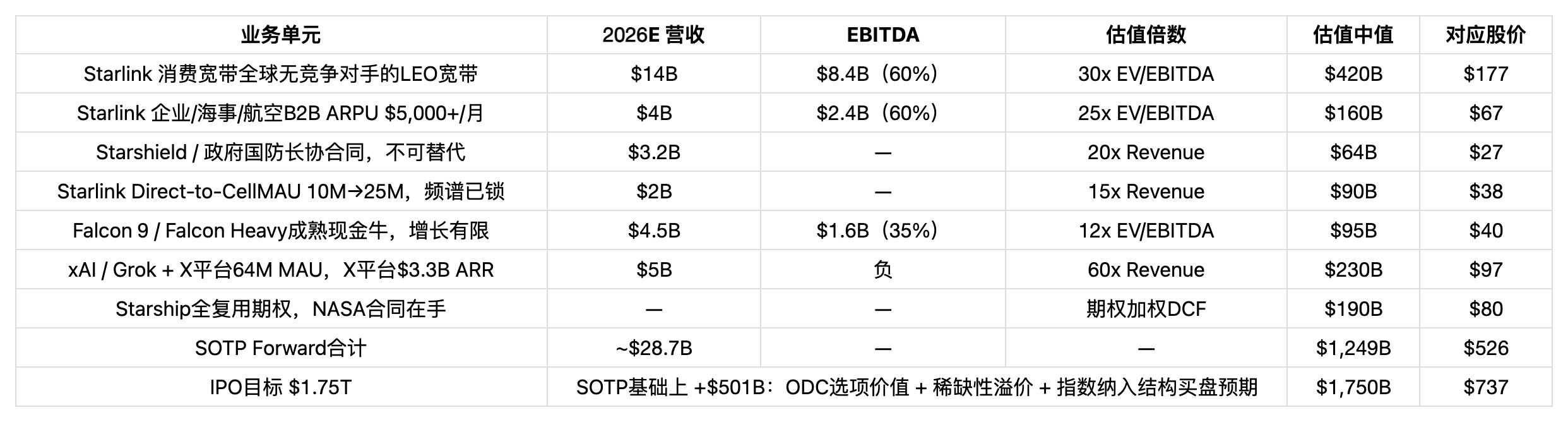
xAI valued at 60x revenue: Anthropic ($61.5B/$3B ARR = 20x), OpenAI ($157B/$11B ARR = 14x). xAI’s faster growth and X Platform cash flow backing make 60x a reasonable upper bound. Starship option valued at $190B: assumes 30% probability of full reusability commercialization; success scenario yields $630B market cap contribution, discounted to $190B.
SOTP Forward median: $1.25T ($526/share)—perfectly aligning with the merger anchor. This confirms the merger price was anchored to fundamentals—not premium. The IPO target of $1.75T adds ~$500B above SOTP, requiring three sources of support:
First, substantive ODC option value. If Starship achieves $100/kg launch costs, ODC economic viability is already validated in Google’s paper. Historically, markets assign option premiums to monopoly-grade platform infrastructure (AWS, Starlink itself) 5–7 years before realization. A $30B–$50B ODC option premium is conservative.
Second, scarcity premium. SpaceX is the sole publicly investable entity combining space infrastructure, global communications networks, and AI capability. Such scarcity has always commanded extra premium historically. Palantir (government data + AI) trades at 40–70x revenue—not due to growth velocity, but because there is no substitute.
Third, forward discounting of structural passive buying. Detailed in the next section, but core logic is: passive index inclusion will generate hundreds of billions in mandatory buy orders post-IPO—market participants will price this support into the IPO valuation upfront.
Overall assessment: $1.75T is defensible under a 2026E forward valuation framework; the premium has clear, identifiable sources—not arbitrary. The $2.0T upside case requires Starlink 2026E outperformance or accelerated ODC progress—lower probability than base case.
Why Post-IPO Won’t Be the Peak: Structural Passive Fund Buying Mechanics
Active investors can choose not to buy—but passive index funds cannot. Once SpaceX enters the Nasdaq-100 and S&P 500, all funds tracking those indices must allocate proportionally—no exceptions, no timing discretion. This is the critical structural distinction between SpaceX’s IPO and ordinary listings.
In Q1 2026, Nasdaq adopted rule amendment SR-NASDAQ-2026-004 (effective May 1): For newly listed companies entering the top 40 of the Nasdaq-100 by market cap, index inclusion evaluation triggers on Day 7, and mandatory inclusion occurs on Day 15. With a $1.75T valuation placing SpaceX among the world’s top five, inclusion is inevitable.
The new rule also introduces a Low-Floating-Share Multiplier: when public float falls below 20%, index weighting applies up to a 5× multiplier. If SpaceX maintains control and releases only 5% of shares to the public, its index weight will be calculated as if 25% were freely tradable. This means funds like QQQ ($372.5B AUM) may need to purchase far more than the actual available float.
1. IPO Listing (Expected June 2026)
Listed on Nasdaq at $1.75T valuation. Retail allocation: 30% (historically highest). Musk retains majority voting control—public float extremely low.
2. Day 7: Index Inclusion Evaluation Triggered
Top-five global market cap and top-40 Nasdaq-100 status ensure automatic pass. Low-float multiplier activates—effective weight amplified 5× relative to actual float.
3. Day 15: All Passive Funds Execute Mandatory Purchases Simultaneously
QQQ, QQQM, and all Nasdaq-100 trackers execute allocation instructions in lockstep. To fund purchases, they must concurrently sell ~$100B in existing weights—including NVDA, AAPL, MSFT. Steve Sosnick (Interactive Brokers): “When everyone buys at once—who is the natural seller?”
4. Five Months Later: Lock-up Expiry—Price Floor Already Established
By the time insiders’ 180-day lock-up expires, passive funds have already built positions at elevated prices. Structural price support emerges, enabling orderly insider selling. This is not manipulation—it’s mechanism.
Tesla precedent: After S&P 500 inclusion was announced in November 2020, Tesla’s stock rose 57% in the prior 30 days. At inclusion, its valuation equaled the combined market cap of the world’s nine largest automakers—with PE multiples in the hundreds. Over the next six months, shares fell ~10%—but that reflected extreme valuation, not flaws in the index inclusion mechanism. SpaceX’s fundamentals are significantly stronger than Tesla’s in 2020—and it delivers positive EBITDA.
Apollo Chief Economist Torsten Slok estimates that concurrent listing of SpaceX and OpenAI would lift the S&P 500’s top 10 stocks’ combined weight from ~40% to nearly 50%. This concentration trend transforms index funds into amplifiers for mega-cap stocks—and SpaceX is the most important new component for years ahead.
Google holds ~5% of SpaceX—worth over $100B at a $2T valuation. Google is not a passive holder: in 2025, it signed a long-term data downlink and edge computing agreement with SpaceX and launched the “Anthos Space Edge” preview, routing AI inference tasks to the nearest LEO satellite coverage zone. SpaceX’s orbital assets are being embedded into Google Cloud’s physical infrastructure—providing strategic validation for post-IPO valuation.
Pre-IPO Entry: Three Price Discovery Channels & Pricing Analysis
Three channels currently offer pre-market exposure to SpaceX. Core anchor: $526.7/share = $1.25T (merger valuation), 2.374 billion total shares outstanding. Below is pricing, structure, and upside analysis for each channel.
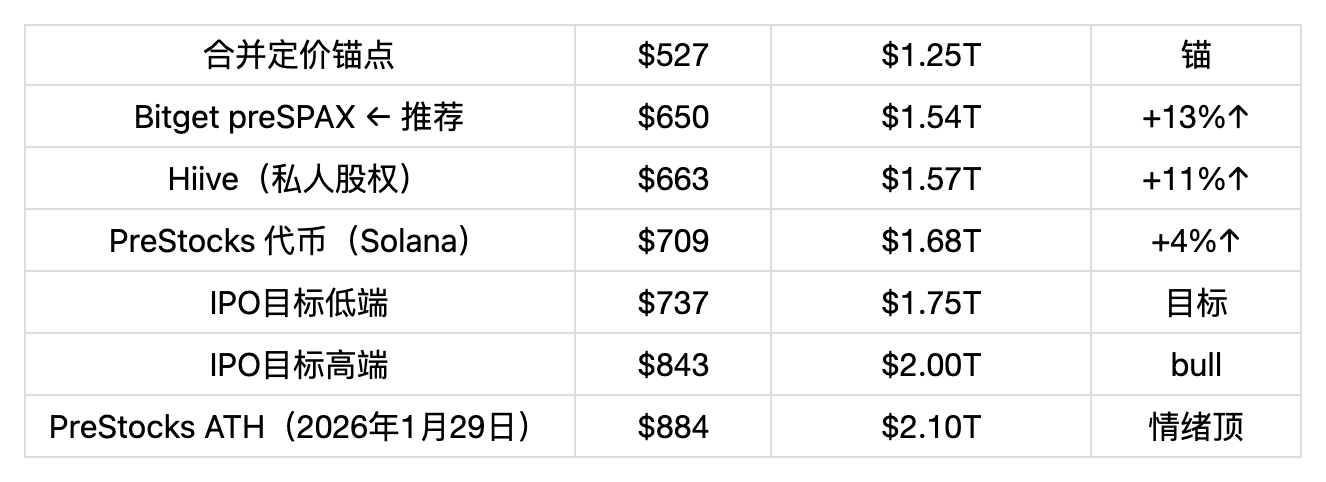
BITGET IPO PRIME · Tokenized · Recommended: preSPAX at $650
Implied valuation: $1.54T
Launched April 21
+13.4% vs. IPO target low end
+29.7% vs. IPO target high end
Backed by Republic; reference index tracks SpaceX’s post-public trading performance. $650 is the lowest entry price across all tradable channels—below Hiive private equity ($663) and PreStocks tokens ($709)—and requires no accredited investor qualification. Economic exposure directly tracks SpaceX’s public market price post-listing.
Real Equity · Accredited Investors Only: Hiive at $663
Implied valuation: $1.57T
100+ active listings
+11.2% vs. IPO target low end
+27.1% vs. IPO target high end
Actual equity transfer; best liquidity among private equity platforms. 3–5% fees; lock-up period varies by share structure. $13 more expensive than preSPAX—but confers direct shareholder rights. Accredited investor status required.
Synthetic Asset · Solana Chain: PreStocks at $709
Implied valuation: $1.68T
ATH: $884 (Jan 29)
+3.9% vs. IPO target low end
+18.9% vs. IPO target high end
Market cap: $4.7M; daily volume: $840K—extremely illiquid. Pricing already $59 above preSPAX, just 4% from IPO low end. Hit $884 on Jan 29 (implying $2.10T), then corrected to current level. Price reflects Solana-chain micro-community sentiment—not fundamentals.
Pricing Conclusion: preSPAX at $650 is the only channel satisfying both “lowest price” and “acceptable liquidity.” Versus Hiive: $13 cheaper (−2%), no accredited investor requirement. Versus PreStocks: $59 cheaper (−8.3%), offers 9.5 percentage points more upside, and provides superior liquidity (Republic-backed vs. Solana-native token). Post-IPO, preSPAX settlement references SpaceX’s public market price—economic payoff path is clear.
Scenario Analysis & Key Assumptions
Pessimistic Scenario: $421–$527
$1.0T–$1.25T
Starship suffers repeated failures; xAI enterprise API revenue misses $1.5B 2026E target; Musk’s political risk jeopardizes government contract renewals; macro tightening forces IPO discounting. Valuation reverts to SOTP fundamentals—Starlink’s $11.4B revenue still supports a $1T floor. From preSPAX $650: downside of ~20%–30%.
Optimistic Scenario: $843–$950
$2.0T–$2.25T
Starlink exceeds expectations at $20B; Starship achieves full reusability milestone during roadshow; first commercial ODC contract announced; retail enthusiasm converges with passive buying pressure. From preSPAX $650: upside of ~30%–46%.
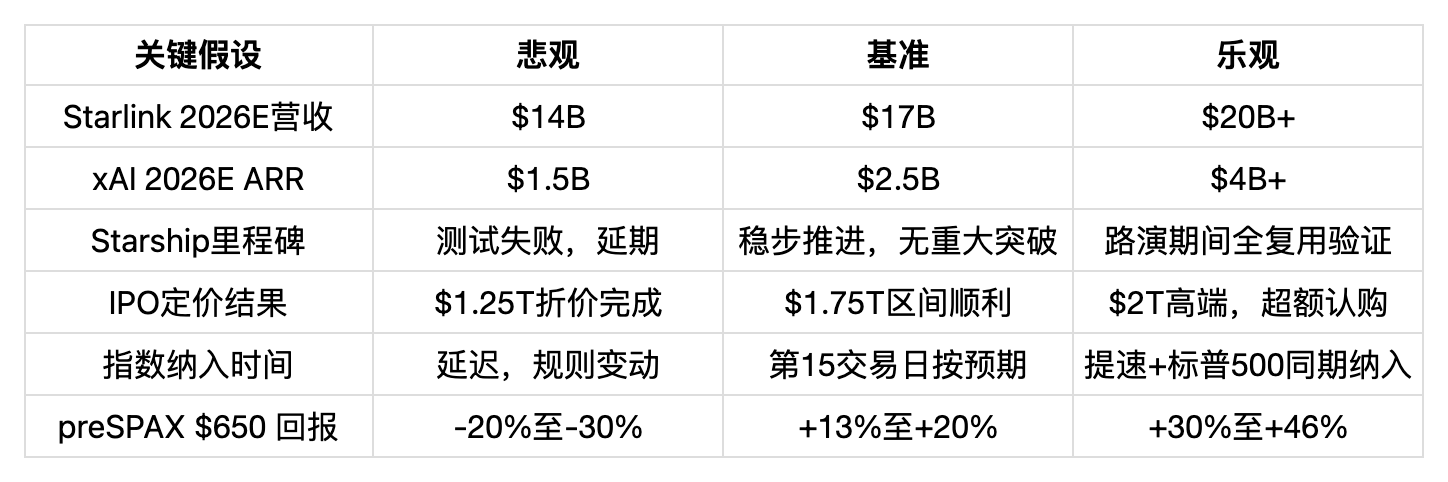
Main downside risks: ① Major Starship accident (highest-impact probability); ② Deteriorating Musk–Trump relationship affecting government contracts; ③ Nasdaq index rule changes challenged at congressional level; ④ Sharp macro tightening shutting down entire IPO market. Each risk has relatively low standalone probability—but compound impact is significant if multiple occur.
This report is for internal research reference only and does not constitute investment advice. Tokenized products (preSPAX, PreStocks) confer no shareholder rights, voting rights, or dividend entitlements; economic returns are linked to a reference index, and settlement depends on platform creditworthiness. Private equity (Hiive) is accessible only to accredited/certified investors, carries 3–5% fees, and lock-up periods vary by share structure. SpaceX’s S-1 filing remains under confidential review; IPO valuation, timing, and offering structure remain subject to change. TRL (Technology Readiness Level) ratings reflect independent analyst judgment and are for reference only.
Join TechFlow official community to stay tuned
Telegram:https://t.me/TechFlowDaily
X (Twitter):https://x.com/TechFlowPost
X (Twitter) EN:https://x.com/BlockFlow_News