Dragonfly Crypto Hiring Survey: Compliance Roles +340%, Data Science +74%; Crypto Enters the “On-Demand Hiring” Era
TechFlow Selected TechFlow Selected
Dragonfly Crypto Hiring Survey: Compliance Roles +340%, Data Science +74%; Crypto Enters the “On-Demand Hiring” Era
Dragonfly found that the crypto hiring logic has changed—without a clear explanation of why it matters, they can’t attract talent.
 Navigating Web3 tides with focused insights
Author: Zackary Skelly (Head of Talent, Dragonfly)
Translated and edited by TechFlow
TechFlow Intro: Dragonfly has released its 2026 Crypto Industry Talent Insights Report, revealing a fundamental shift in hiring logic. The industry saw a net reduction of 472 roles in 2025—but compliance roles surged by 340%, and data science roles grew by 74%. The most critical change? Candidates are no longer driven by bull-market impulses; they demand clear value articulation and certainty. If you cannot clearly explain *why this role matters*, your conversion rate will plummet.
1/
We’ve entered Q1 of 2026—and hiring in crypto looks unlike any previous cycle.
We’ve just published our latest Talent Insights Report, breaking down how we got here and what it means for founders and talent teams.
2/
TL;DR
2025 didn’t kill crypto hiring—it matured it.
Companies no longer hire based on price; they hire based on real need.
This shift has become the new baseline entering 2026.
3/
The year split cleanly in two.
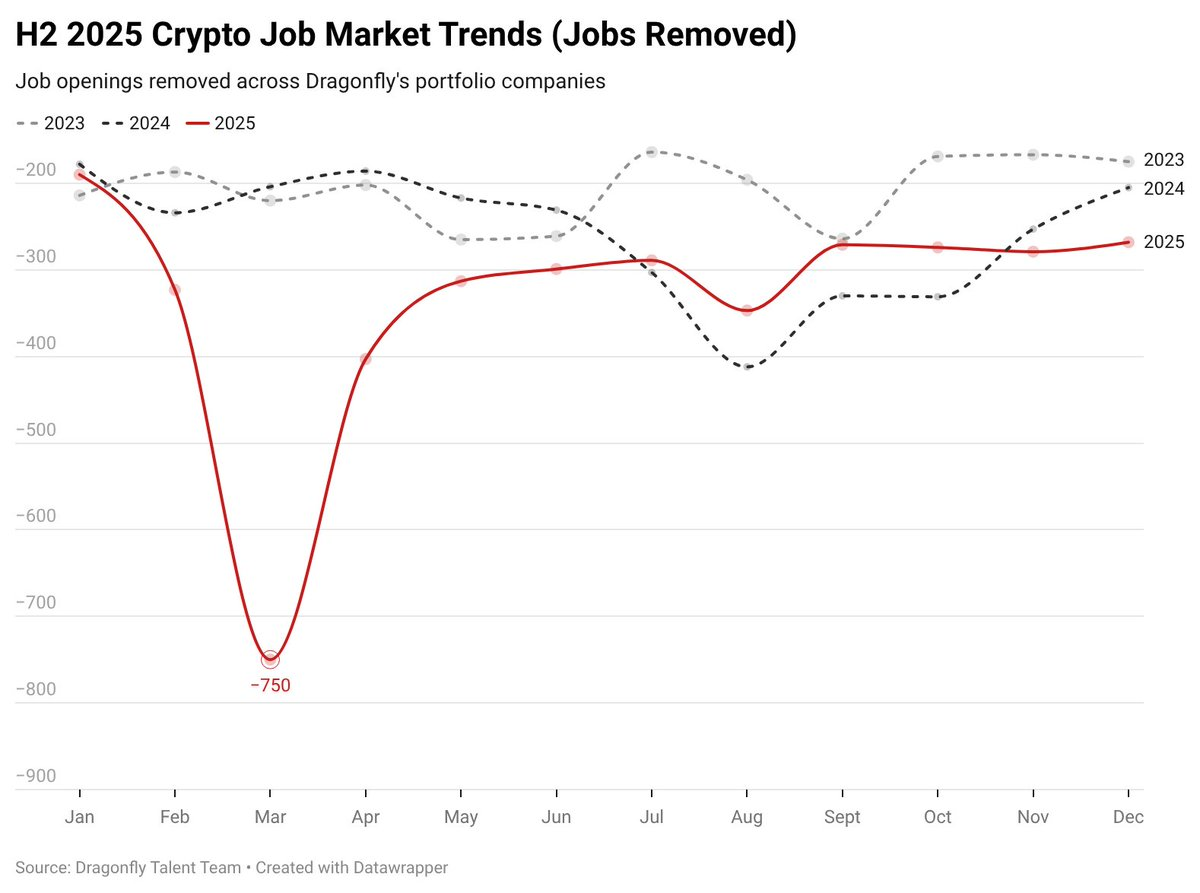
H1 2025 was turbulent—macro shocks triggered a rapid reversal of pro-crypto optimism.
Job removals spiked in March (750 roles), with most losses concentrated in the first half.
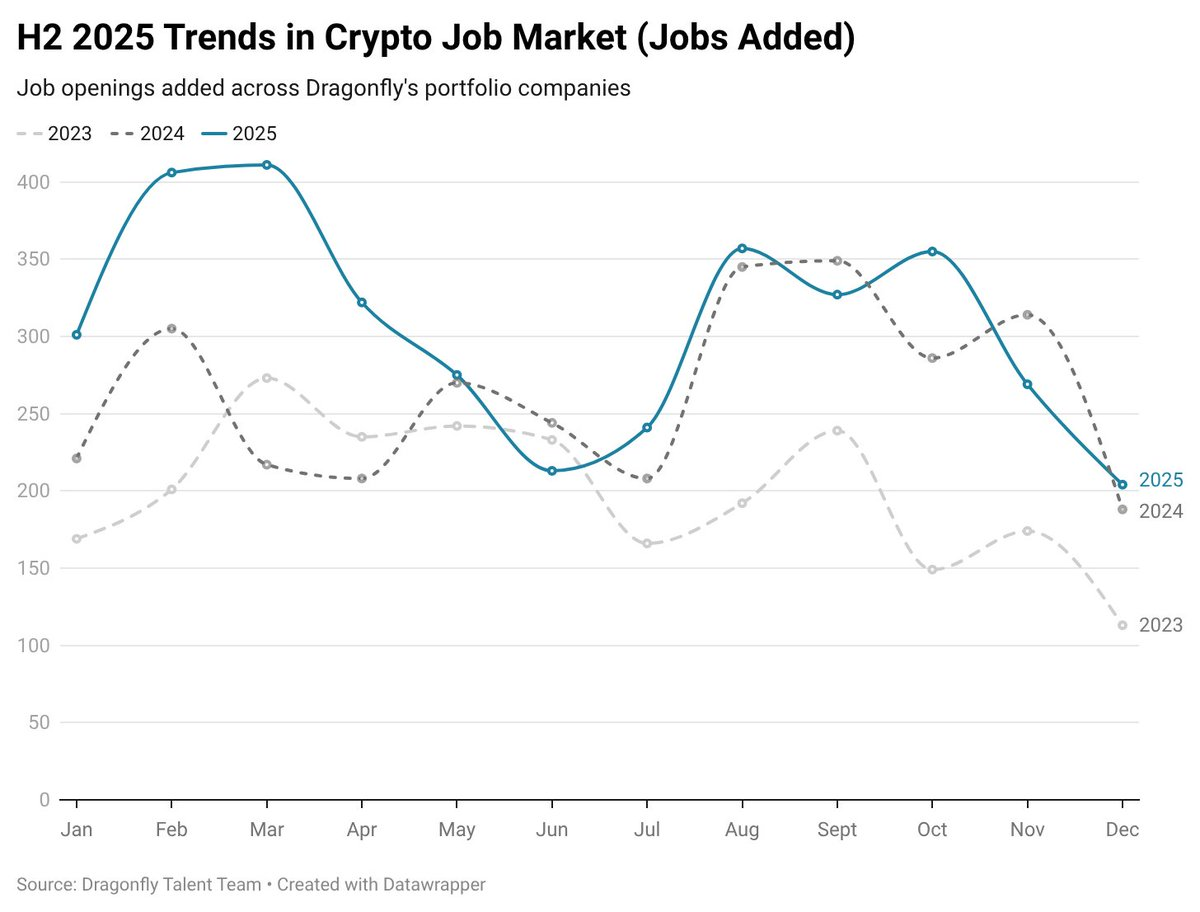
~3,700 roles were added across the year; ~4,100 were removed—net change: -472.
4/
H2 brought discipline and recovery.
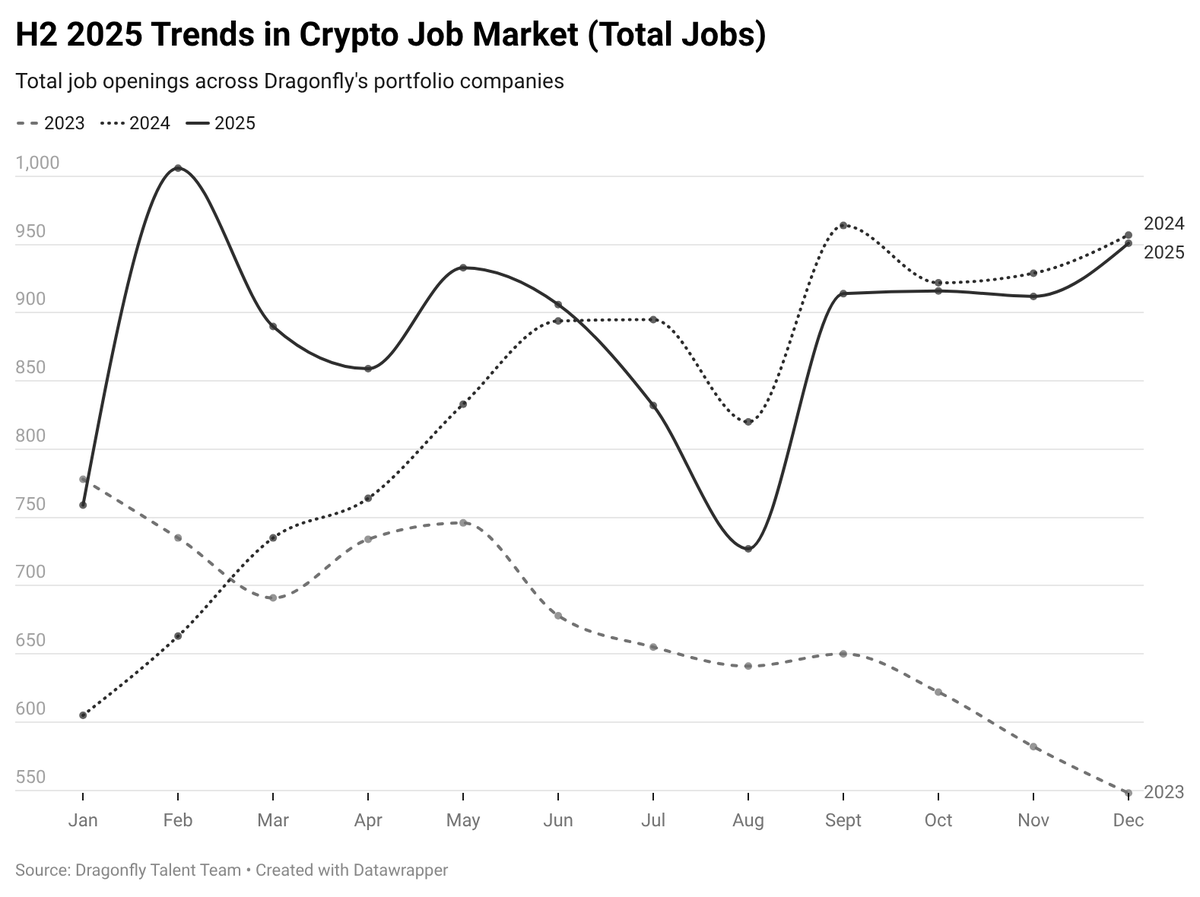
The overall job trend line in H2 closely mirrored 2024’s—but at a lower absolute level.
July: reset. August: bottomed out. September: reopened. Q4: stabilized.
The sharper spring reset is the primary reason 2025 as a whole ran below 2024.
5/
In our H1 2025 report, we made several predictions. Here’s how they scored:
✓ Late-Q3 rebound (jobs opened in September up +26%), Q4 slowdown, early start to compliance hiring
✗ Underestimated the degree of divergence between traffic and application volume; overestimated legal roles’ resilience relative to compliance roles
6/
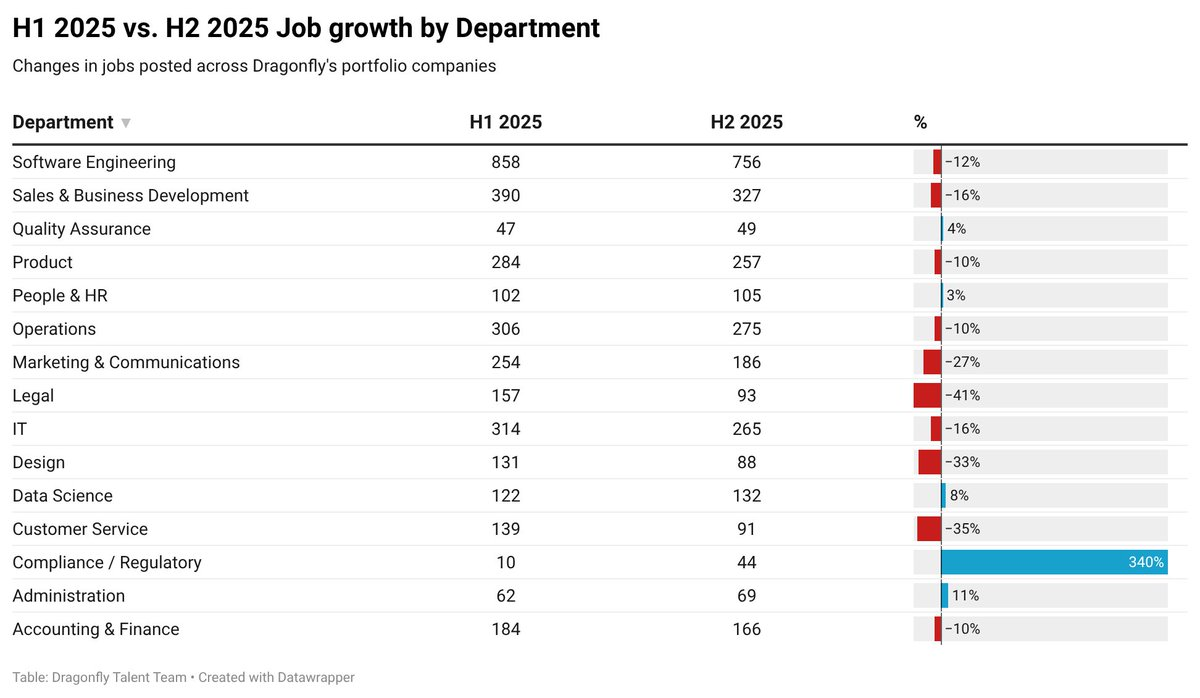
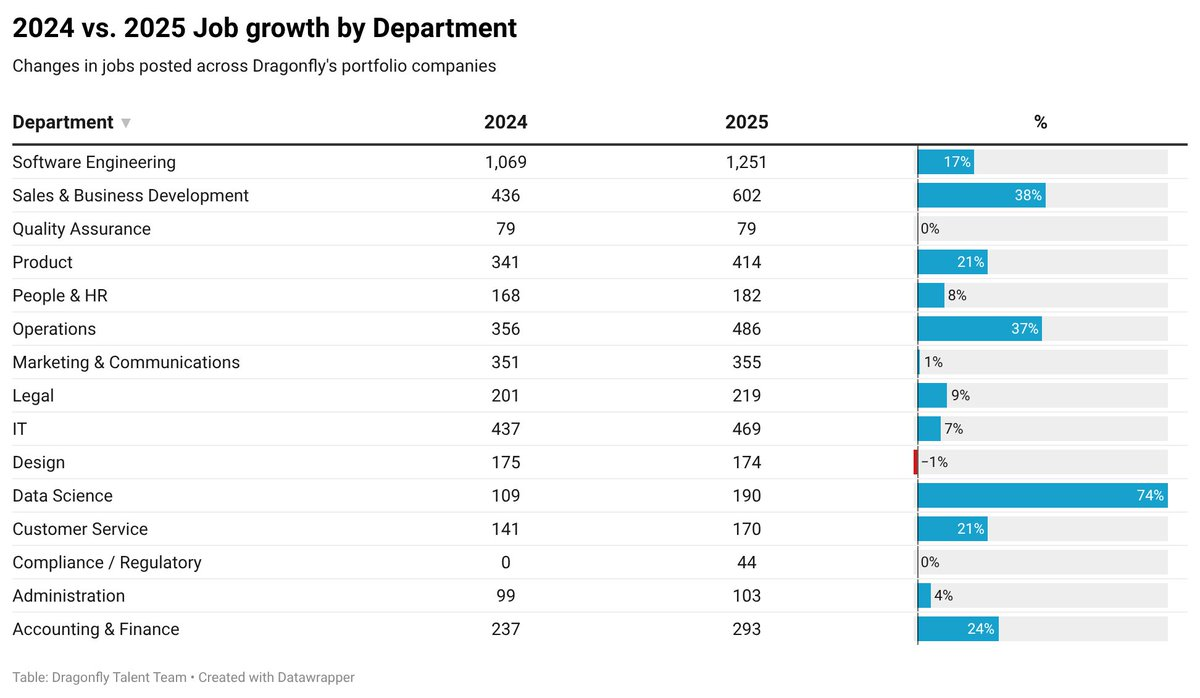
The real shift from H1 to H2 wasn’t *how many* people companies hired—but *which roles* they prioritized. Core functions first—win the right to scale.
→ Engineering: -12%, still the anchor
→ Marketing: -27%
→ Design: -33%
→ Customer Support: -35%
→ Sales & BD: -16%
→ Legal: -41%
→ Compliance: +340%
7/
Data Science was the clearest winner of the year—up +74% YoY. (Thanks to AI?)
8/
Candidates also shifted in interesting ways.
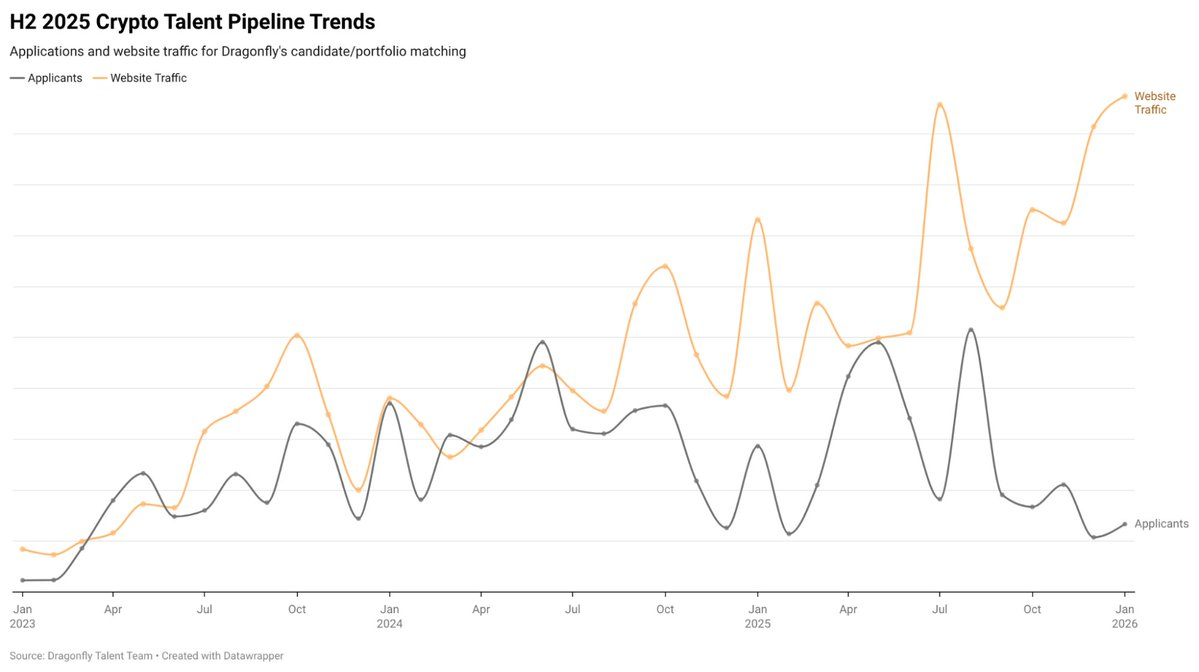
Traffic held steady in H2, but applications dropped ~26%.
People kept browsing—just stopped applying impulsively.
9/
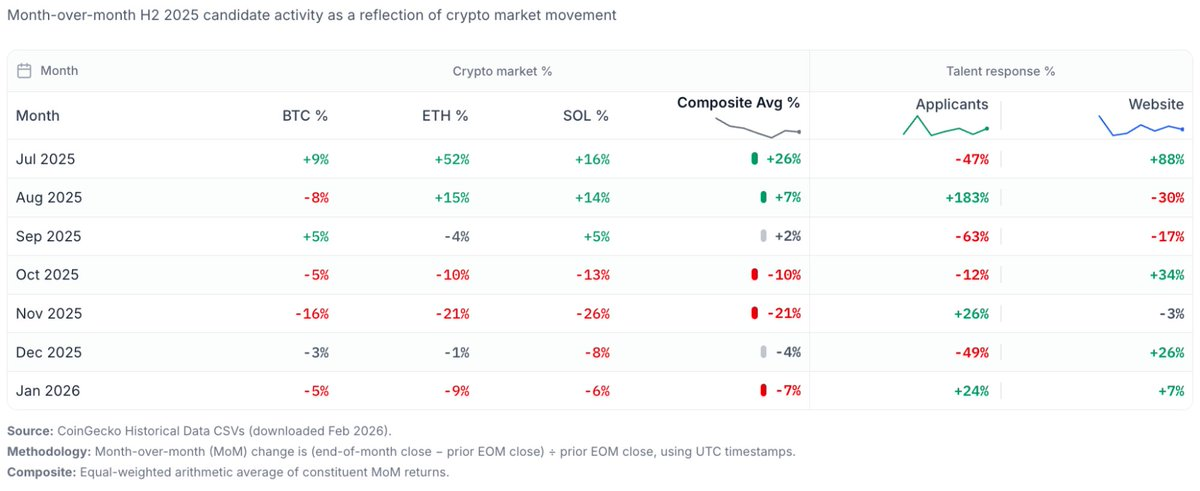
In earlier cycles, market euphoria did much of the recruiting work: salaries rose, applications flooded in.
That mechanism is breaking down.
Stronger months still lift traffic—but attention-to-application conversion is weaker than before.
10/
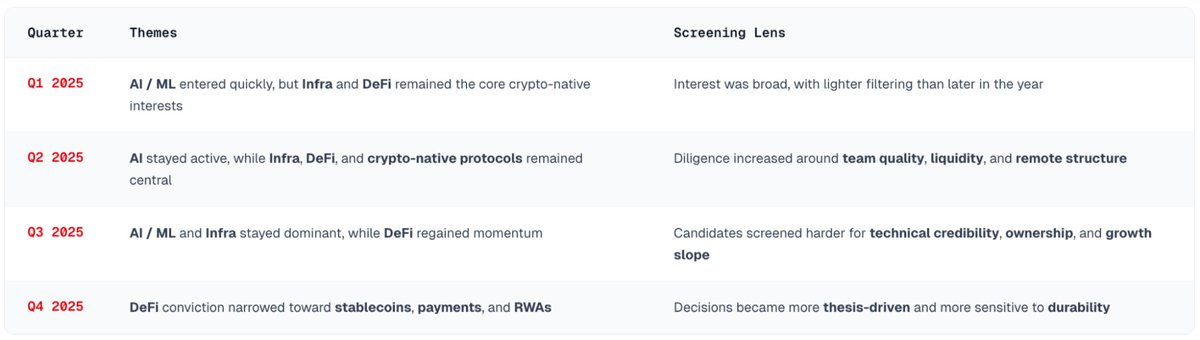
Why? Partly because candidates have grown more cautious.
They’re scrutinizing company durability, ownership clarity, team quality, and technical credibility more rigorously: open-source proof, product depth, hard technical problems, GTM roadmap.
Generic category narratives no longer work.
11/
Areas of concentrated conviction: Infrastructure, DeFi, L1s, and L2s remain core—but DeFi interest narrowed sharply to stablecoins, payments, and RWAs.
Fintech-adjacent and institutional use cases gained significant traction. AI remains a key area of interest.
12/
Stage preference tells an interesting story too.
Seed and Series A stages remain most attractive to candidates—founder roles and “first employee” roles are in high demand. That said, larger, more mature companies still draw strong interest.
13/
The top factor causing candidate drop-off isn’t compensation, stage, or size—it’s ambiguity.
If you can’t clearly articulate why the company matters, what scope the candidate will own, and why the opportunity is durable, your conversion rate plummets.
14/
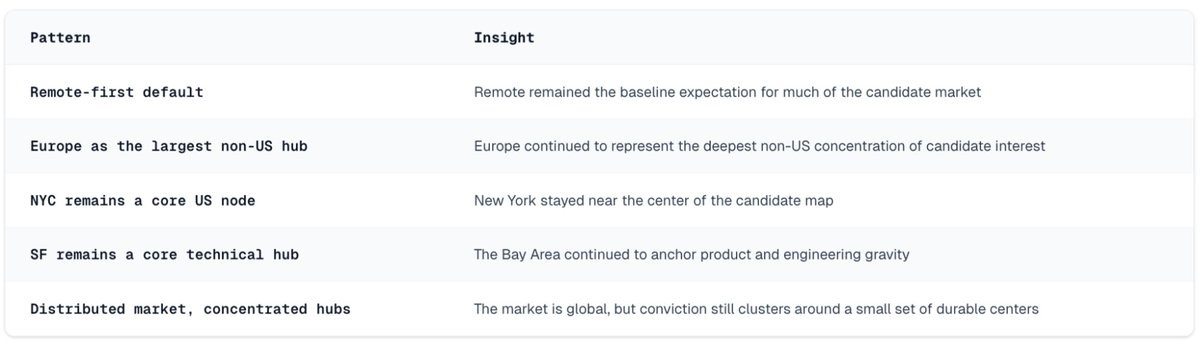
Geographically, remote remains the norm—but the most active hiring teams are increasingly clustered in New York, with stronger preferences for in-person work.
Talent remains global—but NY + Bay Area still dominate. Europe is the largest non-U.S. hub.
(Note: Location-specific hiring = smaller TAM, longer hiring cycles.)
15/
Another force shaping today’s landscape: hiring is concentrating toward later-stage teams—and heavily skewing into the verticals candidates care about most.
We expect hiring for the rest of 2026 to be driven more by acquisitions, transformations, and integrations—not pure greenfield growth.
16/
So what should founders do?
Hire against milestones—not market cycles or calendar plans: product launches, revenue inflection points, key partnerships, regulatory progress.
Companies that hired well in H2 2025 could clearly articulate—and consistently uphold—the rationale behind every role.
17/
Recognize that teams differ—and thoughtfully sequence hires:
→ Core builders first (engineering, security, data/protocol)
→ BD to explore fit
→ Product flexes by type (consumer earlier, infrastructure leaner)
→ Compliance, finance, risk
→ Marketing/support scaled only after leverage emerges
18/
Maintain evergreen pipelines for scarce talent.
Engineering, AI/ML, and security roles face severe supply constraints—you can’t restart from zero each cycle. Keep relationships warm even after specific needs close.
19/
Recognize that role-selling has changed.
Candidates want runway clarity, explicit ownership for Days 30–60, and transparent upside mechanisms.
You must sell differentiation. You’re not selling your category—you’re selling *why you’ll win*, and *exactly what role they’ll play*.
20/
You also need a genuine AI story—not “We’re an AI company.”
Candidates want to know:
→ How AI is used internally
→ How it transforms the product
→ Whether it creates real advantage
Vague answers lose talent.
21/
Specific advice for talent teams:
Put your strongest people at the front of the process (first impressions matter), keep interview loops tight, and deliver clear feedback.
22/
An open question: AI makes 2026 harder to predict.
People can do more with fewer colleagues. Better tools let some go build solo. Others may jump directly into AI roles.
Meanwhile, higher output per employee enables faster scaling—and crypto’s positioning is broader than ever.
23/
Our current view on AI’s impact: Deceleration signals outweigh acceleration signals until clear AI × Crypto use cases solidify.
📎 Further reading: The Agentic Economy Will Be Massive, Agentic Commerce Won’t
24/
Our baseline expectation for 2026: Flat to modest growth—led by engineering, AI/data, and security. Consolidation continues.
Regardless of bull, base, or bear markets—this is a year focused on quality building.
25/
The teams that win talent will be those with the most credible stories—not the loudest voices.
Execution discipline, durable business models, and clear articulation of both are now table stakes.
Join TechFlow official community to stay tuned
Telegram:https://t.me/TechFlowDaily
X (Twitter):https://x.com/TechFlowPost
X (Twitter) EN:https://x.com/BlockFlow_News
 @dragonfly_xyz