Kalshi CEO Calls on U.S. Department of Justice to Prosecute Insider Trading; Voluntarily “Inviting Punishment” Reflects a Survival Struggle
TechFlow Selected TechFlow Selected
Kalshi CEO Calls on U.S. Department of Justice to Prosecute Insider Trading; Voluntarily “Inviting Punishment” Reflects a Survival Struggle
Kalshi is attempting to distinguish itself from its competitor Polymarket by proactively embracing regulatory enforcement.
 Navigating Web3 tides with focused insights
Author: Claude, TechFlow
TechFlow Editorial Note: Kalshi CEO Tarek Mansour publicly stated at the Semafor Global Economic Summit that he expects the U.S. Department of Justice (DOJ) to file criminal charges for insider trading on prediction markets, calling it “a federal crime.” Kalshi—a prediction market giant valued at $22 billion with weekly trading volume exceeding $1 billion—has launched 200 insider trading investigations over the past year. Amid at least eight pending regulatory bills in Congress and federal lawsuits filed against it in three states, Kalshi is attempting to differentiate itself from rival Polymarket by proactively embracing law enforcement.
One of the largest players in the prediction market space—Kalshi—is openly inviting federal prosecutors to take action against violators on its own platform.
According to a Semafor report dated April 15, Kalshi CEO Tarek Mansour declared at the Semafor Global Economic Summit that insider trading on prediction markets “is now a federal crime,” and that he expects the DOJ to bring criminal prosecutions in some cases. He also called for a federal-level consumer protection framework to replace the current patchwork of state-by-state regulations.
This statement comes as the prediction market industry faces mounting pressure from all sides: congressional legislation, state-level lawsuits, DOJ investigations, and recurring insider trading scandals—while Kalshi and Polymarket, two competitors each valued above $20 billion, respond to this regulatory storm with sharply divergent strategies.
Mansour’s Public Call: “Insider Trading Is a Federal Crime”
Mansour’s language was unusually direct. At the summit, he said: “If you engage in insider trading on Kalshi, it will become—and already is—a federal crime. I do expect the Department of Justice to prosecute some of these cases.”
He added that Kalshi holds authority to impose a range of penalties on violators—from fines to referrals for criminal prosecution—and that the company has already publicly disclosed certain cases, “with more to come.”
Mansour also criticized the current state-by-state regulatory landscape for prediction markets. He noted that among the 34 states that have legalized sports betting, only one prohibits marketing to problem gamblers—a “patchwork” regulatory system he declared “a failure.” He advocated instead for a unified federal consumer protection framework.
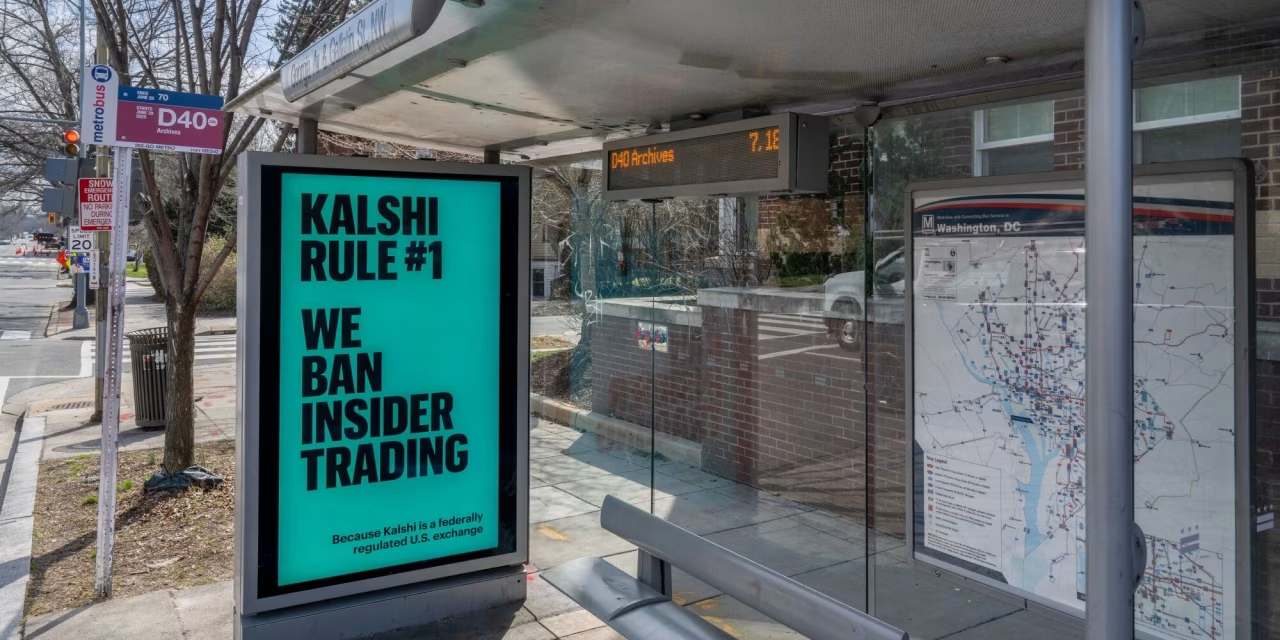
The timing of this statement was highly strategic. On the same day Mansour spoke, CNBC reported that both Kalshi and Polymarket had significantly ramped up lobbying efforts in Washington, D.C. According to OpenSecrets data, the two companies collectively spent nearly $1 million on federal lobbying in 2025. Kalshi deployed extensive outdoor advertising across Washington, D.C., with slogans such as “We Ban Insider Trading,” “We Don’t Run Death Markets,” and “We Operate Within U.S. Law.”
The DOJ Is Already Acting: Southern District of New York Prosecutors Meet with Polymarket
Mansour’s remarks were not made in a vacuum. According to an exclusive CNN report on March 30, the head of the Securities and Commodities Fraud Unit at the U.S. Attorney’s Office for the Southern District of New York recently met with representatives of Polymarket to discuss how existing laws apply to potential misconduct on prediction markets.
Jay Clayton, U.S. Attorney for the Southern District of New York, had already signaled his position clearly in February at a securities enforcement forum. When asked whether criminal prosecutions related to prediction markets were anticipated, Clayton affirmed they were—and emphasized, “Just because it’s a prediction market doesn’t mean you’re immune from fraud charges.”
Nicholas Biase, spokesperson for the Southern District of New York U.S. Attorney’s Office, stated in a declaration to CNN that the office has explicitly informed market participants that multiple statutes—including insider trading laws, anti-money laundering laws, anti-manipulation laws, and various anti-fraud provisions—apply broadly to activities observed on prediction markets.
Yet legal uncertainty remains regarding prosecution prospects. Aitan Goelman, former CFTC Enforcement Director and now a criminal defense attorney, told CNN that prosecutors must not only prove traders acted while in possession of material nonpublic information, but also demonstrate their conduct breached a fiduciary or trust duty—“all within an untested area of law.”
200 Investigations, MrBeast Staff Fined: Kalshi’s Enforcement Record
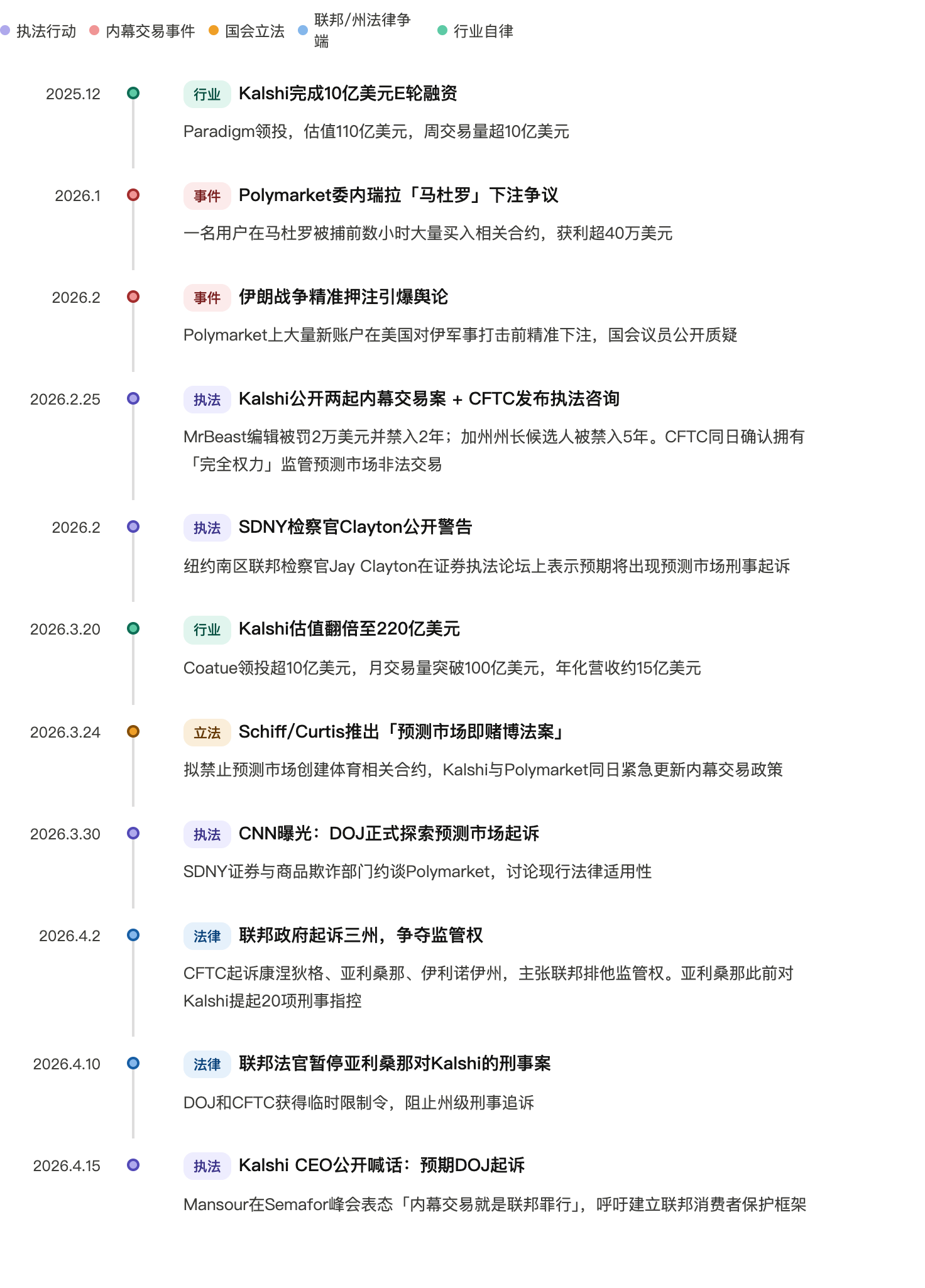
Kalshi is indeed ahead of the curve in enforcing insider trading rules. As disclosed by the company on February 25, Kalshi has initiated 200 insider trading investigations over the past year, frozen numerous flagged accounts, and elevated more than 12 cases to active status.
Two concluded cases disclosed the same day drew widespread attention. The first involved Artem Kaptur, a video editor for top YouTube creator MrBeast. Kalshi found Kaptur had traded approximately $4,000 on markets tied to the MrBeast channel and achieved “nearly perfect trading accuracy” on low-probability contracts—an outcome statistically anomalous. Kalshi determined Kaptur, as an editor, likely possessed material nonpublic information relevant to his trades and imposed a $20,397.58 penalty ($5,397.58 in profit disgorgement plus a $15,000 fine), along with a two-year suspension from the platform.
The second case involved a California gubernatorial candidate who traded roughly $200 on his own election market and posted videos of those trades on social media. Kalshi fined him $2,246.36 and banned him from the platform for five years.
On the same day, the Commodity Futures Trading Commission (CFTC) issued an enforcement advisory on prediction markets, affirming its “full authority to regulate” unlawful trading on registered exchanges and warning that trading based on material nonpublic information may violate Section 6(c)(1) of the Commodity Exchange Act and CFTC Rules 180.1(a)(1) and (a)(3).
Bets on Venezuela, Iran War: Polymarket Under Fire
In contrast to Kalshi’s proactive “invite prosecution” posture, Polymarket faces more concentrated controversy.
The most explosive incident occurred in January. As reported by PBS, CNN, and others, a Polymarket user purchased large volumes of contracts linked to Venezuelan President Nicolás Maduro’s capture by U.S. military forces hours before the event—and ultimately profited over $400,000. Then, in February, around the time of U.S. military strikes against Iran, Polymarket saw another wave of precisely timed trades originating from newly created accounts.
According to Fortune, reports also surfaced indicating that an internal KPMG employee placed bets on companies audited by the firm using Polymarket.
These controversies are especially damaging to Polymarket because its U.S.-based site has yet to fully launch; the most contentious Venezuelan and Iranian markets occurred exclusively among overseas users—making federal prosecution more legally complex due to cross-border jurisdictional challenges.
Under mounting pressure, Polymarket announced rule revisions on March 24 explicitly prohibiting users from trading on contracts where they possess confidential information or could influence the outcome. Kalshi, on the same day, announced it would preemptively block politicians from trading on their own elections and sports personnel from trading on events in which they participate.
The Logic Behind Kalshi’s $22 Billion Valuation
Mansour’s decision to publicly call on the DOJ is, at its core, a carefully calculated positioning strategy.
Kalshi closed a financing round exceeding $1 billion in March 2026, led by Coatue Management, doubling its valuation from $11 billion to $22 billion. According to Sacra data, the company’s annualized revenue run rate has reached approximately $1.5 billion, with weekly trading volume surpassing $1 billion and monthly volume exceeding $10 billion in February. Kalshi operates as a CFTC-approved, compliant exchange—the single most critical point of differentiation between it and Polymarket.
Yet risks are accumulating rapidly. Arizona has filed 20 criminal charges against Kalshi; Nevada has imposed an operational ban; and more than 20 lawsuits are ongoing. Institutions including Point72 and Balyasny have prohibited their employees from trading on prediction markets.
Against this backdrop, the logic behind Mansour’s “invite prosecution” strategy becomes clear: if insider trading cannot be effectively curbed, ordinary users will lose confidence—and the liquidity upon which prediction markets depend will dry up. For a platform with over $1 billion in weekly trading volume, trust infrastructure matters more than any individual trade.
Discussions on Hacker News reflect deeper skepticism. HN user tptacek highlighted an inherent contradiction in the industry: if prediction markets derive value from aggregating private information to improve forecasting accuracy, then insider trading should be a feature—not a bug. But if they function instead as unregulated gambling venues, insider trading is akin to peeking at opponents’ cards in poker. “You can tell what kind of platform these companies think they are by how they handle insider trading.”
Donald Trump Jr., son of former President Donald Trump, invested in Polymarket through his venture fund and also serves as a strategic advisor to Kalshi—a political connection that adds further complexity to this contest.
Join TechFlow official community to stay tuned
Telegram:https://t.me/TechFlowDaily
X (Twitter):https://x.com/TechFlowPost
X (Twitter) EN:https://x.com/BlockFlow_News
 深潮TechFlow