10 Survival Rules for Ordinary People in the AI Era
TechFlow Selected TechFlow Selected
10 Survival Rules for Ordinary People in the AI Era
You don’t need more time—you need to protect your best time for doing what only you can do.
 Navigating Web3 tides with focused insights
Audience: Approximately sixty people—founders, engineers, product managers, investors, fresh graduates, and a few who described themselves as “just here to listen before figuring things out.”
Speaker: Alan Walker, serial entrepreneur from Silicon Valley and firsthand witness to three tech cycles; drinks only black coffee and never uses question marks.
Date: April 2026, one week after the launch of Project Glasswing.
This is not a methodology. Not a set of workplace tips.
It’s about how to survive—and then thrive—amid a species-level transformation.
Opening · ALAN WALKER
“Someone messaged me before coming: ‘AIan, with AI arriving, do ordinary people still have a chance?’ Alan didn’t reply—because the question itself is flawed.
Before Gutenberg’s printing press appeared in 1440, the most valuable profession in Europe was that of the scribe. In monasteries, a senior scribe held status equivalent to today’s top-tier engineer—he controlled knowledge production and distribution. When the printing press arrived, some scribes vanished. Others became editors, publishers, authors, teachers. They didn’t disappear—they migrated.
Everyone in this room today is a descendant of those scribes. Your ancestors weren’t wiped out by the printing press—that’s why you’re sitting here now asking this question. Anyone who can sit here and ask this question is already among the luckiest people in human history. The issue isn’t “Is there opportunity?” It’s “Are you willing to look clearly at where opportunity lies?”
Today I’ll give you ten laws. No fluff—each one has been thoroughly thought through.” — Alan Walker, Silicon Valley
Law I · Your opponent isn’t AI—it’s the person who uses AI
Jobs aren’t being eliminated. People who believe “This has nothing to do with me” are.
Here’s a counterintuitive fact: In any technological revolution, it’s not jobs that get destroyed—it’s people who refuse to learn. This isn’t motivational rhetoric; it’s historical record. In 1900, 41 million horses powered transportation across the U.S. When automobiles arrived, horse trainers disappeared—but mechanics, gas station attendants, highway engineers, auto insurance actuaries, and traffic police all emerged. Net gain—not net loss.
In 1997, Deep Blue defeated Kasparov, prompting widespread belief that professional chess was doomed. Then in 2005, “centaur chess” competitions appeared—a regular amateur player paired with an ordinary PC could beat combinations of elite grandmasters and supercomputers. It wasn’t the strongest human or the strongest machine that won. It was the human best able to collaborate with the machine. This conclusion applies to every industry in 2026—word for word.
ALAN · Live on stage
Your competitor today isn’t Claude, GPT, or Gemini. It’s the person sitting beside you—who’s already using these tools while you’re still debating, “Is this thing reliable?” Technology adoption curves never wait. Within five years of the printing press’s emergence, those who seized it first defined the next two centuries of knowledge production. Today’s window may be far shorter than five years.
AI isn’t replacing you. People who use AI are replacing you. These two sentences sound identical—but they demand entirely different responses.
Law II · AI Can’t Steal the Pits You’ve Fallen Into
Large language models can absorb all knowledge that’s been written down. They cannot absorb what hasn’t been written—the part that truly makes you valuable.
Philosopher Michael Polanyi wrote a slim hundred-page book in 1966 titled Tacit Knowledge. Its core thesis is simple: “We know more than we can tell.” He gave an example: You can recognize a face, but you can’t explain how. This ability resides in your nervous system—unverbalizable, unteachable, and irreproducible.
The essence of large language models is extreme compression and retrieval of knowledge humans have already expressed. They ingest textbooks, papers, code, conversations—all documented content. But there’s a class of knowledge they can’t access: the judgment honed over eighteen failed projects; the intuition triggered after witnessing a certain situation three times; the gut sense about human nature forged through years of grinding in an industry. None of this appears in any document. It exists as neural circuitry in your brain—activated only through lived experience, not conveyed through language.
So the experiences you dismiss as useless? They’re your true moat in the AI era. Detours taken, landmines stepped on, wrong calls made—these are forming a scarce asset AI cannot touch. Provided, of course, you consciously systematize them: write them down, articulate them, teach them.
ALAN · Live on stage
I know a restaurateur with eighteen years’ experience—no Excel skills, no coding, Mandarin spoken haltingly. Yet thirty minutes before a new restaurant opens, he walks through once and tells you which dish will fail today, which staff member is off their game, and roughly how many table-turns to expect tonight. How does he know? He can’t say. But that “can’t say” is worth millions. AI can generate a comprehensive restaurant management manual—but it hasn’t fallen into those eighteen years of pits.
Systematize your missteps. Verbalize your failures. This isn’t writing memoirs—it’s forging the most undervalued moat in the AI era.
Law III · Depth Is Your Credential; Cross-Domain Fluency Is Your Weapon
AI performs “adequately” in any single domain. What it cannot do is layer the underlying logics of two fields to glimpse a third possibility.
Economics offers the concept of “comparative advantage” (Ricardo, 1817): You needn’t outperform others at everything—only be more efficient at a particular combination. Today, comparative advantage stems not from a single skill but from cross-domain synthesis—your biology background plus financial intuition plus product sense creates a perspective AI cannot replicate from any single training dataset.
Truly transformative innovations in human history rarely occur within disciplines—they happen at boundaries. Mendel, a monk, applied statistics to pea plants and founded genetics. Shannon, a mathematician, used thermodynamic entropy to model communication and invented information theory. Jobs, a Zen practitioner and aesthetician, welded humanities and engineering to define consumer technology. In an age where AI rapidly covers any singular domain, the capacity to make cross-domain connections stands among humanity’s last cognitive advantages.
› Identify your deepest domain—this is your anchor; without it, everything else floats
› Deliberately build functional knowledge across two or three adjacent or opposing domains—not mastery, just enough
› Train “connection intuition”: Can the foundational logic of this domain explain phenomena in that domain?
› Let AI retrieve; you connect—this is division of labor, not competition
ALAN · Live on stage
The most formidable investor I’ve met isn’t the one with the strongest finance chops—but the one who’s financially competent, possesses genuine technical intuition, reads human nature, and remembers history. Combined, these four dimensions are irreproducible by AI today—because “insight” hinges on integration, and integration requires real-world collision across disparate systems—not pattern-matching extracted from training data. Your complex lived experience remains terra incognita to AI—for now.
Depth without breadth makes you a well. Breadth layered onto depth makes you a network. AI is water—it flows into every well, but the network is yours to weave.
Law IV · Attention Is the Only Truly Scarce Resource in the AI Era
AI drives the cost of information production toward zero. That means information itself approaches zero value—while its scarce complement, focused attention, becomes the hardest currency of our time.
Herbert Simon wrote a prophetic sentence in 1971 (Simon, 1971), decades before the internet: “Information richness inevitably leads to attention poverty.” He spoke this truth using basic economics: When something becomes extremely abundant, its value declines—while the value of its scarce complement rises.
Today, AI generates more content daily than humanity produced over centuries. Your brain hasn’t upgraded; your total attention capacity remains fixed. Where you place your attention is where you cast your vote—and where you train your capabilities. A person adrift in fragmented information for three hours daily isn’t merely wasting time—they’re actively downgrading their cognitive architecture into a consumption terminal—receptive only, incapable of production; reactive only, incapable of reflection.
Here’s a counterintuitive conclusion: In the AI era, deep reading ability is rarer—and more valuable—than programming skill. AI writes code, retrieves information, generates reports. It cannot replace your act of truly understanding a book and integrating its insights into your own framework of judgment. A person capable of sustained focus, independent thought, and autonomous judgment stands as AI’s collaborator. A person consuming fragments stands as AI’s terminal. Terminals don’t think—they receive.
ALAN · Live on stage
Try this test: Pick a book you consider important. Sit down and read for two hours—no phone. If you can’t do it, your attention has already been colonized. This isn’t moral judgment—it’s cognitive assessment. In an age where AI flattens everyone’s productivity, those who retain deep focus become cognitive aristocrats—not because they’re smarter, but because they safeguard what most have surrendered.
Protecting your attention is protecting your cognitive sovereignty. Surrendering attention is volunteering to become AI’s consumption terminal—not its collaborator.
Law V · Trust Is the Only Thing AI Cannot Mass-Produce
AI can generate your résumé, mimic your writing style, forge your voice. It cannot forge the trust accrued through repeated, real-world commitments fulfilled.
What is trust, fundamentally? From game theory: Trust emerges from repeated interactions (Axelrod, 1984)—when two parties interact frequently enough to verify each other’s reliability (“they do what they say”) with high probability, they lower defensive costs and enter higher-efficiency collaboration. This process cannot be compressed, faked, or scaled. Its essence is a record of fulfillment across time.
As AI generates any content and simulates any style, authentic interpersonal trust paradoxically appreciates in value. The more AI floods the world, the scarcer—and more valuable—“a real human who delivers” becomes. Your reputation is your sole anti-counterfeiting label in the AI era.
Deeper still: Trust isn’t just “you keep promises”—it’s “others willingly place uncertainty upon you.” When someone entrusts you with an outcome they can’t predict, it’s not because they’re sure you’ll succeed—but because they believe you’ll go all-in, report honestly, and never vanish. This bond is a private contract AI cannot enter—it’s offline, emotional, and built over time.
ALAN · Live on stage
I know someone with no elite university degree, no big-tech pedigree, English spoken haltingly. His sole credential: Over fifteen years, he’s delivered on every single promise he’s ever made. Now, when he sends a message, fifty people prioritize replying. In the AI era, this is called signal penetration power—in a world saturated with AI-generated noise, his signal cuts through cleanly. Not one of those fifty replies based their response on his résumé.
Every fulfilled commitment is the most valuable investment you can make in the AI era. Every broken promise destroys an asset AI cannot rebuild.
Law VI · Answers Are Depreciating. Good Questions Are Appreciating
AI answers any question in three seconds. It doesn’t know which questions deserve asking. That “not knowing” is your territory.
For three centuries, human education trained one skill above all: answering standardized questions. Exams test answers; interviews test problem-solving; performance reviews measure output. The system’s implicit assumption: Questions are fixed; answers are scarce. AI shatters that assumption—answers are no longer scarce; good questions are.
Einstein reportedly said: “If I had one hour to solve a life-or-death problem, I’d spend fifty-five minutes defining the problem and five minutes solving it.” In 2026, that changes: Those five minutes you can outsource to AI. Those fifty-five minutes belong solely to you.
What makes a good question? Three traits: First, it reveals something you couldn’t previously see. Second, it prompts the other party to re-examine their assumptions. Third, it opens a new possibility space—not narrowing an existing answer’s boundary. Cultivating this demands voracious reading, rich dialogue, and constant switching between systems until “obvious” feels instinctively suspect.
ALAN · Live on stage
The most competitive workflow in the AI era looks like this: You launch AI with a good question; AI returns ten answers; you deploy a better question to excavate the eleventh—the direction AI itself missed. In this loop, you’re the director; AI is the actor. If you only consume AI’s output, you’re the audience. Audiences don’t earn directors’ fees. The world perennially lacks great directors—not audiences.
Learning to ask beats learning to answer—in value. Because AI answers everything, yet knows nothing about what to ask. That “not knowing” is your sovereign domain.
Law VII · Find Where “Human Presence Equals Value”
Not all efficiency deserves optimization. Some value grows precisely because it’s inefficient—and requires a real human.
Thorstein Veblen, in 1899, described a peculiar class of goods (Veblen, 1899): Demand rises as price increases—because price itself signals value. Today, human involvement is becoming a Veblen attribute for certain services: Human presence equals value—and scarcity amplifies worth.
Consider: How many times more valuable is a diagnosis from a doctor who truly knows your history versus an AI-generated report? How irreplaceable is a friend sitting across from you in crisis versus any AI companion app? What’s the essential difference between a decision-maker who can approve and bear consequences face-to-face versus an AI-optimized recommendation? These share a trait: Human presence isn’t incidental—it’s intrinsic, inseparable value.
From evolutionary perspective, this isn’t surprising. Humans are hyper-social animals—our nervous systems evolved to respond to real human presence. Oxytocin, mirror neurons, facial recognition systems—none activate for AI. When an AI says “I understand how you feel,” your limbic system knows it’s false—even if your rational cortex is momentarily convinced. Humans possess a biological need for human presence—irreplaceable digitally.
ALAN · Live on stage
I predict one industry poised to surge amid AI: end-of-life care. Not because AI can’t deliver information or companionship—but because no one wants to face their final moments staring at a screen. This is the extreme case of the “human premium”—yet it reveals a universal principle: Find domains where automation leaves people feeling hollow—that’s your opportunity. Where efficiency cools, human warmth gains value.
Ask yourself: If AI handled this entirely, what would customers lose? That “lost thing” is your permanent moat.
Law VIII · Uncertainty Isn’t Your Enemy—It’s Your Last Advantage
Evolution never rewards the strongest—it rewards those who survive longest amid change. Those who maintain agency amid high uncertainty are the true strongmen of the AI era.
Nassim Taleb’s *Antifragile* (Taleb, 2012) reshaped my worldview with a simple framework: There are three types of systems. Fragile systems collapse under stress; robust systems withstand stress; antifragile systems grow stronger under stress. Nature rewards not robustness—but antifragility. Muscles grow under strain; immune systems strengthen through infection; economies advance via creative destruction.
Uncertainty in the AI era is structural—not temporary. Every few months bring new models, shifting capability frontiers, industries remade. This isn’t chaos—it’s the new equilibrium. You can’t predict the next card. You can train yourself to act, learn, and retain direction—even without knowing what comes next.
A deeper truth: Uncertainty is ordinary people’s last weapon against large institutions. Corporations, governments, capital giants hold absolute advantage in stable worlds—they wield resources, scale, moats. In volatile, uncertain terrain, their size becomes a liability, their processes shackles, their history baggage. You—a person who decides in 72 hours, pivots fully in a week—possess flexibility no institution can replicate.
ALAN · Live on stage
More concretely: Place small bets, iterate fast—never go all-in on a single judgment. Build a life structure that absorbs errors—not one demanding perpetual correctness. Cap failure costs within your tolerance; maximize learning velocity to your sustainable peak. You can’t forecast which industry AI will disrupt next—but you can train yourself to greet that disruption with excitement—not panic. Large institutions fear uncertainty because they’re too heavy to turn. You’re light—you can pivot. This is your final structural edge—don’t waste it on anxiety.
Uncertainty is the sole structural advantage ordinary people hold over large institutions. Institutions fear it—so you should love it.
Law IX · Keep Producing—Turn Your Cognition into Public Assets
AI lets everyone “produce content.” But content and insight are distinct. Those with unique perspectives who consistently express them achieve exponential visibility amid AI noise.
Economics defines “network effects” (Metcalfe, 1980): A network’s value scales with the square of its nodes. Your public expression is your node in humanity’s knowledge network. Each article, speech, or idea multiplies your connections. Node value derives from uniqueness—not quantity.
Before AI drove content production costs to zero, scarcity lay in production capacity. Afterward, scarcity shifted to trustworthy, distinctive viewpoints. Anyone can use AI to generate an “AI-Era Survival Guide”—but few can write something readers finish thinking, “This person has seen the real world.” The latter demands lived experience, independent judgment, sustained reflection—three things AI cannot perform.
A more fundamental logic: If you don’t produce, you don’t exist. In the digital age, existence equals visibility—and visibility enables value flow. A person brimming with brilliant ideas but silent in public is functionally equivalent to someone clueless in the world’s information stream—they’re both invisible. Turning cognition into public assets is the most undervalued compounding behavior in the AI era.
ALAN · Live on stage
I know a factory manager in a second-tier city—no elite degree, no glossy resume. Three years ago, he began publishing raw, real-world factory operations online—not methodologies, but visceral failure cases and hard-won conclusions. Today he has 200,000 readers, three factories proactively seeking his counsel, and a publisher offering a book deal. He didn’t get smarter—he simply moved what lived inside his head into the world. The world saw it—and value flowed toward him. If you don’t produce, the world doesn’t know you exist.
Move what’s in your head into the world—not for performance, but so the world knows you exist, and value knows where to find you.
Law X · Manage Your Energy, Not Your Time
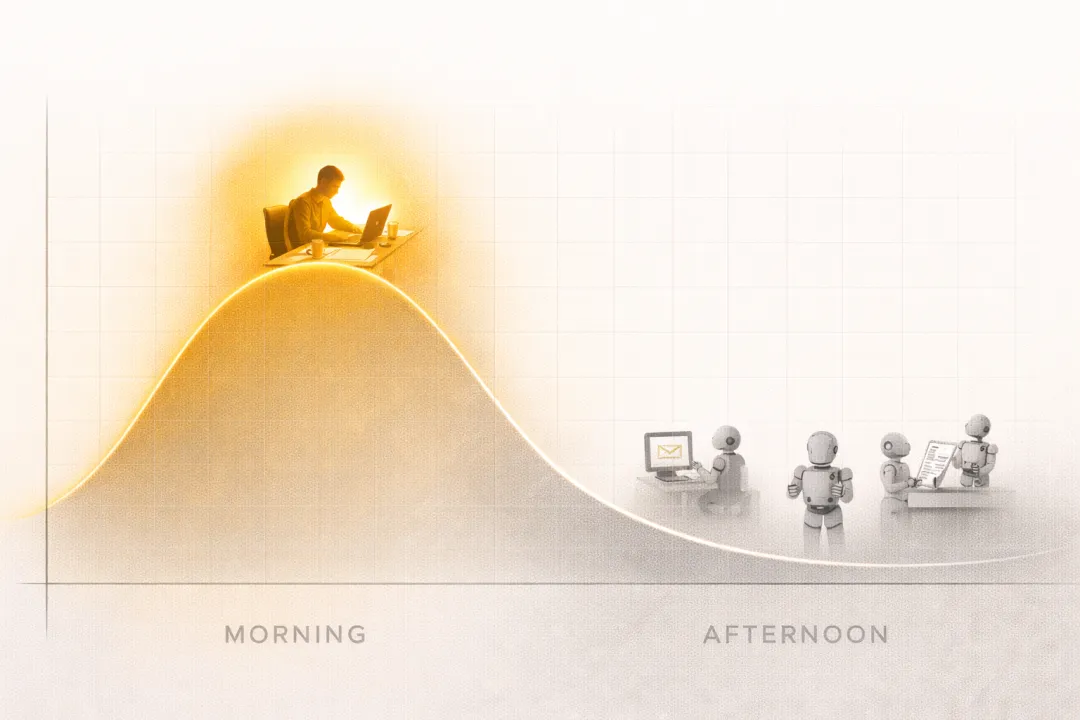
Time management is an industrial-age logic—factories demanded steady output, so you traded time for product. The AI era demands creative cognitive bursts—so you must manage energy, not time.
Industrial logic assumed: Time = output. Work eight hours, produce eight hours’ value. This holds on assembly lines—linear, additive, non-peak-dependent work. Creative work isn’t linear. Two peak-state hours can yield what twenty exhausted hours cannot.
Neuroscience confirms this (Kahneman, 2011): Human high-order cognition—deep analysis, creative connection, complex judgment—depends on highly active prefrontal cortex states. These states are energetically expensive, available only in limited daily windows. Most people waste this most precious window on emails, social media, low-quality meetings—then attempt deep thinking in depleted states, blaming low efficiency and lost creativity.
In the AI era, this error becomes fatal. AI handles all low-cognitive-cost tasks—information retrieval, formatting, data aggregation, standard writing. What it cannot replace is your judgment, insight, connection, and creation—produced only in peak cognitive states. Waste peak time on low-value tasks, and you’re using your most expensive resource for the cheapest work—while reserving your most critical work for your worst state.
ALAN · Closing remarks
Each morning, I have roughly three peak-state hours. During those hours, I check no messages, hold no meetings, answer no emails. I do one thing only: Think deeply about today’s most critical question. Everything else—including much of my actual work—I delegate to AI or postpone to afternoon. This isn’t laziness—it’s rational allocation. The value of your three most expensive hours depends entirely on how you use them. With AI, the stakes intensify: Used right, your peak output dwarfs average output tenfold; used wrong, your low-output state matches AI’s baseline. Asimov wrote Three Laws of Robotics to bound machines. Today, I offer you ten laws—to reclaim humanity’s place. Your place is at the peak—not on the assembly line.
You don’t need more time. You need to protect your best time—for doing what only you can do.
“AI isn’t your ceiling—it’s your lever.
Your place is at the peak—not on the assembly line.”
I Your opponent has never been AI—it’s the person who uses AI
II AI can’t steal the pits you’ve fallen into
III Depth is your credential; cross-domain fluency is your weapon
IV Attention is the only truly scarce resource in the AI era
V Trust is the only thing AI cannot mass-produce
VI Answers are depreciating. Good questions are appreciating
VII Find where “human presence equals value”
VIII Uncertainty isn’t your enemy—it’s your last advantage
IX Keep producing—turn your cognition into public assets
X Manage your energy, not your time
-Melly
Join TechFlow official community to stay tuned
Telegram:https://t.me/TechFlowDaily
X (Twitter):https://x.com/TechFlowPost
X (Twitter) EN:https://x.com/BlockFlow_News