UniPat AI launches the EchoZ prediction model, achieving a 63% win rate in live trading on Polymarket—“outperforming human traders”
TechFlow Selected TechFlow Selected
UniPat AI launches the EchoZ prediction model, achieving a 63% win rate in live trading on Polymarket—“outperforming human traders”
Echo’s mission, in one sentence: turning “what will happen in the world next” into programmatically accessible inputs for developers.
 Navigating Web3 tides with focused insights
Polymarket’s annual trading volume has already reached several billion dollars—but over 90% of its traders consistently lose money (Dune Analytics, March 2026). In a game fundamentally centered on “predicting the future,” most participants are simply subsidizing a small minority of superior decision-makers.
If the key to winning or losing lies in who judges probabilities more accurately, the question becomes: Can this ability be replicated?
UniPat AI’s EchoZ-1.0 delivers a quantifiable answer to precisely this question. In head-to-head comparisons against human Polymarket traders, EchoZ achieves a win rate of 63.2% on political questions and 59.3% on long-term predictions. The team deployed five EchoZ Agents in live trading—four turned a profit, with the top-performing agent generating a 15% return within one week.
This is not the result of “trading tricks,” but rather an overflow of model capability. Core members of UniPat AI hail from leading large language model teams—including Qwen, Kimi, Xiaomi, and Seed—and have long focused on building reasoning models and complex decision systems. In prediction markets—a domain that is, at its core, a “probability game”—they are systematically replacing intuition with models, rigorously validating this capability in real markets.
More importantly, this is not just a model that shines only in reports—it is a fully deployable predictive capability. UniPat AI is productizing EchoZ and plans to release it as a public API. For developers and institutions, this means they will soon be able to input a question in natural language and receive a complete, structured output—including conclusion, probability distribution, evidence chain, and counterfactual analysis.
Before full public launch, a more critical question arises: Where does EchoZ’s advantage actually come from?
What Does a 63% Win Rate Mean?
Anyone experienced in probabilistic games knows the magnitude of statistical advantage implied by a sustained >60% win rate in a zero-sum market where most participants lose money. A win rate above 50% yields positive expected value; at 60%, a stable, profitable strategy becomes feasible.

EchoZ’s win rates against human Polymarket traders, by scenario:
- Politics & Governance: 63.2%
- Long-Term Predictions (7+ days): 59.3%
- High-Uncertainty Intervals (Human Confidence: 55%–70%): 57.9%
The pattern is clear: EchoZ’s edge grows strongest precisely where humans hesitate most—longer time horizons, multi-factor博弈, fragmented information.
These are exactly the highest-value decision contexts: regulatory policy direction, macroeconomic variables, on-chain governance proposals, token listing timing—all involve high uncertainty, extended timeframes, and interwoven causal factors. Sustained accuracy in probabilistic judgment here equals alpha.
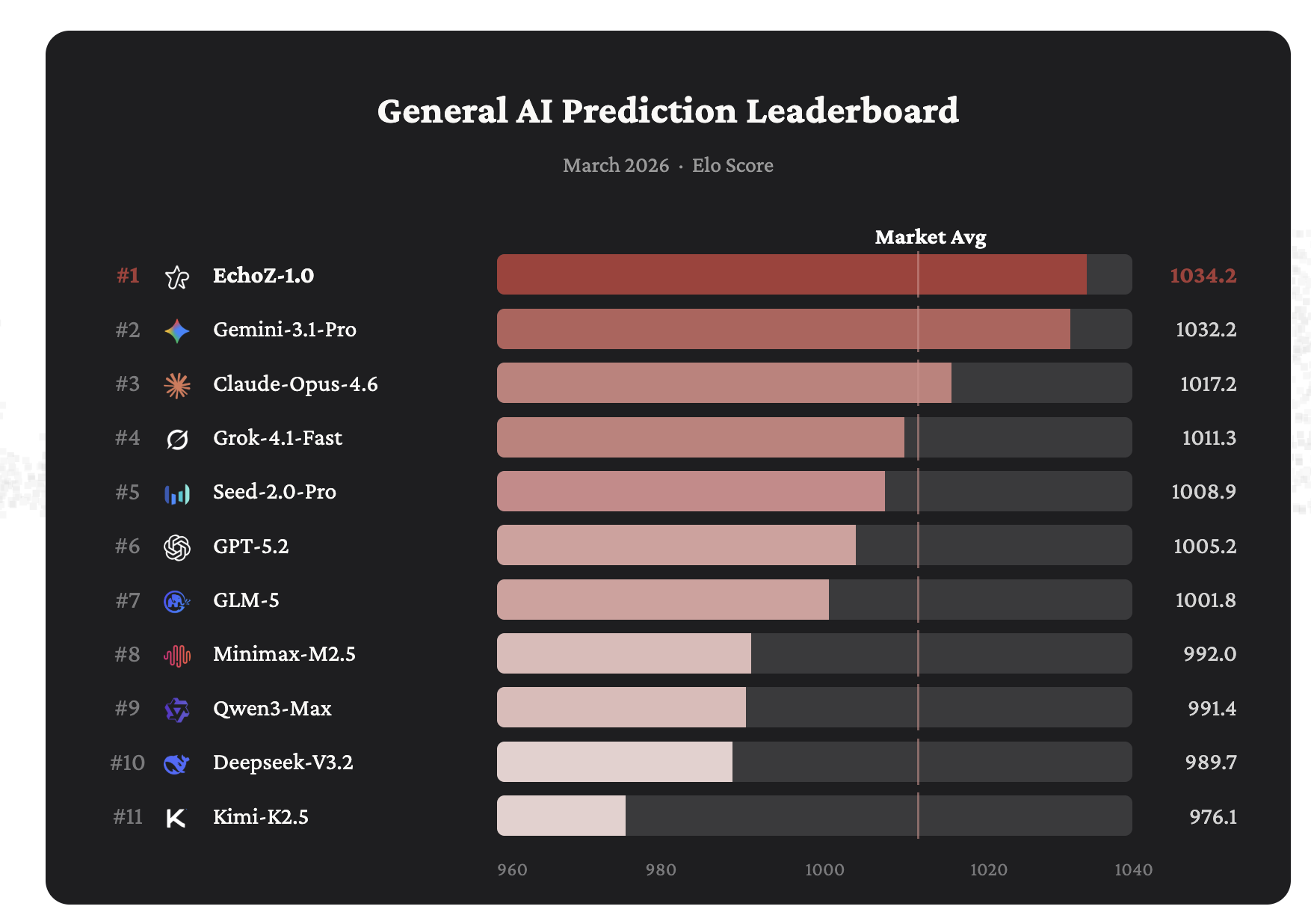
EchoZ ranks #1 on the General AI Prediction Leaderboard with an Elo score of 1034.2—outperforming Gemini-3.1-Pro (1032.2), Claude-Opus-4.6 (1017.2), and GPT-5.2. The leaderboard evaluates 12 models across 7 domains and over 1,000 active prediction questions.
Is This Ranking Credible?
A self-built leaderboard naturally raises the first impression: “Awarding themselves the prize.” UniPat AI did something deeply Crypto Native: They made all data publicly available.
All prediction questions, model outputs (including full probability distributions), and final settlement results are openly hosted at echo.unipat.ai, enabling anyone to audit and verify every prediction retroactively.
Beyond that, they published four rigorous stress tests:
- Varying core parameters of the scoring framework (σ from 0.01 to 0.50, nine settings total): EchoZ ranked #1 in every single setting—the only model with zero ranking volatility. GPT-5.2 fluctuated wildly between positions #2 and #9.
- Randomly dropping 10%–70% of data: rankings remained stable.
- Removing 1–6 models from the leaderboard: the relative ordering of remaining models barely changed.
- Introducing new models: rankings converged to stability in just 5.4 days.
Transparent. Verifiable. Robust.
How Does It Make Money?
EchoZ autonomously searches for information, reads news, queries data sources, and outputs a structured prediction report: probability distribution, evidence chain, and reasoning basis—every inference step fully traceable.
Here are three real-world cases:
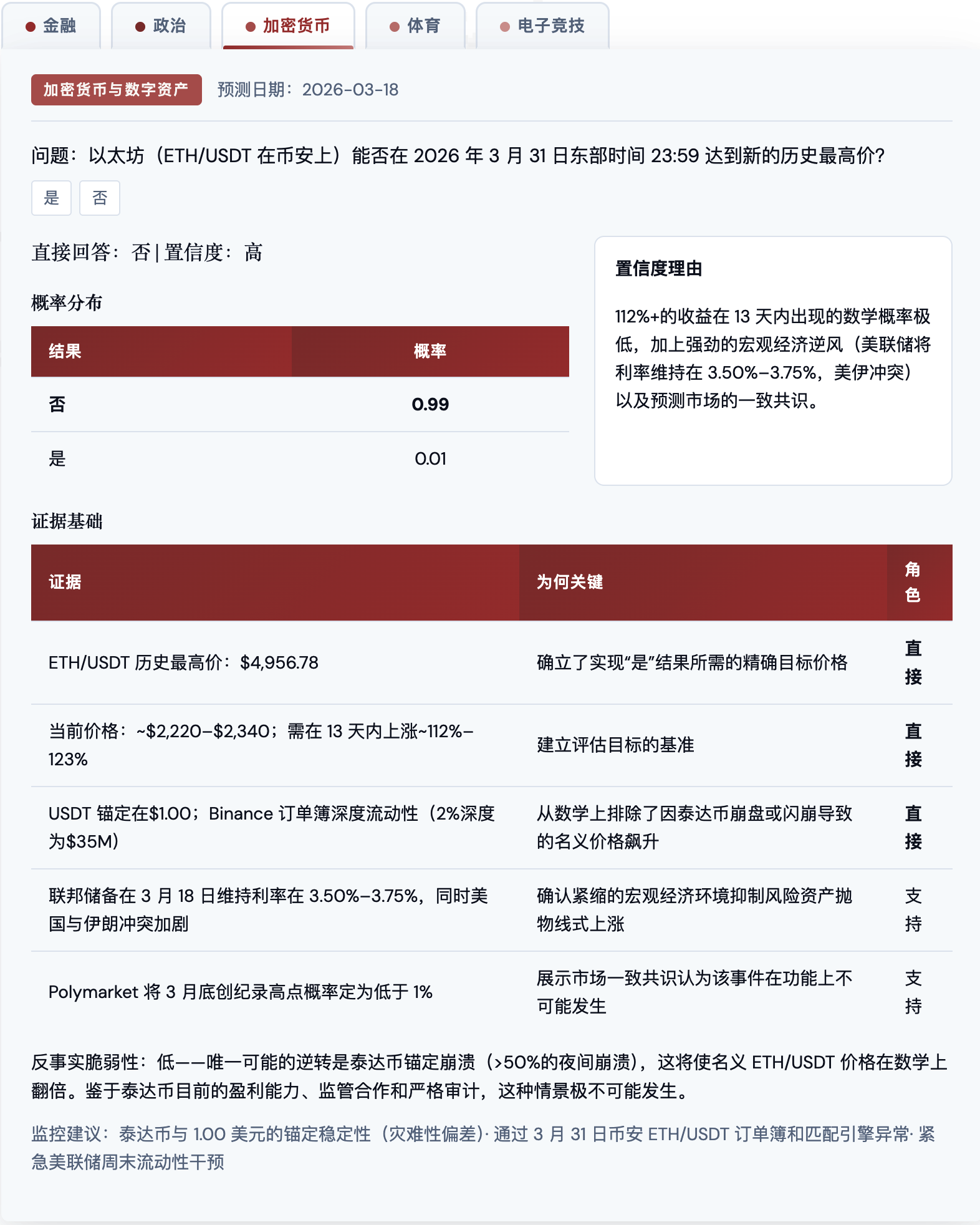
NVIDIA Market Cap Prediction. On March 18, 2026, EchoZ answered the question: “Which company will have the highest global market cap on March 31?”—assigning NVIDIA a 98% probability. Its judgment wasn’t based on a single data point, but on four independent, cross-validating evidence chains: (1) NVIDIA’s market cap (~$4.43T–$4.45T) led Alphabet and Apple by ~$700B—nearly impossible to close in nine trading days; (2) the U.S. Department of Commerce rescinded AI chip export control rules on March 13, eliminating the largest regulatory risk before the target date; (3) options market implied volatility was only ±1.98%, indicating derivatives markets priced no crash capable of erasing NVIDIA’s 15% lead; (4) Qatar helium facility shutdown posed supply-chain risk, but TSMC had not halted production. These four lines of evidence locked in the conclusion from market math, regulation, derivatives pricing, and supply chain—four orthogonal dimensions.
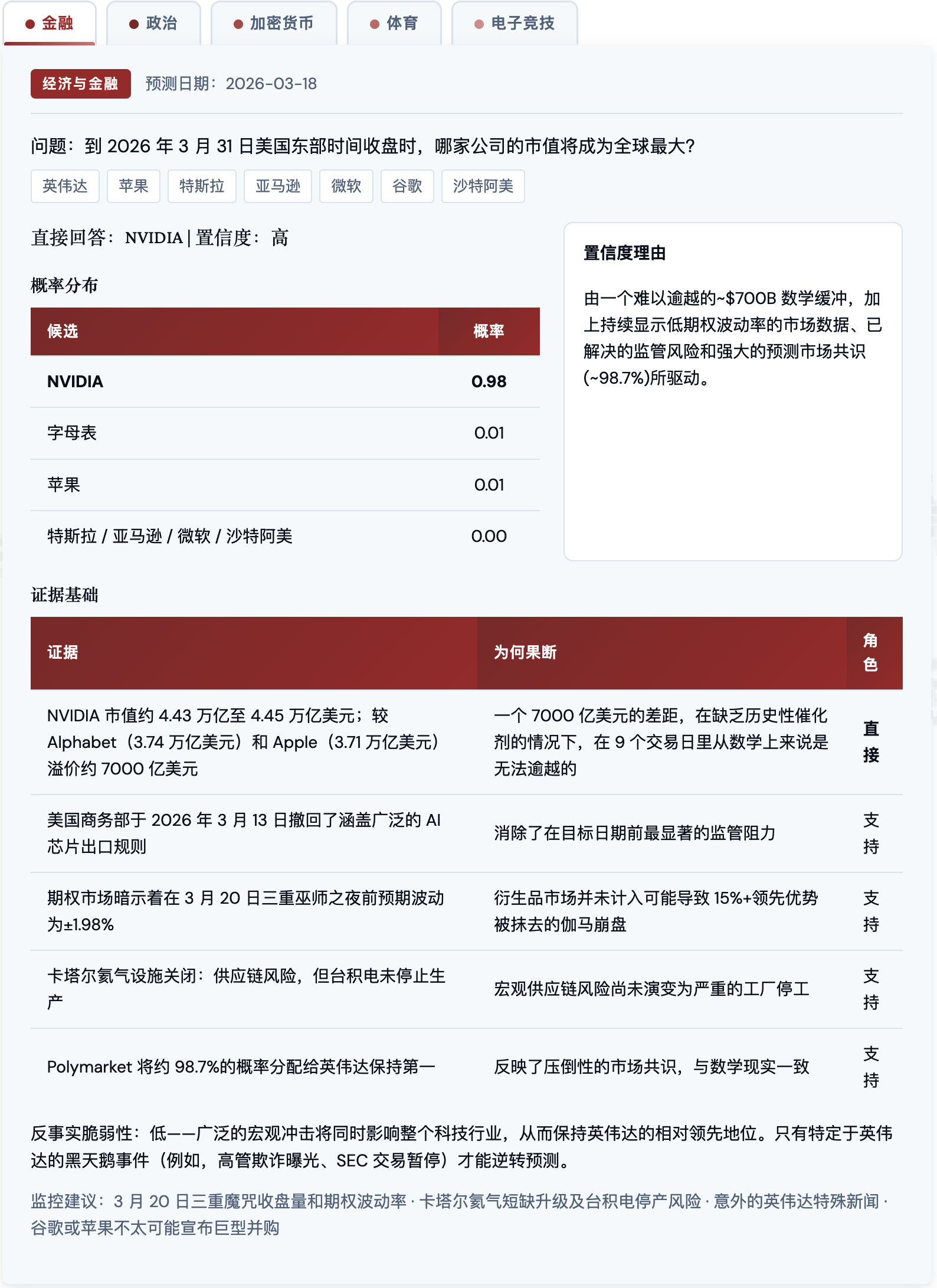
ETH All-Time High Prediction. Also on March 18, 2026, EchoZ responded to “Will ETH/USDT reach a new all-time high before March 31?”—assigning a 99% probability to “No.” The reasoning was crisp: current price ($2,220–$2,340) vs. ATH ($4,956.78) requires a 112%–123% gain in 13 days; Fed holding rates steady at 3.50%–3.75% amid U.S.-Iran tensions suppresses risk-asset rallies; USDT remains tightly pegged and Binance ETH/USDT depth is robust ($35M liquidity within a 2% price band), ruling out nominal price distortion from stablecoin de-pegging. Three independent evidence chains converged—and Polymarket consensus aligned closely (<1%).
NBA Western Conference #1 Seed Prediction. Same day, March 18: EchoZ predicted the 2025–26 NBA Western Conference #1 seed, assigning the Oklahoma City Thunder an 89.9% probability. Core logic: OKC stood at 54–15, leading San Antonio by 3 games, with both teams having 13 games left; though SA held the head-to-head advantage (4–1), their remaining schedule was the toughest in the league (opponent win rate .560); OKC’s magic number was just 11—meaning normal performance would clinch the top spot. LA maxed out at 57 wins, mathematically eliminated—confirming this was strictly a two-team race.
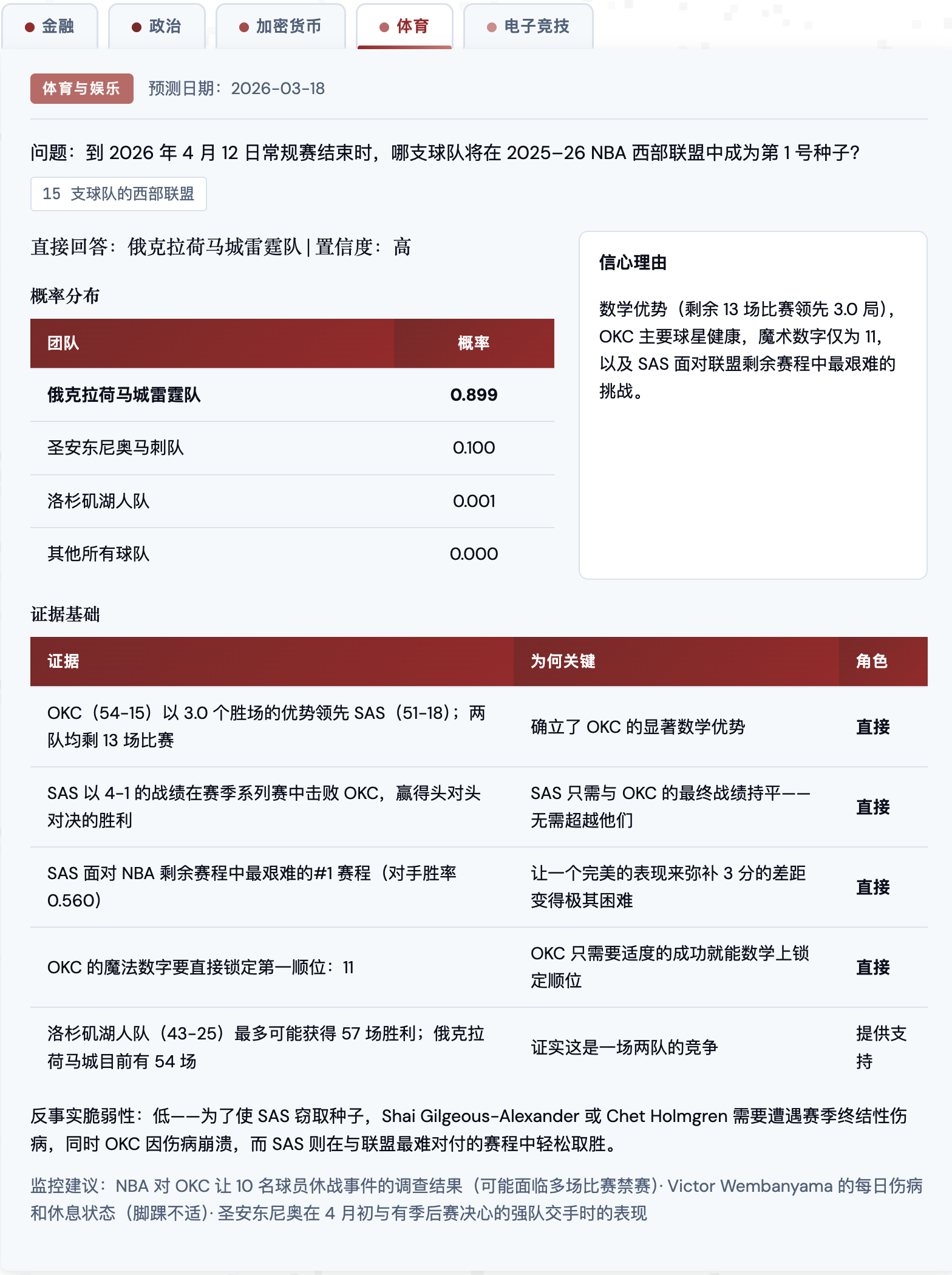
Critically, these predictions were not cherry-picked post hoc. Timestamps, probability outputs, and settlement outcomes for every question are publicly verifiable.
Why Can’t GPT or Claude Do This?
Briefly: different training methodology.
Commercial LLMs train prediction capabilities on historical data—but historical data suffers from two flaws: models often encounter answers directly while web-searching (data leakage), and real-world randomness introduces noise—e.g., a sound analysis penalized by a black swan event, or a random guess rewarded by luck.
EchoZ adopts a paradigm called Train-on-Future: models predict events that have not yet occurred, and evaluation focuses on the quality of reasoning—not waiting for ground-truth resolution. Good analysts sometimes err—but maintain high long-term win rates. EchoZ’s training logic mirrors this principle.
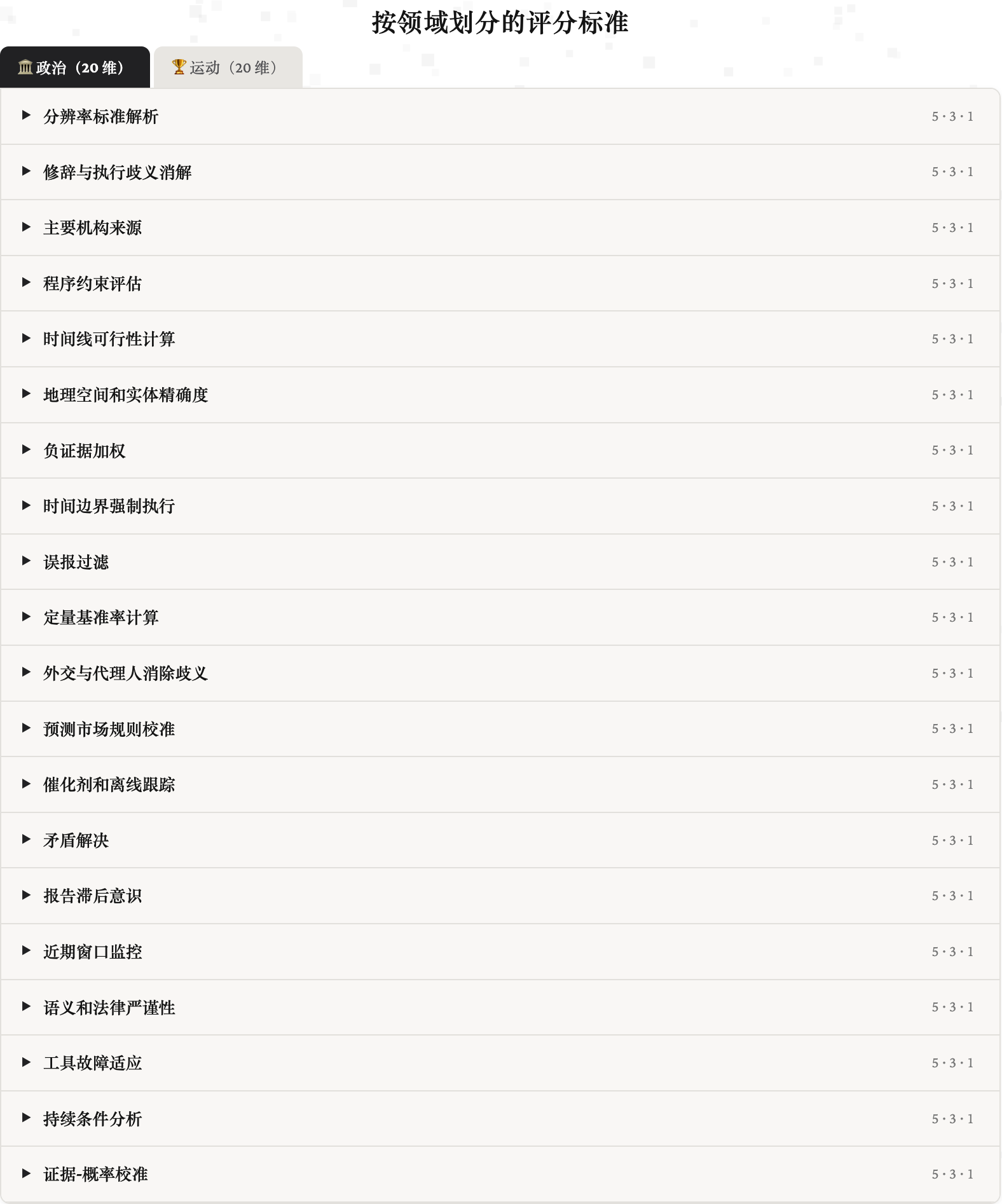
But who defines “good reasoning”? Criteria vary dramatically across domains. UniPat’s approach is data-driven rubric search (Rubric Search): they prepare candidate evaluation dimensions, use them to score and rank model reasoning steps, then correlate those scores against true-outcome-based Elo rankings—the higher the correlation, the closer the rubric approximates genuine “good reasoning.” Rubrics are searched and refined per domain, iteratively.
The results are fascinating. In politics, the optimal rubric contains 20 dimensions—including “absence signal detection”: whether the model treats “nothing happening” as meaningful information (e.g., no new court filings, no new military bulletins). Another is “speech-action separation”: distinguishing politicians’ social-media declarations from legally binding actions entering formal process. All dimensions emerged purely from data—not human intuition.
What Can You Build After API Launch?
The Prediction API will soon open to enterprises and developers. Input a forecasting question in natural language; receive a full, structured report:
- Probability Distribution: Quantified likelihoods for each possible outcome
- Evidence Chain: Multiple independent supporting pieces of evidence, weighted and ordered
- Counterfactual Analysis: How probabilities shift under changes to key variables
- Monitoring Recommendations: Signals and trigger conditions requiring ongoing attention
For exchanges and prediction-market platforms, this enables direct integration of AI-powered prediction layers—users browsing a prediction market contract see EchoZ’s probability assessment, core rationale, and key variables alongside it. For quant teams, these structured probability outputs can feed directly into strategy engines as new alpha factors. For DeFi protocols, event probabilities represent an entirely new on-chain data dimension—conditional options, prediction-based insurance pricing, dynamic risk-control parameters. Today, reliable on-chain event-probability data is virtually nonexistent—and EchoZ aims to fill that gap.
This is a new category: predictive capability as callable infrastructure.
Why This Team?
UniPat AI’s core team comes from top-tier LLM organizations—including Qwen, Kimi, Xiaomi, and Seed—with over a dozen researchers specializing in reinforcement learning, agent systems, data synthesis, and model evaluation. The company has secured backing from multiple leading U.S.-dollar venture funds.
This team composition explains EchoZ’s product architecture. Building predictive intelligence requires solving three interlocking challenges: how to train (RL + process-based reward), how to evaluate (dynamic assessment systems), and how to enable autonomous information retrieval and judgment (agent design). These three challenges align precisely with the team’s deepest technical strengths.
They chose to build prediction infrastructure because predictive capability is inherently quantifiable, verifiable, and monetizable—the rare AI capability with a direct, measurable path to commercial value.
UniPat AI states: “Predictive capability is among the few AI competencies that directly map to commercial value. When probabilistic judgment becomes structured, verifiable, and callable, it becomes a foundational input for trading and financial systems.”
What’s Next?
Over the past few years, capabilities successively API-ified have been text, images, and code.
The next frontier may be judgment under uncertainty itself. When probabilistic forecasts of the future become a callable, integrable, and verifiable parameter, they embed into far broader decision pipelines—trading strategies, risk models, product pricing, compliance alerts—extending well beyond prediction markets alone.
In one sentence, EchoZ’s mission is: Turn “what happens next in the world” into a developer-callable input.
ECHO Website: https://echo.unipat.ai
Technical Blog: https://unipat.ai/blog/Echo
Join TechFlow official community to stay tuned
Telegram:https://t.me/TechFlowDaily
X (Twitter):https://x.com/TechFlowPost
X (Twitter) EN:https://x.com/BlockFlow_News
 @UniPat_AI