Overseas capital is accelerating its exit, and U.S. Treasuries are facing their largest sell-off pressure in six years.
TechFlow Selected TechFlow Selected
Overseas capital is accelerating its exit, and U.S. Treasuries are facing their largest sell-off pressure in six years.
If the trend continues, long-end yields may face an upside risk of over 100 basis points.
 Navigating Web3 tides with focused insights
By Bu Shuqing
Source: WallStreetCN
The U.S. Treasury market is facing potential selling pressure from foreign official investors—a development that has triggered heightened market vigilance.
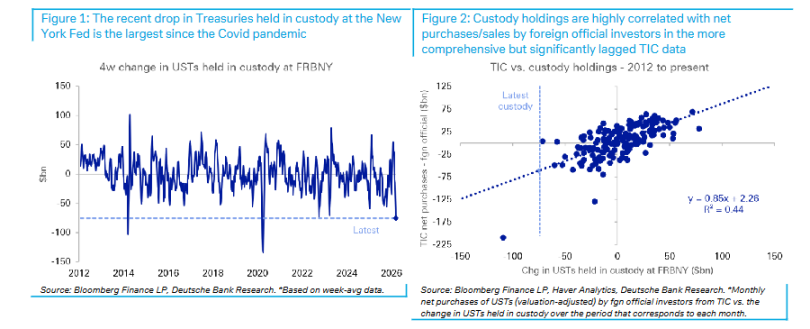
According to Wind Trading Desk, Deutsche Bank’s March 23 research report shows that foreign official holdings of U.S. Treasuries held in custody at the Federal Reserve Bank of New York dropped sharply by $75 billion over the past four weeks—the largest single-month decline since the pandemic shock of 2020. Based on historical data modeling, this shift implies actual net foreign official sales of U.S. Treasuries totaling approximately $60 billion—also the largest such outflow since the pandemic.
This data aligns with the recent sharp rise in U.S. Treasury yields—especially the unusual uptick in “belly” (mid-term) yields, precisely where foreign official holdings are most concentrated. Deutsche Bank warns that if foreign demand continues to erode, the “convenience yield” advantage of U.S. Treasuries could be undermined, posing a material upside risk to long-end yields.
Custodial Data Reveals Selling Signals
The most authoritative source for tracking foreign official investors’ U.S. Treasury activity is the U.S. Treasury’s TIC (Treasury International Capital) report—but it suffers from significant lags, with March data not due until mid-May at the earliest.
As an alternative, the Federal Reserve Bank of New York’s weekly H.4.1 release includes a memorandum item recording the face value of securities held in custody by foreign official and international accounts. This data lags by just one day. In their report, Deutsche Bank strategists Matthew Raskin, Steven Zeng, and Andrew Fu note that the latest H.4.1 data shows foreign official custodial holdings of U.S. Treasuries declined by $75 billion over the past four weeks on a weekly average basis—an降幅 not only the largest since March 2020 but also the second-largest over any comparable period in the past decade.
Notably, unlike a similar episode in March 2023, FIMA repo volumes did not rise concurrently this time—indicating these reductions stem from outright sales or non-rollover at maturity, rather than liquidity provision via repos with the Fed. Foreign reverse repos, foreign official deposits, and FIMA securities lending have also remained largely unchanged over the past month.
High Correlation Between Custodial and TIC Data
To what extent can custodial holdings serve as a proxy for overall changes in foreign official U.S. Treasury positions? Deutsche Bank conducted a systematic validation.
The report finds that over the past 15 years, changes in custodial holdings have exhibited a strong correlation with foreign official net purchases reported in the TIC data—explaining roughly 50% of the variation. Even when restricting the sample to post-2019 to filter out potential shifts in reserve management practices, this relationship remains robust.
Based on this historical relationship, the $75 billion drop in custodial holdings corresponds to approximately $60 billion in net foreign official sales. Deutsche Bank notes this would represent the largest net foreign official sale since the pandemic—and the only comparable instance prior to that dates back to December 2018.
Shift in Fund Flows Amid FX Intervention
This decline in custodial Treasury holdings closely matches recent market dynamics observed by Deutsche Bank’s foreign exchange strategy team.
As noted in a prior report by Deutsche Bank’s FX strategy team, the U.S. dollar failed to strengthen as expected following the outbreak of conflict in Iran and the surge in oil prices—partly because several Asian central banks engaged in large-scale foreign exchange intervention. Meanwhile, the team’s high-frequency ETF monitoring data also shows a marked slowdown in foreign investor purchases of dollar-denominated assets.
These two strands of evidence converge on a single conclusion: foreign official investors are reducing their allocations to dollar assets—and Treasury sales are a direct manifestation of this trend.
Sustained Selling Could Push Long-End Yields Up by Over 100 Basis Points
Deutsche Bank’s analysis uncovers a structural concern: U.S. Treasury yields have long benefited from the “convenience yield” conferred by the dollar’s reserve currency status—and that advantage is now under pressure.
Citing its own prior research, the report notes that the current 10-year Treasury yield stands more than 100 basis points below the level implied by the U.S. net international investment position (NIIP). A recent academic working paper estimates that the dollar’s reserve currency status depresses U.S. long-term interest rates by roughly 90 basis points relative to a “normal” level.
Deutsche Bank warns that persistent declines in foreign demand could trigger a reversion in this convenience yield, opening up substantial room for upward movement in both Treasury term premiums and overall yields—posing a direct headwind to holders of U.S. Treasuries.
Join TechFlow official community to stay tuned
Telegram:https://t.me/TechFlowDaily
X (Twitter):https://x.com/TechFlowPost
X (Twitter) EN:https://x.com/BlockFlow_News