As hundreds of billions in U.S. debt find their "crypto buyers," we are witnessing the birth of Dollar 2.0
TechFlow Selected TechFlow Selected
As hundreds of billions in U.S. debt find their "crypto buyers," we are witnessing the birth of Dollar 2.0
The GENIUS Act aims to establish the first federal regulatory framework for the U.S. stablecoin market, undergoing a dramatic shift from initial failure to bipartisan compromise.
 Navigating Web3 tides with focused insights
Author: White55, Mars Finance
1. Legislative Journey: A Dramatic Turn from "Near Death" to "Resurrection"
From May to June 2025, the U.S. Senate's debate over the GENIUS Act (short for the Guiding and Establishing National Innovation with Stablecoins Act) amounted to an epic battle intertwining politics and finance. This legislation, aiming to create the first federal regulatory framework for the $250 billion stablecoin market, made a dramatic comeback—from "procedural death" to "bipartisan compromise"—ultimately advancing to full Senate debate by a vote of 68 to 30. Yet behind this victory lay months of partisan bargaining, lobbying battles among industry giants, and ethical controversies surrounding the Trump family’s "crypto goldmine."
Timeline Recap:
-
March 2025: Republican Senator Bill Hagerty formally introduced the initial bill draft, aiming to establish a dual-tiered "federal + state" regulatory system for payment-focused stablecoins.
-
May 8: The first procedural vote unexpectedly failed 48–49, as Democrats collectively opposed it citing “conflict of interest” involving the Trump family.
-
May 15: Emergency bipartisan negotiations produced a revised version, removing provisions targeting the Trump family’s crypto ventures in exchange for partial Democratic support.
-
May 20: The amendment passed the critical Cloture Vote 66–32, clearing legislative hurdles.
-
June 11: The Senate approved the bill overwhelmingly 68–30, moving into final debate and amendment procedures.
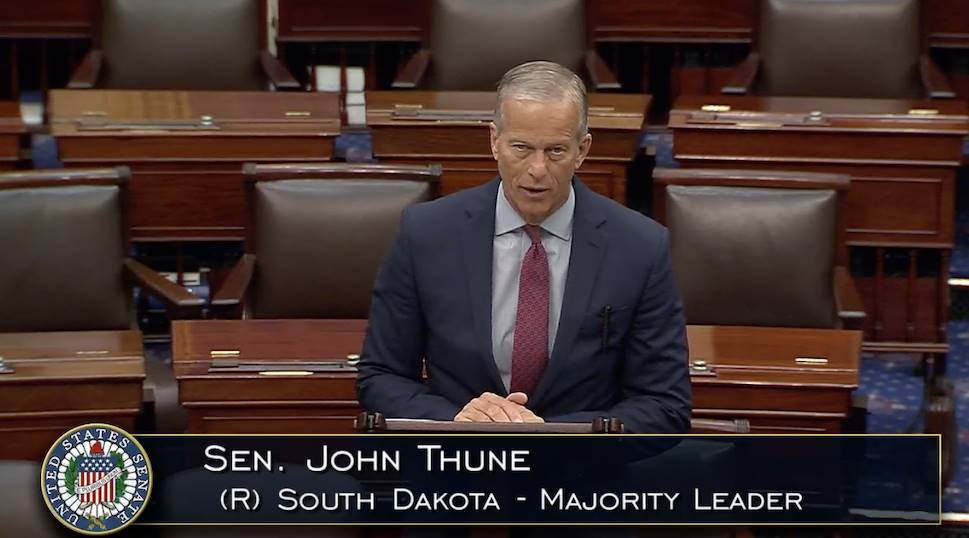
Senate Majority Leader John Thune speaks Wednesday in support of passing the GENIUS Act. Source: U.S. Senate
The turning point in this series of events was the Republicans’ strategic framing of the bill as a tool for securing “digital dollar dominance,” coupled with growing Democratic concern over financial risks arising from a “regulatory vacuum.” Senate Majority Leader John Thune’s rhetoric proved particularly persuasive: “If America doesn’t lead on stablecoin rules, China will fill the void with digital yuan!”
2. Key Provisions: The Regulatory Blueprint and the "Devil in the Details"
The GENIUS Act attempts to balance innovation promotion against risk prevention through a regulatory framework built on six core pillars:
Dual Oversight and Issuance Thresholds
Stablecoins exceeding $10 billion in circulation fall under federal oversight led by the Office of the Comptroller of the Currency (OCC); smaller issuers may opt for state-level regulation, provided their standards align with federal requirements. This structure appeases state autonomy while drawing clear boundaries for major players—widely seen as indirect protection for Circle (USDC) and Tether (USDT).
1:1 Reserves and Asset Segregation
Stablecoin issuers must fully back tokens with highly liquid assets such as cash or short-term U.S. Treasuries, with reserves strictly segregated from operating funds. While directly addressing the 2022 Terra collapse, the allowance of money market funds—considered riskier assets—as part of reserves has drawn criticism for potentially “planting landmines.”
Restrictions on Tech Giants ("Tightening the Headband")
Non-financial tech companies (e.g., Meta, Google) must obtain approval from a newly established Stablecoin Certification Review Committee (SCRC) before launching stablecoins, meeting data privacy and antitrust criteria. This provision is widely interpreted as a targeted move against allies of Trump, such as Elon Musk’s X platform stablecoin initiative.
Consumer Protection and Bankruptcy Priority
In case of issuer bankruptcy, stablecoin holders have priority rights to redeem assets, and reserve funds are excluded from bankruptcy estates. However, Democrats argue that this falls short of traditional FDIC bank insurance, leaving users vulnerable to frozen funds.
Anti-Money Laundering and Transparency
Stablecoin issuers are brought under the Bank Secrecy Act, mandating KYC compliance and suspicious transaction reporting. A key loophole remains: decentralized exchanges (DEXs) are not covered, leaving channels open for illicit financial flows.
"Loophole for Presidential Family"
The bill does not explicitly ban members of Congress or presidential relatives from participating in stablecoin businesses. As a result, USD1—a stablecoin issued by World Liberty Financial (WLF), linked to the Trump family, with a $2 billion market cap—gains de facto legitimacy. Senator Elizabeth Warren denounced this: “This is a green light for Trump’s crypto corruption!”
3. Controversy Storm: Trump’s "Crypto Goldmine" and Partisan Divide
The biggest obstacle to the bill wasn't technical policy but the deep entanglement of the Trump family in the crypto industry. Three key controversies pushed political tensions to a boiling point:
"Regulatory Arbitrage" via USD1
WLF has already channeled $2 billion into Binance via an Abu Dhabi investment firm. The Trump family could earn over $80 million annually in trading fees. More critically, upon passage of the bill, USD1 would automatically gain federal recognition, potentially increasing its market value tenfold to $20 billion.
Moral Crisis of "Pay-to-Meet"
Trump has sold meme coins (e.g., TRUMP Coin) offering holders access to “presidential dinners,” prompting Democratic accusations of “securitizing national power.” Senator Jeff Merkley stated bluntly: “This is the most brazen quid pro quo ever seen!”
The Revolving Door Between Legislature and Executive
Hagerty, one of the bill’s chief architects, was revealed to have received political donations linked to WLF. Democrats attempted to introduce amendments banning public officials from stablecoin involvement, but these were blocked en masse by Republicans.
Although both parties reached a compromise on May 15 by removing direct references to Trump, figures like Warren continued a “last stand” effort in the Senate, demanding disclosure of financial ties between the Trump family and WLF. This ethics battle is, in reality, a prelude to the 2026 midterm elections.
4. Market Turbulence: Compliance Windfall and the Rise of a "Oligarchic Era"
If ultimately enacted, the GENIUS Act will trigger structural realignment across the stablecoin market:
Winners Among Market Leaders
Circle (USDC) and Tether (USDT), already compliant with reserve regulations (80% in short-term Treasuries), will gain federal licenses by default, further squeezing smaller issuers. Goldman Sachs forecasts their combined market share could rise from 94% to 98%.
Traditional Finance Entering the Fray
Institutions including JPMorgan Chase and Wells Fargo have applied for Limited Purpose Stablecoin Licenses, planning to use on-chain payments to erode cryptocurrency exchanges’ market share. The clause allowing insurers to issue stablecoins opens even wider doors for traditional financial titans.
Solution or Poison Pill for the Treasury Crisis?
By mandating U.S. Treasuries as primary reserve assets, the bill may ease short-term liquidity pressures on government debt. But long-term, it risks worsening “maturity mismatch”—investor preference for short-term bonds could depress demand for long-term Treasuries, exacerbating fiscal deficits.
Domino Effect on Global Regulation
The EU, UK, and Singapore have signaled intentions to model policies after the GENIUS Act, potentially forming a “Dollar Stablecoin Alliance.” Renminbi- and yen-denominated stablecoins may be squeezed out of cross-border payments, reshaping global monetary dynamics.
5. Next Battleground: House Negotiations and Trump’s Final Judgment
Despite Senate approval, the bill still faces three major hurdles:
House Passage via Simple Majority
The Republican-controlled House (220–215) needs only 218 votes for passage. However, the House version—the STABLE Act—differs significantly: it grants exclusive regulatory authority to the federal government and bans tech companies from issuing stablecoins. Reconciliation between chambers may drag until just before the August recess.
The President’s Conflict of Interest
While Trump publicly supports the bill, his family’s financial interests are deeply tied to its details. If Democrats push an “anti-corruption amendment” in the House, Trump might resort to veto power, potentially killing the legislation.
The "Gray Rhino" of Legal Challenges
The U.S. Constitution’s Emoluments Clause prohibits the president from receiving profits from foreign governments. Since 20% of USD1 users reside in sanctioned countries (e.g., Iran, North Korea), this could trigger intervention by the Supreme Court.
6. Conclusion: "Dollar Hegemony 2.0" in the Crypto Age
The ultimate ambition of the GENIUS Act goes far beyond market regulation—it seeks to embed dollar hegemony into the DNA of blockchain. By tying U.S. Treasuries to stablecoins, America aims to build a “digital dollar empire,” where every on-chain transaction globally subtly reinforces the dollar’s reserve currency status. Yet the stakes are equally high: if DeFi (decentralized finance) bypasses regulated stablecoins, or if China accelerates the internationalization of digital yuan, the act may end up as nothing more than a house of cards.
Political maneuvering, corporate lobbying, and technological revolution—standing at this historic crossroads, the fate of the GENIUS Act will determine who controls the next decade of global financial order.
Join TechFlow official community to stay tuned
Telegram:https://t.me/TechFlowDaily
X (Twitter):https://x.com/TechFlowPost
X (Twitter) EN:https://x.com/BlockFlow_News