Stripe and Tempo jointly launch the Machine Payment Protocol (MPP); AI agent autonomous payment infrastructure is now in place.
TechFlow Selected TechFlow Selected
Stripe and Tempo jointly launch the Machine Payment Protocol (MPP); AI agent autonomous payment infrastructure is now in place.
If this protocol becomes the industry standard, AI agents’ “autonomous consumption” will evolve from a concept into a scalable reality.
 Navigating Web3 tides with focused insights
Author: Tempo / Liam Horne
Translation & Compilation: TechFlow
TechFlow Introduction: The Tempo mainnet has officially launched, accompanied by the Machine Payment Protocol (MPP)—an open standard for machine payments co-drafted with Stripe. This is not a solo effort by a crypto project to build an ecosystem; Visa, Anthropic, OpenAI, Mastercard, and Shopify have already integrated this open standard.
The core innovation of MPP is the “session” mechanism—akin to OAuth in payments: An agent authorizes once and pre-funds its account; thereafter, every API call or data consumption triggers real-time, automatic settlement without requiring individual on-chain transactions per payment.
If this protocol becomes a widely adopted standard, AI agents’ “autonomous spending” will evolve from concept to scalable reality.
Full Text Below:
Tempo Mainnet Is Live!
Tempo is internet-scale infrastructure built for real-world payments. Its design goals are instant settlement, predictable low fees, high throughput, and global availability. Starting today, you can begin building on Tempo via our public RPC endpoint.
Start Building →
Alongside the mainnet launch, we’re also releasing the Machine Payment Protocol (MPP)—an open standard for machine payments co-authored by Stripe and Tempo. Details follow below.
When we first introduced Tempo in September, our premise was simple: If stablecoins become the foundational layer of internet commerce, then the infrastructure for moving money must be purpose-built for payments.
Stablecoins enable cross-border instant settlement and 24/7 availability. Yet most existing blockchains were not designed for large-scale payment workloads—fees fluctuate, throughput is limited, and transaction structures don’t align with common payment flows.
Unlike other blockchains, Tempo is engineered around the needs of real-world payment systems: predictable costs, high throughput, and reliable settlement for massive volumes of transactions.
Over the past few months, a new class of applications has made these requirements even clearer:
The Rise of Agent Payments
Agents are already capable of writing code, orchestrating services, retrieving data, and executing complex workflows across the internet. But as these systems grow more capable, they increasingly need to transact.
A research agent may need to pay for access to a dataset. A development agent may need to purchase compute or testing infrastructure. A workflow agent may need to coordinate multiple services, paying each one upon task completion.
In such scenarios, payments become continuous and programmable. A single workflow may involve dozens—or even hundreds—of micro-payments to different services, rather than a single bilateral transaction.
This pattern quickly exposes the limitations of existing payment infrastructure.
Traditional payment systems assume human-initiated transactions and manual approval workflows. Meanwhile, many existing blockchains aren’t designed for high-frequency, low-value transactions—where predictable cost and reliability are paramount.
Tempo provides the settlement infrastructure for interactions at this scale, enabling agents to conduct programmable transactions.
Machine Payment Protocol (MPP) Launch
To lay this foundation, we’re launching the Machine Payment Protocol (MPP)—an open standard for machine payments. Designed to be extensible and payment-agnostic, MPP currently supports stablecoins, cards, and more.
MPP offers agents and services a standardized, programmatic way to coordinate payments. Rather than each service inventing its own billing process, MPP defines a simple protocol for machines to initiate, authorize, and settle payments with one another.
We’ve released MPP as an open standard to ensure consistency in machine payments across services and payment channels.
MPP currently runs on Tempo—but the protocol itself is designed to be underlying-rail-agnostic and extensible. For example, our design partner Visa has extended MPP to support card payments over its network. Stripe has extended it to support cards, wallets, and other payment methods via its platform. Lightspark has extended it to support Bitcoin payments over the Lightning Network.
Streaming Payments via Sessions
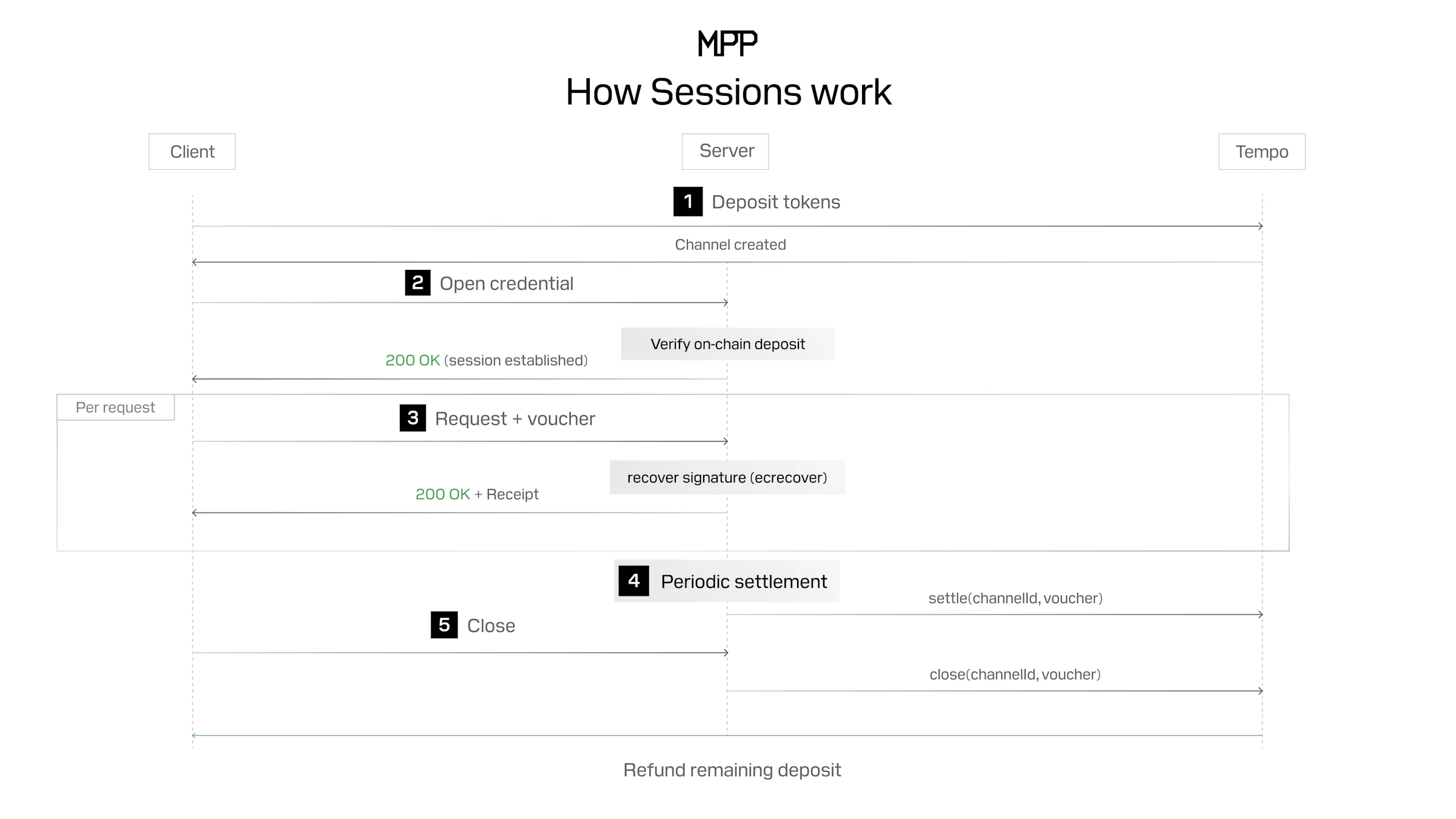
MPP enables agents to autonomously pay for services: An agent requests resources from a service; the service returns a payment request; the agent authorizes payment from its wallet; the transaction settles instantly; and the service delivers the requested resource.
This mechanism is enabled by a new primitive called a “session,” designed to support ongoing payments. Think of it as OAuth for payments: authorize once, then allow automated payments within predefined limits.
When an agent initiates a session, it pre-locks funds. As the agent consumes resources from the service—API calls, model inference, data queries, etc.—payments stream continuously, without requiring separate on-chain transactions for each interaction.
Thousands of micro-transactions can be aggregated into a single settlement transaction, making true usage-based pricing feasible at internet scale.
Payment Directory
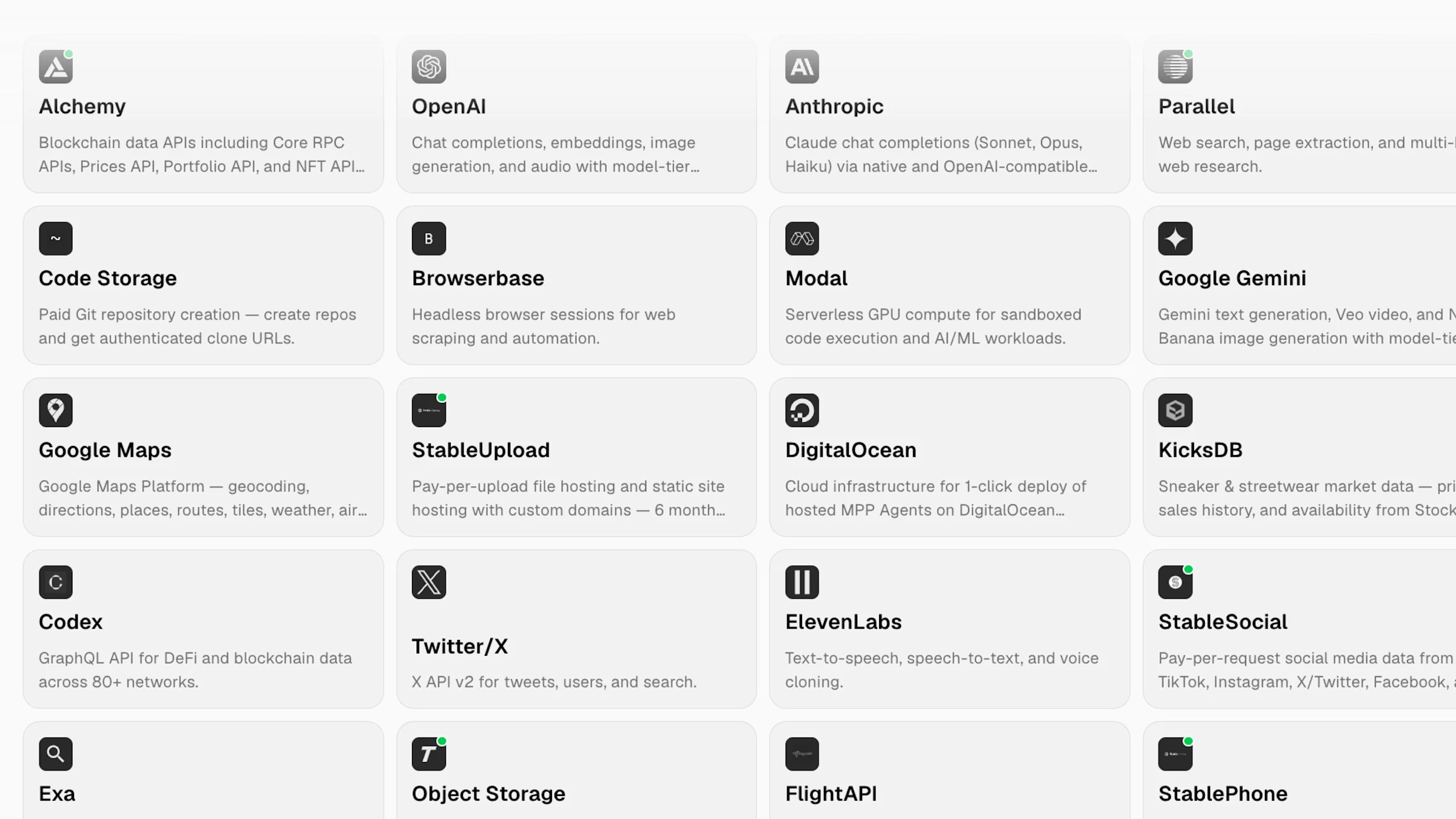
Our Payment Directory provides a unified catalog of MPP-compatible services—any agent can automatically transact with them.
Service providers can also onboard to monetize their offerings and make them discoverable to agents. MPP supports diverse use cases—including per-call APIs, monetized MCP servers, paid content and data, and multi-service workflows.
At launch, the Payment Directory includes integrations with over 100 services spanning model providers, developer infrastructure, compute platforms, and data services—including Alchemy, Dune Analytics, Merit Systems, and Parallel Web Systems.
Infrastructure for Scaling Payments
While agents represent a novel commercial paradigm emerging on Tempo, our infrastructure architecture also supports traditional payment use cases—including global payroll, cross-border remittances, embedded finance, and tokenized deposits—scenarios that remain surprisingly difficult to build and operate today.
Since our public testnet launched in December last year, we’ve been collaborating with design partners across payments, commerce, and financial services to migrate real-world payment workloads onto stablecoins:
Global Payroll: Platforms disbursing bulk payments to employees, sellers, and creators often handle millions of payouts simultaneously. Such systems demand predictable costs and reliable throughput. Tempo’s dedicated payment channels enable instantaneous, congestion- and fee-volatility-proof payroll execution at scale.
Cross-Border Remittances: Today’s international transfers typically route through multiple intermediaries, taking days to settle. Partners are testing remittance channels on Tempo to achieve second-level settlement—with full auditability and predictable costs.
Embedded Finance: Software companies are increasingly embedding payment flows directly into their products. Tempo’s smart accounts and protocol-level memo fields let developers integrate financial workflows natively—without building ledger infrastructure from scratch.
Tokenized Deposits: Financial institutions are exploring tokenized representations of deposits and other assets to enable continuous settlement—not constrained by traditional banking hours. Tempo provides reconciliation primitives and compliance registries aligned with legacy financial control frameworks—while supporting real-time settlement.
We’re partnering with Anthropic, DoorDash, Mastercard, Nubank, OpenAI, Ramp, Revolut, Shopify, Standard Chartered, and Visa to bring these use cases to the mainnet. We’ll also roll out additional features tailored specifically for enterprise payment workloads—and share further updates in the coming months.
Start Building on Tempo
The Tempo mainnet is live today.
Developers building agents can now begin using MPP to enable agents to pay for services. Fund your agent’s wallet, set spending limits, and empower your agent to transact autonomously across the internet.
Developers building global payment systems can leverage Tempo’s infrastructure for high-throughput settlement, cross-border transfers, and embedded finance workflows.
You can get started in the following ways:
- Create a wallet on Tempo and send your first transaction
- Explore the Machine Payment Protocol documentation and SDK
- Monetize your API via the Payment Directory and open it up to agents
- Build directly on the Tempo mainnet using our public RPC endpoint
Join TechFlow official community to stay tuned
Telegram:https://t.me/TechFlowDaily
X (Twitter):https://x.com/TechFlowPost
X (Twitter) EN:https://x.com/BlockFlow_News
 @tempo