When AI agents hire each other, who supervises them?
Written by: Thejaswini M A
Translated by: Saoirse, Foresight News
For a long time in the history of the internet, search engines were only responsible for returning lists of results; everything else was left up to the user. What greeted your eyes were blue titles and hyperlinks. Then we would click on the content that seemed to match our query needs. Talking about this experience as a thing of the past feels a bit strange, and it inevitably evokes a sense of nostalgia.
As a writer, I have always been wary of SEO. Keywords can ruin a lot of the great content in an article; in Google's ranking logic, external citations are treated as votes. Essentially, if more other webpages link to your page, your page's authority increases. But it's understandable, nothing to really complain about. Some credibility is better than complete dismissal. Ads sustain the entire internet. But content publishers clearly despise this mechanism.
This model is now heading toward extinction. If I want to find a book related to finance and economics, or figure out how to deal with ankle pain after walking for a long time, I just open Gemini. Some people use Perplexity, others use GPT. For those who aren't sensitive to token consumption, they directly choose Claude. Are these tools' results necessarily better than reading a whole article? We don't know... Perhaps not, but they do make life easier. You don't have to read two articles with completely opposing viewpoints; AI has already handled the problem for you.
I believe that at least the under-30 demographic no longer treats search engines as an entry point requiring active visits.
Then came the agents, which completely shattered the old landscape. Non-human traffic has surpassed human traffic. An agent performing a research task might read thousands of webpages and ultimately output just a single memo. This is completely different from humans. Therefore, in an agent-driven economic system, ads could lose their value. I once wrote two articles exploring whether software should pay for the resources it consumes. We concluded that the act of paying itself is actually the simplest part.
For an agent to complete tasks on the network and achieve value settlement, it requires a set of six independent layers of technology stack.
Agents need to find webpage resources, trust returned results, trust other bots, confirm task completion, execute payment, and leave appropriate compensation for content creators. Next, we will unfold this layer by layer in order.
What's on the Real Web?
Both machines and humans use "search," but their requirements for webpages are fundamentally different.
Human searches return full lists of webpages for users to browse by title and choose where to navigate. Machine search for AI agents is different. Constrained by context windows (short-term memory), agents won't browse entire webpages. They won't return all links sorted by weight; instead, they extract only a few highly relevant paragraphs most useful for the task, feed them directly to the model to avoid buffer overflows, and the entire process takes only milliseconds.
The two major players in this space are Parallel and Exa, both independent companies serving agent search. Parallel was founded by Parag Agarwal after leaving Twitter, completed a $100 million funding round in April, and reached a $2 billion valuation. Parallel executes searches based on clear objectives, returns compressed content snippets sorted by their contribution to the task, and attaches citation sources and confidence scores to each fact.
Meanwhile, Exa, led by a16z, raised $250 million in May with a $2.2 billion valuation. Serving over 5,000 enterprises and 40,000 developers, it provides underlying capabilities for products like Cursor, Cognition, HubSpot, OpenRouter, and Monday.com. Exa focuses on semantic understanding rather than keyword matching; even if the exact query term isn't in the original text, it can return matched content, while also delivering clean raw webpage text.
According to Parallel's official documentation, two high-speed tiers charge $1 per 1,000 search requests, while two low-speed tiers charge $5 per 1,000 requests. Regardless of webpage length, URL content extraction is uniformly priced at $1 per 1,000 items. Exa charges $7 per 1,000 search requests, seven times that of Parallel; webpage content extraction costs $1 per 1,000 pages, and its Q&A API with citations runs $5 per 1,000 calls.
Just How Good Is Search Performance?
Google primarily conducts search quality assessments internally: determining whether users click the top result, stay on the page, or immediately bounce; it also hires human raters to score results. Tests like RTEC existed in the past, but there are no publicly available, purchasable rankings. Google Analytics and Similarweb track traffic, not search quality.
In the agent internet, laboratory benchmark datasets have emerged specifically to measure whether search tools can help AI obtain correct answers.
OpenAI released BrowseComp in April 2025, containing 1,266 reverse-engineered exam questions. Question designers first identify a verifiable objective fact, then craft a question that buries the fact under multiple constraints. If questions are posed first like standard trivia, models might easily guess correctly using internal knowledge or a lucky search. Only by fixing the fact first and then packaging the question can we truly test a tool's web retrieval capabilities.
Native GPT-4o scored only 0.6%; GPT-4o with web browsing enabled scored 1.9%; OpenAI's Deep Research achieved 51.5%.

The testing goal is to verify whether the system can locate a hidden, verifiable fact on the real internet and output it. All 1,266 questions have brief standard answers. The model gets only one chance to answer; a match yields points, a mismatch yields zero. The final score equals the percentage of correctly answered questions. Native GPT-4o's 0.6% indicates the model almost cannot retrieve facts relying solely on inherent memory; GPT-4o with browsing enabled scored 1.9%, showing that basic search tools bring negligible improvement; Deep Research's 51.5% suggests that a longer search-read cycle gives roughly a 50% probability of finding the target fact.
Other evaluation sets besides BrowseComp include: SimpleQA (OpenAI, 4,326 questions), a factual benchmark easy to score; as browsing tools accelerated, models easily broke through SimpleQA's difficulty, hence BrowseComp. GAIA (Meta / Hugging Face, 466 human-created tasks) targets real-world assistant scenarios, possibly requiring web browsing, tool invocation, file reading, and multi-step reasoning, going beyond simple search. DeepSearchQA is a multi-turn retrieval research dataset that Artificial Analysis uses for comprehensive evaluation. FRAMES (Google DeepMind, 824 samples) is a multi-hop question set requiring fact extraction and synthesis from multiple sources.
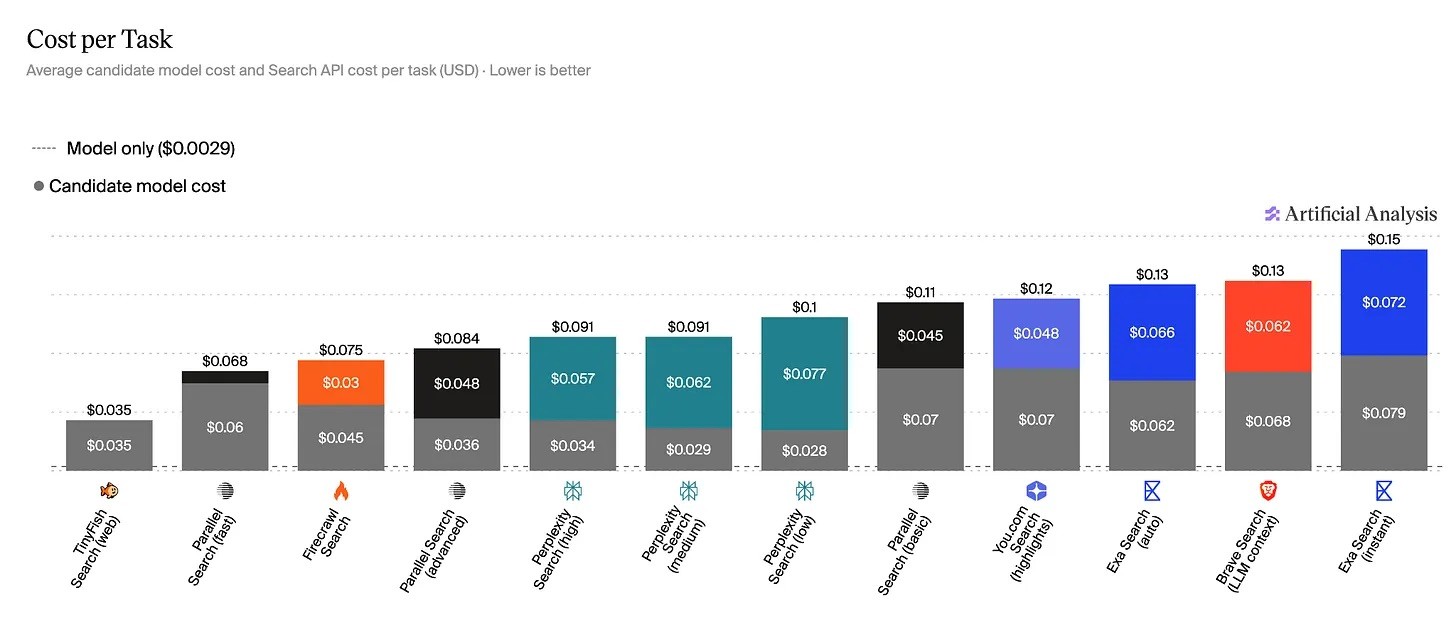
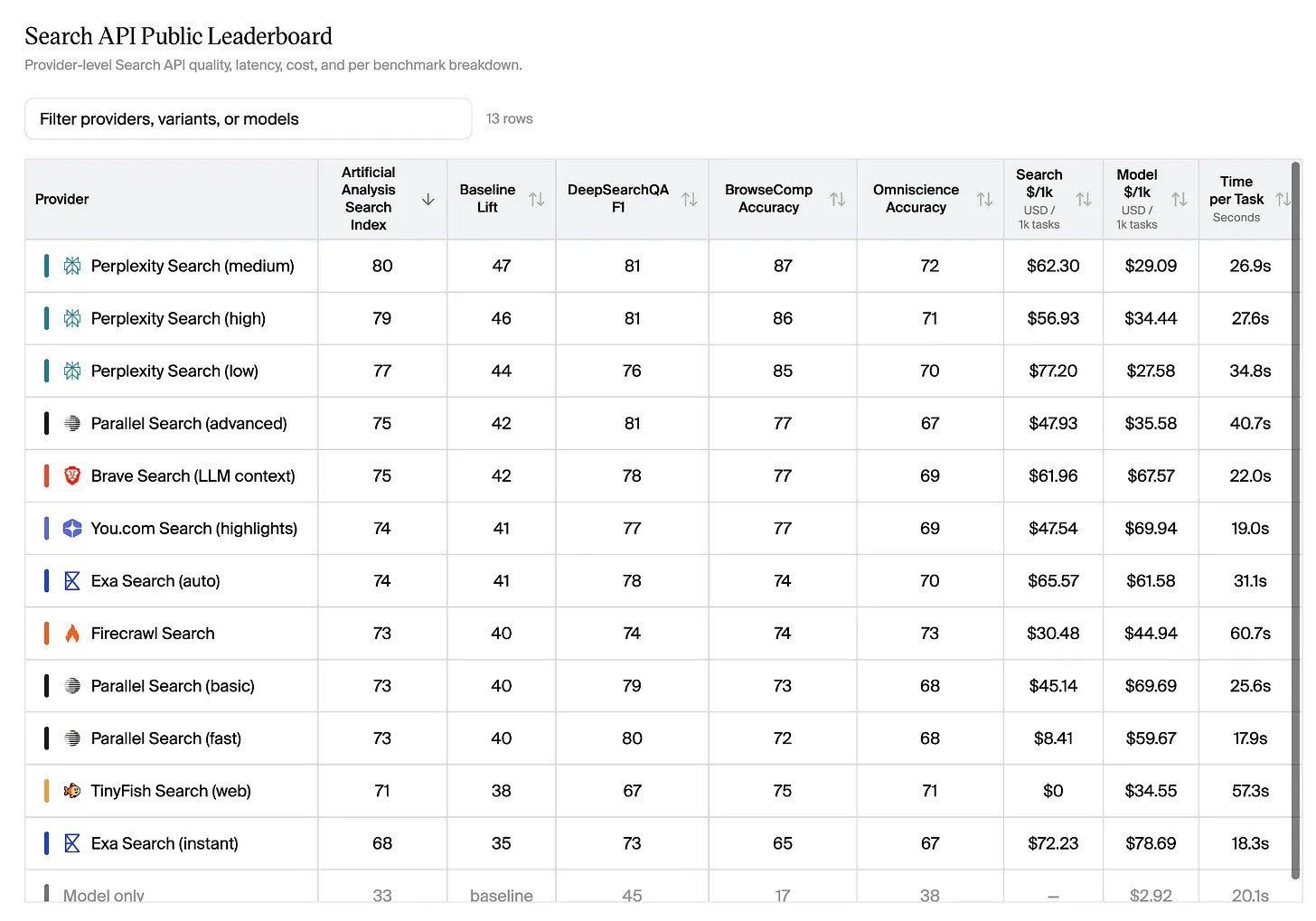
Private firm Artificial Analysis, co-founded by George Cameron and Micah Hill-Smith, released its Search Index on August 18, 2026. This evaluation fixes the AI model and scoring rules used for responses, swapping only the search API called by the agent. Changes in scores indicate differences stem from the search tool itself, not model capabilities.
Source: @artificialanalysis
Without using any search, the same model scores a baseline of 33 on this index and 17 on the BrowseComp subset. Even as ranking positions among search providers shift, the baseline scores remain unchanged.
As of August 27 on the Artificial Analysis Search Index: Perplexity's mid-tier version ranks first with 80 points; Parallel's advanced tier and Brave tie at 75 points; You.com and Exa score 74 points; Firecrawl, Parallel's basic tier, and Parallel's high-speed tier all score 73 points.
If a search tool scores above the baseline, it means the search genuinely helped the model acquire new information. The logic is straightforward: AI answering solely from memory achieves the baseline score; integrating search boosts the score, indicating the search retrieved information the model previously lacked; no score improvement means the search failed to deliver utility.
However, the evaluations themselves have limitations: neither the test questions nor the models used are tailored to specific business scenarios. Providers can optimize specifically for known benchmarks (like DeepSearchQA), much like websites historically optimized for Google via SEO.
Who Is the Robot on the Other Side?
When two AI agents entrust work to each other, a wallet address and a bio are insufficient to establish trust. A wallet address only proves the account holds funds; description text is easily forged, failing to verify the bot's developer identity or corroborate past work records. The ERC-8004 standard was designed to solve agent identity and reputation verification.
ERC-8004 was co-authored by representatives from MetaMask, the Ethereum Foundation, Google, and Coinbase, went live on the Ethereum mainnet on January 29, 2026, and includes three major registries.
First, the Identity Registry, implemented as an NFT. Each agent corresponds to a numbered token, whose uniform resource identifier points to a registration file recording the agent's name, server endpoint, x402 payment support, and supported trust models. The token holder is the agent owner; upon ownership transfer, old payment wallet info is cleared, and the new holder must re-sign to prove control.
Second, the Reputation Registry, which accepts signed feedback—an on-chain public review system. After using an agent, users can leave ratings on-chain with task tags (e.g., search, rating). Agent owners cannot review themselves, and reviews support revocation. Anyone can add comments below a review, appending refund records or spam warnings next to the rating. This is a public comment section bound to the agent ID, not a private star-rating system within a single app.
Third, the Verification Registry, interfacing with third-party independent validators. Agents initiate verification requests; verifier smart contracts return a 0-100 score along with evidence links; evidence sources can include repeated task execution results, zero-knowledge proofs, or attestations from secure chips.
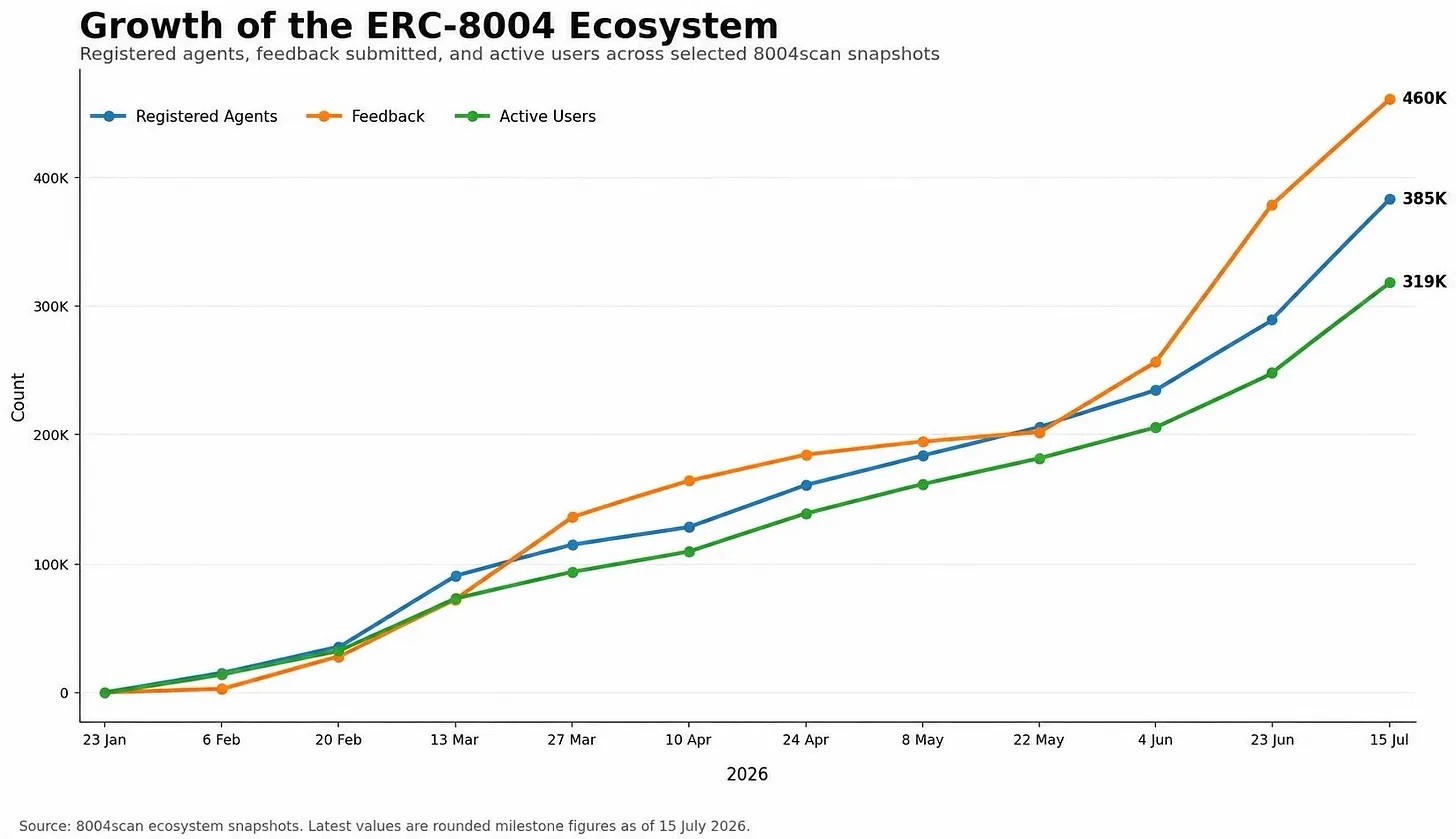
The specification itself does not handle payment logic, as explicitly stated in its documentation. It only records agent identity, external reviews, and third-party validation results; payments are delegated to other protocols. The registry's data quality leaves much to be desired. According to July stats from 8004scan, 385,998 agents are registered across 29 public chains, boasting over 460,000 reviews. The vast majority of IDs are just empty badges; 89.2% do not publish callable standard service interfaces; only 8,631 agents offer usable services, accounting for a mere 2.24%.
Source: @8004_scan
A crawler survey conducted in May across Ethereum, BNB Chain, and Base found: on-chain ratings cannot be horizontally compared across different agents. Most feedback lacks bound, publicly verifiable task results, making review farming cheap. After flagging and filtering suspicious reviews, many rated agents lack any remaining valid reviews. This standard only unifies the output format of review data; determining which reviews are genuine and trustworthy is left to external systems. ENS, EigenLayer, The Graph, and Taiko have all expressed intent to integrate this standard, but review filtering tools have yet to be developed.
Did the Agent Actually Complete the Work?
The Agentic Commerce architecture, jointly designed by the Ethereum Foundation and Virtuals Protocol, aims to enable autonomous AI agents to hire each other, collaborate, and settle transactions on-chain without human intermediaries. ERC-8004 works alongside ERC-8183 (the escrow standard) to build this system. ERC-8183 standardizes the end-to-end process of task publishing, fund escrow, result verification, and settlement between agents.
The workflow operates as follows: the client agent initiating the task publishes it, detailing the description, deadline, budget, and designated evaluator. The client deposits funds into a smart contract; the funds are locked so neither party can unilaterally access them.
The servicing agent completes computations off-chain, uploads the final result to decentralized storage like IPFS or Arweave, and submits only a hash or URI on-chain. The evaluator (which could be a dedicated judge agent, automated oracle, or zero-knowledge proof verifier) inspects the deliverables.
If the evaluator deems the task successful, it pays the service provider after deducting fees; if unsuccessful, it refunds the funds to the client. Should the service provider go silent or the evaluator stall past the deadline, the contract triggers a public refund mechanism, returning funds to the client to prevent assets from being permanently locked.
The evaluator can also be the client itself, documented as the standard approach for non-third-party scenarios. The specification simultaneously states: This protocol does not provide dispute resolution or arbitration mechanisms; rejected outcomes or expired deadlines constitute final judgments. If the scoring bot you selected maliciously scams you, there is no admin or customer service to appeal to. You are left without recourse; moreover, given the issues mentioned in the previous layer, you cannot rely on on-chain reviews to pick a reliable evaluator, as most reviews are fake.
Systems like UMA, Kleros, and Bittensor can mitigate the risk of single-point evaluator misconduct but sacrifice speed and increase costs. Purely automated escrow settlement can be completed in seconds with extremely low fees; upgrading the dispute process via UMA or Kleros requires challenge windows, bonded margins, and human participation for voting.
Has the Fund Transfer Completed?
This area has seen extensive industry discussion recently; here is a brief overview.
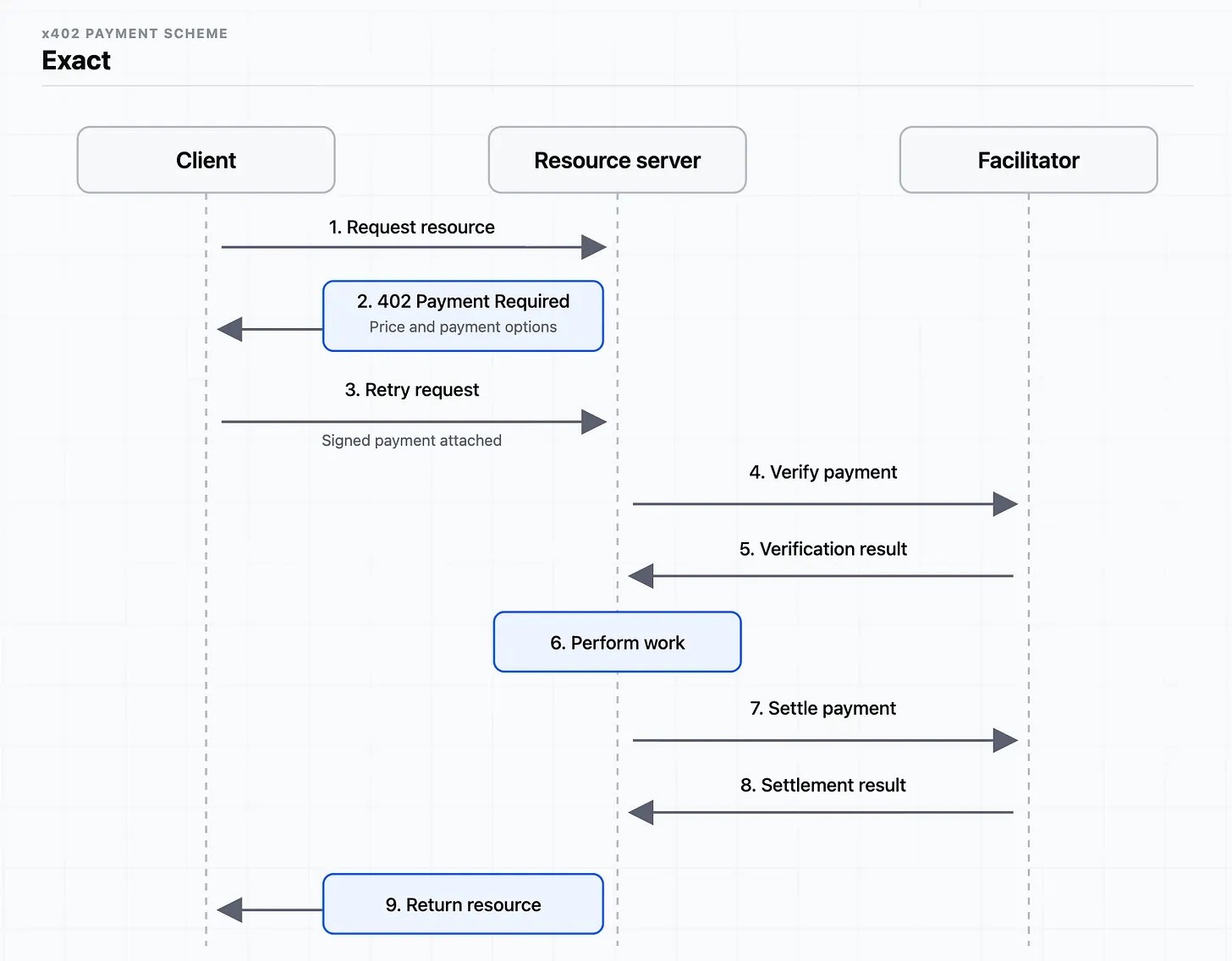
x402, introduced by Coinbase, is a protocol layered atop existing public chains. It deducts fees per request and settles transfers using stablecoins.
Source: @coinbase
Another is the Machine Payment Protocol (MPP), jointly released by Stripe and Tempo in March 2026, launching on the same day Tempo's mainnet went live. MPP is an HTTP standard. The server returns a 402 Payment Required response with challenge information; the agent resubmits the request carrying payment credentials; the server returns the resource along with a payment receipt.
Actual fund flow depends on the underlying channels. On-chain settlement for a single Tempo transaction takes roughly 0.5 seconds. Facing a series of micro-calls, an agent can pre-lock a batch of funds, continuously log transactions during the process, and settle collectively on-chain at the end, rather than initiating an on-chain transaction for every call. Payment limits are controlled by session-locked caps or access keys, avoiding a "one-time authorization, perpetual deduction" model.
MPP supports multiple underlying channels: Visa has published a card specification allowing agents to pay via tokenized cards; Lightspark implements a Lightning Network payment solution based on the same 402 workflow, complemented by a Visa card program. Merchants already integrated with Stripe card payments can directly accept MPP card payments, with funds flowing into standard Stripe accounts; the Lightning Network serves as another optional channel under MPP rules. Stripe supports both x402 and MPP. Although both reuse the HTTP 402 Payment Required status code, they operate as two distinct protocols.
Are Content Creators Getting Paid?
If creators don't get paid, there will be no new content available for retrieval. Unable to profit, they will cease publishing, and AI agents will eventually exhaust fresh reading material.
Cloudflare, Parallel, and OpenLedger are three representative projects in this field.
Cloudflare initially charged crawlers a flat fee for webpage scraping. This scheme was too crude, charging the same amount for grabbing a homepage versus deep investigative reporting. Cloudflare has now shifted to a value-based billing model: creators are compensated only when content genuinely generates value. Additionally, for ad-monetized sites, Cloudflare will block AI crawlers if AI providers refuse to pay.
Parallel launched its Index product on May 19, drawing on the Shapley value algorithm from cooperative game theory to calculate each information source's contribution proportion to the agent's final task outcome, thereby distributing revenue. Instead of flat fees per click, mathematical models measure each article's actual contribution to the task. Partners include The Atlantic, Fortune, PR Newswire, PitchBook, ZoomInfo, Tracxn, RocketReach, Enigma, and Fiscal AI.
Currently, Index settlements occur only when agents use Parallel's proprietary search tool. Unless all other AI platforms integrate it, it cannot become a universal web-wide standard.
OpenLedger offers an alternative approach using a token system. It quantifies a dataset's impact on AI models and compensates contributors with its native token. This solution targets AI training data developers, not daily news articles by journalists.
I attempted to find actual payment figures these projects have disbursed to creators. Cloudflare hasn't published redemption numbers; Parallel remains undisclosed; OpenLedger settles in OPEN tokens without publicly releasing independent aggregate payout statistics. Therefore, we currently lack concrete facts to evaluate the real-world effectiveness of this mechanism.
In the history of human commerce, cash registers were actually a late arrival. Humans spent years establishing verbal agreements and local reputation systems before inventing low-friction payments. The machine internet's developmental path is entirely inverted: from its inception, it enabled instant, streaming global settlement. Now, the agent economy is hastily scrambling to build on-chain micro-dispute courts just to prevent two robots from scamming each other over a few dollars.
To conclude, I'll quote Terry Pratchett:
"It is easy to talk purely logically and say machines merely carry out commands given to them. But people have a right to expect that a machine should possess a little common sense."