

Nasdaq Partners with Kraken: A Financial Revolution No One Understands
TechFlow Selected TechFlow Selected
Nasdaq Partners with Kraken: A Financial Revolution No One Understands
The era of round-the-clock stock trading has arrived, and the old rules are collapsing.
 Navigating Web3 tides with focused insights
By Aman Narain
Translated by Luffy, Foresight News
Imagine it’s 1985. An executive sits behind a mahogany desk and wants to wire money. He calls his broker; the broker calls the trading floor; a slip of paper passes hand to hand. One day passes. Then another. The trade settles—and the process ends.
Fast-forward to 2026. Your smartphone translates seventeen languages in real time, drafts legal contracts, and wires $10,000 across continents before your coffee goes cold.
Yet if you want to buy Apple stock at 11 p.m. on Sunday—right as breaking news hits Asia? You wait. If you want to use Tesla shares as collateral on another platform? You’re locked inside one brokerage’s system—bound by its business hours, vulnerable to its outages, powerless to act.
In the age of AI, stock trading remains as archaic as handwritten checks. And recently, that changed.
A Temporal Mismatch at the Core of Global Finance
Let’s first name the absurdity—because it deserves naming.
We live in a world where stablecoin transaction settlement volume hit $27.6 trillion in 2024—surpassing Visa’s ~$15.7 trillion—yet the New York Stock Exchange still closes at 4 p.m. That trading window hasn’t changed since 1985—the same year fax machines were considered cutting-edge technology.
Today, when you buy stocks through any traditional broker—Charles Schwab, Fidelity, Robinhood—you settle on a T+1 basis. A trade you place early today won’t officially finalize until tomorrow. Shares only become fully yours after clearinghouses, custodians, counterparties, and brokers each complete their steps. This settlement architecture has remained largely unchanged for decades—aside from minor upgrades.
It hasn’t changed not because of technical limitations—but complexity. Global equity infrastructure resembles a cathedral built from interlocking legacy systems, each bearing immense responsibility. You don’t renovate a cathedral while people are praying inside. Or, as I said on this week’s podcast: You can’t rebuild an operational airport while planes are landing.
Until now, every attempt ended the same way—failure.
Years of Accumulation, Culminating in a Single Moment
On March 9, 2026, Nasdaq announced a partnership with Payward—the parent company of Kraken—to build the so-called “Equity Transformation Gateway,” running atop Kraken’s xStocks infrastructure.
In plain terms: Your Apple shares, your Tesla shares, your S&P 500 ETF—they’re tokenized on-chain, traded 24/7, and settled in seconds. They carry identical voting rights and dividends as the underlying equities—not synthetic assets, not derivatives, but real shares operating on a new rail.
Four days earlier, on March 5, Intercontinental Exchange (ICE)—the parent company of the NYSE—made a major investment in crypto exchange OKX, valuing it at $25 billion, with the explicit strategic intent to tokenize NYSE-listed equities on OKX.
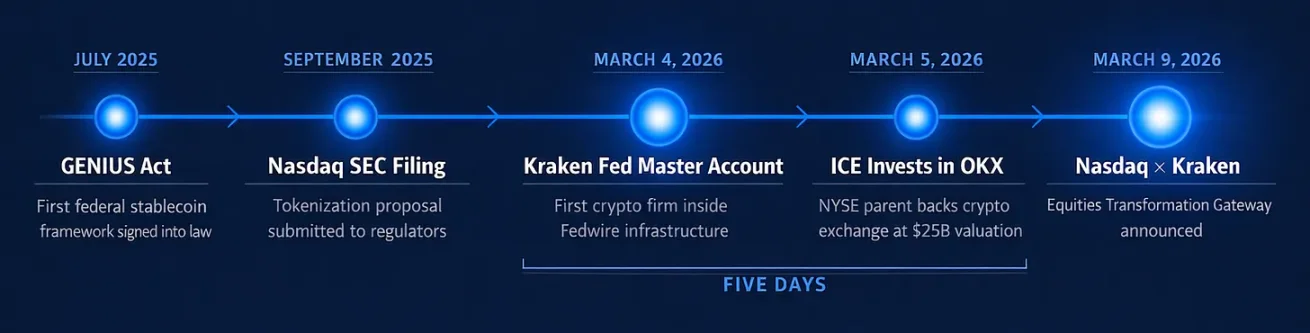
The GENIUS Act, Nasdaq’s SEC filing, Kraken’s Fed master account, ICE’s investment in OKX, Nasdaq’s Equity Transformation Gateway—five pivotal developments in eight months
The two most influential financial exchanges globally placed bets on the same direction—in the same week. This isn’t a trend. It’s not a pilot. It’s the conclusion.
What most financial journalists missed is that these weren’t sudden announcements. Nasdaq filed its tokenization proposal with the SEC in September 2025. The xStocks framework had already processed over $25 billion in transactions before Nasdaq’s partnership announcement. The U.S.’s first federal stablecoin regulatory framework—the GENIUS Act—was signed into law in July 2025. These developments had long been laying groundwork. What’s unfolding now is simply inevitable.
All Prior 24/7 Trading Attempts Failed—But This Time Is Different
This isn’t the first attempt at 24/7 trading—and previous efforts all failed spectacularly.
In 2015, the Australian Securities Exchange (ASX) announced plans to replace its entire settlement infrastructure with blockchain. The project attracted global attention, significant funding, and institutional credibility reserved only for national exchanges. Seven years later, AUD $250 million was gone. In November 2022, the project was scrapped entirely.
ASX wasn’t alone in ambition and failure. Several exchanges achieved instant settlement for specific products; others extended trading hours. Yet globally—not a single exchange has ever delivered both instant settlement *and* 24/7 trading simultaneously.
ASX committed what I call the “Cathedral Error”: attempting to replace a live system. Every broker, custodian, clearinghouse, and regulator would have needed to migrate at once—a complexity utterly beyond control.
Nasdaq’s difference lies in simplicity of concept and precision of execution. They didn’t tear down the airport—they built a second runway beside it.
Traditional markets continue operating as usual; the tokenized layer runs in parallel. Assets move seamlessly between the two worlds via designated bridges. Legacy infrastructure remains for institutions, pensions, and regulated custodians—while the new layer serves populations the old system could never reach.
This isn’t a technology upgrade. It’s a design principle: build in parallel—not replace. It’s the first true triple jump in global market history—simultaneous delivery of instant settlement, fractional ownership, and 24/7 trading—where all prior attempts barely kept pace.
A less obvious insight: ASX asked existing participants to relinquish control over a revenue-generating system. Nasdaq’s model makes no such demand—clearinghouses still clear; custodians still custody. The new channel grows the pie—it doesn’t redistribute it. That’s why regulators engage. That’s why incumbents won’t kill it.
This Isn’t Robinhood: The Difference Is Architecture
I know what some of you are thinking: “Don’t I already own fractional Apple shares on my phone? Isn’t this just Robinhood repackaged?”
No—and the distinction matters more than you think.
Robinhood gives you *access*. Tokenized equities give you *ownership and control*. These are fundamentally different.
On Robinhood—and every traditional broker—your shares exist solely within their internal systems: just numbers in their databases. You cannot transfer them. You cannot pledge them as collateral on other protocols. You cannot trade them at 11 p.m. on Sunday. You’re merely a guest in their building—obeying their rules, operating within their hours.
In January 2021, Robinhood halted GameStop trading. That wasn’t conspiracy—it was the fragility of centralization disguised as democratization. That chain may be gilded—but it’s still a chain.
Tokenized equities settle instantly on-chain, trade continuously 24/7, and can serve as collateral across multiple platforms simultaneously. They’re programmable—meaning they can interact with financial applications not yet invented.
A retail trader in Manila, a pension fund manager in Oslo, a family office in Singapore—all operate on the exact same infrastructure as floor traders at the NYSE. Fees aren’t lower. No confetti falls when you click “buy.” Everything is equal.
Stablecoins: The Hidden Infrastructure Layer
Beneath all of this lies the foundational layer—the force enabling everything else.
Tokenized equities require a settlement layer: something capable of moving value across blockchains, across jurisdictions, and between the institutional world and the open, decentralized world—something stable enough for institutions to trust, yet programmable enough for developers to build upon.
That asset is the stablecoin.
The GENIUS Act, signed into law in July 2025, marked the U.S. government’s formal recognition of this reality. It established the first federal regulatory framework for stablecoins—including reserve requirements, audit standards, and legal definitions. This isn’t the finish line—it’s the starting gun. When implemented in early 2027, stablecoins will be eligible to settle equities, bonds, and any other tokenizable asset. T+1 will become a historical footnote; the clearinghouse monopoly will end.
Add this: On March 4—five days before Nasdaq’s announcement—Kraken Financial became the first crypto company in history to obtain a Federal Reserve master account. It gained direct access to Fedwire, the Fed’s interbank settlement system—the same rails used by JPMorgan Chase. Kraken moved from the periphery into the core of infrastructure.
Connect these three dots: tokenized equities settled via xStocks; a firm with direct Fed access; and the NYSE’s parent company building equivalent capability through another partner.
This isn’t a product launch—it’s infrastructure convergence. A convergence quietly maturing for a decade, then announced in a single week.
This isn’t crypto going mainstream. It’s crypto becoming the mainstream’s infrastructure. There’s a difference—and that difference is permanent.
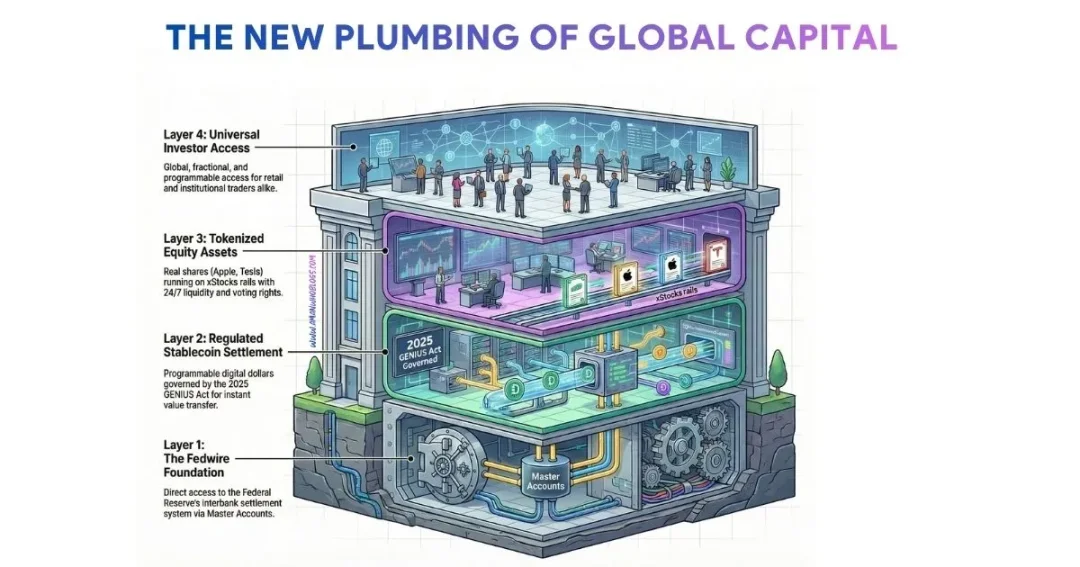
An overview of the new global capital architecture. Layer 1: Fedwire—now accessible to crypto via Kraken’s Fed master account. Layer 2: Regulated stablecoin settlement under the GENIUS Act. Layer 3: Tokenized equities—trading real Apple and Tesla shares 24/7 on xStocks, with full voting rights. Layer 4: Universal access channels for all investors.
Three Things to Watch
Global finance’s infrastructure is being rebuilt in real time. Most people won’t realize it until 2030—and will assume it happened overnight. It didn’t. It’s happening now.
First, the SEC’s decision on Nasdaq’s tokenization proposal (filed September 2025). If approved by mid-2027, it will open the ecosystem to U.S. retail investors for the first time—and mark the beginning of institutional capital inflows. Important note: Until approval, xStocks remains inaccessible to U.S. investors. Watch this timeline closely.
Second, the GENIUS Act implementation countdown. The law is signed. Countdown begins to January 2027—or 120 days after regulators issue final rules, whichever comes first. Once those rules take effect, stablecoins will settle equities—and T+1 will be history. This isn’t an uncertain horizon—it’s a fixed schedule.
Third, signals from asset managers. BlackRock has tokenized its Treasury fund on Ethereum via its BUIDL product. Fidelity is building its own digital asset infrastructure. If either announces a tokenized equity product within the next six months, the race shifts from infrastructure construction to product competition. When the world’s two largest asset managers—managing over $20 trillion combined—move, the industry won’t hesitate. It will follow.
Any one of these developments would be significant. Together, they represent a generational shift.
The Mailroom Moment
In my essay “Pipes, Protocols, and Paradoxes,” I wrote about Stripe building the future of money while profiting from the very system it aims to replace. This week, that paradox resolved differently.
Nasdaq and the NYSE aren’t being disrupted from outside—they’re building the replacement themselves. This isn’t a story of disruptors versus incumbents. It’s the railroad company of 1905 deciding to invest in automobiles.
The mailroom didn’t die the day email emerged overnight. It died quietly—one executive at a time—stopping use without announcement, without fanfare, without a press release.
That’s happening now—inside your brokerage.
A retail trader in Singapore buys tokenized Apple shares at 11 p.m. on Sunday. She doesn’t ponder which clearinghouse she bypassed—she only knows she completed the trade. Brokers whose moat is access won’t receive a press release—just a slow, quarterly erosion of customers, until they vanish.
Then, one Thursday—like Schroders—someone reads a statement aloud. (Note: On February 12, 2026, the century-old asset manager Schroders formally announced its acquisition by Nuveen of the U.S., ending independent operations.)
Join TechFlow official community to stay tuned
Telegram:https://t.me/TechFlowDaily
X (Twitter):https://x.com/TechFlowPost
X (Twitter) EN:https://x.com/BlockFlow_News
 @amanwhotweets















