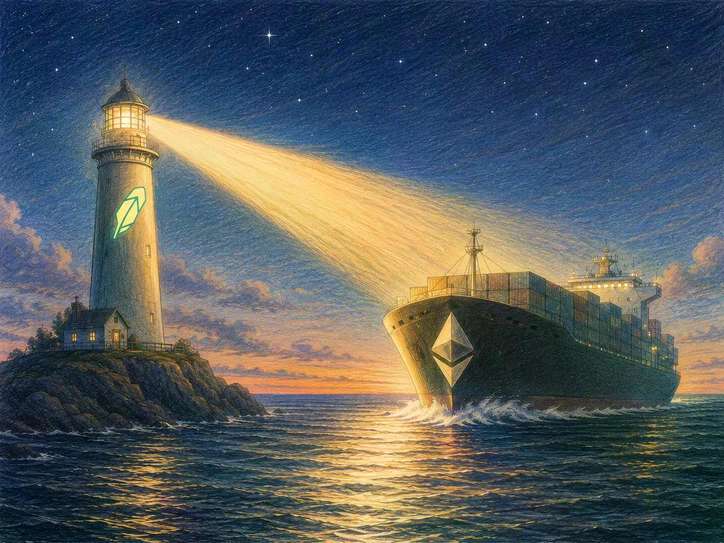
Vitalik’s Rare Self-Criticism: Ethereum Missed the Truly Important Battlefield
TechFlow Selected TechFlow Selected
Vitalik’s Rare Self-Criticism: Ethereum Missed the Truly Important Battlefield
Ethereum Is Absent from the Truly Important Battleground—Vitalik’s Reflections and Direction
 Navigating Web3 tides with focused insights
Author: Vitalik Buterin
Translated and edited by TechFlow
TechFlow Intro: This is one of the rare occasions when Vitalik has publicly critiqued himself. He directly points out Ethereum’s near-total absence from various societal challenges over the past several years—and proposes a new framework: “sanctuary tech.”
This post represents some of the most valuable internal discussion within the Ethereum community: What exactly are we building—and for whom?
Full text below:
Over the past year, many people I’ve spoken with have expressed concern about two things:
First, the direction of the world: government control and surveillance, war, corporate power and surveillance, technological degradation and corporate bloat, social media devolving into information battlegrounds, AI—and how it intertwines with all of the above…
Second, a more painful reality: Ethereum does not seem to be meaningfully improving people’s lives in response to these issues—even along dimensions we care about most, such as freedom, privacy, digital safety, and community self-organization.
It’s easy to empathize with the first concern—we can all collectively lament how the world’s beauty is fading, darkness advancing, and unfeeling elites at the top driving it all forward. But acknowledging the problem is easy; what’s hard is charting a concrete path forward—proposing a specific, actionable solution that improves the situation.
The second concern has weighed heavily on me—and on many of the smartest, most idealistic members of the Ethereum community. I’ve never felt anger or fear seeing political meme coins launch on Solana—or zero-sum gambling apps deploy on some 250-millisecond block-time chain. What truly unsettles me is Ethereum’s extremely limited role during the past few years’ low-intensity online information wars, cross-border corporate and governmental power grabs, and other real-world crises. So what technologies *have* delivered genuine liberation? Starlink stands out; locally run, open-source large language models are another; Signal is a third; and Community Notes tackles the issue from yet another angle.
One possible response is: “Don’t dream—face reality. Finance is our domain; let’s just focus there.” But this stance is ultimately hollow. Financial freedom and security are unquestionably vital. Yet clearly, even a fully free, open, sovereign, and inflation-resistant financial system—once built—would only solve part of the puzzle. Most of our deeper anxieties about the world would remain unresolved. Individuals may choose to focus solely on finance—but we must also be part of a larger whole, capable of engaging meaningfully with other critical issues.
At the same time, Ethereum cannot—and should not—fix the entire world. Ethereum is a “tool of the wrong shape”: beyond a certain boundary, “fixing the world” becomes an exercise in power projection—more akin to a centralized political entity than a decentralized technical community.
So what *can* we do? I believe the Ethereum community should position itself as part of an ecosystem building “sanctuary tech”: free and open-source technologies that empower people to live, work, communicate, manage risk, accumulate wealth, and collaborate around shared goals—all optimized first and foremost for resilience against external pressures.
The goal is *not* to reshape the world in Ethereum’s image—not to decentralize all finance, govern everything via DAOs, or distribute blockchain-based UBI into “social recovery wallets.” The goal is precisely the opposite: *de-totalization*. That is, lowering the stakes of this celestial battle—by preventing winners from achieving total victory (i.e., full control over others) and losers from suffering total defeat. Creating digital islands of stability amid chaos. Ensuring interdependence cannot be weaponized.
Ethereum’s role is to create “digital spaces” where different entities can cooperate and interact. Communication channels enable interaction—but a channel itself is not a “space”: it cannot host a persistent, unique object representing a socially agreed-upon arrangement that evolves over time. Currency is one key example; a multisig wallet whose members can change is another—it exhibits persistence beyond any single individual or public key; markets and governance structures constitute a third. And there are many more.
I believe it’s time to double down—with clearer intention. Don’t try to become Apple or Google, treating crypto as just another tech sector aimed at boosting efficiency or adding polish. Instead, build our part of the sanctuary tech ecosystem—the “ownerless shared digital space” that supports not only open finance but much more. Proactively construct a full-stack ecosystem: upward into wallets and application layers (including AI as an interface), downward into operating systems, hardware—and even physical and biological security layers.
Ultimately, technology without users holds no value. But we must seek out those users—individuals and institutions—who genuinely need sanctuary tech. Optimize payments, DeFi, decentralized social applications, and other tools specifically for these users and these goals—precisely where centralized technologies show no interest. We have many allies—including many outside the “crypto world.” It’s time to move forward, openly and collaboratively.
Replies & Additions
@MarkSmitb Yes—but it *does* give people more freedom.
The answer isn’t opposing Starlink, but supporting ten or more organizations with diverse perspectives—each building their own Starlink-like alternative. Ideally, at least one should be open-source and built on open protocols…
@deuce897 Friend, I’m posting via Firefly on X, which simultaneously publishes to all major social platforms.
@hashdag Good question.
There are two vectors for influencing global events:
1. Influencing the world’s structure in a way that is context-agnostic yet clearly directional—guiding outcomes toward the ideal (e.g., empowering those who were previously…
@PingChenTW How should this be understood?
Join TechFlow official community to stay tuned
Telegram:https://t.me/TechFlowDaily
X (Twitter):https://x.com/TechFlowPost
X (Twitter) EN:https://x.com/BlockFlow_News
 @VitalikButerin