When AI Coding Takes Over Everything, Why Is Ethereum Still Emphasizing Security and Decentralization?
TechFlow Selected TechFlow Selected
When AI Coding Takes Over Everything, Why Is Ethereum Still Emphasizing Security and Decentralization?
In the AI-accelerated era, Ethereum’s real question is no longer just about how to become faster and cheaper.
 Navigating Web3 tides with focused insights
Author: imToken
At the Hong Kong Web3 Carnival, Vitalik Buterin unsurprisingly revisited that perennial question: What exactly should Ethereum become?
In fact, over the past few years, the crypto industry has grown accustomed to framing public-chain competition in terms of performance metrics—such as who achieves higher TPS, faster confirmation times, or lower gas fees—leading many to label the “fastest” chain as the “next-generation infrastructure.”
But by 2026, whether for Ethereum or newer public chains, the challenges facing the ecosystem extend far beyond internal topics like DeFi, NFTs, Layer-2 scaling, and onchain finance. AI coding is rapidly absorbing attention across domains; formal verification and zero-knowledge proofs are also advancing significantly.
These developments signal a fundamental shift in the world that public chains must now confront. So do we still need a public infrastructure that anyone can verify, exit from, self-custody on, and that remains immune to single-point control?
And how, precisely, is Ethereum thinking about—and preparing for—this future?
I. What Is Ethereum For? Bulletin Boards and Computation
“Ethereum isn’t competing with high-frequency trading platforms. Ethereum isn’t trying to be the fastest chain. Ethereum aims to be the secure chain—the decentralized chain—that stays online continuously, the chain you can always rely on.” In this speech, Vitalik redefined Ethereum’s value using two foundational concepts: first, Ethereum functions like a “public bulletin board”; second, Ethereum provides “computation” capabilities.
These simple ideas not only reflect Ethereum’s newly articulated strategic direction—which we’ve emphasized recently—but also capture the essential distinction between Ethereum and conventional internet services.
The “public bulletin board” is not merely an abstract metaphor. It means applications can post messages on Ethereum, visible to everyone—including both content and ordering. These messages may be transactions, hashes, encrypted data, or any other information requiring public commitment, ordering, and verification (see further reading: From “Global Computer / Settlement Layer” to “Bulletin Board”: What Is Ethereum—and Vitalik—Really Trying to Do?).
This is Ethereum’s most fundamental difference from ordinary servers. Servers may be faster, cheaper, and more efficient—but they typically require users to trust their operators not to tamper with records, deny service, or shut down the system at critical moments. Ethereum exists to eliminate that need for trust.
“Computation,” meanwhile, refers to Ethereum’s ability to support shared digital objects governed by code—objects such as ERC-20 tokens, NFTs, ENS names, DAOs, onchain organizations, financial protocols, or even more sophisticated applications.
Therefore, if, by 2026, we continue evaluating Ethereum solely through performance lenses—or compare it against newer public chains only via TPS, gas costs, or confirmation speed—we risk overlooking the core problems Ethereum is truly designed to solve next.
In coming years, public-chain scaling will no longer focus merely on “making the chain faster.” Instead, the priority will be preserving verifiability, decentralization, and user self-sovereignty—even within increasingly complex application scenarios. In other words, scaling isn’t about transforming Ethereum into another centralized, high-performance system. Rather, it’s about enabling more applications to run without compromising Ethereum’s foundational trust assumptions.
That’s also why Vitalik has reevaluated Layer 2s so significantly since early this year.
Put plainly, he believes the market has traditionally viewed L2s as mere scaling tools for Ethereum: when mainnet becomes expensive or congested, simply migrate more transactions to L2s. Today, however, L2s have largely fulfilled that initial historical mission—and must now evolve beyond mere transaction offloading. They should instead serve as the vanguard extending Ethereum’s reach into diverse new application domains.
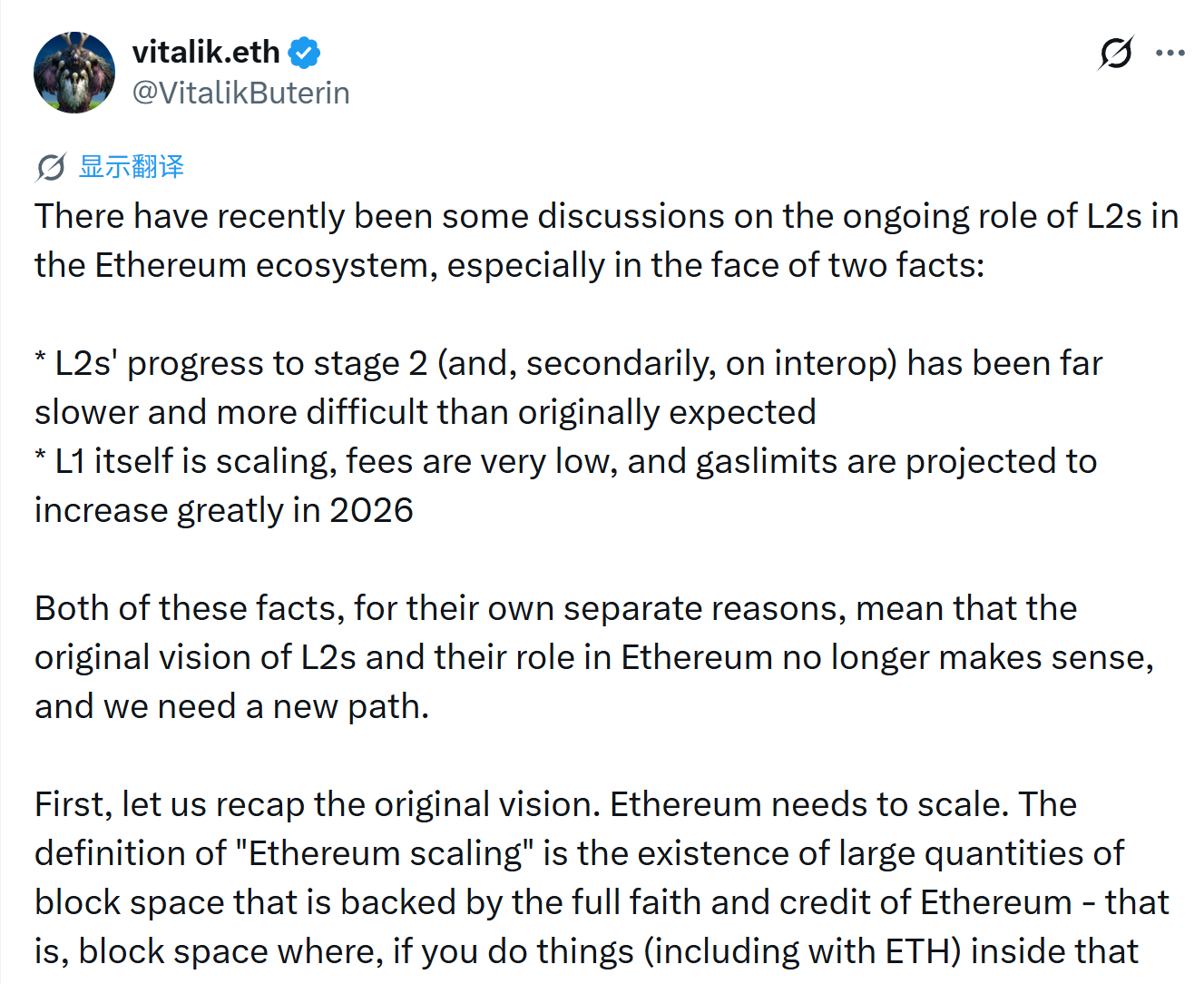
This perspective is especially crucial for today’s Ethereum ecosystem.
Over recent years, markets often reduced L2s to “cheaper Ethereum.” But under Vitalik’s framework, L2s aren’t simple drop-in replacements. Rather, they’re functional extensions built atop Ethereum’s public base layer: L1 handles the most critical roles—commitments, settlement, data publication, and verification—while L2s and offchain systems deliver higher-frequency, more flexible, and privacy-friendly execution tailored to specific use cases.
That’s also why Vitalik refuses to prioritize “speed above all else” for Ethereum.
Speed matters, yes—but if achieving it comes at the cost of ordinary users being unable to run nodes, verify state, or protect themselves when the system fails, then the chain gradually devolves into a less-efficient centralized service.
For Ethereum, speed is a matter of user experience; security and decentralization are its very reason for existence.
II. In the AI Era, Ethereum’s Value Will Be Amplified—Not Diminished
One of the most noteworthy aspects of this speech is that Vitalik didn’t treat AI as just an external trend. Instead, he embedded it directly into Ethereum’s technical roadmap.
For example, the Ethereum community has already begun experimenting with AI to generate code proofs—verifying that Ethereum client software versions possess the properties they’re supposed to exhibit. Two years ago, this would have been extremely difficult. But rapid AI progress is making software security verification increasingly feasible.
Underlying this is a stark reality: as blockchains carry ever more assets, identities, organizations, and rules, the cost of code vulnerabilities rises exponentially. If AI can help developers detect bugs, generate proofs, and assist with formal verification, then it ceases to be merely an efficiency tool at the application layer—and becomes integral to protocol-level security engineering (see further reading: As Hackers Leverage AI More Efficiently, How Is the Web3 “Arms Race” Between Offense and Defense Evolving?).
Yet AI’s deeper impact on Ethereum extends beyond development—it reaches end users, particularly reshaping how ordinary people interact with digital systems.
As widely known, human-computer interaction has evolved through several phases over the past decades. Initially, users communicated with computers via command-line interfaces—accessible only to those with technical expertise. Later, graphical user interfaces and mobile apps democratized access: users could now complete tasks via buttons, pages, and menus.
Today, AI is shifting interaction toward natural language: users no longer need to understand each step—they simply state their goal, and the system automatically decomposes the path, invokes tools, and executes the task.
Applied to Web3, this change carries even greater implications.
Right now, completing a cross-chain DeFi operation requires users to manually select networks, confirm gas fees, approve contracts, execute swaps, bridge assets, and deposit into protocols—each step demanding a signature and carrying potential for error. In the future, if AI agents become key entry points for wallets and onchain applications, users might simply say: “Convert part of my ETH into stablecoins and deposit them into a yield protocol following low-risk strategies.” The rest—path planning, protocol selection, transaction simulation, and execution—could be handled entirely by intelligent agents.
On the surface, this dramatically lowers barriers to entry. But new challenges inevitably arise: When users no longer click every step themselves—and AI agents interpret intent, invoke contracts, and initiate transactions on their behalf—how do users ensure those agents don’t overstep authority? How do they know the chosen path isn’t malicious? And how can they retain the ability to revoke actions, verify outcomes, and protect themselves—all without sacrificing usability?
This is precisely where Ethereum’s value becomes amplified anew.
AI can make interactions more natural—but natural language itself doesn’t confer trust. A smarter interface, backed by an unverifiable black-box system, merely replaces “trusting the platform” with “trusting the model.” Ethereum, by contrast, offers trust infrastructure for the AI era.
Extending this idea further, it also elevates the importance of wallets. Future wallets may evolve beyond simple “signature tools” or “asset lists”—instead becoming permission managers mediating between users, AI agents, onchain applications, identity systems, and payment networks. Users will need wallets to define boundaries: which operations can auto-execute, which require secondary confirmation, which assets cannot be accessed, and which authorizations demand periodic review and cleanup.
III. CROPS: From Foundation Charter to Community Covenant
Interestingly, shortly before Vitalik reinterpreted Ethereum’s vision from a protocol roadmap perspective, the Ethereum Foundation released its EF Mandate—a formal endorsement of this strategic direction at the values level.
This Mandate states that Ethereum’s ultimate purpose is safeguarding user self-sovereignty: enabling individuals to independently control their assets, identities, actions, and choices—without reliance on any centralized intermediary.
Building on this principle, the EF Mandate introduces the acronym “CROPS”—standing for Censorship Resistance, Open Source, Privacy, and Security. According to the Foundation, Ethereum must uphold these four attributes above all else. Without them, Ethereum loses its justification for use, for building upon, and for defending.

Objectively speaking, censorship resistance, open source, privacy, and security are hardly novel concepts in the Web3 lexicon. They’ve been debated since crypto’s inception. Yet reemphasizing them today carries profoundly different meaning.
Early crypto discussions centered on opposing centralized platforms and financial intermediaries. Today, these same values must address fresh challenges posed by the AI era. As the EF Mandate notes, centralization in the future may no longer manifest as a platform forcibly controlling you—but rather as your inability to understand how systems (especially AI) make decisions on your behalf.
For instance, when recommendation algorithms determine what content you see, when AI assistants filter information for you, when intelligent agents execute trades autonomously, and when identities, assets, and data are all wrapped behind opaque APIs—user sovereignty risks being diluted invisibly, one “more convenient” experience at a time.
Thus, Ethereum’s decentralization shouldn’t be measured solely by node count, client diversity, or consensus mechanisms. Instead, it should be understood as a system where no single entity can easily alter the rules—a system where users can verify state, developers can build freely, applications remain publicly auditable, and assets and identities need not be fully entrusted to platforms.
Vitalik also stresses that decentralization isn’t merely a feature of Ethereum—it’s the very reason Ethereum exists. Lose decentralization, and Ethereum becomes nothing more than a less-efficient centralized service. This statement explains why the Ethereum community consistently emphasizes: “Everyone is a Builder.”
- In the Web2 era, most users were passive consumers. Platforms defined the rules; users accepted them. Platforms changed interfaces; users adapted. Platforms discontinued services; users migrated—or abandoned them altogether.
- In the Ethereum ecosystem, builders aren’t limited to a small group of core developers. They include wallet developers, DApp developers, node operators, researchers, educators, auditors, community contributors—and even ordinary users who diligently manage their private keys, study onchain security, and participate in governance discussions.
This implies CROPS must transcend slogans. It demands concrete implementation—in products and daily practices. Take imToken, for example: security isn’t just a warning message—it’s manifested in mnemonic phrase management, risk alerts, DApp authorization controls, transaction parsing, and phishing detection—across the entire user experience.
Final Thoughts
Returning to Vitalik’s speech at the Hong Kong Web3 Carnival, it superficially outlines a five-year technical roadmap: scaling, zkEVM, post-quantum security, formal verification, privacy, block construction, account abstraction, zkVM, and more.
But at a deeper level, it answers a fundamental values question: When the entire industry races toward “faster” and “cheaper,” what should Ethereum optimize for—and why?
The answer isn’t rejecting performance or dismissing user experience. Rather, it’s ensuring ordinary users can more easily use onchain applications—while rigorously upholding self-sovereignty, security, verifiability, and fair participation—not trading these principles away for short-term efficiency gains.
The AI era will render this tension even sharper.
Viewed this way, Ethereum’s most critical challenge in the next phase may not be whether it becomes the fastest chain—but whether it remains the most trustworthy, most easily verifiable, and least dependent on any single point of authority: the public infrastructure we all rely on.
Join TechFlow official community to stay tuned
Telegram:https://t.me/TechFlowDaily
X (Twitter):https://x.com/TechFlowPost
X (Twitter) EN:https://x.com/BlockFlow_News
 @imTokenOfficial