

Paradigm bets on centralized public chains, but the advantages of decentralization cannot be replaced
TechFlow Selected TechFlow Selected
Paradigm bets on centralized public chains, but the advantages of decentralization cannot be replaced
Decentralize critical infrastructure, centralize user-facing applications—the optimal solution lies in balance.
 Navigating Web3 tides with focused insights
Author: s4mmy
Compiled by: TechFlow
The recent launch of Tempo, a project by Stripe and Paradigm, has reignited debates about the true importance of decentralization. At the same time, decentralized artificial intelligence (DeAI) is also being scrutinized, as the value proposition of DAOs (decentralized autonomous organizations) is questioned when compared to centralized alternatives like OpenAI.
This article challenges the notion that "centralization will dominate," demonstrating the advantages of decentralization through successful crypto products.
Table of Contents
-
Preface
-
Understanding Trade-offs
-
Advantages of Decentralization
-
Sustainable Ecosystems vs. Hype Cycles
-
The Future of Hybrid Models
Preface
First, it must be acknowledged that decentralization (in its current form) faces real challenges:
-
Scalability limitations
-
Governance complexity
-
User experience barriers
However, adopting "strategic decentralization" in critical infrastructure can lead to superior long-term outcomes for innovation, resilience, and the development of autonomous AI agents.
The path forward requires a hybrid model, combining the strengths of decentralization with certain centralized features to enhance the performance of crypto products.
The pendulum between distributed and centralized systems will continue to swing in search of balance; so, what is the optimal level of distribution?
Understanding Trade-offs
Decentralization is not a panacea.
The blockchain trilemma—the trade-off among decentralization, security, and scalability—forces us to make compromises. For example:
-
Bitcoin processes 7 transactions per second (TPS), while Visa handles up to 65,000 TPS, clearly illustrating this limitation.
-
Early DAO governance faced issues such as collaboration paralysis and token concentration among wealthy holders.
Yet, these are engineering challenges, not fundamental flaws.
-
Ethereum reduced energy consumption by 99.95% after transitioning to Proof-of-Stake, while maintaining security:
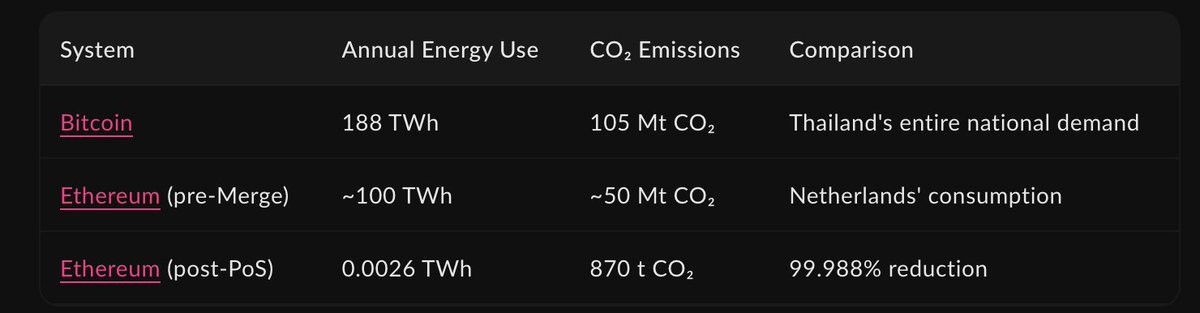
Source: SURF Co-Pilot
-
Layer-2 solutions achieve thousands of TPS while inheriting Ethereum’s decentralization.
-
AI agents can provide decision-making efficiency that can be integrated into DAOs to optimize human shortcomings.
Thus, it's understandable why cypherpunks question Tempo's choice of an alternative Layer-1 solution:
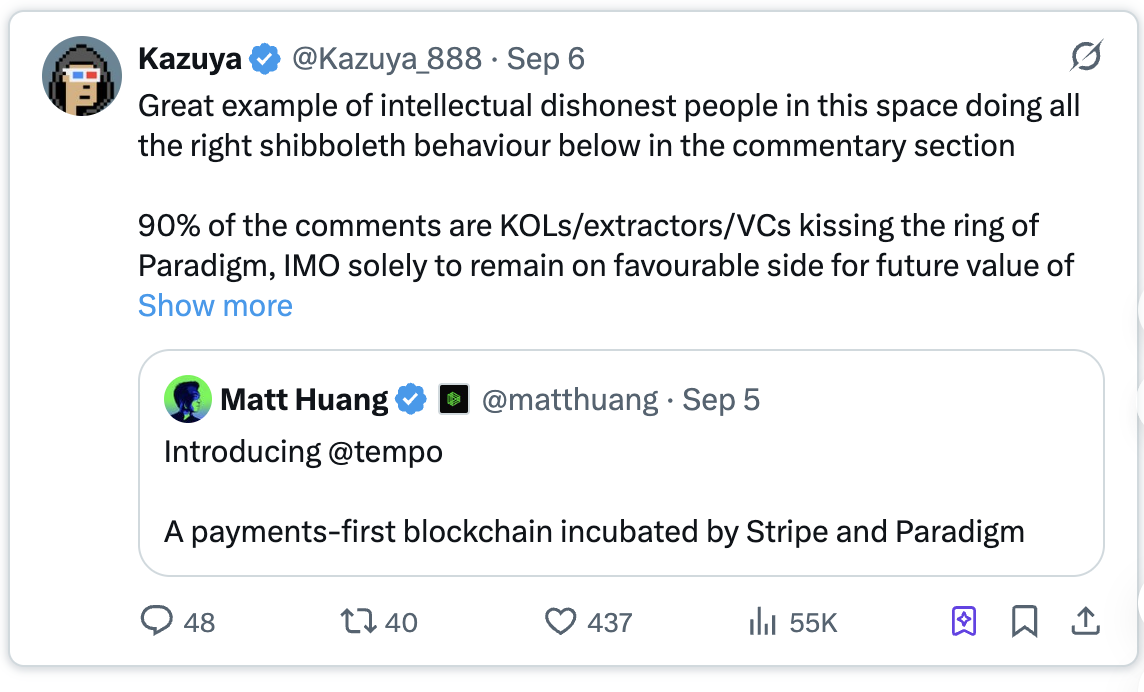
Original tweet link: Click here
But @matthuang also clearly stated that the Ethereum ecosystem (including Layer-2s) isn't evolving fast enough to meet the upcoming surge in on-chain payments. Hence, building @tempo independently becomes necessary.
"From an operational standpoint, we felt compelled to build for the coming demand and reduce dependencies—including reliance on the pace of Ethereum L1 progress."
This slowness is indeed an issue, but it doesn’t negate areas where decentralization excels. Both realities can coexist.
Advantages of Decentralization
a) Censorship Resistance
In an era where centralized platforms can "ban" users or restrict content under political pressure, decentralized systems offer an unstoppable space for innovation.
Of course, there are downsides, making balanced design crucial. But these stem more from human nature than technological flaws.
For instance, AI development on networks like Bittensor cannot be shut down by any single authority, enabling research in sensitive yet vital domains.
b) System Resilience
In 2023, USDC depegged due to Silicon Valley Bank's collapse, revealing how centralized systems create risks of single points of failure.
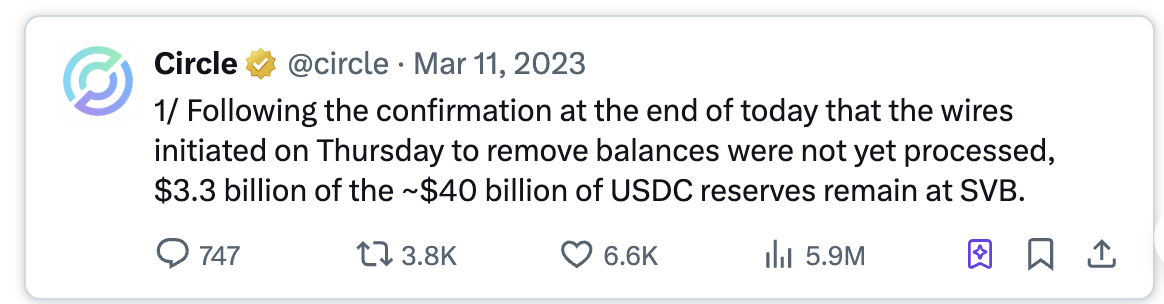
Original tweet link: Click here
Decentralized alternatives like Ethena’s USDe employ delta-neutral strategies across multiple venues, reducing counterparty risk.
c) Democratic Access to Resources
Centralized cloud providers have formed oligopolies over key AI infrastructure.
Networks like @Rendernetwork break Big Tech's monopoly on AI development resources by providing computing power at competitive prices through thousands of nodes.
Sustainable Ecosystems vs. Hype Cycles
Yes, there are occasional deserters in the trenches, as primal gambling instincts are satisfied by betting on the next "sure thing."
Yet, today's market maturity emphasizes fundamentals, especially among institutional investors who prefer relying on what they do best—revenue.

Original tweet link: Click here
Despite significant market hype at the intersection of AI and crypto, genuine decentralization fosters sustainable ecosystems based on actual utility, not just speculation.
I agree many projects exploit AI hype for profit without delivering functional value:

Original tweet link: Click here
But as with any emerging field, ephemeral, valueless projects will eventually be replaced by those offering real utility.
For example:
-
Fetch.ai built a network where autonomous AI agents perform tasks
-
Ocean Protocol created a marketplace for secure data sharing, essential for AI training
-
Bittensor established a competitive arena for AI models
-
@Caesar_data, @openservai and @Surf_copilot deliver fine-tuned models in specific domains, outperforming centralized general-purpose alternatives.
In these systems, tokens are not merely speculative assets—they serve as tools for accessing services, incentivizing contributions, and governing the network, creating robust, self-sustaining economies beyond short-term market trends.
Assuming optimized tokenomics that return value to holders, consider these concrete examples of revenue generated by crypto AI products:

Original tweet link: Click here
The Future of Hybrid Models
So, what is the optimal balance point?
The pure cypherpunk vision grows increasingly challenging, especially as traditional systems begin adopting cryptographic rails.

Original tweet link: Click here
Still, there's a strong argument that optimal outcomes lean more toward distributed systems rather than those controlled by a single entity.
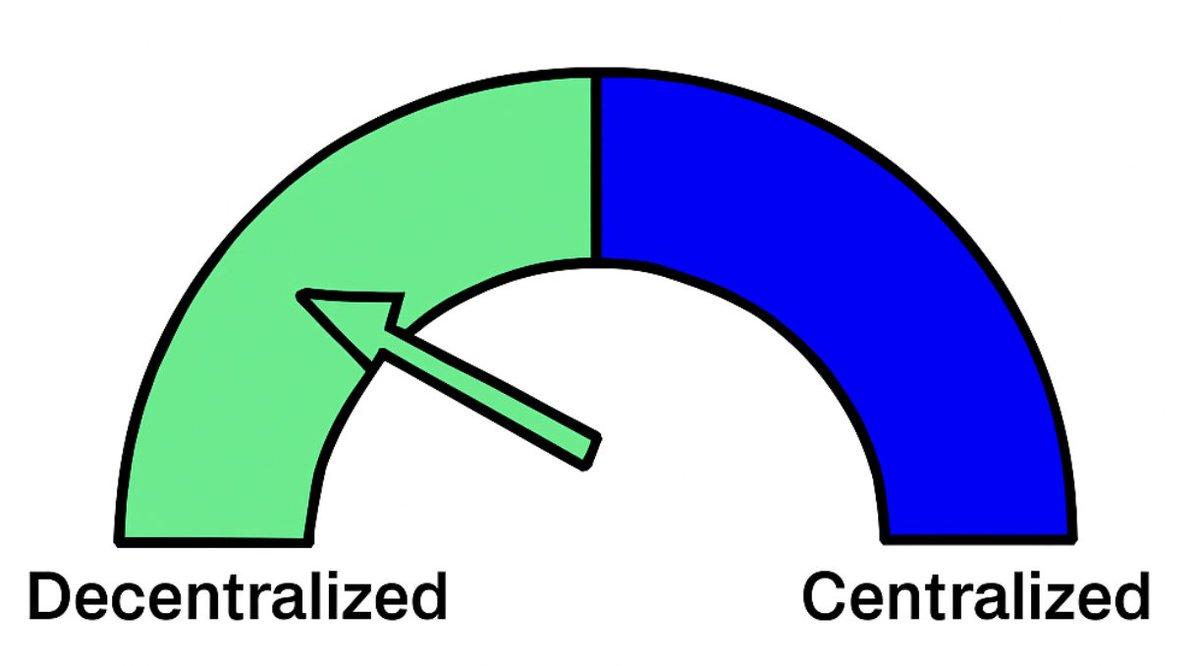
The ideal approach isn't full decentralization, but strategic decentralization in the most critical areas.
Key infrastructure benefits from greater distribution:
-
Financial rails
-
AI training networks
-
Data markets
Meanwhile, user-facing applications can retain some centralization to optimize user experience (UX).
This is precisely where AI agents shine—transforming crypto’s notoriously poor UI/UX through more accessible, user-friendly systems.
It's also why I strongly support the convergence of crypto and AI.
AI is empowered by crypto’s permissionless rails, while crypto gains mass adoption through AI-driven products.
Conclusion
Decentralization does face real challenges, but these can be overcome with better technological and governance designs.
The core question isn't whether everything should be fully decentralized, but rather where decentralization offers irreplaceable advantages: at foundational layers that drive innovation, resist censorship, and enable fair value distribution.
The future belongs to hybrid systems—strategically decentralized in critical infrastructure, while optimizing user experience through centralized interfaces. This balanced approach captures the transformative potential of decentralization while pragmatically addressing its limitations.
As for Tempo, will it repeat Libra’s fate, or become the "@Paradigm" moment that shifts how traditional systems perceive crypto rails? Time will tell.
Disclaimer: This article does not constitute investment or financial advice and is provided solely for informational and educational purposes.
The author holds some of the assets mentioned and has partnerships with certain projects.
Join TechFlow official community to stay tuned
Telegram:https://t.me/TechFlowDaily
X (Twitter):https://x.com/TechFlowPost
X (Twitter) EN:https://x.com/BlockFlow_News
 @S4mmyEth















