
How do potential returns and risks stack up for listed companies jumping on the cryptocurrency bandwagon?
TechFlow Selected TechFlow Selected
How do potential returns and risks stack up for listed companies jumping on the cryptocurrency bandwagon?
The premium frenzy of top-tier tokens and the value trap of long-tail assets.
 Navigating Web3 tides with focused insights
Author: kushagra
Translation: Luffy, Foresight News
Every day we see new crypto treasury strategy tools emerging. This article analyzes the performance of Bitcoin as a corporate treasury strategy and key trends in private investment in public equity (PIPE)-based crypto strategies.
Every region is launching its own "Bitcoin" strategy, but my concern lies with the tail assets (Right Tail Assets) that might adopt similar approaches. Bitcoin works well as a reserve asset—but what about your favorite L1 or L2? That makes little sense. After all, who would be the marginal buyer for the 50th zkEVM L2? Not to mention, tail assets suffer from low float issues, meaning paper gains seen by market participants may not be realizable. So, friends, proceed with caution.
Mechanics
There are three primary paths to build such treasury vehicles:
-
Business transformation: distressed companies pivot into crypto financial services and execute crypto strategies (e.g., Solana staking);
-
Mergers & acquisitions: private firms merge into small-to-mid-sized Nasdaq/NYSE-listed companies;
-
SPAC mergers: merging via a special purpose acquisition company (SPAC), followed by restructuring business and treasury strategies.
Regardless of the path, all strategies rely on funding through private investment in public equity (PIPE) and convertible debt. Below is the typical PIPE structure:
-
Target shell companies: typically SPACs or failing small-to-mid-sized firms publicly traded on Nasdaq or NYSE;
-
Collaborate with the company to establish reserves in Bitcoin or other crypto assets;
-
Engage investment banks to issue/build two instruments: i) traditional PIPE and ii) convertible bonds;
-
Traditional PIPE: direct sale of common or preferred shares at a fixed price (usually discounted) to qualified investors;
-
Convertible bonds: issuance of convertible notes or convertible preferred shares, which investors can convert into common shares of the issuing company within a certain period or upon meeting specific conditions. These typically offer downside protection while partially capping upside returns.
For example, Trump Media & Technology Group (DJT) adopted the following structure:
-
Raised $1.44 billion by selling nearly 56 million shares at $25.72 per share;
-
Issued $1 billion of 0% senior secured convertible notes due 2028 (conversion price at $34.72 per share);
-
A hybrid structure combining stock dilution and senior convertible debt, blending features of both PIPE and convertible bonds.
Note: Compared to other offerings, PIPEs are subject to less SEC oversight but may lead to equity dilution for existing shareholders. These shares come with registration rights, requiring the company to file a registration statement with the SEC, allowing PIPE investors to resell their shares to the public after lock-up periods.
Investor Framework
You might wonder why investors participate in such offerings. The reasons can be summarized in three points:
-
Team Intellectual Property: The industry influence of the chairman or core team is critical. For instance, Joe Lubin (co-founder of Ethereum) launching an ETH strategy is easily framed as the “Ethereum version of MicroStrategy.” After witnessing MSTR’s success, investors flocked to the ETH strategy due to Joe’s standing in the industry—after all, ConsenSys remains pivotal to Ethereum’s ecosystem development.
-
Asset Quality: The choice of reserve assets is crucial. A wave of tail assets (e.g., top 50 market cap tokens) being added to small-cap corporate treasuries is expected. However, these tail asset strategies carry higher risk, as their volatility often exceeds that of Bitcoin.
-
Crypto Premium: The reason these PIPE vehicles raise large amounts isn’t because the value of Bitcoin or Ethereum in corporate strategy has suddenly increased 3–4x overnight. Rather, it's because traditional hedge funds and crypto-native institutions rush in, fearing they’ll miss out (FOMO) on current primary/secondary market arbitrage opportunities. While these strategies may generate yield or leverage through staking and lending, does this justify a 3x premium over net asset value (NAV)? Probably not.
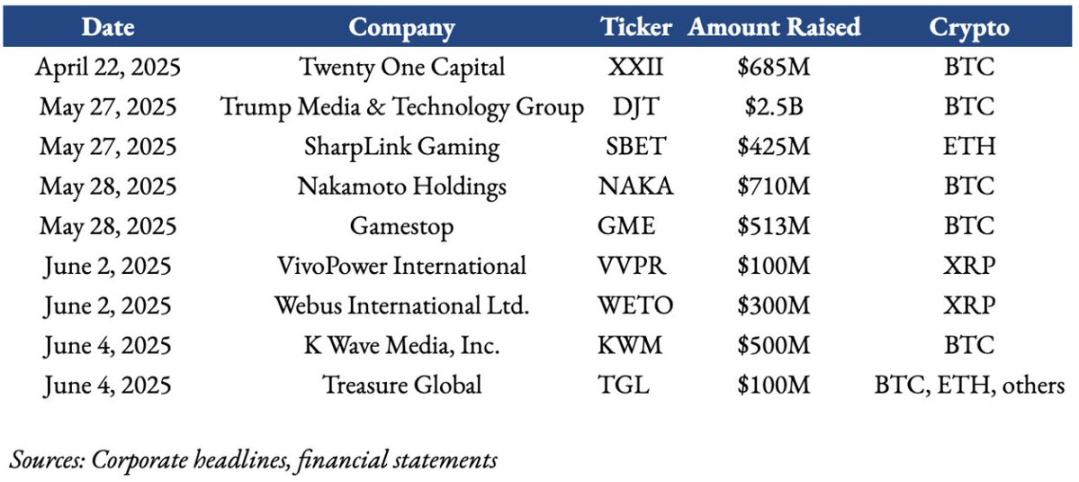
Overview of corporate crypto treasury deals over the past two months
To date, the most controversial treasury deal has been Trump Media. It also raises questions about “strategic Bitcoin (or digital asset) reserves”—how should potential conflicts of interest be managed? At least in the short term, inspired by MicroStrategy (MSTR) and Metaplanet (3350.T), both private and public investors expect such financings to deliver strong medium- to short-term returns.
MSTR initially treated Bitcoin as a store of value and inflation hedge; today’s crypto PIPEs take a more active approach, generating returns through staking and lending. Private investor demand for crypto PIPEs is nearly frenzied—once announced, stock prices often surge 2–10x at launch.
Performance of Corporate Crypto Treasury Strategies
While history doesn't predict the future, there's ample data on Bitcoin strategies. Below is a performance study of pure corporate Bitcoin treasury strategies—I analyzed 17 publicly listed companies:

The list includes 17 publicly traded companies with Bitcoin holdings exceeding 30% of market cap and holding more than 300 BTC

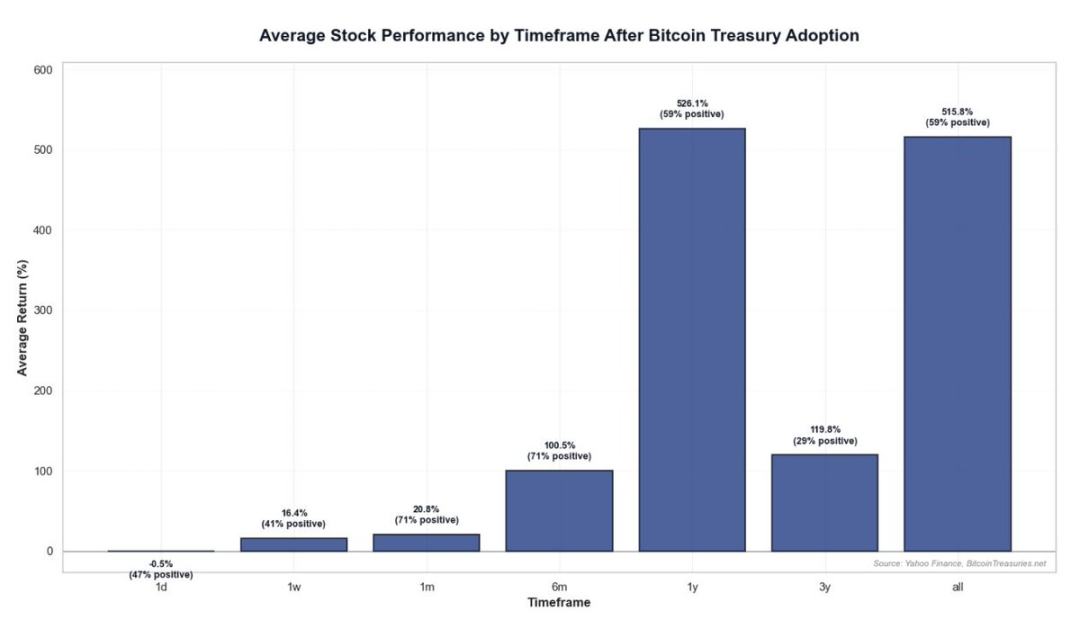
To date, MicroStrategy has been the most successful adopter of this strategy, being one of the earliest entrants into corporate Bitcoin holdings. However, with the introduction of Bitcoin ETFs and new treasury strategies, its “Bitcoin-to-market-cap” premium may gradually erode. In the short term, announcements of Bitcoin funding strategies tend to increase the likelihood of short- and even long-term returns. Returns vary widely, even across different time horizons. Yet, over time, performance declines:
-
1-year average return: 526% (59% of companies profitable);
-
3-year average return: 119% (only 13.64% of companies profitable);
-
Historical average return: 515% (59% of companies profitable).
Note: Median returns are significantly lower than the mean, indicating outliers are inflating the overall average. From 2020–2025, Bitcoin outperformed most asset classes, serving as the main driver behind these high returns.


Heatmap of Bitcoin strategy performance
-
Success stories: companies with strong community consensus, capable of increasing “BTC per share” and creating financial engineering opportunities, perform exceptionally well.
-
Failures: SOS Limited (a former crypto miner pivoting to commodities trading) underperformed due to core business struggles and poor execution of its Bitcoin strategy. Clearly, markets favor “pure-play Bitcoin strategy” firms over those with minor allocations.
-
Risk warning: Bitcoin-related companies may face extreme volatility and drawdowns, but when a company’s net asset value (NAV) exceeds its market cap, turnaround opportunities may arise. Note: for distressed firms, merely holding a small amount of Bitcoin on the balance sheet won’t reverse fundamental decline.
Conclusion
With Circle’s successful IPO as a pure-play stablecoin company, the convergence between stock markets and crypto markets is accelerating. More high-quality crypto companies are expected to go public, alongside a proliferation of crypto strategy tools. Given recent market enthusiasm for crypto strategies, investors can capture opportunities using this framework: team influence, asset quality, sustainability of crypto premium, and deep project-level analysis.
However, when strategies involve tokens outside the top 20 by market cap, exercise extreme caution. These tokens lack Bitcoin’s hard asset attributes and often lack consistent net buying demand. Structurally, investors must clarify: 1) the underlying business strategy the company is pursuing; 2) the transaction’s capital structure (debt, convertible bonds, PIPE); and 3) net asset value per share.
Join TechFlow official community to stay tuned
Telegram:https://t.me/TechFlowDaily
X (Twitter):https://x.com/TechFlowPost
X (Twitter) EN:https://x.com/BlockFlow_News
 @etherary