TGE Approaching: 5 Perspectives Analyzing the Advantages and Potential of Oracle Project RedStone
TechFlow Selected TechFlow Selected
TGE Approaching: 5 Perspectives Analyzing the Advantages and Potential of Oracle Project RedStone
Using Pyth's $2 billion FDV as a reference, the price of each RED token should be $2.
 Navigating Web3 tides with focused insights
Author: Poopman
Translation: CryptoLeo, Odaily Planet Daily
Although the crypto market has been dominated by memes, memes, and more memes in recent months, compared to the end of 2024, the meme hype has now twisted into an extremely distorted corner—from Trump-themed tokens to the recent "Libra scandal"—and overall market sentiment around memes has declined accordingly. See the chart below:
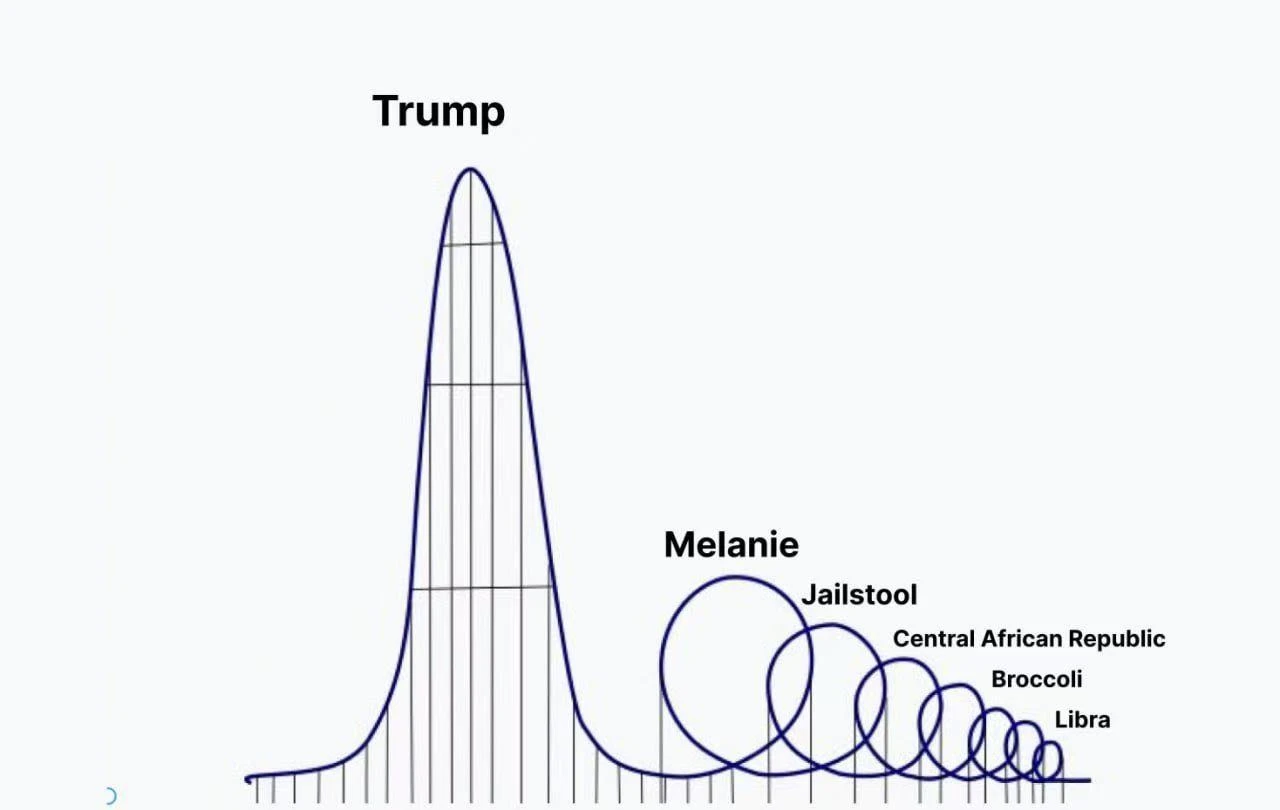
From a data perspective, since the launch of the LIBRA token, daily trading volume on pump.fun (including purchases and trades of newly issued tokens) has dropped 33.7% from $184 million to $122 million. Beyond volume, pump.fun has shown stagnation in other areas as well. On Tuesday, the platform registered only 59,000 new wallets—the lowest since November 17, 2024. Compare this to Inauguration Day last month when the platform reached approximately 110,000 active wallets. Compared to today’s “distorted meme” phase, one can’t help but miss the AI Agent meme era just a few months ago. But PvP isn't the endgame for blockchain—utility and innovation remain the industry's enduring themes.
One project that recently stands out for combining utility with innovation is the oracle project RedStone. The project closed a $15 million Series A funding round in July 2024 and released its tokenomics a week ago. DeFi KOL Poopman wrote about RedStone yesterday, analyzing its strengths and potential from several angles including modular architecture, market share, and token economics. Odaily Planet Daily translation follows:
TL;DR
-RedStone’s modular architecture, AVS scalability, robust security, and ultra-low latency make it one of the most trusted and fastest oracles in the ecosystem.
-In 2024, with $3.8 billion TVS and over 100 partners, RedStone became the second-largest oracle provider in the space.
-During the $2 billion liquidation event in February 2024 and the Renzo (ezETH) depeg, RedStone outperformed other oracles in update speed, low latency, stability, and accuracy.
-Its token RED is a yield-bearing utility token that captures value from data and price feed services. To improve capital efficiency, RED can be wrapped as an LRT and deployed across various DeFi protocols to earn additional yield.
-Benchmarking against Pyth’s $2 billion FDV, RED is expected to trade around $2. The tokenomics prioritize community growth, with 70% of tokens locked during the first 12 months.
The current market cycle has drifted away from fundamentals for some time, and everyone knows this isn't healthy for long-term industry development. Many tokens we know today are merely bubbles or memes, while innovative protocols with real demand and mass adoption potential remain underappreciated.
Recently, RedStone Oracle announced that its token RED is approaching TGE. Its tokenomics are designed to deliver greater value to users and token holders.
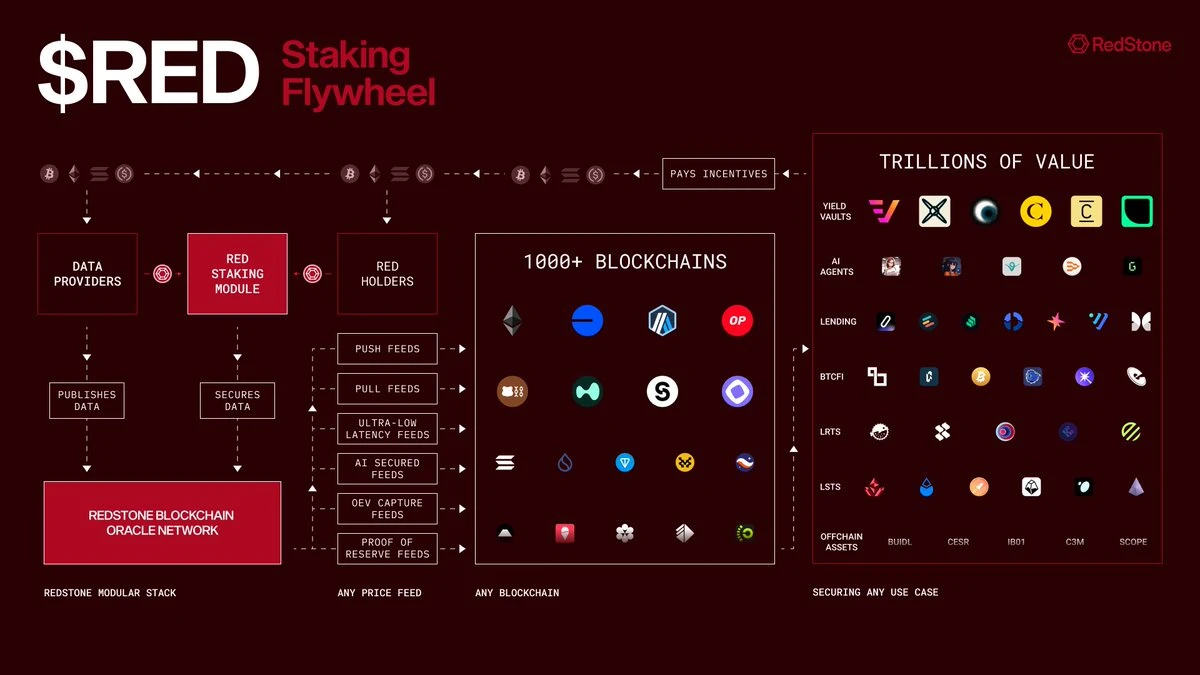
In this article, the author analyzes RedStone’s strengths and potential from five perspectives:
-RedStone features
-RedStone market adoption
-Comparison with other oracles
-RED tokenomics
-Potential valuation of RED
Why is RedStone better?
As is widely known, oracles are one of the most critical components of blockchain. Without oracles, blockchains would be closed ecosystems unable to access external data. In today’s market, every chain and dApp needs an economically efficient, secure, and flexible oracle.
And I believe RedStone has successfully filled this gap.
In recent years, RedStone has integrated and provided price oracles for hundreds of Tier-1 protocols from day one, including USDe, Pendle, Morph Blue, Berachain, EtherFi, and Lombard BTC. But what makes RedStone the preferred choice among so many projects?
The answer is simple: security and modularity.
Security via AVS
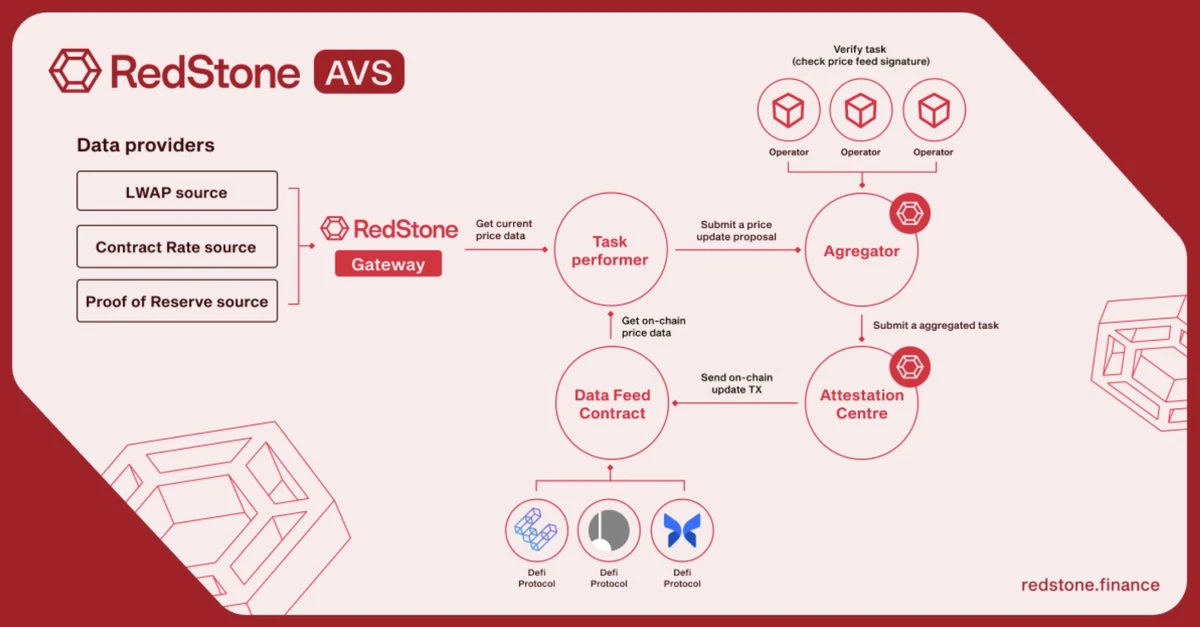
Unlike other oracles, RedStone leverages the EigenLayer AVS framework to verify the accuracy and validity of price feed data, achieving greater gas efficiency and scalability.
Odaily note: AVS stands for Actively Validated Service, a core concept in the EigenLayer ecosystem. An AVS is simply a protocol, service, or system that requires staking to validate "tasks." The AVS itself handles fetching and reporting prices, and it also has a corresponding Service Manager contract that communicates with the EigenLayer contract, containing state related to service functions such as operators running the service and the amount of deposit securing it.
Traditional oracle push models work by collecting data from multiple sources and validating it through DDL (Data Definition Language) and data consumption modules. Because on-chain validation consumes significant gas, it becomes quite expensive. With RedStone’s AVS, data processing occurs off-chain, enabling highly optimized gas usage for verification.
The process works as follows: AVS operators fetch market prices and TWAP rates from data source modules, verify their accuracy, then submit the validated results on-chain.
Since most computation happens off-chain while maintaining trust and verifiability through AVS, RedStone delivers a significantly more cost-effective oracle solution compared to others in the space.
Modularity
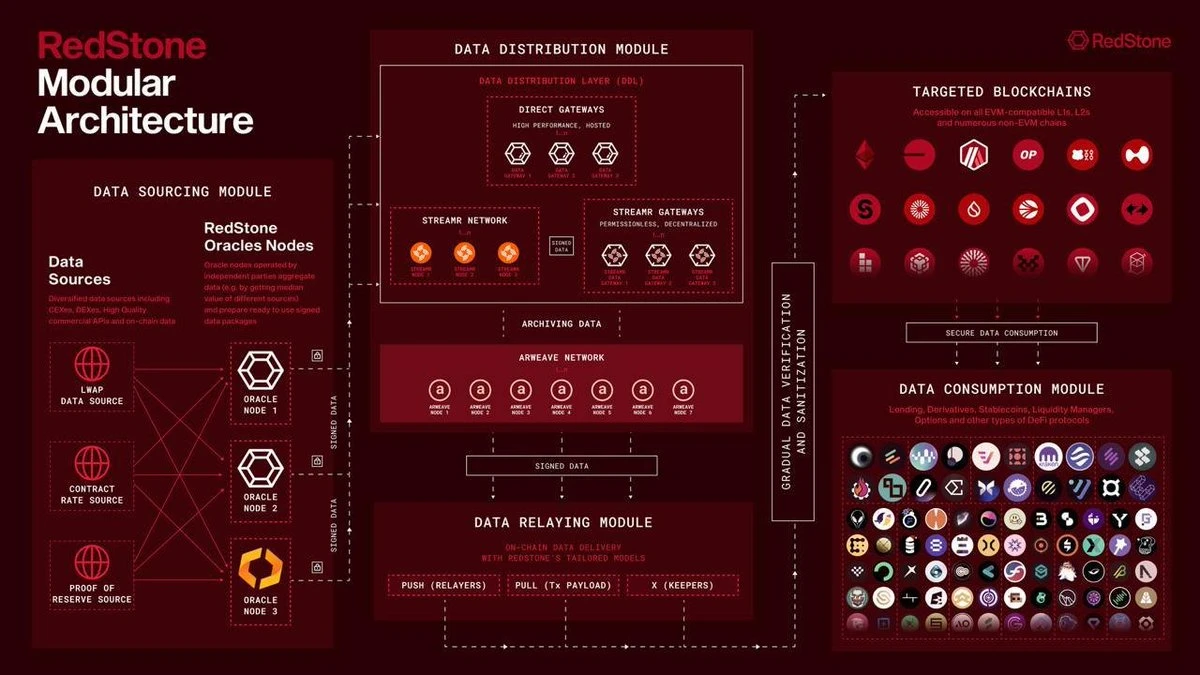
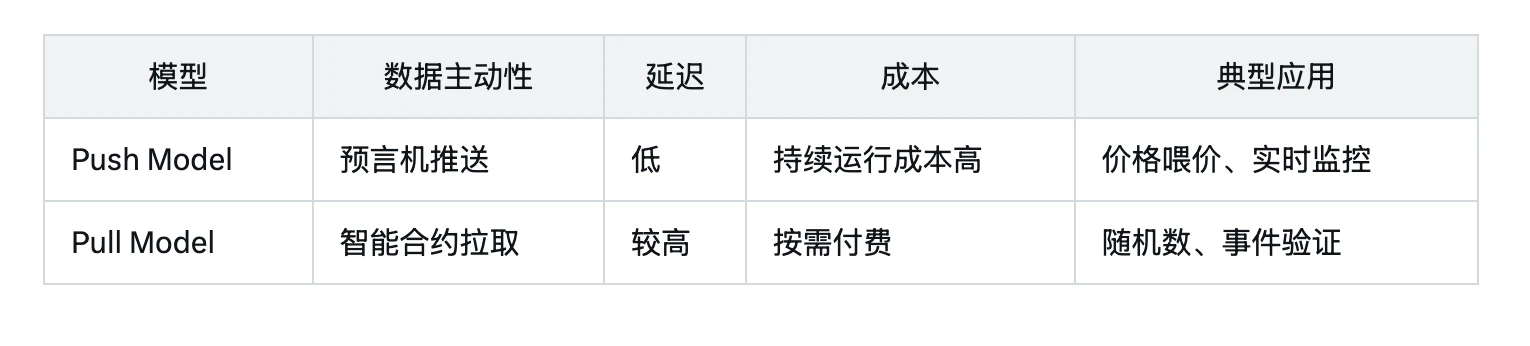
Beyond scalability, modularity is one of RedStone’s key strengths. The platform offers both pull and push models, giving projects greater flexibility to choose between managed or raw oracle data sources based on their specific needs. Projects can opt for carefully filtered and verified price feeds or customizable raw data streams to protect their assets.
Odaily note: pull model and push model are illustrated below:
Thanks to its modular architecture, RedStoneinfra allows seamless swapping of components across different systems without compromising system performance or reliability. This plug-and-play modularity makes RedStone one of the most versatile oracle solutions in today’s DeFi innovation and emerging chain ecosystems.
Market Metrics
Customer Growth
RedStone’s modular, plug-and-play architecture has driven rapid user growth, making it one of the fastest-growing oracle solutions in the blockchain space.
Throughout 2024, RedStone significantly expanded its reach, forming partnerships with over 100 new clients and launching on more than 30 chains. With over $6.8 billion in TVS, RedStone has become the second-largest multi-chain oracle provider, while Chainlink primarily focuses on the ETH ecosystem.
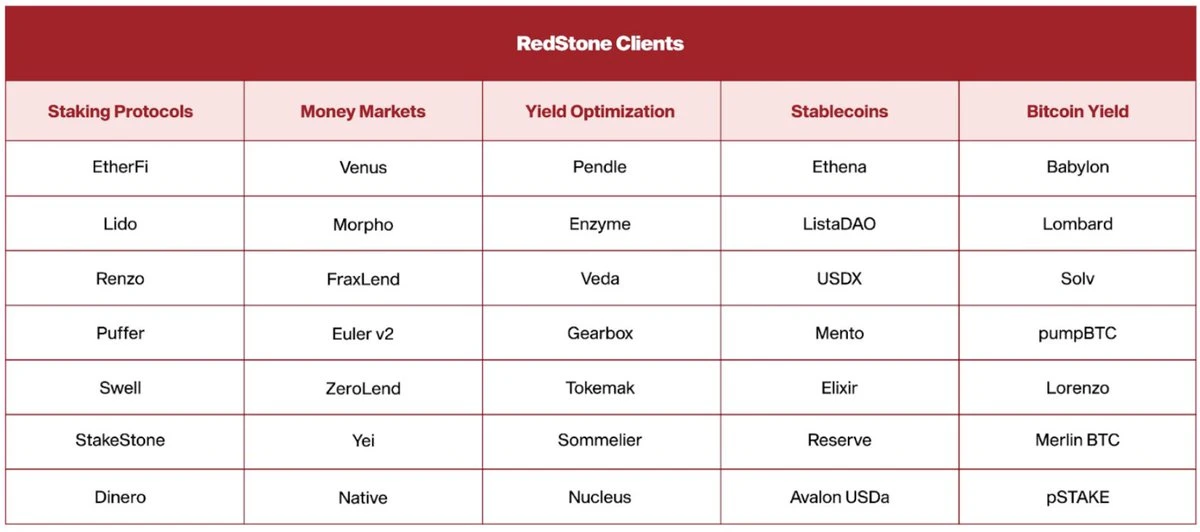
The platform’s reputation for reliability continues to attract mainstream DeFi players. Notable partnerships include delivering $3 billion TVS for Spark (Maker’s lending protocol), providing price feeds for DeFi leaders like Pendle and Ethena, and supporting various BTC staking, yield-bearing stablecoins, LSTs, and LRTs. This client list reflects strong industry confidence in RedStone’s reliable and customizable oracle solutions.
Price Feed Latency (Low Latency)
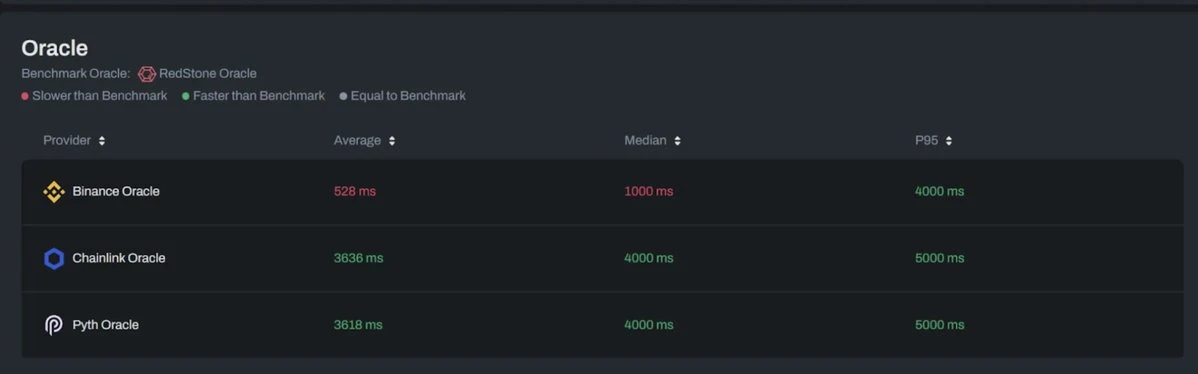
RedStone is one of the fastest and most reliable oracles in the space, all while maintaining decentralization—a combination often considered a trilemma. In terms of speed, RedStone outpaces most centralized oracles (only Binance is slightly faster). Maintaining decentralization while competing with CEXs on speed is a major achievement.
Stability
RedStone has also demonstrated reliability during market volatility, consistently delivering accurate price updates when they matter most. During the $2 billion liquidation event in February 2024, RedStone successfully pushed 119,000 updates within 24 hours, with ETH/USDC price updates surpassing Chainlink by 30 data points, providing more timely and accurate pricing.
During the Renzo (ezETH) depeg in April 2024, RedStone proved faster at tracking price changes than Chainlink. Over three blocks, RedStone published around 40 price updates, while Chainlink delivered only about 20 in the same timeframe. This shows RedStone is actually faster than the market-leading oracle provider. Refer to Chaos Labs report for details.
Comparative advantage: Every oracle project has its strengths, but RedStone combines the best of all worlds into one integrated solution.
RedStone vs Other Oracles
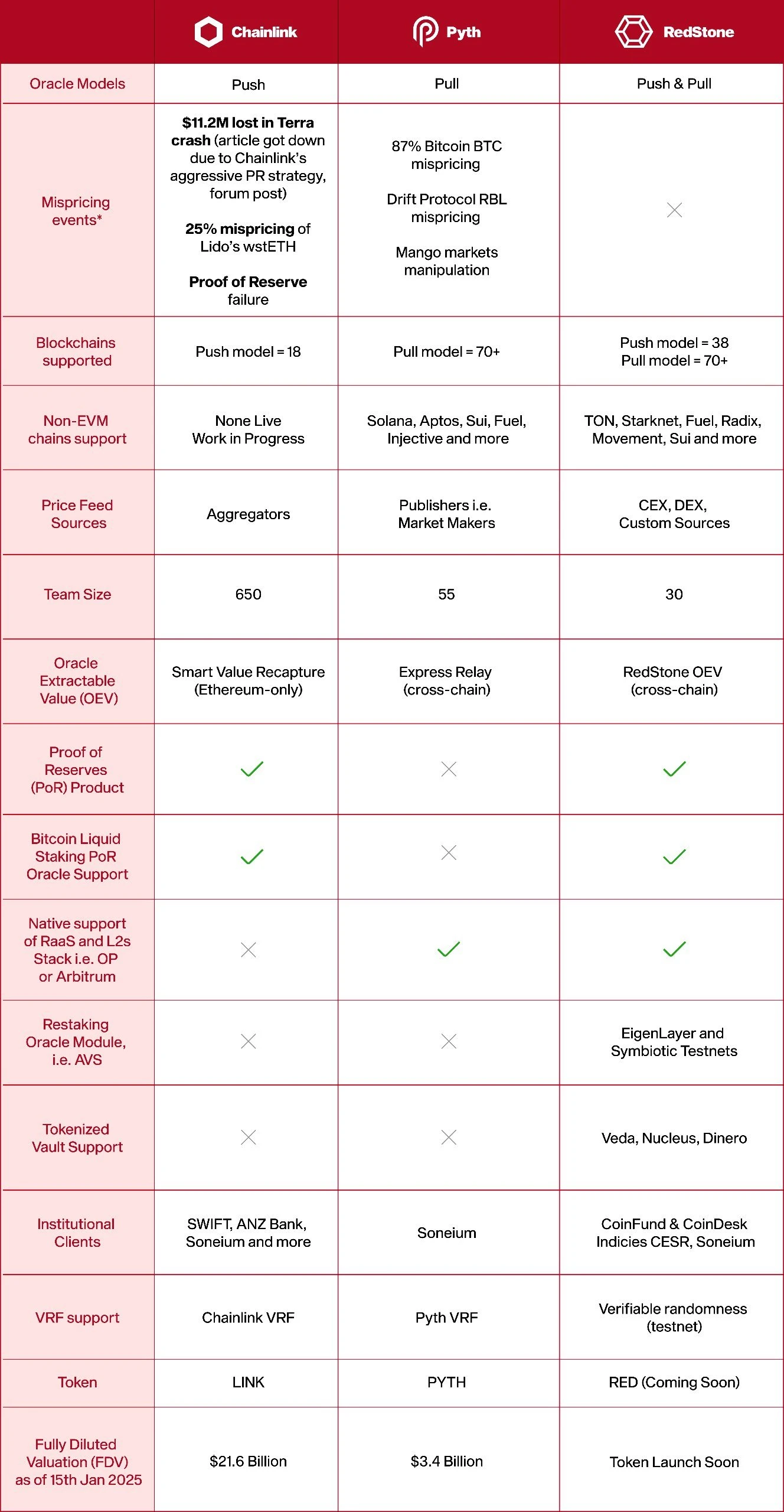
Below is a brief overview of major oracle projects in the current market:
Chainlink: Primarily targets EVM and OG DeFi, uses push model, delivers reliable data via CCIP bridge with costly integration setup, supports only a limited number of blockchains;
Pyth: Targets non-EVM and Perps markets, uses pull model, relies on Wormhole as cross-chain relay, emphasizes data quality;
RedStone: Supports any chain and any market, offers both push and pull models, uses EigenLayer AVS for cost-efficient on-chain validation, includes reserve proof for wrapped BTC assets, etc.
The image below compares three major oracle providers in the market:
Upcoming TGE: RED Tokenomics
As RedStone expands across thousands of on-chain protocols, the RED token will play a crucial role in decentralizing the oracle and capturing value from all integrated projects. RedStone’s data providers (operators) have full flexibility—they can set any collateral, charge fees in any token, or establish any requirements they wish.
RED will function as a utility token. Holders can stake and delegate their tokens to data providers to earn a share of fees and rewards.
In addition, RED will support a restaked version, allowing its LRT to be used across any DeFi protocol to unlock additional economic value (similar to stETH).
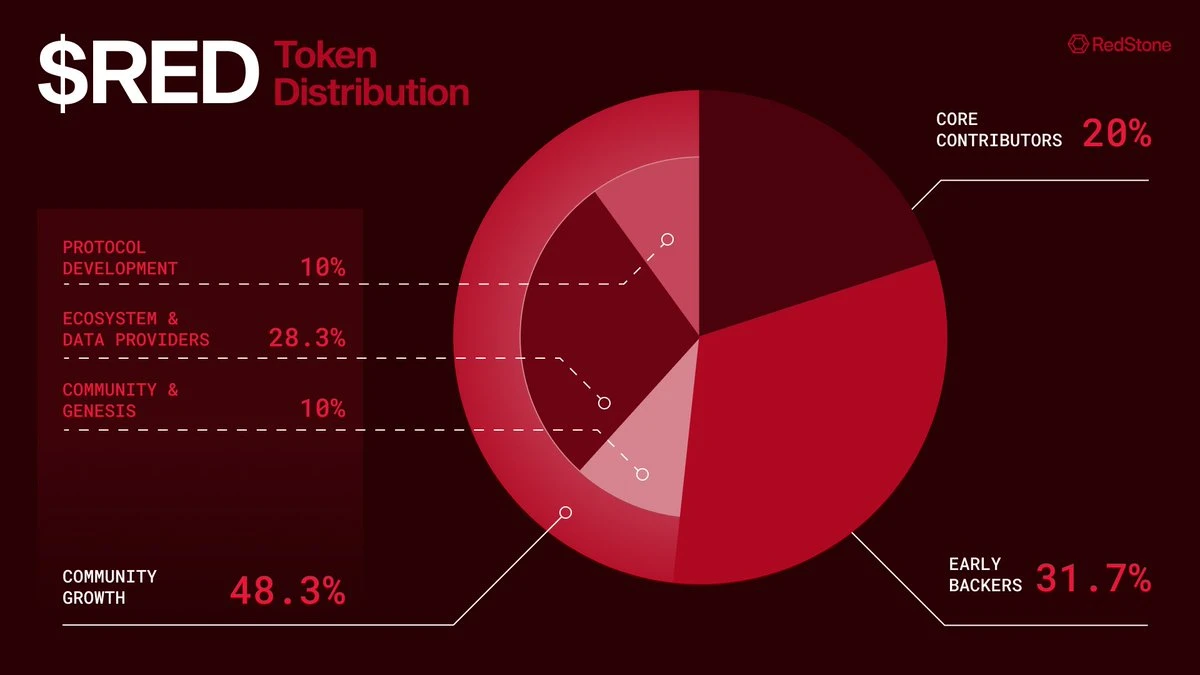
Official data shows a total supply of 1 billion RED tokens. Initial circulating supply accounts for 30%. RED will launch as an ERC-20 token but can later be natively bridged via Wormhole to Solana, Base, and all other supported networks.
RED is community-centric by design: the majority of the token supply (48.3%) will go toward community growth initiatives, including airdrops, future grant programs, and incentives. 20% will be allocated to core contributors.
To ensure long-term sustainability, 70% of RED tokens will be fully locked for the first 12 months post-TGE, gradually unlocking over the following 36 months.
As RedStone’s customer base grows, operators will earn higher fees, increasing returns for RED token holders. Higher yields will drive higher staking rates, ultimately creating a positive feedback loop.
RED Token Valuation
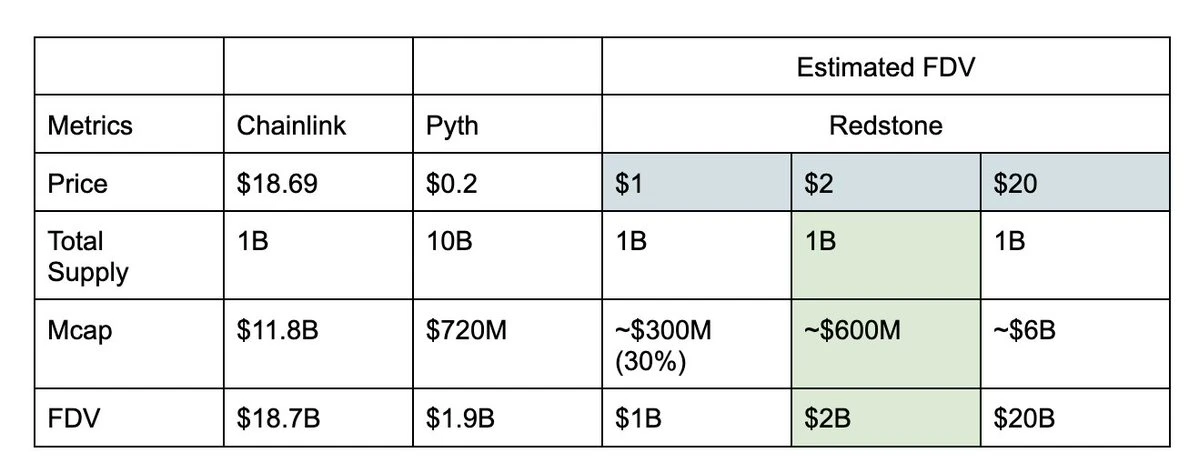
Leading oracle projects in the market have achieved FDVs in the billions. As another top-tier oracle protocol, comparing RedStone with Chainlink and Pyth helps estimate RED’s token price:
With a total supply of 1 billion tokens, a $1 initial price would give RedStone a $1 billion FDV. However, given the project’s current market positioning, $1 seems conservative.
A better benchmark is Pyth’s $2 billion FDV. Considering a 30% initial circulating supply, a $2 per token price aligns with expectations—that’s the RED price I anticipate.
If market conditions improve, RED could potentially reach Chainlink’s FDV level, pushing the token price as high as $20 per token.
Join TechFlow official community to stay tuned
Telegram:https://t.me/TechFlowDaily
X (Twitter):https://x.com/TechFlowPost
X (Twitter) EN:https://x.com/BlockFlow_News
 @poopmandefi