How RedStone Is Redefining Oracles Through Modular Design After Raising $15 Million
TechFlow Selected TechFlow Selected
How RedStone Is Redefining Oracles Through Modular Design After Raising $15 Million
RedStone adopts a differentiated modular design to meet the needs of DeFi protocols, enabling data providers to avoid constantly delivering and transmitting on-chain data.
 Navigating Web3 tides with focused insights
Author: 1912212.eth, Foresight News
Oracles were highly sought after in the previous cycle, riding the DeFi wave and benefiting from their critical role as middleware. Today, Chainlink firmly dominates the market, while Pyth gains traction through the Solana ecosystem and aggressive expansion into DeFi protocols. As public blockchains, restaking, and other sectors advance rapidly with modular designs, where does modularity stand in the oracle space?
Today we introduce RedStone, a modular oracle protocol. In early July, RedStone completed a $15 million Series A funding round led by Arrington Capital, with participation from Kraken Ventures, White Star Capital, Spartan Group, Amber Group, SevenX Ventures, IOSG Ventures, and angel investors including Berachain’s Smokey the Bera and Homme Bera, Ether.Fi’s Mike Silagadze, Jozef Vogel and Rok Kopp, and Puffer Finance’s Amir Forouzani, Jason Vranek, and Christina Chen.
What is RedStone
RedStone is a modular oracle network that provides data sources for DApps and smart contracts on L1s, L2s, and Rollup-as-a-Service networks (such as EigenLayer), especially yield-generating collateral in lending markets like LSTs and LRTs.
Current oracle networks are far from perfect, with room for improvement in data accuracy and completeness. Moreover, as new assets are listed faster and more frequently, some oracles often react slowly—or fail to support them altogether.
RedStone adopts a differentiated modular design tailored to meet the needs of DeFi protocols. Data providers can avoid continuously delivering data on-chain, while end users are allowed to deliver signed oracle data directly on-chain themselves. RedStone also uses Arweave to archive and maintain oracle data.
According to official figures, since launching its mainnet in January 2023, RedStone has supported over 20 blockchains and integrated more than 1,000 assets from 50 data sources—including not only cryptocurrencies but also stocks, fiat currencies, commodities, and ETFs.
How RedStone Works
Most oracle solutions in today’s market rely on third-party push models. The well-known oracle protocol Chainlink uses a Pull model, whereas Pyth employs a Push model—both aiming to address trustworthiness and cost-efficiency in oracle systems.
Specifically, Chainlink's primary price-source oracle nodes obtain data from secondary sources. These oracles pull price updates onto individual chains at set time intervals, requiring gas fees for each on-chain update. Adding new price feeds or reducing latency increases costs for the oracle network, limiting scalability. In contrast, Pyth’s Push model receives data directly from exchanges, market makers, and DeFi protocols within its network (such as Jane Street, Binance, and Raydium). These entities are incentivized to act honestly and provide high-quality data to maintain strong reputations and avoid being banned by the protocol.
RedStone implements a modular design, utilizing three distinct models to deliver data based on specific business requirements and inter-chain architecture—maximizing the strengths of each model while avoiding their weaknesses.
- Pull Model: Dynamically loads data into user transactions, saving gas and optimizing user experience—ideal for individual transactions.
- Push Model: Data is relayed on-chain for storage, primarily designed to integrate seamlessly with existing oracle-dependent protocols.
- X Model: Focuses on eliminating front-running risks, specifically catering to the needs of perpetual contracts, options, and derivatives protocols.
A typical operational flow begins with data collection from sources such as centralized exchanges (e.g., Binance, Coinbase, Kraken), on-chain DEXs (e.g., Uniswap, Balancer), and market data aggregators (e.g., CoinMarketCap, CoinGecko).
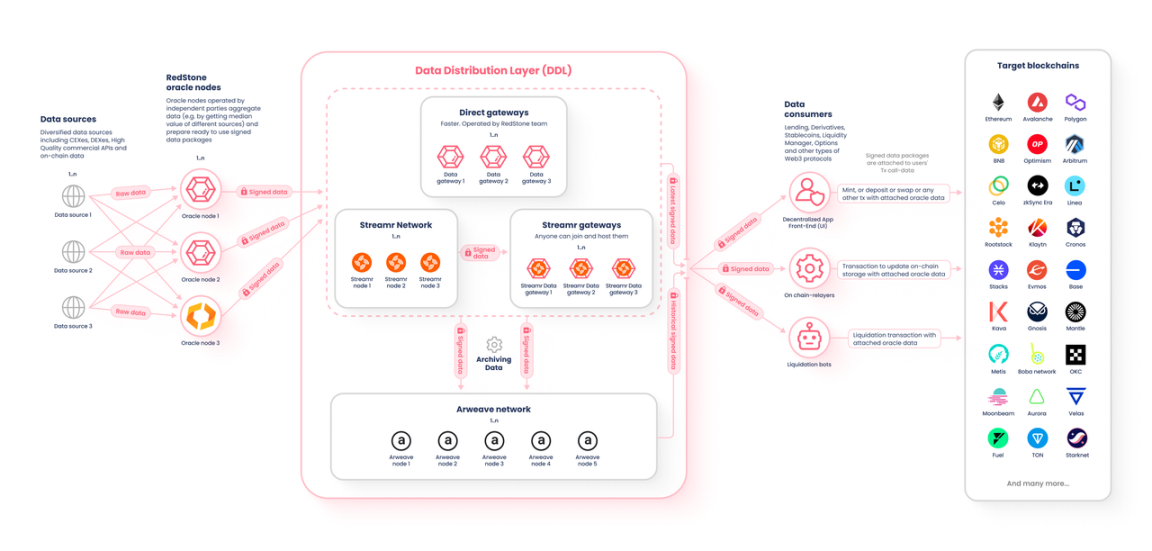
The data is aggregated by independent nodes operated by data providers, using various security measures—including median calculation, time-weighted average price (TWAP), linear weighted average price (LWAP), and outlier detection—to ensure data quality.
These data streams are broadcast directly to open-source gateways that can easily separate data on demand. Data can either be pushed on-chain via dedicated relayers under predefined conditions, or delivered on-chain by bots (e.g., liquidation executors) or end users interacting with protocols.
RedStone first places this data into a data availability (DA) layer before it is pulled onto-chain. This enables high-frequency broadcasting of large volumes of asset data to cheaper layers, only bringing it on-chain when required by protocols.
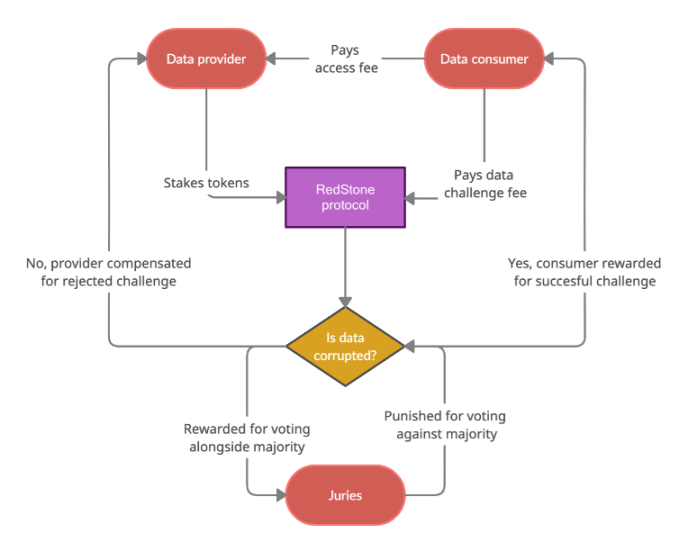
RedStone has not yet launched a token, but its official documentation outlines potential token utilities, including: paying data access fees, staking tokens within the ecosystem to ensure bad actors are penalized, voting to resolve disputes, and supporting early market development. The team also stated that early adopters and data providers will receive token grants and subsidies.
Join TechFlow official community to stay tuned
Telegram:https://t.me/TechFlowDaily
X (Twitter):https://x.com/TechFlowPost
X (Twitter) EN:https://x.com/BlockFlow_News
 Foresight News