DeepSeek: Why Is It Making AI Professionals in the West So Anxious?
TechFlow Selected TechFlow Selected
DeepSeek: Why Is It Making AI Professionals in the West So Anxious?
This won't be the last Chinese AI model to threaten the dominance of Silicon Valley giants.
 Navigating Web3 tides with focused insights
Author: Carl Franzen
Translation: TechFlow
Just days ago, only the most dedicated tech enthusiasts (and I count myself among them) had heard of DeepSeek, a Chinese AI company and subsidiary of High-Flyer Capital Management—a quantitatively driven firm founded in 2015 with an equally distinctive name. Yet in just the past few days, it may have become the most watched company in Silicon Valley.
This surge in attention is primarily due to the release of DeepSeek-R1, a new large language model (LLM) capable of performing "reasoning" similar to OpenAI’s current top-tier model, o1—meaning it can spend seconds or even minutes working through difficult questions and complex problems via step-by-step or "chain-of-thought" analysis, reflecting on its own reasoning process.
Not only does DeepSeek-R1 match or exceed OpenAI’s o1 across various third-party benchmarks (tests measuring AI performance in answering questions across multiple subjects), but it reportedly achieved this at a training cost of only around $5 million and using far fewer graphics processing units (GPUs) than the number strictly embargoed by the U.S. (OpenAI’s home base).
Unlike o1, which is accessible only to paying ChatGPT Plus subscribers ($20/month) and higher-tier plans such as the $200/month Pro tier, DeepSeek-R1 was released as a fully open-source model—explaining why it quickly rose to the top of Hugging Face’s rankings for most popular and active AI models.
Moreover, because it's fully open source, the model has already been fine-tuned and retrained by users for various specialized tasks—such as shrinking it to run efficiently on mobile devices or combining it with other open-source models. Even for development use, DeepSeek’s API costs over 90% less than OpenAI’s equivalent o1 model.
Most impressively, you don’t even need to be a software engineer to use it: DeepSeek offers free websites and mobile apps for U.S. users, featuring an R1-powered chatbot interface nearly identical to OpenAI’s ChatGPT. But once again, DeepSeek goes a step further by integrating this powerful reasoning model with web search—an integration OpenAI hasn't yet achieved (web search is currently only available on weaker GPT-series models).
An Obvious Irony
Given OpenAI’s original mission to democratize AI for the public, there’s a striking, perhaps even unsettling irony here. As Jim Fan, senior research manager at Nvidia, put it on X: “We’re living in a timeline where a non-American company is carrying forward OpenAI’s original mission—truly open frontier research that empowers everyone. It doesn’t make sense. But the most interesting outcomes are often the most likely.”
As X user @SuspendedRobot noted (referencing reports that DeepSeek appears to have been trained on ChatGPT-generated Q&A outputs and other data): “OpenAI steals data from the entire internet to get richer, while DeepSeek steals it back and gives it freely to the people. That reminds me of an English folk tale.”
Meta in Crisis Due to Falling Behind with Open-Source Llama?
But it’s not just Fan who’s noticed DeepSeek’s rise. Based on conversations and readings across engineers, thinkers, and industry leaders, DeepSeek-R1’s open availability, high performance, and seemingly sudden emergence to challenge the former generative AI frontrunner have sent shockwaves throughout Silicon Valley and beyond. If not quite “everyone” as my sensational headline suggests, it’s certainly a hot topic within tech and business circles.
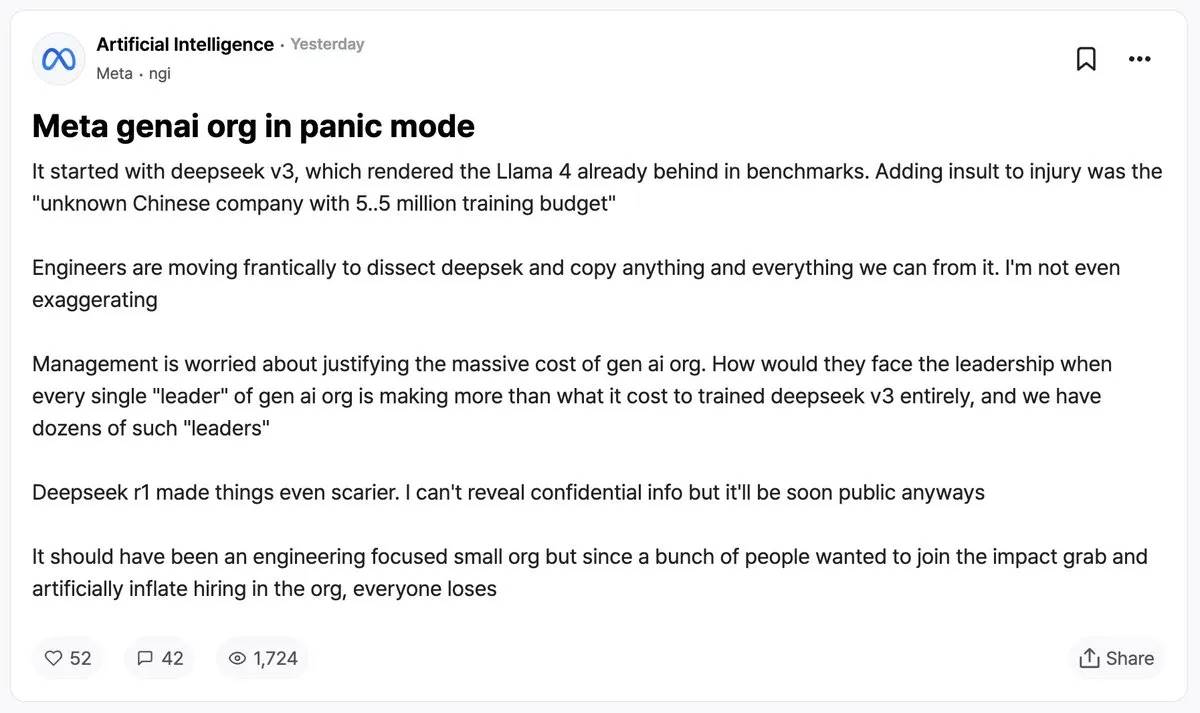
A post circulating widely on Blind (an anonymous gossip-sharing app popular in Silicon Valley) implies Meta is in crisis mode over DeepSeek’s success, as it has so rapidly outpaced Meta’s own efforts to become the king of open-source AI through its Llama models.
"This Changes the Entire Game"
X user @tphuang made a compelling argument: “DeepSeek has already commoditized AI outside the very top tier. The first chart blew my mind. R1 is cheaper than American labor, meaning many jobs will be automated within the next five years.” He later explained why DeepSeek’s R1 is more attractive to users than OpenAI’s o1:
“o1 has three huge problems:
1) Too slow
2) Too expensive
3) Lack of end-user control / excessive reliance on OpenAI.
R1 solves all of these. Companies can buy their own Nvidia GPUs to run these models without worrying about extra fees or OpenAI servers being slow or unresponsive.”
@tphuang also posed a thought-provoking analogy: “Will DeepSeek become the Android of the LLM world?”
Web entrepreneur Arnaud Bertrand spoke bluntly on X about the staggering implications of DeepSeek’s success: “The extent to which this changes the entire game cannot be overstated. This isn’t just about AI—it’s a massive irony directed at the misguided U.S. attempt to block Chinese technological advancement. Without those restrictions, DeepSeek might never have emerged (as the saying goes, necessity is the mother of invention).”
The Issue of Censorship
Still, some caution against DeepSeek’s rapid ascent, noting that as a startup operating in China, it must comply with the country’s laws and content censorship requirements. Indeed, when I used the iOS version of DeepSeek in the U.S., I found it refused to answer certain questions.
As someone in journalism, I naturally place great value on freedom of speech and expression—one of the foundational principles I firmly uphold.
Yet I must also point out that OpenAI’s models and products, including ChatGPT, similarly refuse to answer a range of questions—particularly those involving human sexuality and adult/NSFW content—even when phrased innocently.
Certainly, this isn’t a perfect comparison. For some, the unease around relying on foreign technology may cast doubt on DeepSeek’s ultimate value and utility. But its performance and low cost are undeniable.
In an era where 16.5% of U.S. consumer goods are imported from China, I find it hard to justify outright warnings against using DeepSeek-R1 based solely on censorship concerns or security risks—especially when the model code can be freely downloaded, used offline, run securely on local devices, and fine-tuned at will.
I do detect in the fervor around DeepSeek a certain existential anxiety about “Western decline” and “Chinese rise.” Some have already linked this to the moment when U.S. TikTok users briefly migrated to Xiaohongshu (Little Red Book) during its temporary ban and were surprised by the quality of life portrayed in the videos shared there. DeepSeek-R1 emerges precisely within this narrative context—one where China appears (and in many metrics actually is) rising, while the U.S. appears (and in many metrics also is) declining.
The First, But Far From the Last, World-Shaking Chinese AI Model
This won’t be the last Chinese AI model to threaten the dominance of Silicon Valley giants—even as those giants like OpenAI raise unprecedented funds toward developing artificial general intelligence (AGI), defined as systems surpassing humans in most economically valuable work.
Just yesterday, another Chinese model—Doubao-1.5-pro from ByteDance, TikTok’s parent company—was released, matching OpenAI’s non-reasoning GPT-4o model on third-party benchmarks at just 1/50th of the cost.
Chinese models are advancing so rapidly and effectively that even people outside the tech industry are noticing: The Economist recently published an article on DeepSeek’s success and broader Chinese AI efforts, and political commentator Matt Bruenig posted on X: “I’ve been using Gemini, ChatGPT, and Claude to summarize NLRB documents for nearly a year. Deepseek outperforms all of them. Its chatbot version is free. Using its API costs 99.5% less than OpenAI’s. [shrug emoji]”
How Will OpenAI Respond?
No wonder OpenAI co-founder and CEO Sam Altman announced today that the company will bring its unreleased second-generation reasoning model series, o3, to ChatGPT—even making it available to free users. OpenAI still appears to be carving its path through more proprietary and advanced models, setting the industry standard.
But the question remains: With DeepSeek, ByteDance, and other Chinese AI companies rapidly closing the gap, how long can OpenAI maintain its lead in creating and releasing cutting-edge AI models? And if it does fall behind, how quickly and severely might it decline?
Still, OpenAI does have another historical precedent to draw from. If DeepSeek and other Chinese AI models play a role akin to Google’s open-source Android in the mobile space—dominating market share for a period—just consider how Apple’s iPhone succeeded by capturing the high end with its closed, proprietary, vertically integrated approach, then steadily expanding downward, especially in the U.S., until now holding nearly 60% of the domestic smartphone market.
Nevertheless, for all those spending heavily on leading lab-developed AI models, DeepSeek demonstrates that comparable functionality may soon be available at much lower prices—and with far greater control. In enterprise environments, that could be enough to win the day.
Join TechFlow official community to stay tuned
Telegram:https://t.me/TechFlowDaily
X (Twitter):https://x.com/TechFlowPost
X (Twitter) EN:https://x.com/BlockFlow_News
 @VentureBeat