SOL Staking Guide: Analyzing the Solana Staking Ecosystem from Mechanisms to Yields
TechFlow Selected TechFlow Selected
SOL Staking Guide: Analyzing the Solana Staking Ecosystem from Mechanisms to Yields
This guide provides a comprehensive overview of SOL staking, covering the most common questions and all key areas.
 Navigating Web3 tides with focused insights
Author: Lostin, Helius
Translation: Glendon, Techub News
If you hold SOL tokens and want to stake them but don't understand Solana's staking mechanism? Don't worry—this guide provides a comprehensive overview of SOL staking, covering the most common questions and all key areas. Let’s get started!
Why Stake SOL?
Staking SOL isn’t just about earning rewards—it’s also crucial for Solana’s decentralization and security. By staking, SOL token holders contribute to the network’s stability and governance. A critical part of this process is selecting a suitable validator to delegate to. Delegating tokens to a validator is akin to voting in a representative democracy, reflecting trust that the validator will maintain high uptime and quickly and accurately process blocks. Other considerations include the validator’s ethical conduct, response to hard forks, and contributions to the Solana ecosystem.
Distributing stake evenly among reputable validators further promotes network decentralization and effectively prevents any single well-funded entity from manipulating consensus decisions for personal gain.
What Happens When You Stake?
There are two forms of staking on Solana: native staking and liquid staking. Currently, 94% of staked SOL uses native staking, so this article focuses primarily on that method, with a brief introduction to liquid staking later. For native staking, users can operate through various platforms, including multisig treasury tools (like Squads), popular wallets, and dedicated staking websites. The native staking process is relatively simple: users deposit their tokens into a stake account and then delegate it to a validator’s vote account. A single user can create multiple stake accounts, each of which can be flexibly delegated to the same or different validators.
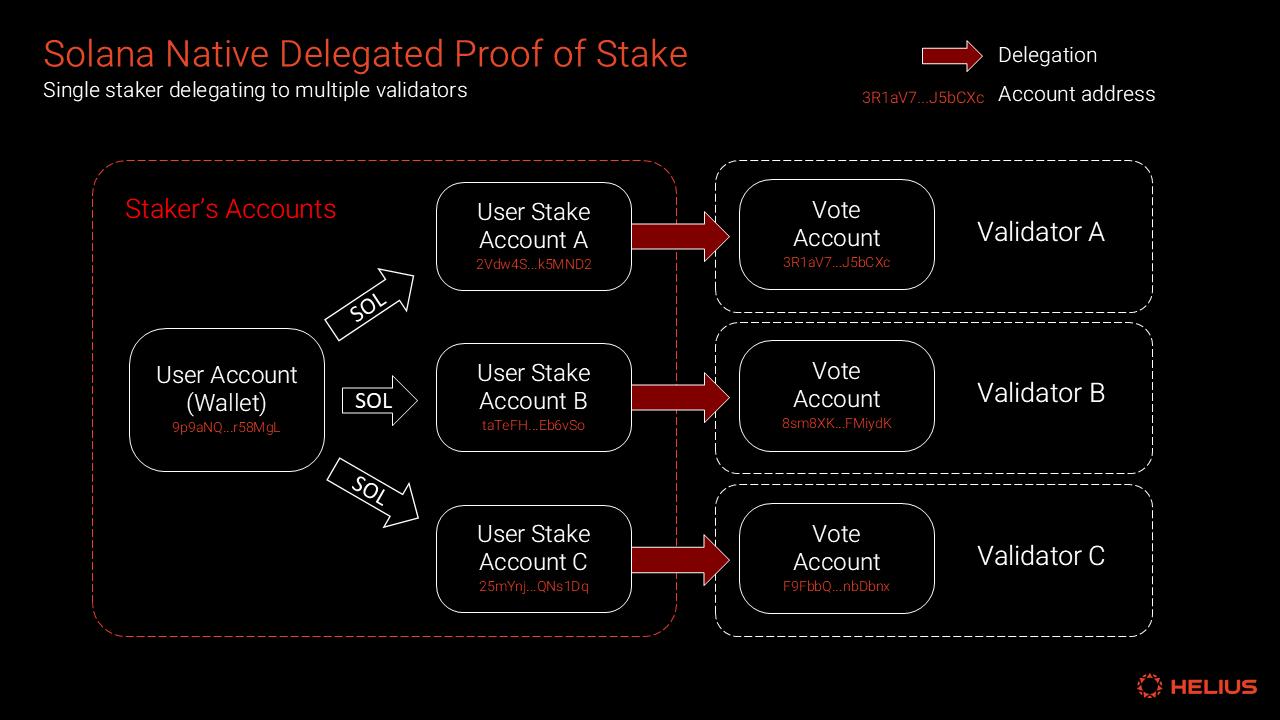
Above: A single staker delegating to multiple validators
Each stake account has two key authorities: staking authority and withdrawal authority. These are automatically set by the system upon account creation and default to the user’s wallet address. Each authority has distinct responsibilities. The withdrawal authority holds greater control over the account—it can remove tokens from the stake account and allows the user to update the staking authority.
The most important time unit in staking is the epoch. Each Solana epoch lasts 432,000 slots, approximately two days. At the start of each new epoch, staking rewards are automatically distributed to stakers. This process requires no manual action—the user will simply see their account balance increase at the end of each epoch. Additionally, users can directly claim MEV rewards via the Jito website (more on this later).
When you stake natively, your tokens are locked for the duration of the current epoch. If a user initiates an unstake at the beginning of an epoch, they may face a cool-down period of up to two days before being able to withdraw. However, if they withdraw at the end of an epoch, the process is nearly instantaneous with no additional wait.
Likewise, initiating staking involves a warm-up period, which could take up to two days or be nearly immediate, depending on when the user activates their stake account. During this time, users can track the progress of the current epoch using a Solana block explorer.
How Do Validators Earn Revenue?
Validator operators earn income through three primary channels:
-
Issuance / Inflation: Minting new tokens
-
Priority Fees: Users send SOL to validators to prioritize transaction processing
-
MEV Rewards: Users pay Jito tips to validators to include transaction bundles
All validator revenue is denominated in SOL and scales directly with their amount of staked SOL. Operational costs are mostly fixed and priced as a mix of SOL and fiat currency.
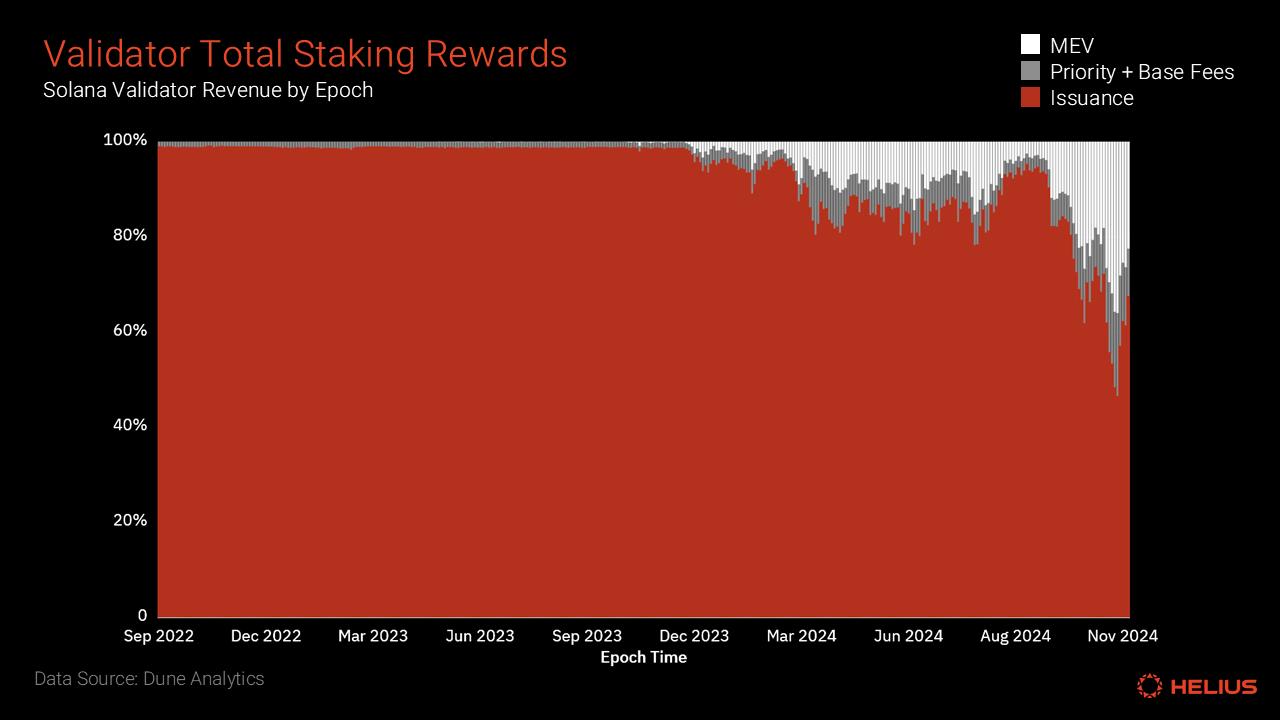
Above: Total staking rewards for Solana validators (Source: Dune Analytics, 21.co)
Token Issuance
Solana periodically issues new SOL tokens according to its inflation schedule, distributing them as staking rewards to validators at the end of each epoch. Currently, Solana’s inflation rate stands at 4.9%, decreasing annually by 15% until it stabilizes at a long-term rate of 1.5%.
The amount of staking rewards a validator receives primarily depends on the number of credits earned through correct voting that confirms their block on-chain. If a validator experiences downtime or fails to vote timely, their credit accumulation decreases. On average, a validator holding 1% of total stake can expect to receive roughly 1% of total inflation rewards.
Furthermore, these rewards are subdivided and distributed among the validator’s delegators based on their relative stake size. During this process, validators may charge a commission on the total inflation rewards received by their delegators. This commission rate is typically a single-digit percentage but can range anywhere from 0% to 100%.
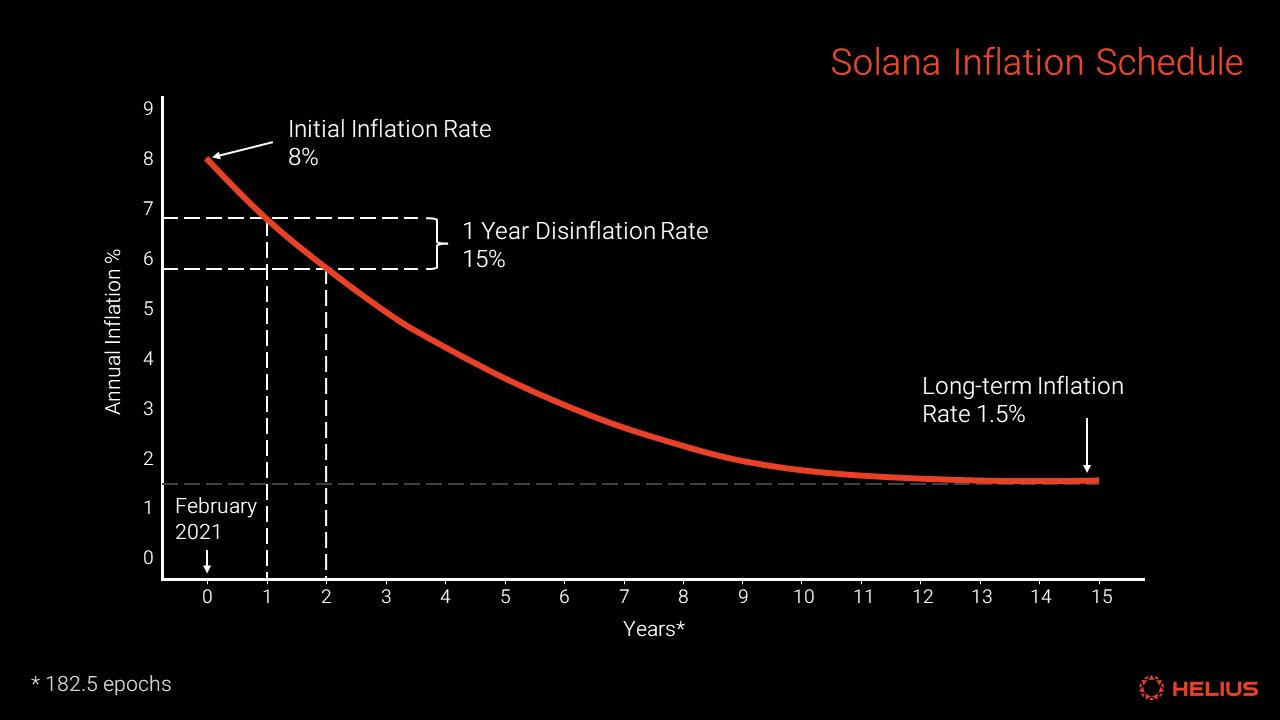
Above: Solana inflation timeline
Priority Fees
On the Solana network, the validator selected to build the current block collects fees from every processed transaction. These fees consist of two components: base fees and priority fees. Prior to SIMD-96, validators received 50% of both base and priority fees, with the remaining 50% burned. With the adoption of SIMD-96, block producers will now be allowed to keep 100% of priority fees.
By paying priority fees, users ensure their transactions are prioritized within a block. This mechanism is especially important in scenarios such as arbitrage, liquidations, and NFT mints, where transaction speed is critical. Complex transactions requiring more computational resources typically require higher priority fees. Generally, highly demanded token accounts necessitate higher priority fees.
While base fees contribute less to revenue, they play an essential role in spam prevention. To maintain network security and stability, Solana sets a fixed base fee of 0.000005 SOL (5,000 lamports) per signature, reducing the risk of malicious transactions and network congestion.
MEV (Jito) Rewards
Currently, validators running the Jito validator client account for over 90% of total SOL staked. Jito introduced an off-protocol blockspace auction mechanism, conducted off-chain, allowing searchers and applications to submit transaction bundles. These bundles often contain time-sensitive transactions like arbitrage or liquidations. To incentivize block builders to prioritize these bundles, each includes a "tip." This provides validators with an additional revenue stream beyond base and priority fees.
In 2024, Jito’s MEV revenue grew from negligible to becoming a major income source for validators. Validators can set commissions on MEV rewards using a mechanism similar to inflation rewards. Delegators then receive a share of the remaining fees proportional to their stake contribution to the block builder.
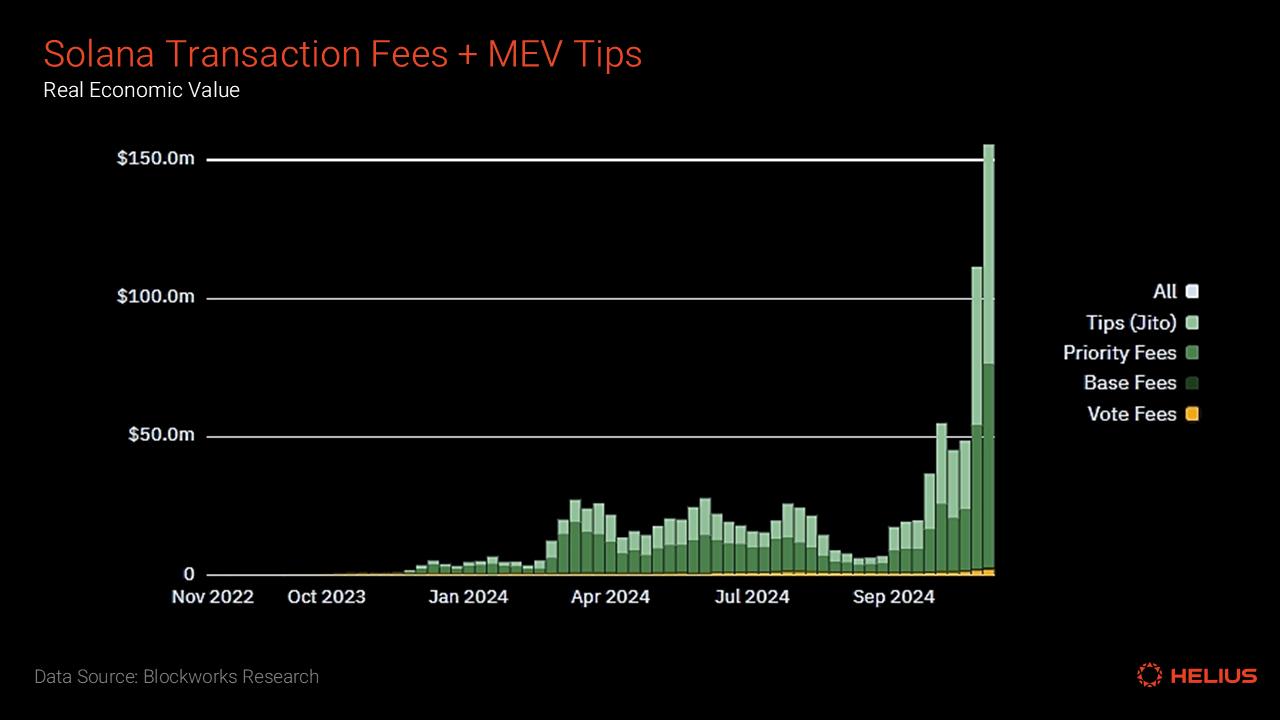
Above: Data quantifying growth in priority fees and Jito tips. Source: Blockworks Research
Where Does APY Come From?
Annual Percentage Yield (APY) measures the compounded annual return a staker would earn if they staked for one full year at the current rate. This yield is influenced by several complex factors, including the network’s current issuance rate, validator performance and uptime, user tips to validators, and the current staking ratio (the proportion of SOL staked relative to total supply). Today, several websites provide validator rankings by APY, with StakeWiz being one of the most comprehensive.
Specifically, APY originates from two main sources: issuance rewards and MEV rewards.
Issuance Rewards
On the Solana network, validators distribute staking rewards based on the size of delegators’ stakes. When distributing rewards, validators charge a service commission ranging from 0% to 100%. Moreover, the rewards a validator earns depend not only on the size of their delegators’ stakes but also closely on their voting performance. Each successful vote earns the validator credits, which serve as the basis for reward distribution.
Well-managed validators achieve higher rewards due to the following factors:
-
Minimal downtime: Validators earn no credits during downtime since they cannot participate in voting.
-
Timely voting: Validators consistently lagging in consensus participation may earn fewer credits.
-
Accurate voting: Credits are only awarded for votes on blocks that are subsequently confirmed.
MEV (Jito) Rewards
MEV rewards are playing an increasingly significant role in staking returns. Rising on-chain transaction volume and resulting arbitrage opportunities drive this growth. Recently, Jito MEV tips have accounted for approximately 20–30% of total rewards, substantially boosting staker yields. Similar to issuance rewards, validators charge commissions on MEV tips ranging from 0% to 100%. Additionally, Jito charges a 5% platform fee on all MEV-related revenue.
Other Considerations
However, stakers do not solely base their validator selection on commission rates. While low-commission validators may offer higher direct returns, many still prefer high-commission validators like Coinbase, driven by factors such as custodial lock-in and regulatory arbitrage. For example, funds using Coinbase Custody must typically stake exclusively on Coinbase’s validator. Meanwhile, centralized exchanges benefit from retail users who prioritize convenience over yield optimization. Off-chain users may be less sensitive to subpar returns, giving exchanges greater flexibility in structuring rewards.
Finally, new protocol mechanisms (e.g., SIMD-123) aim to allow validators to directly share block rewards with stakers. If successfully implemented, this would provide stakers with an additional revenue stream.
Key Players in the Solana Staking Ecosystem
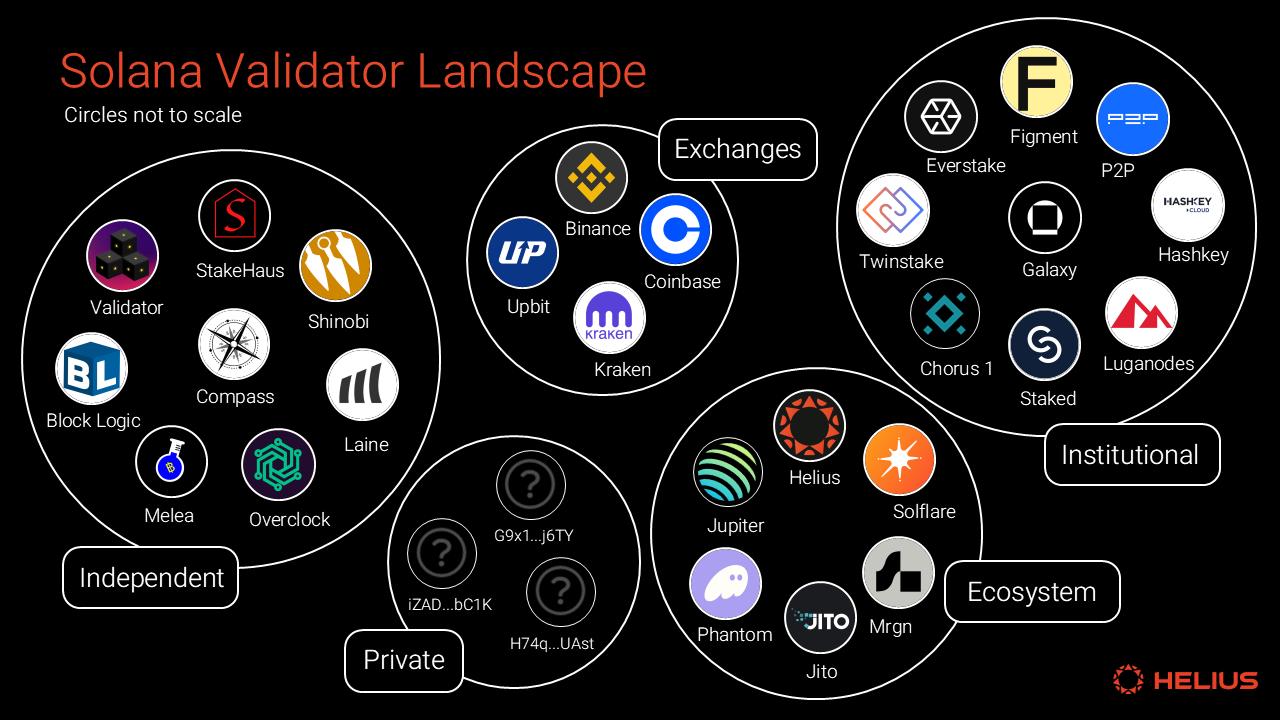
Solana validators can be categorized into several groups.
Ecosystem Teams
Many prominent Solana applications and infrastructure teams operate validators complementary to their core business. For instance, Helius runs a validator to support its RPC services.
Examples:
-
Helius
-
Mrgn
-
Jupiter
-
Drift
-
Phantom
Centralized Exchanges
Centralized exchanges rank among the highest-staked Solana validators, offering one-click staking solutions for off-chain exchange customers.
Examples:
-
Kraken
-
Coinbase
-
Binance
-
Upbit
Institutional Solution Providers
These companies specialize in providing customized staking services for institutional clients. They support multiple blockchains to meet broader customer needs.
Examples:
-
Figment
-
Kiln
-
Twinstake
-
Chorus One
Independent Teams
The Solana validator ecosystem includes many independently operated mid-sized and long-tail validators. Some have been active since the network’s genesis and contribute to the ecosystem through education, research, governance, and tool development.
Examples:
-
Laine
-
Overclock
-
Solana Compass
-
Shinobi
Private Validators
The network also hosts over 200 private validators. Their stake is self-delegated and may be controlled by the operating entity. These validators are characterized by a 100% commission rate and lack publicly identifiable information on block explorers and dashboards.
What Is Liquid Staking?
Liquid staking allows users to diversify their staking exposure across multiple operators via staking pools, which issue liquid staking tokens (LSTs). These LSTs represent ownership shares in the underlying staked accounts.
LSTs
LSTs are yield-bearing assets whose value appreciates over time based on the annual percentage yield (APY) of the underlying staked accounts. In native staking, rewards increase the staked SOL balance each epoch. In contrast, with liquid staking, the quantity of LSTs remains constant while their value relative to SOL increases over time.
LSTs enhance capital efficiency in staking by unlocking DeFi opportunities. A typical use case is depositing LSTs as collateral on lending platforms, enabling users to borrow while maintaining their positions and continuing to earn staking rewards.
Current State of Liquid Staking
Currently, although only 7.8% of staked SOL uses liquid staking, this segment is growing rapidly. Data shows liquid staking has accumulated 32 million SOL, up from 17 million at the beginning of 2024—an 88% annual growth rate. Among them, JitoSOL is the most popular Solana LST with a 36% market share. Other notable options include Marinade (mSOL) and JupiterSOL (jupSOL), holding 17.5% and 11% of the market, respectively.
Tax Advantages
In fact, liquid staking offers tax benefits to users. In many jurisdictions, staking rewards paid in tokens are treated as taxable events (similar to stock dividends) and taxed as income upon receipt. However, because LSTs keep the user’s wallet balance unchanged—only increasing in value—users do not trigger taxable events with each reward distribution.
Is SOL Staking Secure?
Native staking offers stakers a direct and secure way to participate in network validation. In this model, stakers always retain control and custody of their SOL. If a validator goes offline or performs poorly, non-custodial stakers can freely undelegate at any time and switch to better-performing validators. During network outages, native stakers’ positions remain unaffected; once network activity resumes, their stakes are preserved.
Likewise, liquid staking provides unique security assurances. To date, five reputable firms have conducted nine audits on staking pool programs, verifying their robustness. Nevertheless, investors should remain aware of market volatility and potential risks when using liquid staking. Under unfavorable market conditions or during “black swan” events, LSTs may trade temporarily below their underlying value. While such deviations are usually short-lived, investors should consider tail risks, especially when using LSTs as collateral.
Slashing Mechanism
Slashing is a penalty mechanism that reduces delegated stake to deter malicious or harmful behavior. Although Solana currently does not implement slashing, network developers are actively considering this option and may introduce it in the future.
Finally, stakers should follow best practices and securely manage their private keys to prevent loss or theft.
How Is Staking SOL Different From Staking ETH?
Solana and Ethereum differ in their staking approaches. Solana natively integrates delegated Proof-of-Stake (dPoS) into its core protocol, enabling delegation without relying on external solutions. This design has led to a high staking participation rate of 67.7% of total supply—significantly higher than Ethereum’s 28%. In contrast, Ethereum’s transition from Proof-of-Work to Proof-of-Stake relies heavily on third-party platforms like Lido and Rocket Pool for delegation and liquid staking services.
On Ethereum, solo staking is the only native staking option, requiring validators to possess advanced technical skills and dedicated hardware. Validators must stake at least 32 ETH and ensure their hardware remains online and well-maintained. This self-custody approach has earned Ethereum a reputation for high decentralization, with thousands of individual stakers forming the backbone of the network.
Although solo staking plays a significant role on Ethereum, liquid staking is widely adopted through major platforms. Lido leads the market, controlling over 28% of staked ETH supply. By issuing the yield-bearing token stETH, Lido enables investors to earn staking rewards while retaining exposure to ETH. However, like all liquid staking tokens, stETH carries risks such as smart contract vulnerabilities and price divergence from ETH. More importantly, Ethereum’s inflation-based returns are relatively low—staking ETH via Lido yields only a 2.9% annual interest rate, far below the returns from staking SOL. Additionally, Lido charges a 10% fee on staking rewards, further reducing investors’ net returns.
Finally, it’s worth noting that Ethereum includes a slashing mechanism to penalize validator misbehavior, though slashing events are rare.
Conclusion
This article comprehensively explores the concepts, mechanisms, and importance of Solana staking. Whether for experienced participants or newcomers to the Solana ecosystem, understanding staking is essential. Staking not only offers long-term SOL holders a way to earn competitive returns but also serves as a fundamental mechanism underpinning Solana’s network security and decentralization.
Join TechFlow official community to stay tuned
Telegram:https://t.me/TechFlowDaily
X (Twitter):https://x.com/TechFlowPost
X (Twitter) EN:https://x.com/BlockFlow_News
 @heliuslabs