DOGE's New Value Cycle: Political Traffic Potential and Musk's "Department of Government Efficiency" (D.O.G.E) Political Career
TechFlow Selected TechFlow Selected
DOGE's New Value Cycle: Political Traffic Potential and Musk's "Department of Government Efficiency" (D.O.G.E) Political Career
DOGE will be the Trump of the cryptocurrency industry—a focal point in any transaction that cannot be overlooked.
 Navigating Web3 tides with focused insights
Author: @Web3Mario
Summary: The meme ecosystem has recently become extremely hot, prompting me to continue observing and researching related topics. Last week, many memes achieved several-fold or even tens of times returns; however, the stories I've seen and heard mostly involve significant losses. Therefore, before diving in, I urge everyone to stay rational when participating, strictly manage risk controls, adhere to trading strategies, and avoid being blinded by survivorship bias. Back to the topic—while studying the meme sector, I started with its leading project, DOGE, and discovered some interesting developments worth sharing. Overall, as Elon Musk’s political prospects grow stronger, DOGE is tapping into a new source of momentum—political traffic. Thus, the upcoming U.S. election results could usher DOGE into a new value cycle.
Looking back at DOGE's history: Traffic drives meme price surges
Let’s briefly review DOGE’s development history. Dogecoin was co-created in December 2013 by Billy Markus and Jackson Palmer, inspired by the popular "Doge" Shiba Inu meme. Initially, the founders intended it as a satire of Bitcoin and the broader crypto market speculation, creating a lighthearted, community-driven token. Its goal was to make cryptocurrency more “friendly” and “accessible,” contrasting sharply with Bitcoin’s technical and financial nature.
Unlike Bitcoin’s capped supply of 21 million coins, Dogecoin has no supply limit. This design aimed to discourage long-term hoarding. Technically, Dogecoin didn’t introduce major innovations during its early years—the core protocol closely resembled Litecoin’s. However, its simplicity and community-led culture laid a solid foundation in the market.
Dogecoin’s growth was largely driven by strong community support. In early 2014, the Dogecoin community raised funds via crowdfunding to sponsor Jamaica’s bobsled team for the Sochi Winter Olympics. Such events brought widespread media attention, establishing Dogecoin as an internet cultural symbol.
In addition, Dogecoin supported other charitable initiatives, such as funding water well projects in Africa and sponsoring NASCAR driver Josh Wise. While these demonstrated Dogecoin’s potential as a payment tool, its price remained relatively low for years, as it was still perceived as a “joke” currency.
Jumping to 2017, amid the broader cryptocurrency boom, Dogecoin’s price also rose—though not matching gains seen by Bitcoin or Ethereum. After the 2018 crypto winter, prices dropped again, and Dogecoin was widely seen as an outdated, niche asset. That changed starting in 2020, when Elon Musk emerged as its most prominent advocate. His repeated tweets about Dogecoin—calling it “the people’s crypto” and dubbing himself the “DogeFather”—consistently triggered sharp price fluctuations.
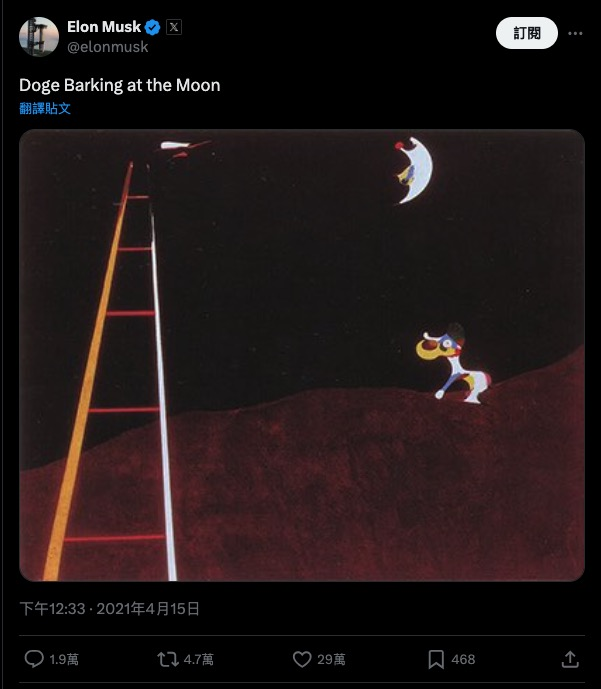
In April 2021, Musk tweeted the now-famous image of a dog howling “To the moon!”, sending Dogecoin to an all-time high above $0.70. Later, in May 2021, despite a temporary sell-off following Musk’s appearance on *Saturday Night Live*, Dogecoin’s popularity endured, and community support strengthened. Though Tesla never adopted Dogecoin for payments, SpaceX announced it would accept Dogecoin for certain services, further expanding its real-world utility.
Thus, we see that Musk has clearly become the primary source of traffic within the current DOGE ecosystem. With Trump’s likely return to politics—and Musk potentially embarking on a political career alongside him—DOGE stands to gain a fresh wave of momentum: political traffic. Last week’s nearly 30% surge in DOGE’s price reflects exactly this dynamic.
Nearly 30% weekly gain: Musk’s “Department of Government Efficiency” and DOGE’s political traffic potential
This momentum stems from a political initiative proposed by Musk: the creation of a “Department of Government Efficiency,” abbreviated as D.O.G.E. This plan, jointly promoted by Musk and former President Donald Trump, aims to conduct comprehensive financial audits of the federal government and propose measures to reduce waste, fraud, and unnecessary spending. Trump announced the initiative during a speech in New York, based on suggestions Musk previously posted on X. Musk stated he’d be willing to participate without compensation or title, emphasizing his commitment to streamlining government operations.
The name D.O.G.E. itself draws inspiration from the DOGE community. On August 20, Musk replied on his official X account to @Sir Doge Of the coin, which likely sparked the naming idea for this department.
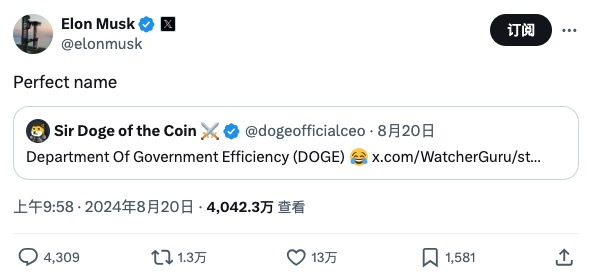
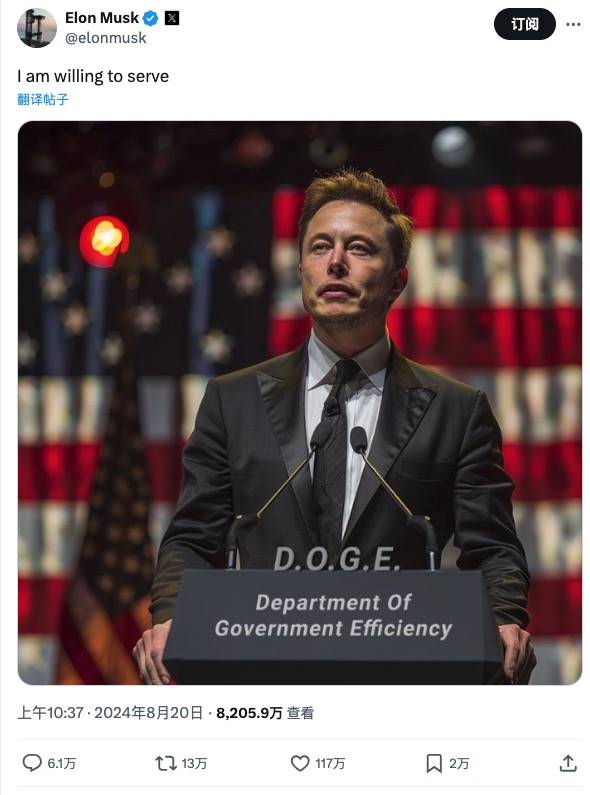
Musk later shared an image expressing his willingness to serve, clearly signaling intent. Since then, KOLs in the Doge space have actively amplified the narrative. Trump responded positively as well, announcing on September 6 during a speech at the New York Economic Club that, if elected, he would establish a Government Efficiency Committee together with Musk—an official endorsement of the D.O.G.E. concept.
At that time, however, election outcomes were still uncertain, so the proposal’s impact wasn’t fully realized. But entering October, poor hurricane relief efforts by Vice President Harris’s administration (representing the incumbent party) significantly damaged their reputation, causing a dramatic shift in public support. As a result, “Trump trades” regained momentum—which also explains last week’s BTC-dominated “vampire rally.”
Then, on October 17, Musk revisited the D.O.G.E. plan during a town hall event in Pennsylvania. Given Pennsylvania’s status as a critical swing state, any political activity there receives unprecedented attention as the election nears its climax. This exposure was the key driver behind DOGE’s 30% price surge.
Now, let’s assess whether Musk entering politics is a genuine possibility or merely an election gimmick. I believe it’s highly plausible. In this U.S. election, Musk has gone all-in supporting Trump—not only acquiring Twitter to break the Democratic Party’s dominance over mainstream media narratives and heavily funding Trump’s campaign but also actively campaigning himself, using X as a platform to promote pro-Trump messages. Trump, in turn, has expressed strong approval, repeatedly stating in interviews his desire to invite Musk into government—as an advisor or cabinet member.
Those familiar with Trump’s first term may recall how difficult his governance was, largely due to early political allies turning against him, severely hampering policy execution. Trump’s initial victory stemmed primarily from Hillary Clinton’s self-inflicted scandals (e.g., the “emailgate” scandal), causing many establishment figures to defect to his populist camp. As a political outsider, Trump needed experienced establishment politicians to help govern. Yet after winning, those same elites—whose interests are rooted in globalization, including military-industrial complexes, big tech, and multinational finance—distanced themselves from Trump, whose populist agenda conflicted with their core interests.
In this election cycle, Trump has both accumulated sufficient political experience and learned from past mistakes. He is now deliberately avoiding interference from traditional establishment figures in choosing allies—evident in selecting J.D. Vance, a younger figure, as vice-presidential candidate. Therefore, appointing a politically inexperienced yet highly influential figure like Musk to shape economic policy is entirely possible.
If the “Department of Government Efficiency” is successfully established, its mission to streamline bureaucracy will be a central component of Trump’s “small government” vision, attracting massive attention. Since memes thrive on traffic, this event would give DOGE access to a powerful new channel: political visibility. Imagine, in January 2025, the U.S. Department of Government Efficiency (D.O.G.E.) announces a 30% reduction in federal workforce—this alone would offer DOGE tremendous exposure. Hence, I believe DOGE is a must-watch element within the crypto sector’s “Trump trade,” and I will continue monitoring its evolution closely.
Join TechFlow official community to stay tuned
Telegram:https://t.me/TechFlowDaily
X (Twitter):https://x.com/TechFlowPost
X (Twitter) EN:https://x.com/BlockFlow_News
 @web3_mario